Dante's Divine Comedy: Purgatorio
Canto XXXIII
Beatrice and her retinue lament the sorrowful state of the Church but soon press on through the forest, followed by Dante, Matilda and Statius. Calling the pilgrim to her side, she discusses all the pageants he has seen and prophesies the eventual deliverance of Christendom. Dante is asked to chronicle all he has experienced for posterity. In the final purgation ritual, Matilda leads Dante to the double fountainhead of Lethe and Eunoe so he may drink from it and eliminate from his memory not only the guilt of sin but the fact of having sinned. Invigorated, he feels ready to ascend to Paradise.
"Deus venerunt gentes," alternating
Now three, now four, melodious psalmody
The maidens in the midst of tears began;[1]
And Beatrice, compassionate and sighing,
Listened to them with such a countenance,
That scarce more changed was Mary at the cross.
But when the other virgins place had given
For her to speak, uprisen to her feet
With color as of fire, she made: response:
"'Modicum, et non videbitis me;
Et iterum,' my sisters predilect,
'Modicum, et vos videbitis me.' "[2]
Then all the seven in front of her she placed;
And after her, by beckoning only, moved
Me and the lady and the sage who stayed.
So she moved onward; and I do not think
That her tenth step was placed upon the ground,
When with her eyes upon mine eyes she smote,
And with a tranquil aspect, "Come more quickly,"
To me she said, "that, if I speak with thee,
To listen to me thou mayst be well placed."
As soon as I was with her as I should be,
She said to me: "Why, brother, dost thou not
Venture to question now, in coming with me?"
As unto those who are too reverential,
Speaking in presence of superiors,
Who drag no living utterance to their teeth,
It me befell, that without perfect sound
Began I: "My necessity, Madonna,
You know, and that which thereunto is good."[3]
And she to me: "Of fear and bashfulness
Henceforward I will have thee strip thyself,
So that thou speak no more as one who dreams.
Know that the vessel which the serpent broke
Was, and is not; but let him who is guilty
Think that God's vengeance does not fear a sop.[4]
Without an heir shall not for ever be
The Eagle that left his plumes upon the car,
Whence it became a monster, then a prey;
For verily I see, and hence narrate it,
The stars already near to bring the time,
From every hindrance safe, and every bar,
Within which a Five-hundred, Ten and Five,
One sent from God, shall slay the thievish woman
And that same giant who is sinning with her.[5]
And peradventure my dark utterance,
Like Themis and the Sphinx, may less persuade thee,
Since, in their mode, it clouds the intellect;[6]
But soon the facts shall be the Naiades
Who shall this difficult enigma solve,
Without destruction of the flocks and harvests.[7]
Note thou; and even as by me are uttered
These words, so teach them unto those who live
That life which is a running unto death;[8]
And bear in mind, whene'er thou writest them,
Not to conceal what thou hast seen the plant,
That twice already has been pillaged here.[9]
Whoever pillages or shatters it,
With blasphemy of deed offendeth God,
Who made it holy for his use alone.
For biting that, in pain and in desire
Five thousand years and more the first-born soul
Craved Him, who punished in himself the bite.[10]
Thy genius slumbers, if it deem it not
For special reason so pre-eminent
In height, and so inverted in its summit.
And if thy vain imaginings had not been
Water of Elsa round about thy mind,
And Pyramus to the mulberry, their pleasure,[11]
Thou by so many circumstances only
The justice of the interdict of God
Morally in the tree wouldst recognize.
But since I see thee in thine intellect
Converted into stone and stained with sin,
So that the light of my discourse doth daze thee,
I will too, if not written, at least painted,
Thou bear it back within thee, for the reason
That cinct with palm the pilgrim's staff is borne."[12]
And I: "As by a signet is the wax
Which does not change the figure stamped upon it,
My brain is now imprinted by yourself.[13]
But wherefore so beyond my power of sight
Soars your desirable discourse, that aye
The more I strive, so much the more I lose it?"
"That thou mayst recognize," she said, "the school
Which thou hast followed, and mayst see how far
Its doctrine follows after my discourse,
And mayst behold your path from the divine
Distant as far as separated is
From Earth the heaven that highest hastens on."[14]
Whence her I answered: "I do not remember
That ever I estranged myself from you,
Nor have I conscience of it that reproves me."[15]
"And if thou art not able to remember,"
Smiling she answered, "recollect thee now
That thou this very day hast drunk of Lethe;
And if from smoke a fire may be inferred,
Such an oblivion clearly demonstrates
Some error in thy will elsewhere intent.
Truly from this time forward shall my words
Be naked, so far as it is befitting
To lay them open unto thy rude gaze."
And more coruscant and with slower steps
The sun was holding the meridian circle,
Which, with the point of view, shifts here and there[16]
When halted (as he cometh to a halt,
Who goes before a squadron as its escort,
If something new he find upon his way)
The ladies seven at a dark shadow's edge,
Such as, beneath green leaves and branches black,
The Alp upon its frigid border wears.[17]
In front of them the Tigris and Euphrates
Methought I saw forth issue from one fountain,
And slowly part, like friends, from one another.[18]
"O light, O glory of the human race!
What stream is this which here unfolds itself
From out one source, and from itself withdraws?"
For such a prayer, 'twas said unto me, "Pray
Matilda that she tell thee;" and here answered,
As one does who doth free himself from blame,[19]
The beautiful lady: "This and other things
Were told to him by me; and sure I am
The water of Lethe has not hid them from him."
And Beatrice: "Perhaps a greater care,
Which oftentimes our memory takes away,
Has made the vision of his mind obscure.
But Eunoë behold, that yonder rises;
Lead him to it, and, as thou art accustomed,
Revive again the half-dead virtue in him."
Like gentle soul, that maketh no excuse,
But makes its own will of another's will
As soon as by a sign it is disclosed,
Even so, when she had taken hold of me,
The beautiful lady moved, and unto Statius
Said, in her womanly manner, "Come with him."
If, Reader, I possessed a longer space
For writing it, I yet would sing in part
Of the sweet draught that ne'er would satiate me;[20]
But inasmuch as full are all the leaves
Made ready for this second canticle,
The curb of art no farther lets me go.
From the most holy water I returned
Regenerate, in the manner of new trees
That are renewed with a new foliage,
Pure and disposed to mount unto the stars.
Illustrations of Purgatorio
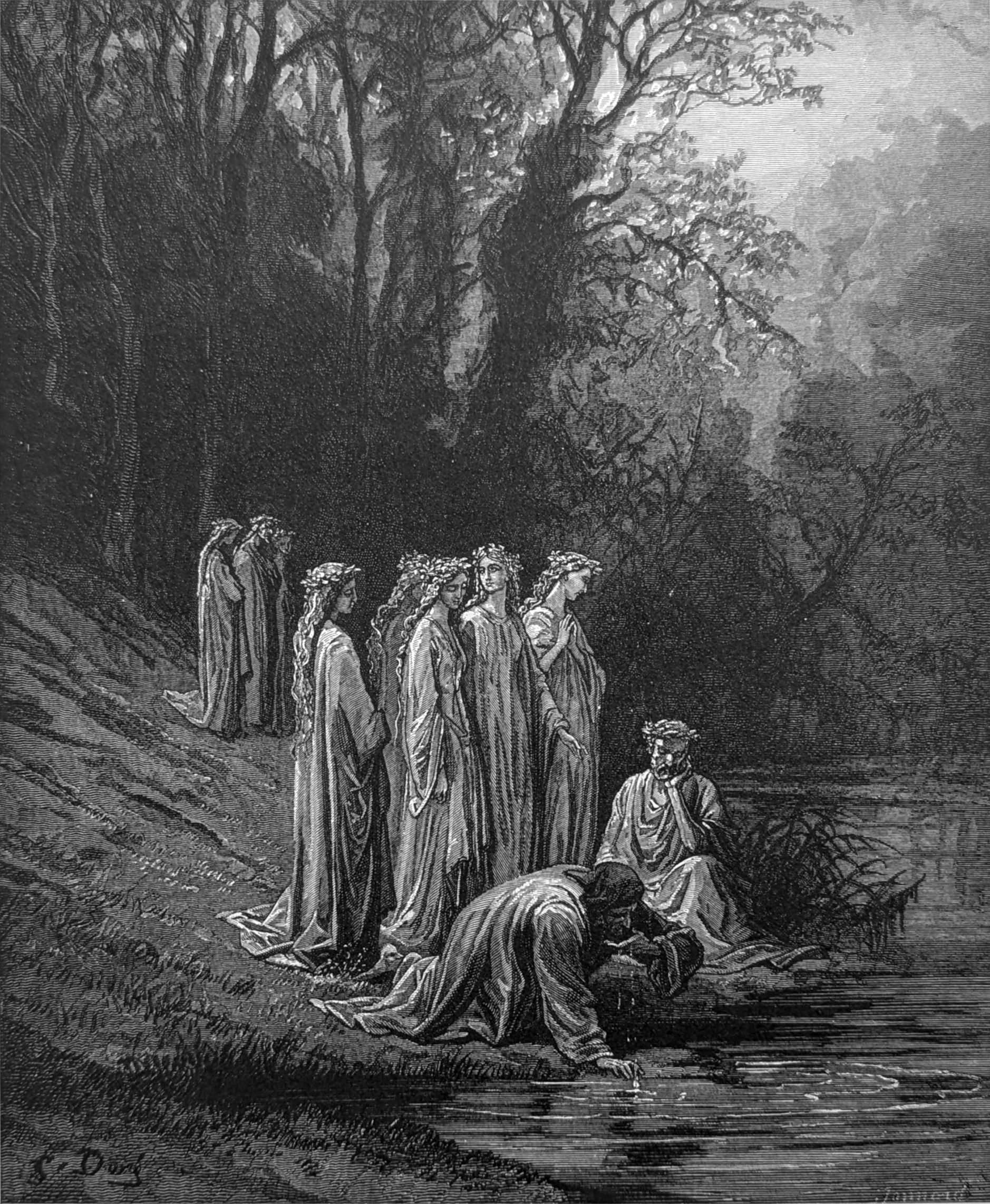
If, Reader, I possessed a longer space / For writing it, I yet would sing in part / Of the sweet draught that ne'er would satiate me; Purg. XXXIII, lines 136-138
Footnotes
1. Deus venerunt gentes, Latin, "God came nations".
Having witnessed the various assaults on the Church at the end of the previous canto, this final canto of the Purgatorio begins with an alternating recitation of Psalm 79 by the seven Virtues. Lamenting the destruction of Jerusalem and its Temple, the Psalm begins: “O God, the nations have invaded your inheritance; they have defiled your holy temple; they have laid Jerusalem in ruins.” Dante compares the grief here experienced by Beatrice with that of the Virgil Mary as she witnessed the crucifixion of her so n Jesus.
Using this Psalm, Dante links the past destruction of Jerusalem and its Temple with the present situation in his own time where the papacy moved from Rome to Avignon. The earlier destruction of Jerusalem, a result of the Israelites’ religious infidelity, led to what is called the Babylonian Captivity of the Jews, which lasted for about 50 years. The move to Avignon was known as the Babylonian Captivity of the Church, and blamed on the corrupt administration of the Church’s affairs. The seven scenes at the end of the previous canto are intended to portray this corruption.
2. Modicum, et non videbitis me, Latin, "A little bit, and you won't see me".
Et iterum, Latin, "And again,"
Modicum, et vos videbitis me, Latin, "A little bit, and you'll see me".
When the Psalm is finished, Beatrice gets up from her position by the Tree of Knowledge and speaks to the seven Virtues with the words of Jesus at the Last Supper (John 16:16): “A little while and you will no longer see me, and again a little while later an d you will see me.”With these words, Jesus indicated both his impending death (not seeing him) and his resurrection (later seeing him again). A few verses later, Jesus continues: “Amen, amen, I say to you, you will weep and mourn, while the world rejoices; you will grieve, but your grief will become joy.” What Beatrice is doing here is subtly indicating to those who are left with her that their time here in the Earthly Paradise is coming to an end. But that end will not be a sorrowful one, and like Jesus, she uses these words to comfort her “sisters” who had witnessed the terrible assaults on the Church. Soon she will assure them that those wrongs will be redressed.
3. As though to heighten the awe he feels at Beatrice’s invitation, and her amicable tone, Dante uses the word “Madonna” to address her, and returns to the formal form with his pronouns. His reply also highlights Beatrice’s role as Wisdom–-she knows all his needs and knows how to satisfy them.
4. She has three points to make: (1) the Chariot which he saw, symbolizing the Church, was assaulted and ruined by the Evil One. It has been destroyed (at least figuratively). The strange form of “was and is not” is taken from the Book of Revelation (17:8): “T he beast that you saw existed once but now exists no longer. It will come up from the abyss and is headed for destruction. The inhabitants of the earth whose names have not been written in the book of life from the foundation of the world shall be amazed when they see the beast, because it existed once but exists no longer, and yet it will come again.” Note that the “beast” in this passage is a veiled reference to the Emperor Nero. (2) Those responsible for this material destruction of the Church by their abuse and corruption (Popes, members of the Church hierarchy, Kings, etc.) will pay for their wickedness. (3) The eagle (the Roman Empire) will re-appear in a different form. This is probably a reference to a future leader who will destroy the whore and the gi ant who went off with the chariot at the end of the previous canto. Remember that Dante sets the poem in the year 1300. Though he is writing it (in this case, the Purgatorio) several years later, he sets later events back into the year 1300 as prophesies.
5. This obscure prophecy has baffled commentators for centuries. On the most literal level, Beatrice tells Dante that she foresees the emergence of a great leader, sent by God with the sole purpose of destroying the giant (probably Philip IV) and the whore (the corrupt Church). The reader will recall an equally obscure prophecy about an unnamed future leader-–the “big dog” in Canto 1 of the Inferno–-who will destroy the savage she-wolf. Ronald Martinez, in his commentary here, highlights three significant passages in the Book of Revelation that match the “job description” of this agent of God: “Babylon, the ‘great whore,’ is destroyed in 18:2. The Antichrist (the beast) is thrown into the pit of fire in 19:20. And Satan, the dragon, is bound and placed in the abyss in 20:2f.”
Finding hidden meaning in numbers and letters was popular in Dante’s time. However, the meaning of the numerological reference-–“a five hundred, a ten, and a five”–-was obviously something Dante purposely intended to remain obscure, as there are no clues in the text or the context to help us understand it. Nevertheless, there have been some interesting attempts over the ages. In Roman numerals, the numbers become DXV. Perhaps the closest we can come is the Latin word for leader: DUX. This works in light of the context, but the spelling doesn’t correspond to the numbers. Yet several commentators over the years have pointed to Henry VII as the leader intended by this prophecy. He became the Holy Roman Emperor in 1308.
6. Admitting that her prophecy is obscure, Beatrice turns to classical mythology, where both Themis and the Sphinx were associated with difficult riddles and obscure prophecies. Themis was the child of Gaea and Uranus (Earth and Heaven), the second wife of Zeus, mother of Prometheus, and the goddess of Justice. The Sphinx, part female and part beast, acted as an oracle of Themis and was famous for her riddle to all who passed by her on their way to Thebes. If they couldn’t solve the riddle, she killed them. The tragic Oedipus solved the riddle, and in a fit of rage, the Sphinx threw herself from the pedestal where she sat and was killed. Themis, also outraged, sent a monster to destroy the crops and flocks of the Thebans. What was the famous riddle? “What walks on four legs in the morning, on two at noon, and on three at night?” The answer: “As infants, we crawl on all fours; as adults, we walk on two legs; in old age we walk supported by a cane.”
7. What Beatrice is saying here is that her presently obscure words (her riddle) will become clear soon enough without the resulting destruction of flocks and fields, as in the classical case of Themis. On the surface, this seems clear enough. However, modern scholarship has determined that Dante used an inaccurate translation of Ovid’s Metamorphoses here, which noted that it was the “Naiads” (water nymphs) who solved the riddle of the Sphinx, not “the son of Laiades” (Oedipus).
Dante’s Italian text reads: “… ma tosto fier li fatti le Naiade, che solveranno questo enigma forte …” (“… but soon the Naiads will be ready to solve this difficult enigma …”). One of the clues for this inaccuracy is the fact that Dante’s earliest commentators also seem to have had inaccurate copies of Ovid because they made the same error. It wasn’t until five hundred years later that commentators had access to more accurate translations.
8. Beatrice will say more on this in a moment, but at this point she wants to highlight for Dante the salvific potential of his Poem for those whose lives are, to quote St. Augustine in his City of God (13:10), “only a race to death.”
9. Once again, Beatrice instructs Dante to write down what he has seen, with particular attention to the Tree of the Knowledge of Good and Evil, which he saw damaged twice. Actually, one could say that the Tree was damaged three times–-each time a blasphemy. T he first damage was done by Adam’s eating of its forbidden fruit. But Dante did not “witness” this. He did, however, witness the next two acts toward the end of the previous canto. The first of these was when the eagle flew into and through the tree ruining its leaves and blossoms. The second was when the giant detached the chariot of the Church from the tree.
10. The second reference to Adam, his waiting for salvation by Christ, will be dealt with more precisely in Canto 26 of the Paradiso. Here, the “more than five thousand years” is simply a brief approximation of the time between his expulsion from the Earthly Paradise until Christ’s death, which, according to tradition, reopened Heaven and released the souls of the just from their exile in Limbo. Adam was the first to be released. Virgil had explained this to Dante in Canto 4 of the Inferno.
11. In her “teaching mode,” Beatrice is quite direct with Dante who, from what she says here, has a hardened mind and still doesn’t understand that this Tree is inviolate and sacrosanct by virtue of its extraordinary height and inverted shape, as noted toward t he beginning of the previous canto. The fruit of this Tree, of course, had been forbidden to Adam and Eve (see Genesis 2:16f). Its immense height and unusual shape (widening as it rose) were designed to prevent climbing it. Furthermore, there is the tradition that the Cross on which Jesus was crucified was fashioned from this tree.
The River Elsa rises in the mountains west of Siena, flows northward, and joins the Arno on the western outskirts of Empoli, about 25 miles west of Florence. Beatrice mentions this particular river here in connection with Dante’s “hardened” mind. The waters of the Elsa are noted for their petrifying properties because they are rich in calcium carbonate.
As for Pyramus, recall the tragic story of he and his lover, Thisbe, in Canto 27 when Dante was passing through the flames. Having killed themselves under a mulberry tree, whose berries were always white, their blood stained its roots and the berries were ever after a blood-red color. Using this second image, Beatrice’s concern is that Dante’s mind is being “stained” by his wandering thoughts which prevent him from understanding why God prevented Adam from eating the fruit of the Tree of Knowledge.
12. In Dante’s time, the three great pilgrimage destinations were the Holy Land, Rome, and Santiago da Compostella in northwestern Spain. Returning pilgrims often adorned their walking staffs with mementos of where they had been. In this case, the long leaves o f palm trees were wrapped around the staffs of pilgrims returning from the Holy Land. Those returning from Rome adorned their staffs with icons of Veronica’s Veil, which is said to have on it the impression of Jesus’s face. And those returning from Composte lla adorned their staffs with scallop shells, a symbol for the apostle St. James, whose body is buried there.
13. We have seen, Dante seems to understand what Beatrice has been saying to him, but the meaning as yet seems to be beyond him. And his frustration is evident. Nevertheless, he assures her, he is a marked man-–the imprint of her seal is on his heart, no matter that he can’t always follow her thinking.
14. We have to recall Beatrice’s prosecution here. After she died Dante abandoned her for another woman–-Lady Philosophy. Beatrice pointedly reminded him that Philosophy could never compete with her, as representing the Revelation of Theology. She is being sarcastic here when she asks Dante to see how nicely his pursuit of Philosophy matched her path. Doing this, he will see how inadequate his philosophical pursuits were, and how they could never have led him to God because philosophy depends ultimately on reason , not faith. To make her point, she quotes from the Prophet Isaiah (55:9), who says: “For as the heavens are higher than the earth, so are my ways higher than your ways, my thoughts higher than your thoughts.”
15. Dante’s protest that he has no recollection of having abandoned Beatrice is evidence, she tells him, that the waters of Lethe have served their purpose–-that is, to erase all memory of sin and error. That he has no memory of his estrangement is evidence that it was sinful. On the other hand, Ronald Martinez, in his commentary here, takes a different approach: “Strictly speaking, to deduce from their present oblivion that past sins existed is fallacious: the lack of memory of sin might indicate the absence of sin, not the cancellation of one.”
With Beatrice’s promise to speak clearly from now on, it is safe to assume that she is satisfied with Dante’s conversion and has completely moved away from further prosecution of her case. From now on, she will speak in a manner that is easily understood by Dante. And with this said, we move to the final scene of this second Canticle of the Commedia.
16. coruscant, Latin, coruscāns, “glittering”.
Recalling that the sun is a symbol of God, we haven’t had an astronomical image for quite a while, and this one suggests that time is slowing down, or so it seems when the sun is directly above. Mark Musa tells us that this is the last reference to time as measured by the sun in the Poem. It is also noon on the Wednesday after Easter, the seventh day of Dante’s journey, and we are moving toward a significant event.
17. Having reached a lovely shaded place in the Earthly Paradise, the seven Virtues, who have been leading this smaller procession, stop at a fountain that comes up out of the ground and separates into two streams. The mention of the Tigris and Euphrates rivers recalls the narrative in Chapter 2 of the Book of Genesis that tells us four great rivers flowed out of the Garden of Eden–-these two among them. That these two flow out from the same source comes from The Consolation of Philosophy by Boethius (V,1,1). In reality, we have already seen one of these two streams, the Lethe, and we are about to see the other one.
18. John Ciardi explains the parting of these two streams as they emerge from the ground: “The two rivers flow off in opposite directions, just as their powers, rising from one source, work in opposite ways to achieve one good.”
19. As we have just learned her name, we now learn what seems to be Matelda’s function in the Earthly Paradise. She effects the saved souls’ final preparation for Paradise by leading them first through the waters of the Lethe to baptism where they lose all memory of their sins, and then through the waters of the Eunoë where they regain the memory of all the good they did when they were alive. Beatrice, we should note, has only come to the Earthly Paradise for Dante, whereas Matelda, it would appear, has always “worked here.”
I remarked earlier that Statius seems to get forgotten in these last cantos of the Purgatorio because they’re so focused on Dante’s confession and absolution. Here, though, Matelda’s kind words of inclusion bring him back to the fore. He has been an actual “citizen” on this Mountain and has gained his freedom. Dante has been a visitor, though he, too, has suffered and learned as he climbed.
20. These closing lines of his Purgatorio Dante addresses the reader. His last act in the Earthly Paradise was to drink from the sweet waters of the Eunoë. Now there is no more he can tell us about Purgatory. Not only has he shown it all to us, but we were privileged, if one wants to think of it that way, to witness his reunion with Beatrice which began with a harsh confrontation that led to his confession and conversion. He has a definite plan for his Poem in mind, and he has reached the goal of this second Canticle. Renewed and purified, he is ready to rise up into the stars-–the word with which he ends each of the three parts of his Divina Commedia.
Top of page