Dante's Divine Comedy: Purgatorio
Canto XI
Dante overhears the penitent Proud reciting their own version of the Lord's Prayer as they approach. Having sinned through pride in their birthright, abilities and worldly powers, they must now seek to recover their spiritual innocence. Omberto Aldobrandesco, a member of the great Ghibelline family, advises the poets to turn right and follow him to the next flight of steps. The manuscript painter Oderisi of Gubbio gives a discourse on the vanity of temporal fame. He points to Provenzan Salvani, a despotic Sienese nobleman, whose one great gesture of Humility led him straight here instead of being detained in Ante-Purgatory in the company of the Late Repentant. Oderisi predicts Dante's coming exile.
"Our Father, thou who dwellest in the heavens,
Not circumscribed, but from the greater love
Thou bearest to the first effects on high,[1]
Praised be thy name and thine omnipotence
By every creature, as befitting is
To render thanks to thy sweet effluence.
Come unto us the peace of thy dominion,
For unto it we cannot of ourselves,
If it come not, with all our intellect.
Even as thine own Angels of their will
Make sacrifice to thee, Hosanna singing,
So may all men make sacrifice of theirs.
Give unto us this day our daily manna,
Withouten which in this rough wilderness
Backward goes he who toils most to advance.
And even as we the trespass we have suffered
Pardon in one another, pardon thou
Benignly, and regard not our desert.
Our virtue, which is easily o'ercome,
Put not to proof with the old Adversary,
But thou from him who spurs it so, deliver.
This last petition verily, dear Lord,
Not for ourselves is made, who need it not,
But for their sake who have remained behind us."
Thus for themselves and us good furtherance
Those shades imploring, went beneath a weight
Like unto that of which we sometimes dream,
Unequally in anguish round and round
And weary all, upon that foremost cornice,
Purging away the smoke-stains of the world.
If there good words are always said for us,
What may not here be said and done for them,
By those who have a good root to their will?
Well may we help them wash away the marks
That hence they carried, so that clean and light
They may ascend unto the starry wheels!
"Ah! so may pity and justice you disburden
Soon, that ye may have power to move the wing,
That shall uplift you after your desire,
Show us on which hand tow'rd the stairs the way
Is shortest, and if more than one the passes,
Point us out that which least abruptly falls;
For he who cometh with me, through the burden
Of Adam's flesh wherewith he is invested,
Against his will is chary of his climbing."
The words of theirs which they returned to those
That he whom I was following had spoken,
It was not manifest from whom they came,
But it was said: "To the right hand come with us
Along the bank, and ye shall find a pass
Possible for living person to ascend.
And were I not impeded by the stone,
Which this proud neck of mine doth subjugate,
Whence I am forced to hold my visage down,[2]
Him, who still lives and does not name himself,
Would I regard, to see if I may know him
And make him piteous unto this burden.
A Latian was I, and born of a great Tuscan;
Guglielmo Aldobrandeschi was my father;
I know not if his name were ever with you.[3]
The ancient blood and deeds of gallantry
Of my progenitors so arrogant made me
That, thinking not upon the common mother,
All men I held in scorn to such extent
I died therefor, as know the Sienese,
And every child in Campagnatico.
I am Omberto; and not to me alone
Has pride done harm, but all my kith and kin
Has with it dragged into adversity.[4]
And here must I this burden bear for it
Till God be satisfied, since I did not
Among the living, here among the dead."
Listening I downward bent my countenance;
And one of them, not this one who was speaking,
Twisted himself beneath the weight that cramps him,
And looked at me, and knew me, and called out,
Keeping his eyes laboriously fixed
On me, who all bowed down was going with them.
"O," asked I him, "art thou not Oderisi,
Agobbio's honor, and honor of that art
Which is in Paris called illuminating?"[5]
"Brother," said he, "more laughing are the leaves
Touched by the brush of Franco Bolognese;
All his the honor now, and mine in part.
In sooth I had not been so courteous
While I was living, for the great desire
Of excellence, on which my heart was bent.
Here of such pride is paid the forfeiture;
And yet I should not be here, were it not
That, having power to sin, I turned to God.
O thou vain glory of the human powers,
How little green upon thy summit lingers,
If't be not followed by an age of grossness!
In painting Cimabue thought that he
Should hold the field, now Giotto has the cry,
So that the other's fame is growing dim.
So has one Guido from the other taken
The glory of our tongue, and he perchance
Is born, who from the nest shall chase them both.
Naught is this mundane rumor but a breath
Of wind, that comes now this way and now that,
And changes name, because it changes side.
What fame shalt thou have more, if old peel off
From thee thy flesh, than if thou hadst been dead
Before thou left the 'pappe' and the 'dindi,'[6]
Ere pass a thousand years? which is a shorter
Space to the eterne, than twinkling of an eye
Unto the circle that in heaven wheels slowest.
With him, who takes so little of the road
In front of me, all Tuscany resounded;
And now he scarce is lisped of in Siena,
Where he was lord, what time was overthrown
The Florentine delirium, that superb
Was at that day as now 'tis prostitute.
Your reputation is the color of grass
Which comes and goes, and that discolors it
By which it issues green from out the earth."
And I: "Thy true speech fills my heart with good
Humility, and great tumor thou assuagest;
But who is he, of whom just now thou spakest?"
"That," he replied, "is Provenzan Salvani,
And he is here because he had presumed
To bring Siena all into his hands.[7]
He has gone thus, and goeth without rest
E'er since he died; such money renders back
In payment he who is on Earth too daring."
And I: "If every spirit who awaits
The verge of life before that he repent,
Remains below there and ascends not hither,
(Unless good orison shall him bestead,)
Until as much time as he lived be passed,
How was the coming granted him in largess?"
"When he in greatest splendor lived," said he,
"Freely upon the Campo of Siena,
All shame being laid aside, he placed himself;
And there to draw his friend from the duress
Which in the prison-house of Charles he suffered,
He brought himself to tremble in each vein.[8]
I say no more, and know that I speak darkly;
Yet little time shall pass before thy neighbors
Will so demean themselves that thou canst gloss it.
This action has released him from those confines."
Illustrations of Purgatorio
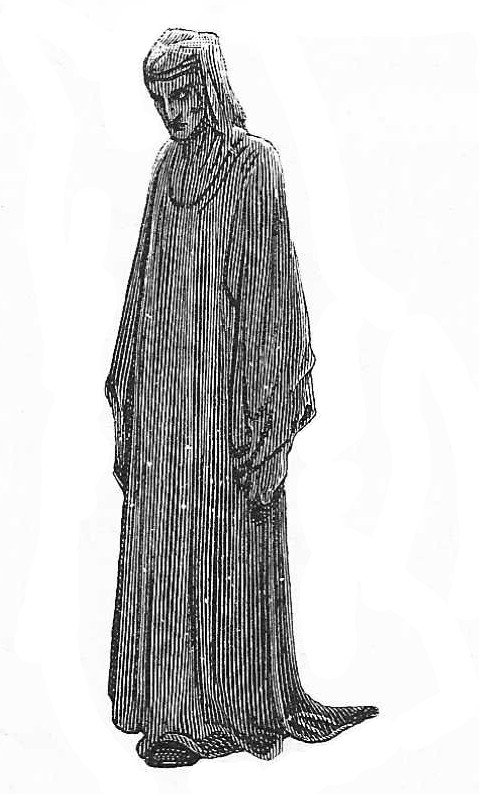
Dante
Footnotes
1. Most readers will immediately recognize what Dante has done here. Also known as “The Lord’s Prayer,” the “Our Father” is one of the most basic and all-encompassing Christian prayers–taught by Jesus himself and recorded in both the Gospels of Matthew (6:9-13 ) and Luke (11:2-4). This wonderful paraphrase is also the only complete prayer Dante uses in the Poem. And since we are on the terrace of the proud, notice how his adaptation of the prayer is so well-suited for the proud sinners here, particularly its humble tone and its last sentence which, in ordinary circumstances, would be practically impossible for a proud person to say. This prayer is not part of the punishment of the proud. The heavy stones they carry constitute the punishment by forcing them to take a bodily posture quite the opposite of their sin. Interestingly enough, though, being forced to look down with their bodies enables them to speak with their hearts and direct the words of the prayer upward, as it were. They recognize that by their own proud wills they would be lost, and thereby never attain peace. And so they join their humble pleas with the rejoicing angels whose wills are always at one with God’s. In the end, they do something very uncharacteristic–they forgive others and they forgive themselves. Only in light of this forgiveness can they end by praying for the salvation of others who still struggle in life.
The Our Father is not only a prayer that can be said at any time by an individual, but from ancient times it has had a significant place in the Christian liturgy. It stands as the community’s prayer between the consecration of the bread and the wine into the body and blood of the Lord and the communion where the worshipers receive and eat that same body and blood. By including this prayer here, Dante wants us to read and hear it from within the ritual or sacred liturgy of the Poem itself. In Canto 25 of the Paradiso, Dante calls his Comedy “…this sacred poem–this work shared by heaven and by earth.”
2. As this next section of the canto begins, it’s not certain who it is that replies to Virgil’s request, mainly because all the sinners are bent over under their weights. And Musa points out that Dante cleverly makes the syntax in these lines more like Latin than Italian, which adds a layer of confusion in trying to determine exactly who is speaking. The reference to his “proud neck” adds a biblical touch here which Dante surely has in mind. In the Hebrew Bible, the Israelites are often referred to as “stiff-necked” as a mark of their pride and disobedience. Nevertheless, the speaker is both helpful in that he answers Virgil’s question about the path, and he is very curious to know who this living man is. Perhaps as an indication that his pride still has a grip o n him, and to solicit pity, the anonymous speaker identifies himself and gives all of us more information than we are expecting. Dante, of course, would certainly appreciate this. On the other hand, when Omberto says to Virgil: “You may not have heard…,” hi s modesty may still be tainted with his pride.
3. Omberto, the first sinner who speaks to Dante and Virgil in Purgatory proper, doesn’t immediately identify himself. Rather, he identifies his father first, saying “…nato d’un gran Tosco”–-“I was born of a great Tuscan.” (He was the second son, actually.) Guiglielmo Aldobrandesco was the Count of Santafiora in the Sienese Maremma (a large region at the southern end of Tuscany with its western border along the Tyrrhenian Sea). The family had been in the Maremma since at least the tenth century and were in constant conflict with Siena. Their castle was in a place called Campagnatico (about 60 miles south of Florence). Guiglielmo, a Ghibelline, eventually broke all ties with Siena and allied with the Guelphs of Florence against Siena.
4. Little is known of Omberto, and such accounts as there are contradict one another, though all agree that he was excessively proud of his lineage. The Aldobrandeschi were in constant conflict with Siena. In 1259, according to varying accounts, the Sienese either besieged the Aldobrandeschi castle in Campagnatico, killing Omberto in battle, or their agents crept in and strangled Omberto in bed. Since Dante refers to it as an event known to every child, he was probably following the account in which Omberto, tho ugh with very few men at his disposal, scorned his enemies, refused to surrender, killed many Sienese, and even made a mad charge into the thick of the enemy’s forces, where he was killed after giving a bloody account of himself. Omberto’s words seem to indicate that his main motive in this action was utter contempt for those who opposed him.”
The Aldobrandeschi were a proud and bothersome force for 300 years. But when Omberto was killed, the entire family fell apart and the Maremma was taken over by their enemies, the Sienese. If the saying, “Hindsight is always 20/20,” has any merit, Omberto’s last words are evidence that it does. To his credit he realizes that his present suffering could have been avoided had he been more humble when he was alive–an admission that shows the progress of his spiritual renewal.
5. Oderisi recognized Dante and called out to him, but he didn’t identify himself. Recognizing him back, Dante called out his name and gives us a thumbnail identification–-he’s from Gubbio, and a famous illuminator of manuscripts whose style of work was known in Paris.
Dante certainly knew of the Aldobrandeschi, but he never encountered Omberto, who was killed/murdered (1259) six years before he was born. So we weren’t given much information about him except the tragic pride that ruined he and his family. Oderisi and Dante, on the other hand, obviously knew each other–most likely from Dante’s days in Bologna where Oderisi was already well-known. Because he’s actually talking to Dante, the artist gives us a wealth of information about himself. Gubbio is a small mountain town about 30 miles north of Perugia and the same from Assisi. St. Francis lived for several years in Gubbio, and it is from there that we get the famous story of St. Francis and the Wolf. St. Francis died only 39 years before Dante was born.
We know that both Oderisi and Franco of Bologna, whom he also names, were commissioned by Boniface VIII to illuminate manuscripts in the Vatican Library. Oderisi died in Rome in 1299, so he has only been here in Purgatory for a short time if we consider the fictional year of the Poem to be 1300. Recalling Sayers’ three dimensions of pride (race, achievement, and domination), Oderisi represents the pride of achievement. Unfortunately, we don’t know much about his work, though the illuminating of manuscripts–the painting of images, stories, and designs on the pages of medieval books–was quite popular and hundreds of gorgeous examples still exist in libraries and museums around the world. And Dante obviously knew that Paris was an art center in Europe. Perhaps he and Oderisi had talked about it. He even engages in a bit of linguistic fun (pride?) here by using the word alluminar for illuminating because it is close to the French verb enluminer. The usual Italian verb for this art is miniare from the Latin word minium, which was a red form of lead used as a pigment.
As for Oderisi’s relationship to Franco, his ability to tell Dante now that Franco was the better artist shows us how the work of soul-restoration operates in Purgatory. Most likely, Oderisi could never have made this admission while he was alive, so concerned was he about his own fame. But now he makes it, and he thanks God for the grace that enabled him to realize, while he was alive, the damage his pride was doing to his soul and turn himself around. This is surely why he is here and not in Ante-Purgatory. It is a different Oderisi who speaks with Dante here in Purgatory, and one can see this in his moralizing after he admits to his lesser stature. Human power and glory are passing things. We read in St. Matthew’s Gospel: “Do not store up for yourselves treasures on earth, where moth and decay destroy, and thieves break in and steal. But store up treasures in heaven, where neither moth nor decay destroys, nor thieves break in and steal. For where your treasure is, there also will your heart be” (6:19-21). We read in Isaiah (40:6): “All flesh is grass, and all its beauty fades like the flower of the field.”
Oderisi’s insights about the passing of fame from one generation to the next are borne out in the examples he uses: Cimabue’s fame passed to his student Giotto who surpassed him and has been called “the father of modern painting.” (Dante and Giotto were friends. There is a portrait of Dante in the Bargello in Florence that is said to be done by Giotto. And Dante may have seen Giotto at work in the gorgeous Scrovegni Chapel in Padua (see Inferno 17:64-66 and commentary). As for the two Guidos, they are most likely Guido Guinizelli from Bologna (d. 1276) and Guido Cavalcante (d. 1300). Guido Guinizelli, whom we will meet in Canto 26, was considered by Dante as his literary father, and father of “all those who wrote poetry of love in a sweet and graceful style.” Toynbee (Dante Dictionary) calls Guinizelli “The most illustrious of the Italian poets prior to Dante.” Guido Cavalcanti, who is said to have surpassed Guinizelli, was a close friend of Dante. Dante dedicated the Vita Nuovato him and wrote there of him: “…h e whom I call first among my friends.” He is also referenced in Inferno 10 when Dante is talking with his father, Cavalcante. There Dante seems to claim superiority to Cavalcanti because his friend didn’t have the same esteem for the high style he himself claimed. He seems to be making a similar claim when Oderisi suggests: “…perhaps one even greater than them has just been born.” In fact, it did!
Oderisi’s last thoughts about the passing of worldly fame are reminiscent of Virgil’s lesson to Dante on the workings of Fortune in Canto 7 of the Inferno: “The changes that she brings are without respite: it is necessity that makes her swift; and for this reason, men change state so often (88-90).
6. Pappe, Italian, "baby food". Dindi, Latin, de + India, " of" + "there", meaning" next".
7. Provenzan Salvani (1220-1269) was, in fact, a significant figure in both Sienese and Florentine history. He was the Ghibelline leader of Siena at the time of the great Battle of Montaperti (1260) in which the forces of Florence were defeated. As a matter of fact, he was so powerful and so arrogant that he took the title dominus (lord)! He represents the third of Dorothy Sayers’ facets of Pride: domination. It was he, at the Council of Empoli, following the defeat of the Florentines, who strongly urged that the city of Florence (the “painted whore”) be completely destroyed. He was countered, luckily, by Farinata degli Uberti who led the army of Siena in Florence’s defeat. In another battle against Florence in 1269, he was taken prisoner and beheaded. Villani writes in his Cronica: “He was an important man in Siena in his time, after the victory of Montaperti. He controlled the whole city, and the entire Ghibelline faction of Tuscany looked to him as its leader. He was very imperious in manner.” At this point, he ’s been in Purgatory for 31 years, paying the price of his presumption. Part of his punishment may, in fact, that Dante does not allow him to speak. Someone else (Oderisi) speaks for him, and for a proud person that would never do. It is interesting, however, that Dante places Farinata in Hell (for the sin of heresy) (Inferno 10) and Provenzan for the sin of pride here in Purgatory.
8. Here is Oderisi’s answer to Dante’s question about how Provenzan got to the terrace of the proud so quickly after he died. The story was probably well-known at the time and is included in the Ottimo Commento, the most important fourteenth-century Florentine commentary on the Comedy: “King Charles [Charles of Anjou] had a friend of his [Provenzan’s] in prison, on whom he put a ransom of 10,000 gold florins. (He had fought with Conradin against Charles in the defeat at Tagliacozzo.) When the king gave him only a short time to pay or die, he appealed to Messer Provenzan. It is said that Messer Provenzan had a bench with a carpet over it put up in the square of Siena, and then sat on it in clothes that the occasion required. Bashfully, he asked the Sienese to help him in his need of money, forcing no one, just humbly asking for help. When the Sienese saw this man, whom they thought of as their lord, usually so proud, begging so pitifully, they were moved to pity. Everyone helped, according to his means. So that, before the time had expired, he was able to buy his friend’s release.”
It goes without saying that this must have been terribly humiliating for Provenzan, and yet it was a heroic act of charity to do such a thing to save his friend. One might say that he killed his pride to save his friend. Which sounds almost Christ-like. But this is what saved him, and most likely sped him to this terrace in Purgatory. That he might have spent time in Ante-Purgatory is not made clear by Oderisi. But the force of his humiliation and charity lead one to consider that he arrived here directly upon his death.
There is a prophecy in Oderisi’s final words. Dante’s “friends” (the Florentines) will exile him and he will live the rest of his life in shame as a recipient of charity from his friends and patrons.