Dante's Divine Comedy: Purgatorio
Canto VII
Sordello asks the travelers who they are. When he discovers the great Classical poet's identity, he drops down on his knees and enquirers about Virgil's fate. Sordello explains the Rule the Mountain, which forbids any climbing after dark, and takes the poets to a beautiful valley, where he identifies distinguished members of the Preoccupied, the third sub-group of the Late Repentant—Rudolph of Hapsburg, Ottocar II, Wenceslas IV of Bohemia, Henry of Navarre, Philip of France, Peter III of Aragon, Henry III of England and William, Marquis of Monferrat and Canavese. Their worldly cares caused them to neglect their spiritual duties and they now continue to fret over family or state matters.
After the gracious and glad salutations
Had three and four times been reiterated,
Sordello backward drew and said, "Who are you?"[1]
"Or ever to this mountain were directed
The souls deserving to ascend to God,
My bones were buried by Octavian.[2]
I am Virgilius; and for no crime else
Did I lose heaven, than for not having faith;"
In this wise then my Leader made reply.
As one who suddenly before him sees
Something whereat he marvels, who believes
And yet does not, saying, "It is! it is not!"
So he appeared; and then bowed down his brow,
And with humility returned towards him,
And, where inferiors embrace, embraced him.
"O glory of the Latians, thou," he said,
"Through whom our language showed what it could do
O pride eternal of the place I came from,
What merit or what grace to me reveals thee?
If I to hear thy words be worthy, tell me
If thou dost come from Hell, and from what cloister."
"Through all the circles of the doleful realm,"
Responded he, "have I come hitherward;
Heaven's power impelled me, and with that I come.
I by not doing, not by doing, lost
The sight of that high sun which thou desirest,
And which too late by me was recognized.
A place there is below not sad with torments,
But darkness only, where the lamentations
Have not the sound of wailing, but are sighs.
There dwell I with the little innocents
Snatched by the teeth of Death, or ever they
Were from our human sinfulness exempt.
There dwell I among those who the three saintly
Virtues did not put on, and without vice
The others knew and followed all of them.[3]
But if thou know and can, some indication
Give us by which we may the sooner come
Where Purgatory has its right beginning."
He answered: "No fixed place has been assigned us;
'Tis lawful for me to go up and round;
So far as I can go, as guide I join thee.
But see already how the day declines,
And to go up by night we are not able;
Therefore 'tis well to think of some fair sojourn.
Souls are there on the right hand here withdrawn;
If thou permit me I will lead thee to them,
And thou shalt know them not without delight."
"How is this?" was the answer; "should one wish
To mount by night would he prevented be
By others? or mayhap would not have power?"
And on the ground the good Sordello drew
His finger, saying, "See, this line alone
Thou couldst not pass after the sun is gone;
Not that aught else would hindrance give, however,
To going up, save the nocturnal darkness;
This with the want of power the will perplexes.
We might indeed therewith return below,
And, wandering, walk the hill-side round about,
While the horizon holds the day imprisoned."
Thereon my Lord, as if in wonder, said:
"Do thou conduct us thither, where thou sayest
That we can take delight in tarrying."
Little had we withdrawn us from that place,
When I perceived the mount was hollowed out
In fashion as the valleys here are hollowed.
"Thitherward," said that shade, "will we repair,
Where of itself the hill-side makes a lap,
And there for the new day will we await."
Twixt hill and plain there was a winding path
Which led us to the margin of that dell,
Where dies the border more than half away.
Gold and fine silver, and scarlet and pearl-white,
The Indian wood resplendent and serene,
Fresh emerald the moment it is broken,[4]
By herbage and by flowers within that hollow
Planted, each one in color would be vanquished,
As by its greater vanquished is the less.
Nor in that place had nature painted only,
But of the sweetness of a thousand odors
Made there a mingled fragrance and unknown.
"Salve Regina," on the green and flowers
There seated, singing, spirits I beheld,
Which were not visible outside the valley.[5]
"Before the scanty sun now seeks his nest,"
Began the Mantuan who had led us thither,
"Among them do not wish me to conduct you.
Better from off this ledge the acts and faces
Of all of them will you discriminate,
Than in the plain below received among them.
He who sits highest, and the semblance bears
Of having what he should have done neglected,
And to the others' song moves not his lips,
Rudolph the Emperor was, who had the power
To heal the wounds that Italy have slain,
So that through others slowly she revives.[6]
The other, who in look doth comfort him,
Governed the region where the water springs,
The Moldau bears the Elbe, and Elbe the sea.[7]
His name was Ottocar, and in swaddling-clothes
Far better he than bearded Winceslaus
His son, who feeds in luxury and ease.[8]
And the small-nosed, who close in council seems
With him that has an aspect so benign,
Died fleeing and disflowering the lily;[9]
Look there, how he is beating at his breast!
Behold the other one, who for his cheek
Sighing has made of his own palm a bed;[10]
Father and father-in-law of France's Pest
Are they, and know his vicious life and lewd,
And hence proceeds the grief that so doth pierce them.
He who appears so stalwart, and chimes in,
Singing, with that one of the manly nose,
The cord of every valor wore begirt,
And if as King had after him remained
The stripling who in rear of him is sitting,
Well had the valor passed from vase to vase,
Which cannot of the other heirs be said.
Frederick and Jacomo possess the realms,
But none the better heritage possesses.[11]
Not oftentimes upriseth through the branches
The probity of man; and this He wills
Who gives it, so that we may ask of Him.
Eke to the large-nosed reach my words, no less
Than to the other, Pier, who with him sings;
Whence Provence and Apulia grieve already[12]
The plant is as inferior to its seed,
As more than Beatrice and Margaret
Costanza boasteth of her husband still.
Behold the monarch of the simple life,
Harry of England, sitting there alone;
He in his branches has a better issue.[13]
He who the lowest on the ground among them
Sits looking upward, is the Marquis William,
For whose sake Alessandria and her war[14]
Make Monferrat and Canavese weep."
Illustrations of Purgatorio
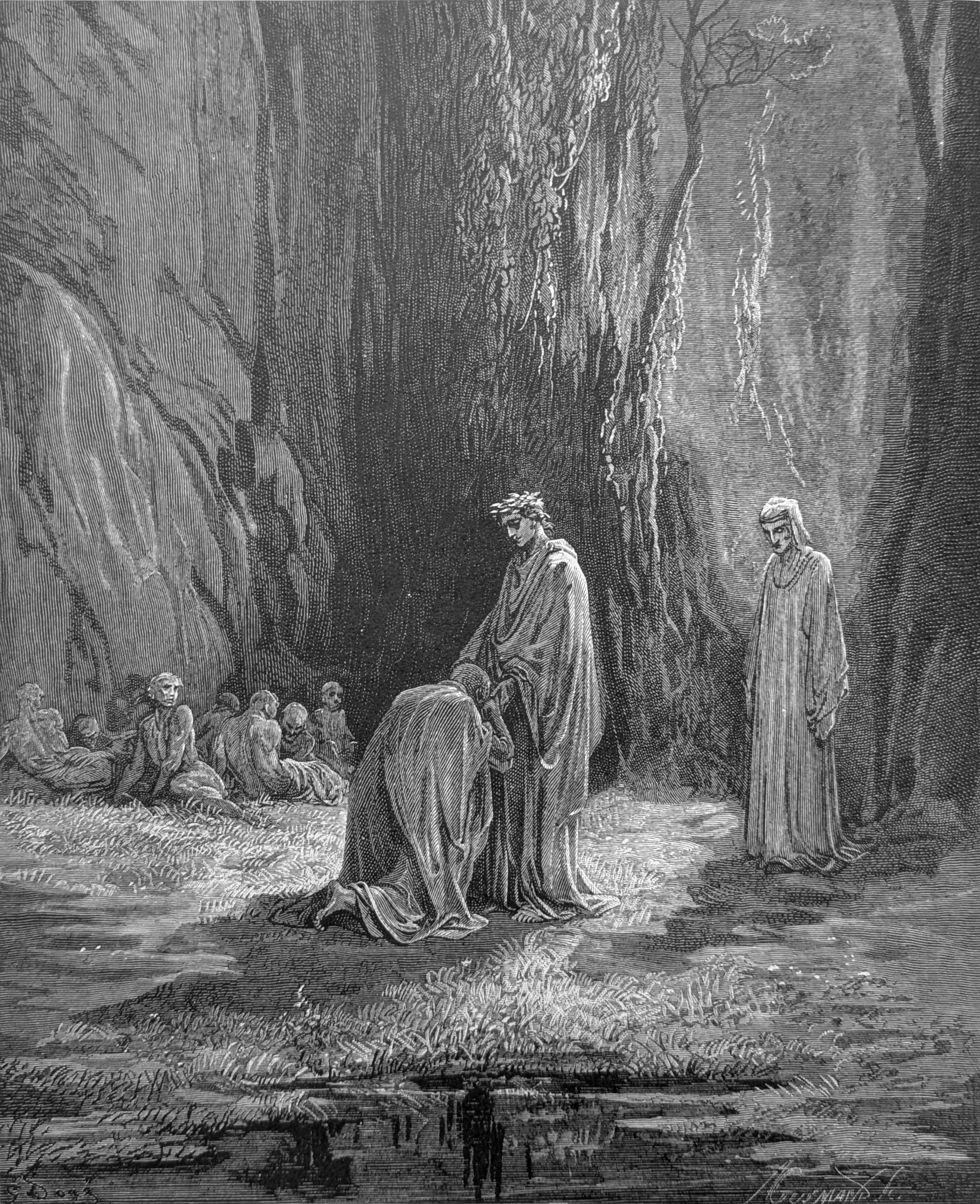
So he appeared; and then bowed down his brow, / And with humility returned towards him, / And, where inferiors embrace, embraced him. Purg. VII, lines 13-15
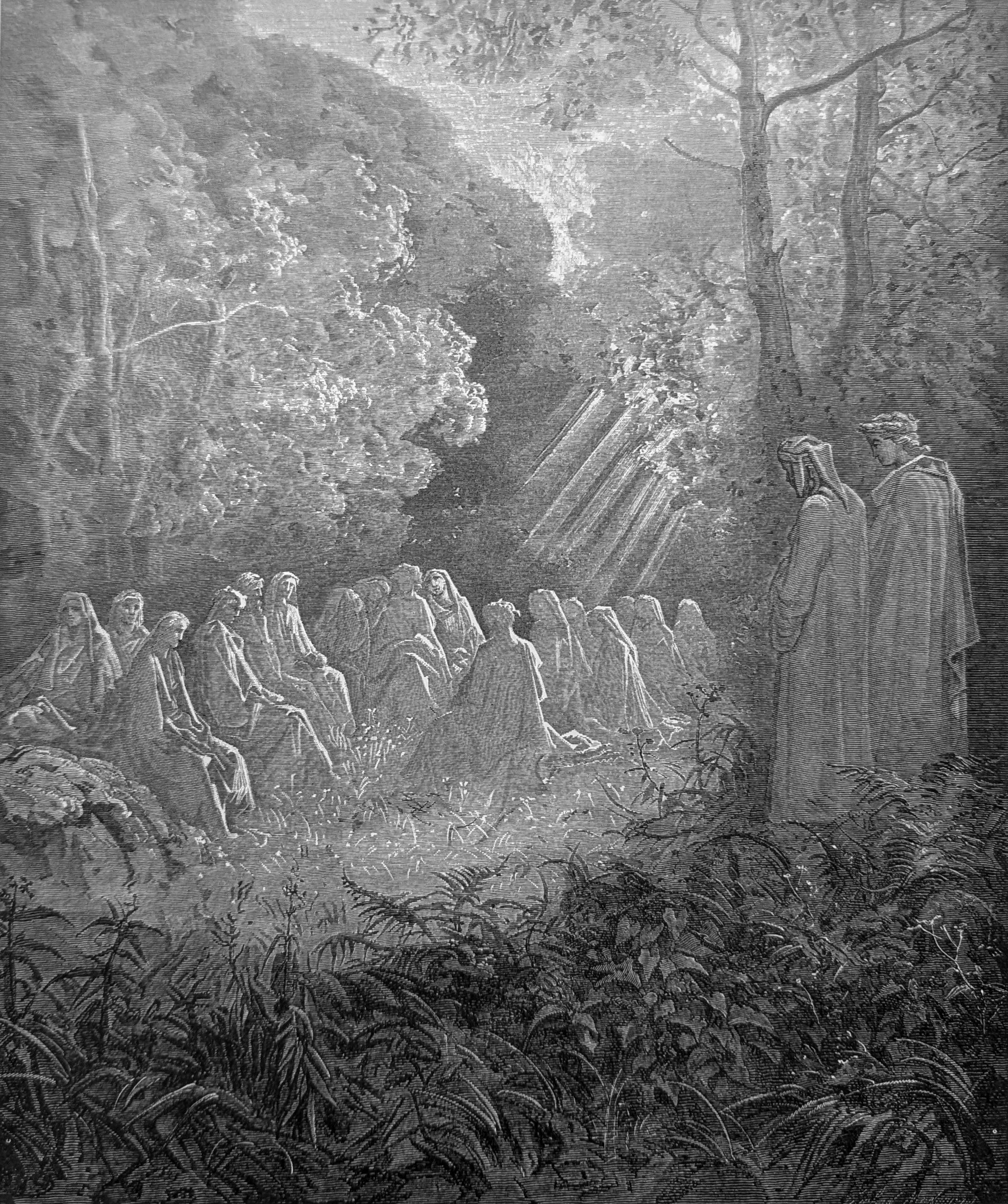
"Salve Regina," on the green and flowers / There seated, singing, spirits I beheld, Purg. VII, lines 82-83
Footnotes
1. An interesting note: in the previous canto, when Dante and Virgil came upon Sordello, both of the pilgrims were in the shade because the sun had moved behind the Mountain, and Dante’s usual “give-away”–his shadow–didn’t appear. Sordello probably thought the y were both shades. Add to this the fact that it was Virgil who initiated the conversation with Sordello, which led to the revelation of their mutual beginnings. While the “you” in Sordello’s question is plural in the Italian, the attention here is focused mainly on the two Mantuans. And as the reader will notice, Dante won’t be mentioned in this canto, with the exception of an inclusive “us” by Virgil. In her commentary, Dorothy Sayers has it all laid out for us. She writes: “ Note how carefully and cunningly the poet prepares his effects over some 290 lines so that he may keep Virgil in the foreground at this point and reserve the revelation that Dante is alive (which would here be an anticlimax) for Canto 8:59, where he can make good dramatic use of it.”
2. Octavian, AKA Augustus (63 BC - 14 AD), founded the Roman Empire, he initiated the Pax Romans, he formed the Principate form of government. His maternal great uncle was Julius Caesar. Octavian, Marc Antony and Marcus Lepides defeated Caesar's assassins at the Battle of Philippi, divided the Roman Empire into three parts, and formed the Second Triumvirate.
3. Three Virtues: Faith, Hope, and Love.
4. The reader will already know that the Garden of Eden sits atop the Mountain of Purgatory. Appealing directly to our imagination, Dante’s description of the valley here is but a foretaste of what we will see there at the end of this Canticle. Apart from the pre-sunrise spectacle that welcomed Dante and Virgil to Purgatory at the start of Canto 1, the rest of the scenery so far has been rather nondescript. But, almost as a celebration of a milestone in their journey, the Poet offers this visual prelude to what we will soon see.
In these few lovely sentences Dante has created what was called a plazer–an ancient literary “moment” when a poet stops to give the reader a list of beautiful things to contemplate. In his commentary, Musa notes: “Among all the descriptions in classical or medieval literature of the locus amoenus (a place–-like Eden–-of idealized beauty), this is unique. The beautiful colors of the grass and flowers are praised, but in such a way that what we see is not grass and flowers but precious stones, metals, dyes and pigments, the sheen of exotic colorings such as one might find in frescoes, miniature paintings, or stained glass windows–-products or raw materials of craftsmen and of the fine arts.”
5. The official daily prayer of the Church is called the Divine Office, the Liturgy of the Hours, or the Breviary. It is divided into eight parts throughout each day as a way to sanctify in holy readings and songs the entire life of the Church and its members. In monasteries it is generally chanted, but it is also prayed daily by priests and members of religious orders who recite it in an abbreviated form. In the monastic tradition that Dante and his contemporaries would have known, the Liturgy of the Hours began in the middle of the night (2 or 3am) with Matins. And then, in order, Lauds (5 or 6am), Prime (approx. 7am), Tierce (approx. 9am), Sext (approx. noon), None (approx. 3pm), Vespers ( approx. 6pm), and Compline (approx 8pm). Following the Second Vatican Council in the 1960s, parts of the Office were conflated and/or abbreviated.
The Salve Regina, is sung every evening at the end of Compline. It is an anonymous Medieval composition and was in general use by Dante’s time. Note how the words to this prayer are particularly apt for the souls in Purgatory:
“Hail, holy Queen, mother of mercy, Hail our life, our sweetness, and our hope. To you we cry, poor banished children of Eve; to you we send up our sighs, mourning and weeping in this valley of tears. Turn, then, most gracious advocate, your eyes of mercy toward us; and after this, our exile, show unto us the blessed fruit of your womb, Jesus. O clement, O loving, O sweet Virgin Mary.”
6. The nine souls/princes Sordello will point out are seated in order of their rank–all of them guilty of negligence. The Emperor Rudolf of Hapsburg (the only Emperor in the group) was born in 1218, died in 1291 (when Dante was 26), and was crowned Emperor in 1273. He and his son Albert bear most of the blame for the political chaos in Italy that Dante so fervently hoped would soon end with peace. On occasion, Dante surprises us with his characters, and this is one of those places. Given the social and political disaster in Italy at the time, one might be hard-pressed to imagine them among the saved. On the other hand, look at Manfred and Buonconte in the previous cantos. At least, as we continue, we will see that Rudolf is grieving.
7. German, Moldau River, also called Vltava, is the longest river in the Czech Republic.
8. This is Ottokar II, King of Bohemia from 1253 to 1278, the year he was, in fact, killed in battle by Rudolf. He was a tyrannical ruler and, again, a surprise to be found here rather immersed in the river of boiling blood in Canto 12 of the Inferno. But Ciar di suggests another perspective in his commentary: “[Dante’s] object in placing him here seems to be to show the reconciliation of enemies after true repentance and forgiveness.” As for Wenceslaus, who is not named among this group, he is probably flying around in the storms of passion we witnessed in Canto 5 of the Inferno, paying dearly for his numerous bedroom escapades and illegitimate children.
9. The flat-nosed sinner here is Philip III of France (also known as “The Bold” and “The Snubnose”). The son of Louis IX, he was born in 1245, died in 1285, and was King from 1270-1285. When Philip’s uncle, Charles of Anjou, lost Sicily to Pedro III of Aragon after the uprising known as the “Sicilian Vespers (1282),” Philip then declared war against Pedro. The end for Phillip came after his navy was defeated. He withdrew from battle and died of dysentery at Perpignan in southern France, thus disgracing France by marring its national symbol, the fleur de lis.
10. The soul who sighs is King Henry I of Navarre (also known as “The Fat”). He was born in 1268, reigned from 1270-1274, and died in 1314. He sighs over the misrule of his son-in-law Philip IV (“The Fair”), also known as the “Plague of France.” Philip III and Henry I are the father and father-in-law. Ciardi paints a damning picture of him in his commentary:
“Philip IV was for Dante the archetype of the evil ruler, in much the same way that Boniface VIII (whom Philip humiliated and drove to an early death) was the archetype of the evil Pope. Internally, Philip ruined whole provinces by his extortions and currency frauds. He systematically jailed Italian merchants (for ransom) on false charges, cruelly robbed the Jews, and suppressed the Knights Templars in order to confiscate their properties. Externally, he played a disastrous hand in Italian politics. Soon after he had eliminated Boniface VIII, he succeeded in placing one of his puppet cardinals on the Papal Throne as Clement V. Under Clement V the Papal Seat was transferred to Avignon.”
11. The “sturdy” king here is Pedro III of Aragon (“The Great”; 1276-1285). He married Constance, the daughter of Manfred, King of Sicily (see canto 3), and claimed the crown of Sicily after the “Sicilian Vespers” revolt (1282).
The soul with the large nose is Charles I of Anjou, King of Naples and Sicily (1266-1285), deposed by Pedro III in 1285.
The son seated behind Pedro III is his oldest son, Alfonso III of Aragon (“The Magnificent”; 1265-1291). He reigned for only six years and left no heirs.
James and Frederick are Alfonso III’s younger brothers and the youngest sons of Pedro III. Neither of them matched their father in character and virtue. James II was King of Sicily and later King of Aragon. He died in 1327. Frederick II (1272-1337) was the King of Sicily from 1296-1327. When Alfonso died, James became king of Aragon and Frederick king of Sicily. Later, James gave Sicily to Charles II of Naples without consulting Frederick. The Sicilians backed Frederick as their king in war against Charles an d James. James withdrew in 1299 leaving Frederick on his throne.
12. Keeping in mind what Dante has stated above, Sordello/Dante finishes by saying that James and Frederick, the degenerate sons of Pedro III, were as much a disgrace (less noble) to him as was Charles II to his father, Charles I. As much as Charles II was less virtuous than his father, the opposite can be said of the Empress Constance (the daughter of Manfred), whose husband was Pedro III. Constance can boast more of her husband’s virtue than Margaret of Burgundy and Beatrice of Provence, both of whom were married to Charles I of Anjou.
13. Henry III (1216-1272), a pious man who lived a simple life, ruled England from 1226-1272. Dante calls him the “king of the simple life.” Ciardi offers a simple perspective on his presence here in his commentary: “Henry is seated alone in part, perhaps, because he had no connection with the Holy Roman Empire, but much more importantly because he is unique in this company. Henry attended so many Masses daily that he never got around to governing his kingdom. His sin, therefore, could not have been neglect of Go d, but rather neglect of his divinely imposed duties to rule his kingdom well. His presence in this company adds an interesting dimension to Dante’s concept, for Henry’s sin is the reverse of the general pattern here.” Some commentators suggest that Henry i s alone because of his modesty, and others that his “apartness” matches Sordello’s sitting alone when Dante and Virgil first encountered him in Canto 6. Unlike other kings here, Henry’s son, Edward I (1239-1307), was remarkable and truly noble. He ruled Eng land from 1272-1307. His reform of English law earned him the title of “The English Justinian.”
14. Montferrat was a small territory in the Piedmont (northwestern) region of Italy, west of the Duchy of Milan and northwest of the Republic of Genoa. William VII (1240-1292) was the Marquis of Montferrat from 1253 until his death. His is a very sad story, and most likely due to his title and his small kingdom, he sits below the others in this group. Like Henry III he also sits apart from the rest. As a Ghibelline leader in both Piedmont and Lombardy, he sought to bring the disordered cities in that region under his control. At first he was successful, but his downfall came when he attacked the city of Alessandria (almost equidistant between Turin, Genoa, and Milan). He was captured and the citizens displayed and tortured him in a cage for more than a year until h e died. His son, John I, attempted to avenge his death, but he and his kingdom (Montferrat) were routed by the Alessandrians.
Top of page