Dante's Divine Comedy: Purgatorio
Canto XXX
The Pageant of the Sacrament procession comes to a halt and the elders rush over to the chariot as one hundred angels chant the Benedictus overhead and toss flowers into the air. Acclaimed by all, the veiled figure of Beatrice suddenly appears on the chariot, symbol and image of the Holy Host and the sacramental principle by which God grants new and eternal life. Dante is overcome by this long-awaited reunion with his beloved and turns to Virgil for reassurance but finds that he is gone. Beatrice scolds Dante for having strayed from the path of Truth and salvation.
When the Septentrion of the highest heaven
(Which never either setting knew or rising,
Nor veil of other cloud than that of sin,[1]
And which made every one therein aware
Of his own duty, as the lower makes
Whoever turns the helm to come to port)
Motionless halted, the veracious people,
That came at first between it and the Griffin,
Turned themselves to the car, as to their peace.
And one of them, as if by Heaven commissioned,
Singing, "Veni, sponsa, de Libano"
Shouted three times, and all the others after.[2]
Even as the Blessed at the final summons
Shall rise up quickened each one from his cavern,
Uplifting light the reinvested flesh,
So upon that celestial chariot
A hundred rose 'ad vocem tanti senis,"
Ministers and messengers of life eternal.[3]
They all were saying, "Benedictus qui venis,"
And, scattering flowers above and round about,
"Manibus o date lilia plenis."[4]
Ere now have I beheld, as day began,
The eastern hemisphere all tinged with rose,
And the other heaven with fair serene adorned;[5]
And the sun's face, uprising, overshadowed
So that by tempering influence of vapors
For a long interval the eye sustained it;
Thus in the bosom of a cloud of flowers
Which from those hands angelical ascended,
And downward fell again inside and out,
Over her snow-white veil with olive cinct
Appeared a lady under a green mantle,
Vested in color of the living flame.
And my own spirit, that already now
So long a time had been, that in her presence
Trembling with awe it had not stood abashed,
Without more knowledge having by mine eyes,
Through occult virtue that from her proceeded
Of ancient love the mighty influence felt.
As soon as on my vision smote the power
Sublime, that had already pierced me through
Ere from my boyhood I had yet come forth,
To the left hand I turned with that reliance
With which the little child runs to his mother,
When he has fear, or when he is afflicted,[6]
To say unto Virgilius: "Not a drachm
Of blood remains in me, that does not tremble;
I know the traces of the ancient flame."
But us Virgilius of himself deprived
Had left, Virgilius, sweetest of all fathers,
Virgilius, to whom I for safety gave me:
Nor whatsoever lost the ancient mother
Availed my cheeks now purified from dew,
That weeping they should not again be darkened.
"Dante, because Virgilius has departed
Do not weep yet, do not weep yet awhile;
For by another sword thou need'st must weep."[7]
E'en as an admiral, who on poop and prow
Comes to behold the people that are working
In other ships, and cheers them to well-doing,
Upon the left hand border of the car,
When at the sound I turned of my own name,
Which of necessity is here recorded,
I saw the Lady, who erewhile appeared
Veiled underneath the angelic festival,
Direct her eyes to me across the river.
Although the veil, that from her head descended,
Encircled with the foliage of Minerva,
Did not permit her to appear distinctly,[8]
In attitude still royally majestic
Continued she, like unto one who speaks,
And keeps his warmest utterance in reserve:
"Look at me well; in sooth I'm Beatrice!
How didst thou deign to come unto the Mountain?
Didst thou not know that man is happy here?"
Mine eyes fell downward into the clear fountain,
But, seeing myself therein, I sought the grass,
So great a shame did weigh my forehead down.
As to the son the mother seems superb,
So she appeared to me; for somewhat bitter
Tasteth the savor of severe compassion.
Silent became she, and the Angels sang
Suddenly, "In te, Domine, speravi:"
But beyond 'pedes meos' did not pass.[9]
Even as the snow among the living rafters
Upon the back of Italy congeals,
Blown on and drifted by Sclavonian winds,[10]
And then, dissolving, trickles through itself
Whene'er the land that loses shadow breathes,
So that it seems a fire that melts a taper;
E'en thus was I without a tear or sigh,
Before the song of those who sing for ever
After the music of the eternal spheres.
But when I heard in their sweet melodies
Compassion for me, more than had they said,
"O wherefore, lady, dost thou thus upbraid him?"
The ice, that was about my heart congealed,
To air and water changed, and in my anguish
Through mouth and eyes came gushing from my breast.
She, on the right-hand border of the car
Still firmly standing, to those holy beings
Thus her discourse directed afterwards:
"Ye keep your watch in the eternal day,
So that nor night nor sleep can steal from you
One step the ages make upon their path;
Therefore my answer is with greater care,
That he may hear me who is weeping yonder,
So that the sin and dole be of one measure.
Not only by the work of those great wheels,
That destine every seed unto some end,
According as the stars are in conjunction,
But by the largess of celestial graces,
Which have such lofty vapors for their rain
That near to them our sight approaches not,
Such had this man become in his new life
Potentially, that every righteous habit
Would have made admirable proof in him;[11]
But so much more malignant and more savage
Becomes the land untilled and with bad seed,
The more good earthly vigor it possesses.
Some time did I sustain him with my look;
Revealing unto him my youthful eyes,
I led him with me turned in the right way.
As soon as ever of my second age
I was upon the threshold and changed life,
Himself from me he took and gave to others.
When from the flesh to spirit I ascended,
And beauty and virtue were in me increased,
I was to him less dear and less delightful;
And into ways untrue he turned his steps,
Pursuing the false images of good,
That never any promises fulfil;
Nor prayer for inspiration me availed,
By means of which in dreams and otherwise
I called him back, so little did he heed them.
So low he fell, that all appliances
For his salvation were already short,
Save showing him the people of perdition.
For this I visited the gates of death,
And unto him, who so far up has led him,
My intercessions were with weeping borne.
God's lofty fiat would be violated,
If Lethe should be passed, and if such viands
Should tasted be, withouten any scot[12]
Of penitence, that gushes forth in tears."
Illustrations of Purgatorio
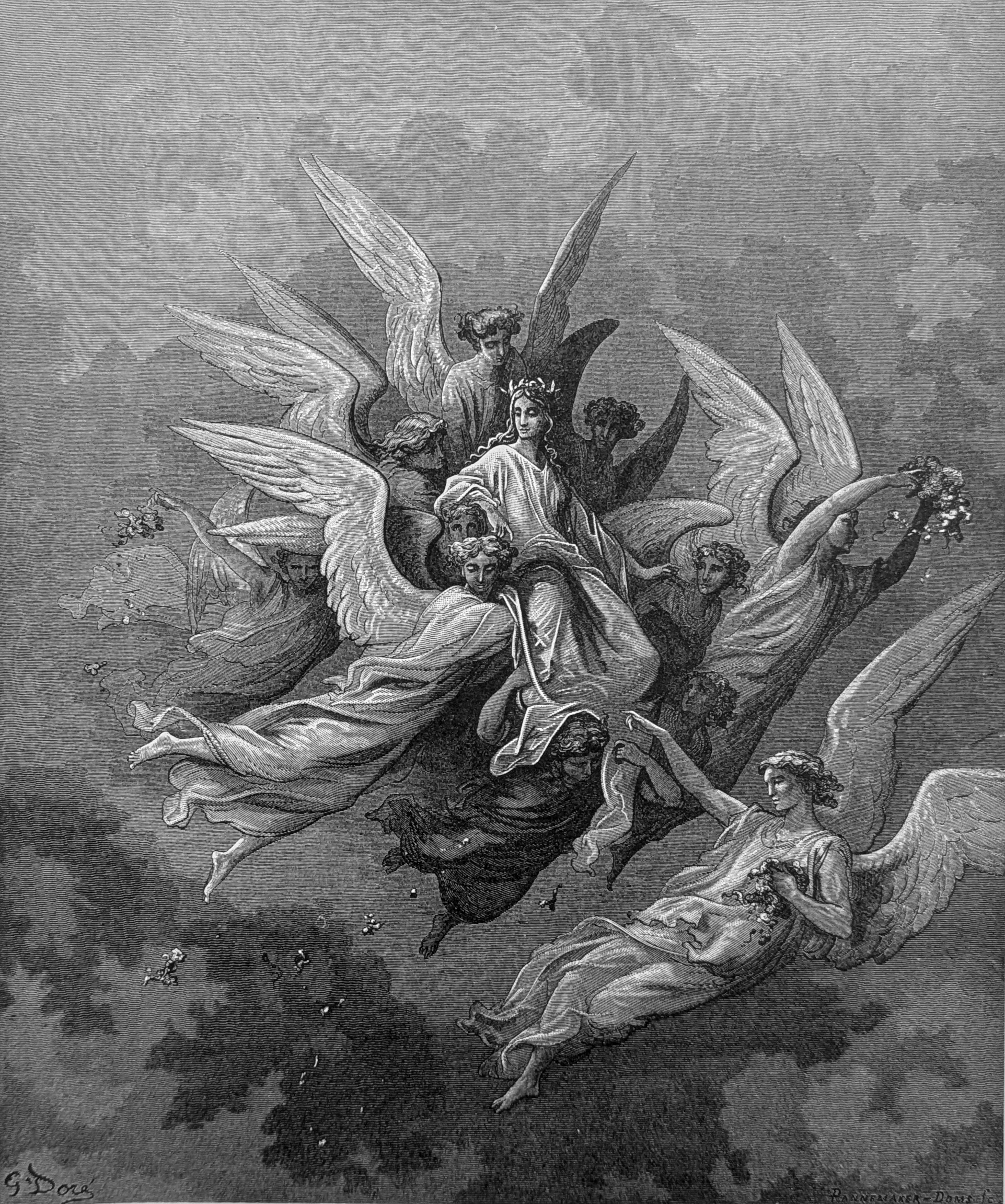
Appeared a lady under a green mantle, / Vested in colour of the living flame. Purg. XXX, lines 32-33
Footnotes
1. Septentrional, meaning "of the north", is a Latinate adjective sometimes used in English. It is a form of the Latin noun septentriones, which refers to the seven stars of the Plough (Ursa Major, Big Dipper), occasionally called the Septentrion.
Dante begins this canto with the mystical procession stopped in front of him just across the stream of Lethe. Directly in front of him–at the midpoint of the procession–-is the triumphal chariot (empty at this moment) drawn by the griffin. He compares the s even great candlesticks with their streaming lights–-representing the seven-fold Spirit of God–-to the seven stars of the constellation Ursa Major–the Big Dipper. This is the most recognized constellation in the sky. Its outer edge points to Polaris, the North Star, which never moves, and which has been a navigational guide in the northern hemisphere for time immemorial. As the seven gifts of the eternal Spirit guide us spiritually, so do the seven stars of the Dipper guide us here on earth. As God’s Spirit i s eternal, so the stars, the oldest objects in creation, seem eternal.
2. Veni, sponsa, de Libano, Latin, "Come, bride, from Lebanon".
With the procession stopped, the twenty-four elders who were first (behind the candlesticks) turn around and face the chariot, which itself, recall, is surrounded by the four creatures with wings full of eyes. Since the chariot represents the Church, Christ and all the souls in heaven, see here how Dante places the books of the Hebrew Bible as looking “toward” the Church–-Christ to come, and the books of the New Testament looking at Christ having come already. With everyone in the procession facing the chariot, note the points of a triangle that is formed by the books of the Hebrew Bible, the books of the New Testament, and Dante.
Now one of the elders, representing the Song of Songs, authored by King Solomon, begins to sing one of the verses from that book. The theme of this particular book is the marriage of God and Israel (the bride), and the elder sings from chapter 4, verse 8: “ Veni, sponsa, de Libano,” “Come to me from Lebanon, my spouse.” The image here is first of God calling the soul forth into divine union, a fitting sentiment here in the Earthly Paradise and so close to Heaven itself. Another significant image is the marriage of Christ and the Church, sometimes referred to as the Bride of Christ. Three times this verse is sung, joined in by all the elders, and note how the “Veni” (come) repeated three times echoes the “Holy, Holy, Holy” in the Mass just before the consecration of the bread and wine. In this way, Dante keeps the liturgical and ritual theme threaded throughout these last cantos of the Purgatorio, and at the same he heightens the tension of anticipation in the song of the Elders, “Veni!”
3. ad vocem tanti senis, Latin, "at the voice of such an old man".
Suddenly, a throng of angels appear at the chariot. Dante tells us the number is 100, but we are intended to imagine that it’s a huge number. And they appear ad vocem tanti senis, “at the voice of so great an elder.” The Latin phrase is Dante’s own, and h e obviously means to call our attention to the fact that the appearance of the angels is related to the song of the Elder, Veni, sponsa di Libano, which is itself a summons that will be answered shortly with the arrival of Beatrice.
4. Benedictus qui venis, Latin, "Blessed are you who come".
Manibus o date lilia plenis, Latin, "Oh, give me your hands full of lilies!"
Now Dante does something quite unusual to mark this extraordinary moment. He has told us that the angels rose up singing at the voice of a great elder. As they sing, they send up a rain of flowers into the air that fall down upon the chariot. And what are t hey singing? Benedictus qui venis! and Manibus, O, date lelia plenis! The first sentence, “Blessed is he who comes (in the name of the Lord),” was shouted by the crowds when Jesus entered Jerusalem a few days before he was killed. It comes from St. Mark ’s Gospel (11:9-f). A Latin scholar might say that the word benedictus here is a mistake because this is the masculine form of the word. Given the context, it should be benedicta. But Robert Hollander shows us clearly what Dante is up to here in his commentary: “Dante could just as easily have said “benedicta” as “benedictus“; neither rhyme nor meter forced his hand. We must therefore understand that the scandalous re-gendering of Beatrice caused by the correct citation of Mark’s Gospel is deliberate. It seems clear that the poet wants his reader to realize that her meaning, her eventual identity, is totally involved in Christ. And thus she comes as Christ, not as herself.”
5. In the rain of flowers thrown up by the host of angels, Beatrice appears at last, descending from Heaven onto the magnificent chariot. In this great moment in the Poem she completes the cast of the mystical pageant. And in a lovely simile, Dante compares he r apparition to the rising of a rose-colored sun on a misty morning–-the mist enabling one to see it before it becomes too bright to look at. As we will see, Beatrice’s face is also veiled. The rising sun, of course, is also a symbol of the coming of Christ, a role Beatrice will assume shortly. Through Hell to its very bottom and up to this Earthly Paradise atop the Mountain of Purgatory she has been an often unseen but driving force of the Poem. She is clothed in all three of the colors we have seen separately in the pageant: the white veil of faith, the green cloak of hope, and the red gown of love. And she wears the crown of olive leaves, signifying peace and wisdom.
6. What happens next is not what we expect, and stands as the saddest moment in the Poem. Standing just a bit in front of him, Dante turns to Virgil with the same trust and confidence a frightened child would turn to its mother (here, Dante uses the Italian wo rd mamma), to share his elation in this moment of revelation, only to discover that he has disappeared. He is not there! At the point when divine revelation appeared in the person of Beatrice, human reason in the person of Virgil who led him to this point , was no longer needed, and Virgil returned to Limbo, his role played out to perfection over the course of two-thirds of the Poem.
7. Beatrice now addresses Dante directly from the chariot–-the only time in the poem that his name is used. The dramatic effect of this should not be short-changed. In some cultures and circumstances, the naming of a person or of some thing indicates control over it and, as we see here, her commanding demeanor reminds him of an admiral–-a somewhat disturbing image of Beatrice, yet clearly in keeping with what is to come. What modulates the image of the stern admiral, though, is that this one “watches and encourages his men” as they work. And we’ll want to pay careful attention to how this “admiral” will behave. Note again the masculine image attached to Beatrice. The direct address of Dante is a way of putting his signature on this moment. He, not us, is being cal led to account by Beatrice, and yet, somehow, we cannot abandon him here. Suddenly, this is not quite the reunion Dante was expecting. As Robert Hollander notes here, “His ‘vacation’ in the Garden of Eden is over.”
8. All of this happens so quickly that Dante has to assure himself that this is, in fact, the same exalted woman he just saw descend into the chariot amid the rain of flowers. And yet note that he still can’t see her clearly because her head is covered with the white veil of faith, crowned with Minerva’s leaves–-olive leaves, symbols of peace and wisdom. This lack of clear sight, his near blindness, is also symbolic of what is still to come. And, finally, if he can’t quite make out her face, he can definitely sense her commanding superiority. That he expects harsh words from her leads us directly to the next scene.
9. In te, Domine, speravi, Latin, "In you, Lord, I have hoped".
pedes meos, Latin, "my feet".
What happens here is completely unexpected. Whether they intercede or interrupt, the angels who are still there around Beatrice and the chariot seem to take advantage of the pause between her sharp words and Dante’s embarrassment. Seeing him in such a state , they begin singing the first nine verses of Psalm 31 in which the soul seeks refuge in the Lord. The words In te, Domine, speravi translate as “In you, Lord, I place my trust.” The angels stop at verse nine with the words pedes meos, “my feet.” That i s: “You will not abandon me into enemy hands, but will set my feet in a free and open space.” Note the significance of this verse in light of how Beatrice (at the behest of the Virgin Mary) has saved him from Hell and brought him to this Earthly Paradise. T he intent of this merciful intervention by the angels may have been to sway Beatrice toward more compassion, yet Dante seems to hear the intent more loudly than the actual words of the Psalm: “Dear Lady, why do you shame him like this?” In the end, Dante hears the words the angels sing and interprets them emotionally as pity. This has the effect of melting his apparently hardened heart (the snow atop the Apennines) and he breaks down in tears-–exactly what Beatrice wants.
10. Slavonia, an eastern province of Croatia.
11. And so, while Beatrice compliments Dante’s potential by noting how gifted he was, she sharply criticizes the fact that he seems to have wasted those gifts by allowing “weeds” to grow in the garden of his many gifts. Moreover, while she was alive, she notes, he could find in her the strength to follow the path toward his potential without losing his way. Sadly, even this didn’t always seem to work, and he lost his focus in other pursuits. Here, Dante isn’t looking at what happened to other souls as he and Virgil encountered them. He’s being forced to look at himself, at himself in the eyes of someone who tried to help him but failed. But has she failed?
12. In the end, Beatrice’s plan seems simple enough. Remember that during the entirety of this long speech (42 lines in the Italian text) she has had two audiences: the angels surrounding her and the chariot, and Dante, on the other side of the stream. Throughout her speech, which is really an explanation of her cold behavior when the angels called for compassion and pity, she has spoken directly to the angels about Dante, not to him. As though presenting her case in a court of law, Beatrice sums up for the jury in this final sentence: if Dante is allowed to cross the Lethe (wherein one loses all memory of sin) without admitting his guilt and doing penance, then the highest laws of God will be rendered meaningless. In other words, even though he was cleansed of the grime of Hell shortly after he emerged from it, even though he was admitted through the Gate of Purgatory after the ritual of the three steps, even though he considered himself liable to suffer some of the punishments he witnessed on the Mountain, and even though he passed through the flames just hours ago, one act is still missing. He must make a personal and public act of contrition. Otherwise, his journey through Purgatory has been a pious trave-log.
Underlying all of this, we must remember that Beatrice not only represents Divine Revelation, but she is also an allegorical representation of the Eucharist and of Christ himself. As the very food of forgiveness, Beatrice as the Eucharist offers Dante a place at the table of communion where his long absence can be reconciled.
“Bearing in mind the four levels at which Dante meant his poem to be interpreted, we see that she is here: (1) Literally: the Florentine woman whom Dante loved. (2) Morally (i.e. as regards the way of salvation of the individual soul): the type of whatever is, for each of us, the “God-bearing image” which manifests the glory of God in His creation, and becomes a personal sacramental experience. (3) Historically (i.e. in the world of human society): the Sacrament of the Altar. (And those who say that Beatrice here represents the Church are not wrong: for Dante has in mind that ancient and apostolic conception of the Eucharist which looks upon it, not only as the commemoration of God’s single act in time, but as the perpetual presentation to God in Christ of Christ's true Body the Church–the verum corpus–which is made in the offertory of the bread and wine; so that, as St. Augustine says, ‘being joined to His Body and made His members, we may be what we receive.’) (4) Mystically (i.e. as regards the way of the soul ’s union with God): the whole principle of Affirmation, whereby that union is effected in and through all the images. Having said thus much, we may admire the poetic tact with which Dante leaves the whole weight of this allegorical structure to be carried o n the framework of the Masque, so that he is free to conduct the interview between Dante and Beatrice throughout in those human and personal terms which make the story dramatically effective.”
Top of page