Dante's Divine Comedy: Purgatorio
Canto II
From the shores of Purgatory, Dante watches the arrival of the ship carrying the souls of those recently saved. Piloted by a gleaming winged angel, the vessel first emerges over the curve of the Earth. The crew is joyfully singing the hymn In exitu Israel de Aegypto! (When Israel Came Out of Egypt) because they have left behind a place of evil for a new life in God's promised land. The souls notice that Dante is alive. Casella the musician stops to play one of Dante's own compositions—a performance which Cato brusquely interrupts, chiding them for wasting time.
Already had the sun the horizon reached
Whose circle of meridian covers o'er
Jerusalem with its most lofty point,[1]
And night that opposite to him revolves
Was issuing forth from Ganges with the Scales
That fall from out her hand when she exceedeth;
So that the white and the vermilion cheeks
Of beautiful Aurora, where I was,
By too great age were changing into orange.
We still were on the border of the sea,
Like people who are thinking of their road,
Who go in heart and with the body stay;
And lo! as when, upon the approach of morning,
Through the gross vapours Mars grows fiery red
Down in the West upon the ocean floor,[2]
Appeared to me may I again behold it!--
A light along the sea so swiftly coming,
Its motion by no flight of wing is equalled;
From which when I a little had withdrawn
Mine eyes, that I might question my Conductor,
Again I saw it brighter grown and larger.
Then on each side of it appeared to me
I knew not what of white, and underneath it
Little by little there came forth another.
My Master yet had uttered not a word
While the first whiteness into wings unfolded;
But when he clearly recognised the pilot,
He cried: "Make haste, make haste to bow the knee!
Behold the Angel of God! fold thou thy hands!
Henceforward shalt thou see such officers!
See how he scorneth human arguments,
So that nor oar he wants, nor other sail
Than his own wings, between so distant shores.
See how he holds them pointed up to heaven,
Fanning the air with the eternal pinions,
That do not moult themselves like mortal hair!"
Then as still nearer and more near us came
The Bird Divine, more radiant he appeared,
So that near by the eye could not endure him,
But down I cast it; and he came to shore
With a small vessel, very swift and light,
So that the water swallowed naught thereof.
Upon the stern stood the Celestial Pilot;
Beatitude seemed written in his face,
And more than a hundred spirits sat within.
"In exitu Israel de Aegypto!"
They chanted all together in one voice,
With whatso in that psalm is after written.[3]
Then made he sign of holy rood upon them,
Whereat all cast themselves upon the shore,
And he departed swiftly as he came.
The throng which still remained there unfamiliar
Seemed with the place, all round about them gazing,
As one who in new matters makes essay.
On every side was darting forth the day.
The sun, who had with his resplendent shafts
From the mid-heaven chased forth the Capricorn,[4]
When the new people lifted up their faces
Towards us, saying to us: "If ye know,
Show us the way to go unto the mountain."
And answer made Virgilius: "Ye believe
Perchance that we have knowledge of this place,
But we are strangers even as yourselves.
Just now we came, a little while before you,
Another way, which was so rough and steep,
That mounting will henceforth seem sport to us."
The souls who had, from seeing me draw breath,
Become aware that I was still alive,
Pallid in their astonishment became;
And as to messenger who bears the olive
The people throng to listen to the news,
And no one shows himself afraid of crowding,
So at the sight of me stood motionless
Those fortunate spirits, all of them, as if
Oblivious to go and make them fair.
One from among them saw I coming forward,
As to embrace me, with such great affection,
That it incited me to do the like.
O empty shadows, save in aspect only!
Three times behind it did I clasp my hands,
As oft returned with them to my own breast!
I think with wonder I depicted me;
Whereat the shadow smiled and backward drew;
And I, pursuing it, pressed farther forward.
Gently it said that I should stay my steps;
Then knew I who it was, and I entreated
That it would stop awhile to speak with me.
It made reply to me: "Even as I loved thee
In mortal body, so I love thee free;
Therefore I stop; but wherefore goest thou?"
"My own Casella! to return once more
There where I am, I make this journey," said I;
"But how from thee has so much time be taken?"[5]
And he to me: "No outrage has been done me,
If he who takes both when and whom he pleases
Has many times denied to me this passage,
For of a righteous will his own is made.
He, sooth to say, for three months past has taken
Whoever wished to enter with all peace;
Whence I, who now had turned unto that shore
Where salt the waters of the Tiber grow,
Benignantly by him have been received.
Unto that outlet now his wing is pointed,
Because for evermore assemble there
Those who tow'rds Acheron do not descend."[6]
And I: "If some new law take not from thee
Memory or practice of the song of love,
Which used to quiet in me all my longings,
Thee may it please to comfort therewithal
Somewhat this soul of mine, that with its body
Hitherward coming is so much distressed."
"Love, that within my mind discourses with me,"
Forthwith began he so melodiously,
The melody within me still is sounding.
My Master, and myself, and all that people
Which with him were, appeared as satisfied
As if naught else might touch the mind of any.
We all of us were moveless and attentive
Unto his notes; and lo! the grave old man,
Exclaiming: "What is this, ye laggard spirits?
What negligence, what standing still is this?
Run to the mountain to strip off the slough,
That lets not God be manifest to you."
Even as when, collecting grain or tares,
The doves, together at their pasture met,
Quiet, nor showing their accustomed pride,
If aught appear of which they are afraid,
Upon a sudden leave their food alone,
Because they are assailed by greater care;
So that fresh company did I behold
The song relinquish, and go tow'rds the hill,
As one who goes, and knows not whitherward;
Nor was our own departure less in haste.
Illustrations of Purgatorio
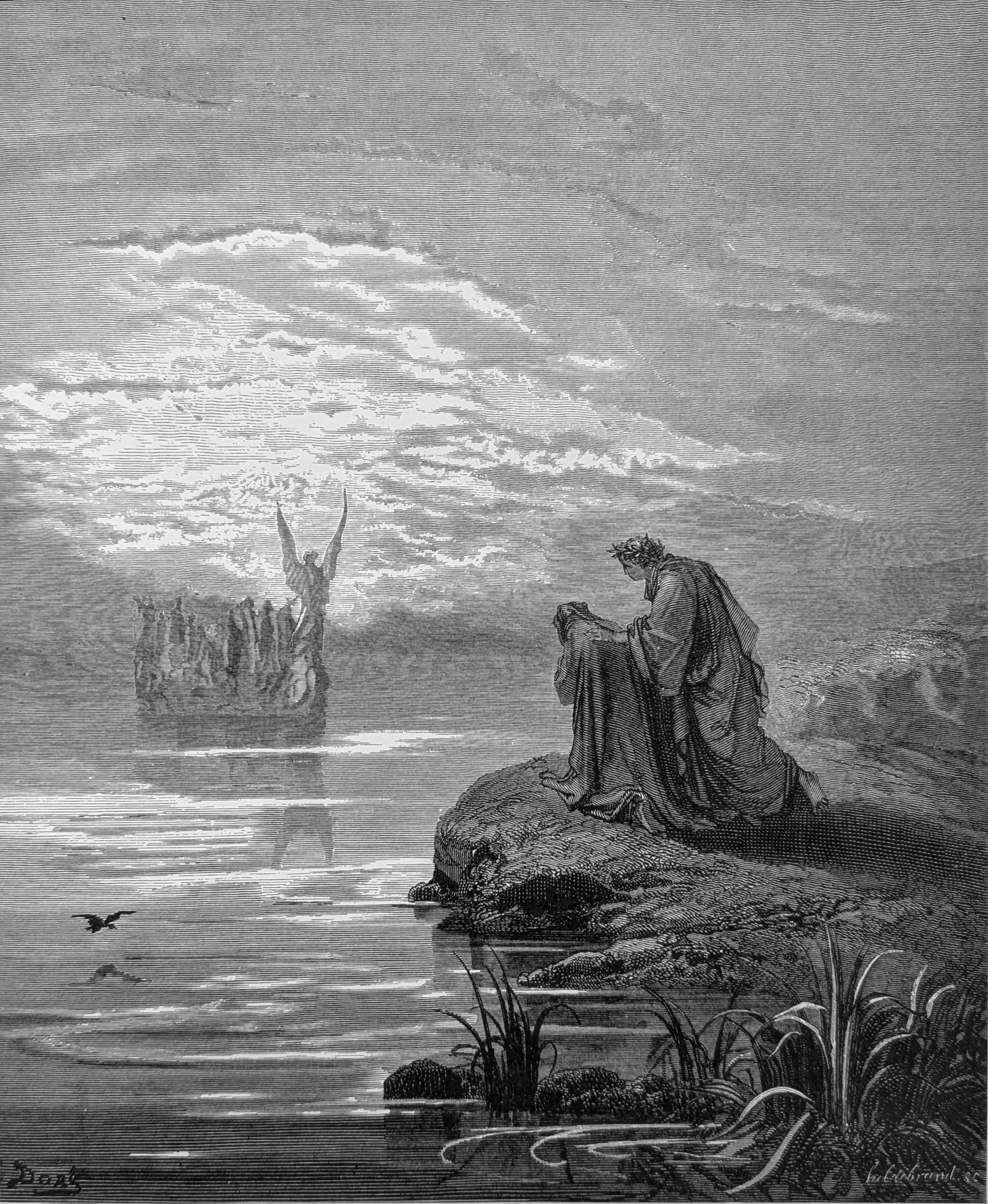
But when he clearly recognised the pilot, / He cried: "Make haste, make haste to bow the knee! / Behold the Angel of God!" Purg. II, lines 27-29
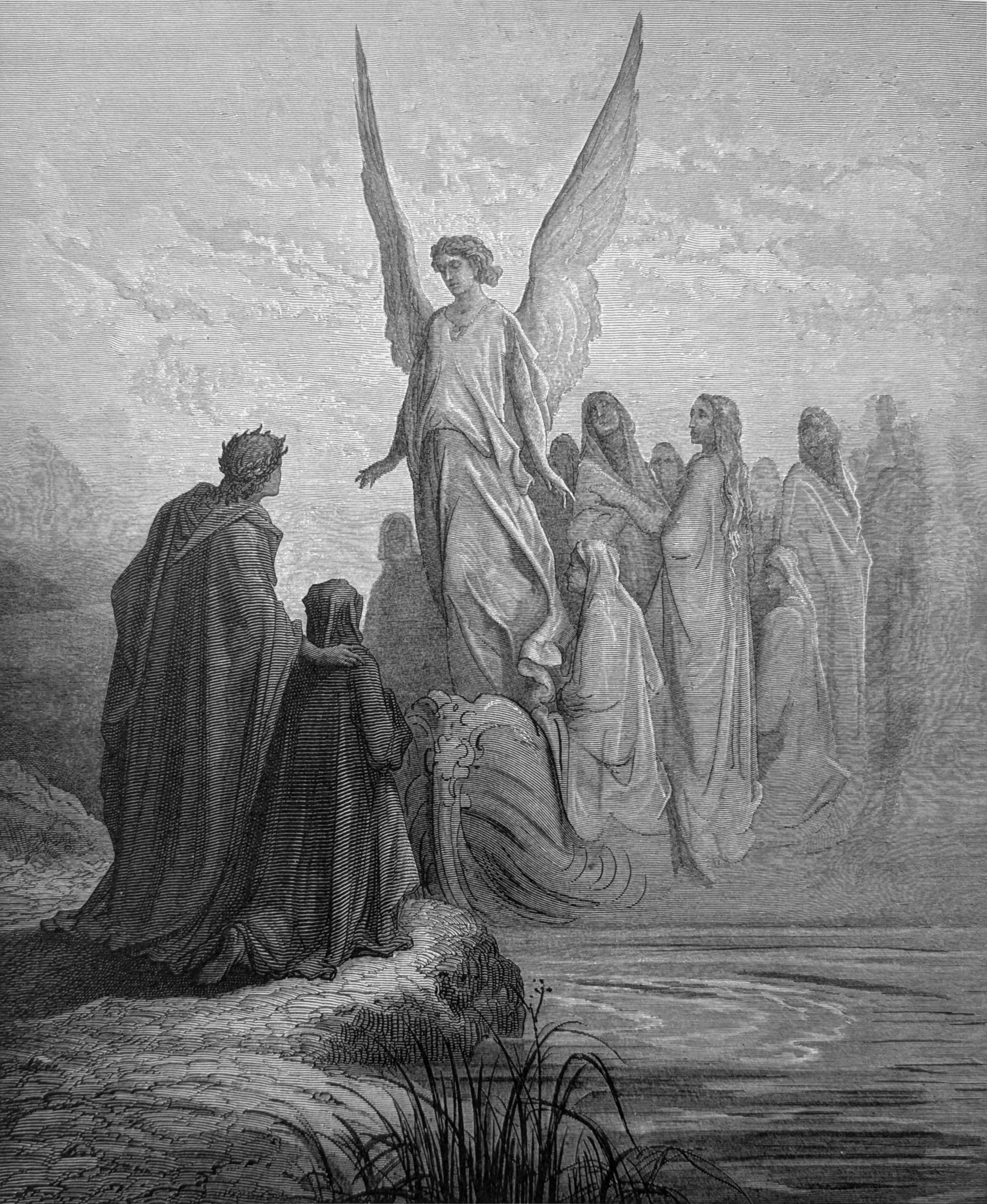
Beatitude seemed written in his face, Purg. II, line 44
Footnotes
1. It is 6:00 am on the shore of Purgatory as Dante and Virgil watch the sun rise over the sea on Easter morning, March 21, 1300. Arriving at this simple explanation takes a bit more time (pun intended!). Keep in mind that Hell and Paradise are eternal, but Pu rgatory exists in time. And according to Dante’s geography, we are to understand that the southern hemisphere (except for Purgatory) is completely covered with water, uninhabited, and unexplored. The reason for this is explained in the notes for Inferno Can to 34. Furthermore, only half of the northern hemisphere (the known world) is land: think of a circle with Jerusalem at its center, the River Ganges at its farthest eastern point, and Gibraltar at its farthest western point. Because the city is directly con nected to the death and resurrection of Jesus, Jerusalem is at the “center of the world.” The mountain of Purgatory is directly opposite to Jerusalem on the other side of the globe. Thus, the time of day in Purgatory is directly opposite that in Jerusalem. Dante also embellishes his time notation here by reference to the Zodiac. As noted in the previous canto, it is the first day of Spring, and at the point of sunrise here on the island of Purgatory, the constellation of Libra disappears and Aries takes its place. As Dante describes this moment in Italian, Libra slips from the hands of night. Finally, as though to affirm Dante’s “baptism” at the end of the previous canto, the face of Aurora, the goddess of dawn, has changed from deep sapphire to a luminous gold.
2. They are astounded by a great red light that moves rapidly across the sea toward them from the west–the opposite direction from the sunrise. Having already mentioned Venus and the stars of Libra and Aires when he first arrived at Purgatory, Dante thinks of Mars here as another morning star, which it really isn’t.
3. When Israel came forth from Egypt, the house of Jacob from an alien people, Judah became God’s sanctuary, Israel, God’s domain.
The sea saw and fled; the Jordan turned back. The mountains skipped like rams; the hills, like lambs.
Why was it, sea, that you fled? Jordan, that you turned back? Mountains, that you skipped like rams? You hills, like lambs?
Tremble, earth, before the Lord, before the God of Jacob, Who turned the rock into pools of water, flint into a flowing spring.
4. We watch as the newly arrived and confused souls try to get their bearings. Since the sun has risen (note how time has passed and note the subtle hunting theme: the rays/arrows of the Sun have driven the constellations of Libra, Aries, and now Capricorn out of the morning sky) it’s easy to see, and the strangers do what any one of us might do in a new place–ask someone for directions. There’s a certain humor to this because Dante and Virgil are also new to this place, as Virgil will soon explain. And everyone knows that they have to climb the mountain. Purgatory isn’t the shore, as we will also soon discover.
5. What a delightful and even humorous scene of reunion this is. Dante is recognized by his dear friend, Casella, a Florentine musician who set some of his poems to music. After three unsuccessful attempts to hug each other, Dante finally recognizes his friend when he speaks. But note how Dante was more than happy to embrace that “stranger” in this passage filled with gentle affection. The virtue of Love, earlier symbolized by the presence of the planet Venus in the pre-dawn sky, is at work even here at the very edge of Purgatory. And, yes, you guessed it! Scenes similar to this can be found in Virgil’s Aeneid (II:792ff) in the Underworld, where Aeneas tries to embrace his first wife, Creusa, three times in vain; and in VI:700ff, where he meets his father, Anchise s, and also tries three times to embrace his dear father, but in vain.
6. Dante, had asked Casella why it took him so long to get here. We know that the Poem is set in the Spring of 1300, and, though little is known about his life, Casella seems to have died at some time in the previous year. But in his answer to Dante he gives u s lots of fascinating information to explore. He tells Dante that he didn’t just find himself at Purgatory when he died. Rather, in the good-natured way we’ve already observed with him, he seems to indicate that God wasn’t in a great hurry with him, and he’ s not complaining. Well, Dante, of course, has fabricated this scene by re-purposing one from the Aeneid (VI:315f). There Aeneas, at the shore of the Acheron, sees that the souls of the dead crowd along the bank pleading to be ferried across. But Charon the boatman doesn’t just take everyone aboard. He picks and chooses whom he will take while the rest have to wait. But recently, Casella says, God took anyone who wanted to cross, so he went to Ostia and got on the boat that has just arrived. The modern port o f Rome is Civitavecchia about 20 miles to the northwest. Ostia, at the mouth of the Tiber river, was the ancient port of Rome, a large city. and an important commercial center of the empire. It is close to Rome’s international airport at Fiumicino, but it n o longer serves as a seaport. The ancient city’s ruins are still a major archaeological attraction. Though we have no idea where the damned souls gathered or entered the Underworld, it seems that Ostia, being so significant to the very life of Rome, the cen ter of the Church, came to be the place where it was believed that the souls of the saved were gathered and transported as we have seen. In the end, all of what Casella tells Dante here suggests that there is a kind of pre-Purgatory time of waiting for some souls before they actually arrive at the mountain itself.
Top of page