Dante's Divine Comedy: Purgatorio
Canto XXVIII
Dante enters the Sacred Wood and finds Matilda picking flowers by a stream. She explains that Adam and Eve were created in the Garden of Eden and that the gentle breeze is caused by the motion of the nine heavenly spheres upon the Earth. This Earthly Paradise represents the recovery of the original innocence that poets and men have so longingly recalled across the ages as if from memory. The water present is not fed by rain but by the twin fountains of Lethe, the river of Oblivion, and Eunoe, the river of Goo d Remembrance.
Eager already to search in and round
The heavenly forest, dense and living-green,
Which tempered to the eyes the new-born day,
Withouten more delay I left the bank,
Taking the level country slowly, slowly
Over the soil that everywhere breathes fragrance.
A softly-breathing air, that no mutation
Had in itself, upon the forehead smote me
No heavier blow than of a gentle wind,[1]
Whereat the branches, lightly tremulous,
Did all of them bow downward toward that side
Where its first shadow casts the Holy Mountain;
Yet not from their upright direction swayed,
So that the little birds upon their tops
Should leave the practice of each art of theirs;
But with full ravishment the hours of prime,
Singing, received they in the midst of leaves,
That ever bore a burden to their rhymes,
Such as from branch to branch goes gathering on
Through the pine forest on the shore of Chiassi,
When Eolus unlooses the Sirocco.[2]
Already my slow steps had carried me
Into the ancient wood so far, that I
Could not perceive where I had entered it.
And lo! my further course a stream cut off,
Which tow'rd the left hand with its little waves
Bent down the grass that on its margin sprang.
All waters that on Earth most limpid are
Would seem to have within themselves some mixture
Compared with that which nothing doth conceal,
Although it moves on with a brown, brown current
Under the shade perpetual, that never
Ray of the sun lets in, nor of the moon.
With feet I stayed, and with mine eyes I passed
Beyond the rivulet, to look upon
The great variety of the fresh may.
And there appeared to me (even as appears
Suddenly something that doth turn aside
Through very wonder every other thought)
A lady all alone, who went along
Singing and culling floweret after floweret,
With which her pathway was all painted over.[3]
"Ah, beauteous lady, who in rays of love
Dost warm thyself, if I may trust to looks,
Which the heart's witnesses are wont to be,
May the desire come unto thee to draw
Near to this river's bank," I said to her,
"So much that I might hear what thou art singing.[4]
Thou makest me remember where and what
Proserpina that moment was when lost
Her mother her, and she herself the Spring."
As turns herself, with feet together pressed
And to the ground, a lady who is dancing,
And hardly puts one foot before the other,
On the vermilion and the yellow flowerets
She turned towards me, not in other wise
Than maiden who her modest eyes casts down;
And my entreaties made to be content,
So near approaching, that the dulcet sound
Came unto me together with its meaning
As soon as she was where the grasses are.
Bathed by the waters of the beauteous river,
To lift her eyes she granted me the boon.
I do not think there shone so great a light
Under the lids of Venus, when transfixed
By her own son, beyond his usual custom![5]
Erect upon the other bank she smiled,
Bearing full many colors in her hands,
Which that high land produces without seed.
Apart three paces did the river make us;
But Hellespont, where Xerxes passed across,
(A curb still to all human arrogance,)[6]
More hatred from Leander did not suffer
For rolling between Sestos and Abydos,
Than that from me, because it oped not then.
"Ye are new-comers; and because I smile,"
Began she, "peradventure, in this place
Elect to human nature for its nest,[7]
Some apprehension keeps you marveling;
But the psalm 'Delectasti' giveth light
Which has the power to uncloud your intellect.
And thou who foremost art, and didst entreat me,
Speak, if thou wouldst hear more; for I came ready
To all thy questionings, as far as needful."
"The water," said I, "and the forest's sound,
Are combating within me my new faith
In something which I heard opposed to this."
Whence she: "I will relate how from its cause
Proceedeth that which maketh thee to wonder,
And purge away the cloud that smites upon thee.
The Good Supreme, sole in itself delighting,
Created man good, and this goodly place
Gave him as hansel of eternal peace.[8]
By his default short while he sojourned here;
By his default to weeping and to toil
He changed his innocent laughter and sweet play.
That the disturbance which below is made
By exhalations of the land and water,
(Which far as may be follow after heat,)
Might not upon mankind wage any war,
This mount ascended tow'rds the heaven so high,
And is exempt, from there where it is locked.
Now since the universal atmosphere
Turns in a circuit with the primal motion
Unless the circle is broken on some side,
Upon this height, that all is disengaged
In living ether, doth this motion strike
And make the forest sound, for it is dense;
And so much power the stricken plant possesses
That with its virtue it impregns the air,
And this, revolving, scatters it around;[9]
And yonder Earth, according as 'tis worthy
In self or in its clime, conceives and bears
Of divers qualities the divers trees;
It should not seem a marvel then on earth,
This being heard, whenever any plant
Without seed manifest there taketh root.
And thou must know, this holy table-land
In which thou art is full of every seed,
And fruit has in it never gathered there.
The water which thou seest springs not from vein
Restored by vapor that the cold condenses,
Like to a stream that gains or loses breath;[10]
But issues from a fountain safe and certain,
Which by the will of God as much regains
As it discharges, open on two sides.
Upon this side with virtue it descends,
Which takes away all memory of sin;
On that, of every good deed done restores it.
Here Lethe, as upon the other side
Eunoe, it is called; and worketh not
If first on either side it be not tasted.
This every other savor doth transcend;
And notwithstanding slaked so far may be
Thy thirst, that I reveal to thee no more,
I'll give thee a corollary still in grace,
Nor think my speech will be to thee less dear
If it spread out beyond my promise to thee.
Those who in ancient times have feigned in song
The Age of Gold and its felicity,
Dreamed of this place perhaps upon Parnassus.[11]
Here was the human race in innocence;
Here evermore was Spring, and every fruit;
This is the nectar of which each one speaks."
Then backward did I turn me wholly round
Unto my Poets, and saw that with a smile
They had been listening to these closing words;
Then to the beautiful lady turned mine eyes.
Illustrations of Purgatorio
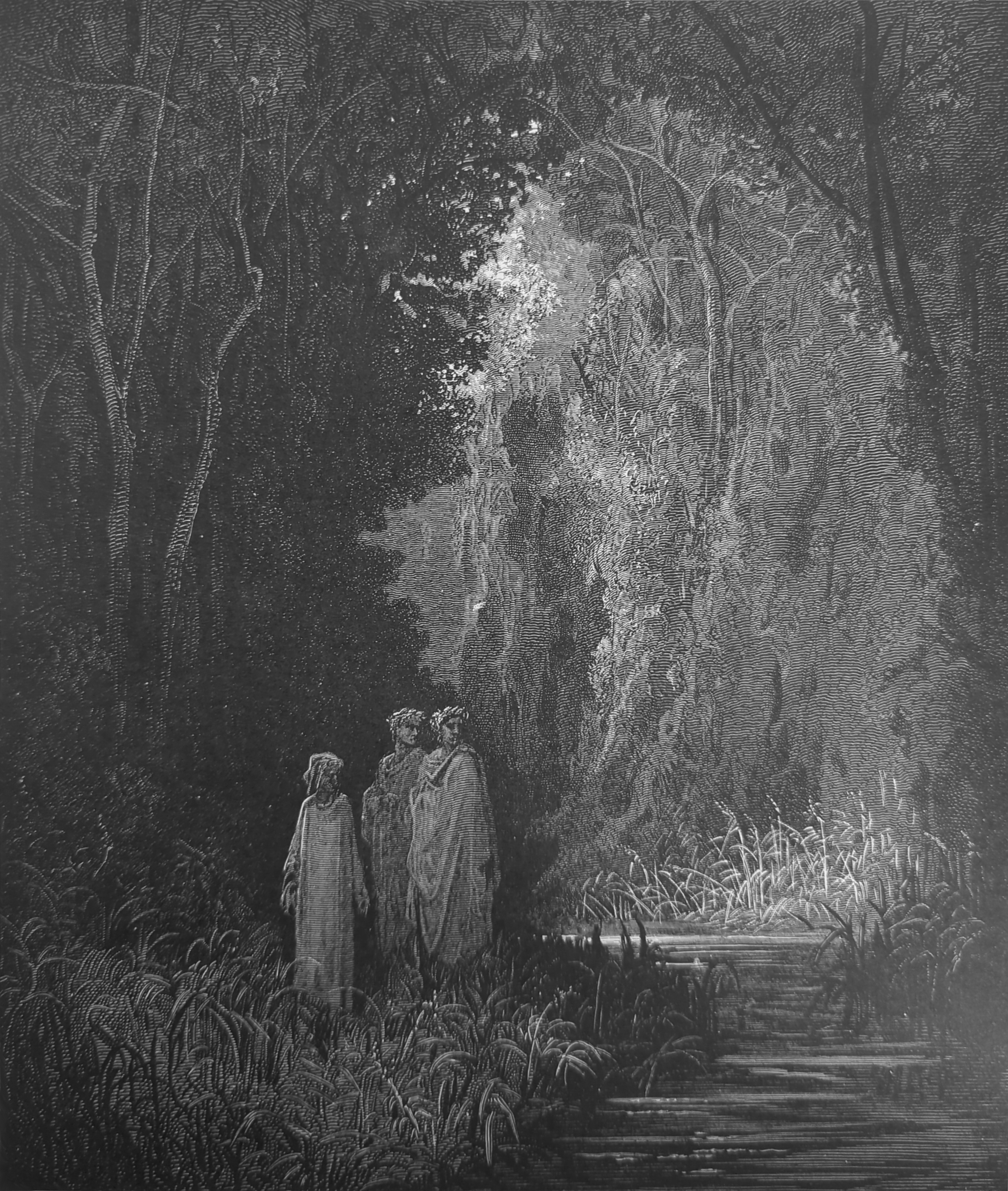
Already my slow steps had carried me / Into the ancient wood so far, that I/ Could not perceive where I had entered it. Purg. XXVIII, lines 22-24
Footnotes
1. As he moves through this wondrous place, Dante makes a point of referring to his face being swept by the gentle breeze. Recall how, after their arrival on the shore below, Cato had Virgil wash the grime of Hell off of Dante’s face. Later, at the Gate of Purgatory, his face was disfigured with the seven Ps, which have all been removed. With his new face he faces east, the direction of the rising sun, and symbolic of the Resurrection and Second Coming of Christ. He also sees how the constant breeze coming from that direction bends the branches and leaves on the trees to the west, the shaded side of the Mountain at this moment.
All of this reminds Dante of the pineta, the great pine forest around the Ravenna of his day in which he enjoyed walking. Nowadays, it has virtually disappeared. What still remains are the occasional hot and gritty winds of the Sirocco that blow up across t he Mediterranean from northern Africa.
2. In Greek mythology, Aeolus refers to three characters. These three are often difficult to tell apart. Diodorus Siculus made an attempt to define each of these three.
The first Aeolus was a son of Hellen and the eponymous founder of the Aeolian race.
The second Aeolus was a son of Poseidon, who led a colony to islands in the Tyrrhenian Sea.
The third Aeolus was a son of Hippotes who is mentioned in the Odyssey and the Aeneid as the ruler of the winds
3. This young woman is one of the most enigmatic characters in the entire Comedy. She will not be named until Canto 33:119, and though many have tried, no one, to this day, has been able to determine who she was. Her function seems fairly clear, and that Dante doesn’t give us any further historical information about her is a good indication that we need to pay more attention to her symbolic significance and to what she says than to who she was. Thus, nothing is spoiled by identifying her now. Her name is Matelda. Robert Hollander writes here: “Someone (it may have been Charles Singleton) once made the remark that if we did not know Matelda’s name we would know much more readily who she is.”
As a symbol of innocence, appropriate for this place, she is at home in this edenic setting, wandering gently, singing to herself and picking flowers. In this, she can be compared with Leah in Dante’s recent dream, representing the active life of the soul. In another sense, she is a new Eve, just as Dante is a kind of new Adam. And her unexpected appearance adds to the miraculous nature of this Earthly Paradise.
4. Dante’s words to Matelda are both gracious and familiar, and the tone is unmistakably poetic. One might suggest from this that he already knows who she is. Just as the light of the sun (God) shone on Dante’s face a while ago, so Matelda’s face is resplendent with the truth of Love. Yet the purpose of this lovely greeting is purely practical: Dante would like her to come closer so that he can understand the words to her song. To this end, he offers a compliment, comparing her to mythical maiden Proserpine.
The story of Proserpine (told by Virgil, Ovid, and others) fits well into Dante’s theme here. The Earthly Paradise is always in full bloom, a perpetual springtime, as it were. And so the beauty of the landscape and the presence of Matelda among the flowers leads him to see her as a kind of Proserpine who, in mythology, was snatched down into the Underworld by Hades as she gathered flowers (like Matelda). At the pleading of her mother, Ceres, her father, Jupiter, sent Mercury to Hades demanding that Proserpine be returned. But because the maiden had eaten from the food of the dead, she could not return to the world of the living. A bargain was struck, however, and she was allowed to return, but only for half of the year. While she was in the upper world, seeds grew, crops flourished, and harvests were abundant. When she returned to the Underworld everything died. And thus we have the seasons.
By using the myth of Proserpine, Dante has in mind the myth of the Fall, and he sees in Matelda both a new Eve and the return of the “eternal season of spring” to the Earthly Paradise that had been lost by the original Adam and Eve. This will become even clearer as he continues to narrate his experience here.
5. The image of the dance and the delicate movement of Matelda toward Dante project both her complete self-confidence and the soft calmness of this place, highlighted by the tender modesty of her eyes. All of this gives her an aura of perfect innocence. Within this aura Dante understands the meaning of her song, perhaps at the moment their eyes meet. Interestingly, he does not share this meaning with us. We would expect all of this in a love poem, and this is exactly what Dante is doing with his Poem. It’s a love story told on the grandest scale possible, embracing both time and eternity. For a moment, the meeting of their eyes takes on epic proportions as the Poet imagines the loving eyes of Venus (Matelda) embracing forever the face of Adonis (Dante). The amorous overtones are clear here, and Dante has fallen in love. But while the image of Venus and Adonis may represent a profane love, Dante has seen in Matelda’s innocent face the truth of Love itself which raises this moment to the level of the sacred.
6. As the mingling of myth with reality continues, Dante compares the narrow stream separating him from Matelda with the Hellespont, the narrow strait whose fearsome currents separate Asia from Europe, now called the Dardanelles. The “impossibility” of this comparison highlights the fact that while the distance across the stream is hardly worth noting, Dante will dare not cross it as did the clever Persian king Xerxes cross the Hellespont in 485 BC.
Adding to the sense of impossibility is his reference to the myth of Leander and Hero found in Ovid’s Heroides: 15-19. In some ways it echoes the story of Pyramus and Thisbe in the previous canto. Leander, living in Abydos on the Asian side of the Hellespont, and Hero, a priestess of Venus, living on the European side, fell in love though their social positions were sharply different, not to mention their parents’ opposition. Their cities were at the narrowest point of the dangerous strait, only a mile across. At night Leander would often swim across to Hero, guided by a light from her tower. One night, however, the light blew out. Losing his way, Leander was drowned. The next day, finding his body along the shore, Hero threw herself into the sea and drowned.
In the end, and bringing the epic references to a close, Dante hates the little stream become the Hellespont because, unlike the Red Sea for Moses, it will not part and allow him to cross.
7. That Matelda is “filled with happiness” has bothered some commentators because this is the location of The Fall. However, we mustn’t forget that this is a place of almost heavenly beauty and a true foretaste of Paradise. For the purposes of the Poem, we have to believe that Dante and his two companions are the first visitors to this place since Adam and Eve were evicted by God. This is a cause for joy. More importantly, what happened here long before led ultimately to the Incarnation—God become human in the person of Jesus in order to lead us back to even more than what Eden has to offer. To quote a line from the great Easter Vigil hymn, the Exultet: “O happy fault that earned so great, so glorious a Redeemer!” In addition, Matelda references Psalm 91 with its words from verse 5, Delectasti me: “You have delighted me, O Lord, in your work; and in the work of your hands I will rejoice.” Note that she doesn’t actually sing this Psalm. Rather, she merely refers to it. As it happens, this Psalm is one of the standard monastic hymns of praise to the Creator sung at sunrise and befitting this early morning encounter here in Eden.
8. Matelda begins to answer Dante’s questions with a brief theological reflection on Genesis 3 as a way to clear his mind and make it receptive to her explanations. As a reflection of His own goodness, God created us as an image of His own perfection. To complement His perfection, God created the Earthly Paradise as the perfection of Nature and gave it to Adam and Eve as a pledge of eternal happiness in Paradise. There is no (physical, meteorological) change here because there is no change in God. It reflects the eternal peace of Paradise. Adam and Eve, tricked by the serpent, presumed to eat from the perfect fruit of the Garden. But in doing so, they radically disturbed the equilibrium of the Earthly Paradise. By their (Original) sin they lost their innocence and were driven out by God. And, as we have seen in this Canticle, the purpose of Purgatory is to purge all traces of that sin and restore us to our original state of perfection.
9. The wind Matelda is explaining actually has a significant purpose. She tells Dante that every growing thing in the Earthly Paradise has a “fruitful power”–namely, seeds. The gently blowing wind picks up seeds from all the growing things here and, as it move s, it scatters them all over the globe. They bloom and grow in accord with the receptivity of the particular ground onto which they fall. This was a commonly accepted notion among scholars in Dante’s time. Not only this, every species of things here are originals of their kind as God had created them. And there is even fruit that grows only here (for example, the fruit on the Tree of Life and the Tree of the Knowledge of Good and Evil). While not every area on earth is suitable for the growing of living thing s, it is quite the opposite here in the Earthly Paradise.
10. Matelda now answers Dante’s question about the stream of water that separates them. (Recall that in Genesis 2:10 there are four rivers in Eden: the Pishon, the Gihon, the Tigris and the Euphrates.) Consistent with the fact that there is no “weather”—in this case, rain—that falls above the Gate of Purgatory, she tells Dante that the source of the water here is a spring, an eternal fountain that both flows continually and is continually refilled, as it were. This spring is controlled by God.
We also learn for the first time that there are actually two streams. While we are not told so directly, we are to assume that both flow from the same eternal fountain just referred to. Matelda tells Dante that the stream that separates them is called Lethe . Recall that Virgil mentioned this stream in Canto 14 of the Inferno when Dante thought it was one of the four rivers of Hell. Virgil told him he would see this river in Purgatory. In classical literature (e.g., Virgil Ovid, Statius, etc.), Lethe is the river of oblivion and forgetfulness. Matelda tells Dante that this stream has the power to remove all memory of sin.
The second stream, Eunoë, is a creation of Dante’s. It’s purpose is to restore the memory of the good deeds one has done. However, one must drink first from the Lethe. Note how drinking from each of these streams in succession will complete the process of a soul’s preparation for entrance into Paradise. Lethe and Eunoë, by the way, are Greek words: the former means “oblivion” and the latter means “well-minded.”
11. In what may be a nod to Dante’s two companions, Matelda suggests that the ancient poets who wrote of the Golden Age may have had the Earthly Paradise in mind because this is where humans were created and nourished in all innocence. As I noted earlier, Ovid in his Metamorphoses (I:107ff) wrote of the Golden Age: “At that time, Spring was everlasting, and gentle breezes with warm breath played among the flowers that sprang from the fecund ground unplanted. Then the earth brought forth her stores of grain, and the unplowed fields whitened with heavy ears of corn. Sometimes rivers of milk flowed, sometimes streams of nectar, and golden honey trickled from the great oak.” Unless its subtlety be lost on us, we should recall that just as the Earthly Paradise sits at op the Mountain of Purgatory, the Muses who inspired the classical poets resided atop another mountain sacred to Apollo: Parnassus.
By her mention of the Golden Age Matelda subtly joins scripture and classical literature. Her point is that from this place all things were touched by the sacred, the eternal. Though we lost access to the Earthly Paradise, its memory still resides deeply within us and all created things. Dorothy Sayers offers this reflection in her commentary here: “This memory belongs to Man’s nature; it is not the gift of revelation, but common to heathen and Christian alike. It follows that when we today contemptuously cal l such dreams ‘nostalgic,’ which means ‘homesick,’ we are unwittingly calling them by their right name, for they quite literally arise from Man’s longing for his true and original home.” At this point in his Comedy, Dante has brought us home, though only temporarily, for Paradise awaits him and all of us.
Top of page