Dante's Divine Comedy: Purgatorio
Canto XVII
Dante emerges from the smoke cloud as the sun is setting and experiences three visions which will serve as the Bridle for his Wrath. The Angel of Meekness utters the benediction, Beati Pacifici, and erases the third P before indicating the stairway to the Fourth Cornice. The two poets rest for the night and Virgil passes the time by arguing that Love lies at the root of every action, whether good or bad. He shows Dante that all seven capital sins stem from deviations of Love, including the excessive love of things that are not God.
Remember, Reader, if e'er in the Alps
A mist o'ertook thee, through which thou couldst see
Not otherwise than through its membrane mole,[1]
How, when the vapors humid and condensed
Begin to dissipate themselves, the sphere
Of the sun feebly enters in among them,
And thy imagination will be swift
In coming to perceive how I re-saw
The sun at first, that was already setting.
Thus, to the faithful footsteps of my Master
Mating mine own, I issued from that cloud
To rays already dead on the low shores.
O thou, Imagination, that dost steal us
So from without sometimes, that man perceives not,
Although around may sound a thousand trumpets,
Who moveth thee, if sense impel thee not?
Moves thee a light, which in the heaven takes form,
By self, or by a will that downward guides it.
Of her impiety, who changed her form
Into the bird that most delights in singing,
In my imagining appeared the trace;[2]
And hereupon my mind was so withdrawn
Within itself, that from without there came
Nothing that then might be received by it.
Then reigned within my lofty fantasy
One crucified, disdainful and ferocious
In countenance, and even thus was dying.
Around him were the great Ahasuerus,
Esther his wife, and the just Mordecai,
Who was in word and action so entire.[3]
And even as this image burst asunder
Of its own self, in fashion of a bubble
In which the water it was made of fails,
There rose up in my vision a young maiden
Bitterly weeping, and she said: "O queen,
Why hast thou wished in anger to be naught?
Thou'st slain thyself, Lavinia not to lose;
Now hast thou lost me; I am she who mourns,
Mother, at thine ere at another's ruin."[4]
As sleep is broken, when upon a sudden
New light strikes in upon the eyelids closed,
And broken quivers ere it dieth wholly,
So this imagining of mine fell down
As soon as the effulgence smote my face,
Greater by far than what is in our wont.
I turned me round to see where I might be,
When said a voice, "Here is the passage up
Which from all other purposes removed me,
And made my wish so full of eagerness
To look and see who was it that was speaking.
It never rests till meeting face to face
But as before the sun, which quells the sight,
And in its own excess its figure veils
Even so my power was insufficient here.
"This is a spirit divine, who in the way
Of going up directs us without asking.
And who with his own light himself conceals.
He does with us as man doth with himself,
For he who sees the need, and waits the asking.
Malignly leans already tow'rds denial.
Accord we now our feet to such inviting,
Let us make haste to mount ere it grow dark;
For then we could not till the day return."
Thus my Conductor said; and I and he
Together turned our footsteps to a stairway;
And I, as soon as the first step I reached,
Near me perceived a motion as of wings,
And fanning in the face, and saying, " 'Beati
Pacifici,' who are without ill anger."[5]
Already over us were so uplifted
The latest sunbeams, which the night pursues,
That upon many sides the stars appeared.
"O manhood mine, why dost thou vanish so?"
I said within myself; for I perceived
The vigor of my legs was put in truce.
We at the point were where no more ascends
The stairway upward, and were motionless,
Even as a ship, which at the shore arrives;[6]
And I gave heed a little, if I might hear
Aught whatsoever in the circle new;
Then to my Master turned me round and said:
"Say, my sweet Father, what delinquency
Is purged here in the circle where we are?
Although our feet may pause, pause not thy speech."
And he to me: "The love of good, remiss
In what it should have done, is here restored;
Here plied again the ill-belated oar;[7]
But still more openly to understand,
Turn unto me thy mind, and thou shalt gather
Some profitable fruit from our delay.
Neither Creator nor a creature ever,
Son," he began, "was destitute of love
Natural or spiritual; and thou knowest it.[8]
The natural was ever without error;
But err the other may by evil object,
Or by too much, or by too little vigor.
While in the first it well directed is,
And in the second moderates itself,
It cannot be the cause of sinful pleasure;
But when to ill it turns, and, with more care
Or lesser than it ought, runs after good,
'Gainst the Creator works his own creation.
Hence thou mayst comprehend that love must be
The seed within yourselves of every virtue,
And every act that merits punishment.
Now inasmuch as never from the welfare
Of its own subject can love turn its sight,
From their own hatred all things are secure;
And since we cannot think of any being
Standing alone, nor from the First divided,
Of hating Him is all desire cut off.
Hence if, discriminating, I judge well,
The evil that one loves is of one's neighbor,
And this is born in three modes in your clay.
There are, who, by abasement of their neighbor,
Hope to excel, and therefore only long
That from his greatness he may be cast down;
There are, who power, grace, honor, and renown
Fear they may lose because another rises,
Thence are so sad that the reverse they love;
And there are those whom injury seems to chafe,
So that it makes them greedy for revenge,
And such must needs shape out another's harm.
This threefold love is wept for down below;
Now of the other will I have thee hear,
That runneth after good with measure faulty.[9]
Each one confusedly a good conceives
Wherein the mind may rest, and longeth for it;
Therefore to overtake it each one strives.
If languid love to look on this attract you,
Or in attaining unto it, this cornice,
After just penitence, torments you for it.
There's other good that does not make man happy;
'Tis not felicity, 'tis not the good
Essence, of every good the fruit and root.
The love that yields itself too much to this
Above us is lamented in three circles;
But how tripartite it may be described,
I say not, that thou seek it for thyself."
Illustrations of Purgatorio
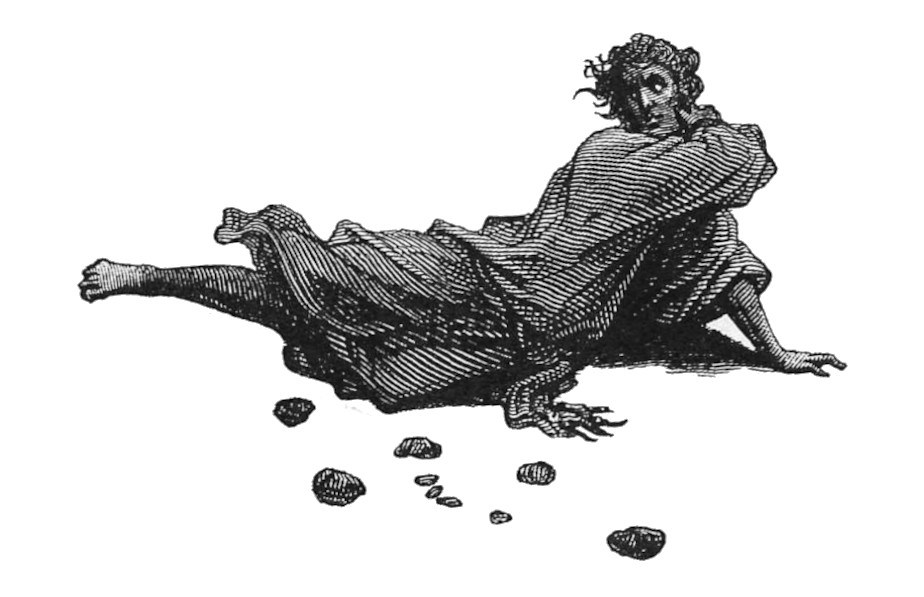
Virgil
Footnotes
1. This canto is exactly in the middle of the Purgatorio, and thus in the middle of the entire Poem. Dante begins with a common experience that readers can relate to, emerging from a dense fog into the sunlight. In his time, it was believed by many that moles’ eyes were completely sealed, while others correctly (Dante included) believed they were covered by an opaque membrane through which they could see a kind of foggy light such as he describes here. Of course, one can also read these lines symbolically. The s in of wrath virtually blinds a person as did the smoke in the previous canto. The sunlight (God) brings one back from sin to spiritual clear-sightedness. In a sense, Dante is inviting the reader to join him in this. At the same time, he is walking unaided, and it’s fascinating to see how, emerging from the blindness caused by the smoke (remember that he had to hang on to Virgil in the previous canto), he experiences a kind of “dawn” as the sun gradually emerges, though it’s actually sunset on his second day ( Easter Monday) on the Mountain. He and Virgil are actually high enough up the Mountain to notice that it’s already getting dark down along the shore.
2. This first scene comes from Ovid’s Metamorphoses, and was noted earlier in Canto 9, a bit more sympathetically. Procne and Philomela were the daughters of Pandion, the king of Athens. Procne was married to Tereus, the king of Thrace. After several years, Procne wanted to see her sister, so Tereus journeyed to Athens to bring her to Thrace. However, he was smitten with her beauty, and on the way, he raped her and cut out her tongue so she could never tell what happened to her. He then hid her and reported to Procne that her sister was dead. Philomela, meanwhile, wove a tapestry depicting the heinous crime and had an old woman deliver it to her sister. When Procne saw the tapestry, she asked the woman to take her to Philomela so that she could rescue her. Returning home, and in revenge against her husband, Procne killed her son, Itys, by stabbing him in the heart and Philomela slit his throat. They cooked him, and served him to, Tereus. This infanticide and cannibalism is “the outrage” he speaks of and the focus of the wrath for which Dante accuses her. When the meal was over, Philomela appeared with the head of Itys and threw it on the table at Tereus. Realizing what they had done to him, he chased after them with an ax to kill them both. But as they ran, the women were turned into birds by the gods: Procne into a nightingale, and Philomela into a swallow. Later, apparently, Tereus was turned into a hawk. The savage horror of this vision of wrath engulfs Dante so completely that he cannot break away from it. Ovid’s detail is even more gruesome. In his commentary here, Robert Hollander notes that this is not simply a scene of intemperate anger, but a premeditated act. Wrath, he notes, will later in this canto be defined as “involving the hardened will in a desire for revenge.” What we have, in the Italian, is a vendetta.
3. This second ecstatic vision comes from chapters 3-7 of the Book of Esther in the Old Testament. In summary, King Ahasuerus of Persia named Haman as his prime minister. Haman, filled with pride, demanded that those beneath him in rank should bow down to him—including the good man Mordecai. When Mordecai refused, the enraged Haman took revenge by persuading Ahasuerus to decree that Mordecai and all Jews living in his kingdom be executed. Queen Esther, Mordecai’s cousin and ward, was also a Jew, but had hidden this from her husband. In desperation for her people, she revealed her identity to her husband, but also the evil plot of his prime minister, Haman. The king was outraged and ordered that Haman be hanged on the same gibbet he had constructed for the execution of Mordecai. Dante’s noting that Haman was crucified stems from a mis-translation of the word for gibbet in the Latin Vulgate Bible. Some translations say that he was impaled on a pole.
4. The image of the bubble—one bursting and another replacing it—is an image of the working of the imagination. An image comes to us and soon another takes its place. In this case, we have the third ecstatic vision—this time a scene from Virgil’s Aeneid. Lavinia, daughter of King Latinus and his wife, Amata, was courted by Turnus, leader of the Rutuli. But after an omen, Latinus promised her in marriage to Aeneas, Turnus’ mortal enemy. Amata opposed the marriage to Aeneas and wanted her daughter to marry Turnus (whom Aeneas eventually kills). Later, hearing a false report that Turnus had already been killed, Amata, in a despairing rage, hanged herself. Acts of rage often have unexpected consequences as we read when Lavinia mourns the loss of her mother. Amata killed herself so as not to lose her daughter. Instead, she herself is both dead and has lost her daughter.
5. Having followed the angel’s direction, Dante and Virgil begin to climb the stairs to the next terrace. As soon as Dante’s foot touches the steps, the Angel of Mercy’s wing brushes the third P from his forehead. As he does so, the angel quotes a part of the seventh Beatitude from the Gospel of Matthew (5:9): “Blessed are the peacemakers,” with his own context-appropriate ending (Dante’s gloss on the text): “…who are free from the sin of wrath.” Robert Hollander offers an important qualification here: the angel quotes the Beatitude, “yet does so in such a way as to indicate tacitly the distinction between ‘good’ anger (righteous indignation) and the ‘bad’ form of wrath that is fueled by desire for personal revenge.” The Gospel (John 2:13ff) offers us an example o f Jesus’ righteous indignation when he drove the money-changers from the Temple.
Beati Pacifici, "Blessed are the Peacemakers": https://www.youtube.com/watch?v=pJopwCdFsLc
6. John Ciardi remarks here: “To read Dante is to educate the eye.” Though the sun has not set completely, the two travelers are so high up the mountain that they can already see stars as the darkness races up behind them. Then, we are immediately reminded aga in of the “rule” against climbing upward in the dark as Dante feels himself becoming weaker. As the two reach the top of the stairs, the darkness catches up with them and they find themselves powerless to move. Welcome to the Terrace of Sloth! The spiritual significance of their situation should not be lost on us: in the light of the Sun (God’s Light) the soul can make progress in virtue and toward salvation. But the darkness (a symbol of sin or acedia) works against our progress because we cannot see the rig ht way to proceed.
The image of the ship is one used here and there throughout the Commedia. It represents the Poem itself that carries us on the journey (voyage) to salvation. Here, he’s not so much suggesting that the ship arrived smoothly in port, but rather more negatively—that it suddenly ran aground, that it was forcibly stopped. The soul, on its journey (voyage) to God, hopes for smooth sailing. But it can also find itself caught in a storm (an image of sin) or worse, as in the case of Ulysses in Canto 26 of the Infer no—utterly destroyed! On the other hand, Dante also wants us to literally understand here that they simply arrived on the fourth Terrace at nightfall and could not continue without the light of the sun.
7. Similar to Canto 11 in the Inferno, where Virgil described the structure of Hell for Dante, he will now give the Poet a (somewhat philosophical) description of how Purgatory is structured in the context of Love, and how all the sins punished here, in one form or another, stem from the wrong use of love. Recalling that this canto stands at the exact center of both the Purgatorio and the entire Commedia, the significance of the following lesson on love at the very center of the Poem should not be lost upon the reader.
8. So, Virgil reminds Dante that all of creation stems from, and is an outpouring of, God’s love which fills all created things (humans, animals, plants, and inanimate things). But, there are two kinds of love: natural love and rational love. Natural love is the simplest to understand: because all created things stem from the love of God, and because God doesn’t create anything bad or evil, the reciprocal love of God is instinctive in them. Rational love, however, sometimes referred to as mental or elective love , pertains only to humans and involves the will which, because it is free, may choose the good or the bad. And here is where the various kinds of sins then come into the picture. This rational love goes astray in three ways: first, when we choose the wrong thing thinking it is good (leading to sins of Pride, Envy, and Wrath); second, by choosing the good, but pursuing it without much vigor or energy (leading to the sin of Sloth); and third, by choosing the good, but with too much drive and energy (leading to the sins of Avarice, Gluttony, and Lust).
9. Virgil summarizes briefly: misdirected love is aimed in various ways at our neighbor, not at God. His three examples of misdirected love point to the first three terraces of the Mountain: Pride, then Envy, and then Wrath. Here, Mark Musa makes an interesting point about Pride and Envy: “In both cases it is the wish for misfortune against one’s neighbors that is the sin rather than active deed against them, emphasizing once again that sins purged in this realm are those of omission or habits of mind that cause the soul to lose its way.” Later, he will claim that the same is case for Wrath, where the sinner “acts out in his mind a vendetta against those who injure him … the proud person ‘sees’ and ‘longs’; the envious person ‘fears’ and ‘wishes’; the angry man ‘flares up’ and ‘thinks’.”
Top of page