Dante's Divine Comedy: Purgatorio
Canto XXVI
In the Seventh Cornice, the fact that Dante is alive excites a great deal of interest. He starts talking to one of the souls but they are interrupted. Two groups, the naturally and unnaturally Lustful, exchange embraces and then each group calls out "Sodom and Gomorrah' while the 'hermaphrodites' refer to the bestial example of Pasiphae. When the soul identifies himself as Guido Guinicelli, Dante praises him as the father of the dolce stil nuovo. He in turn yields to Arnaut Daniel, who speaks in his native Provençal.
While on the brink thus one before the other
We went upon our way, oft the good Master
Said: "Take thou heed! suffice it that I warn thee."
On the right shoulder smote me now the sun,
That, raying out, already the whole west
Changed from its azure aspect into white.
And with my shadow did I make the flame
Appear more red; and even to such a sign
Shades saw I many, as they went, give heed.
This was the cause that gave them a beginning
To speak of me; and to themselves began they
To say: "That seems not a factitious body!"
Then towards me, as far as they could come,
Came certain of them, always with regard
Not to step forth where they would not be burned.
"O thou who goest, not from being slower
But reverent perhaps, behind the others,
Answer me, who in thirst and fire am burning.
Nor to me only is thine answer needful;
For all of these have greater thirst for it
Than for cold water Ethiop or Indian.
Tell us how is it that thou makest thyself
A wall unto the sun, as if thou hadst not
Entered as yet into the net of death."
Thus one of them addressed me, and I straight
Should have revealed myself, were I not bent
On other novelty that then appeared.
For through the middle of the burning road
There came a people face to face with these,
Which held me in suspense with gazing at them.
There see I hastening upon either side
Each of the shades, and kissing one another
Without a pause, content with brief salute.
Thus in the middle of their brown battalions
Muzzle to muzzle one ant meets another
Perchance to spy their journey or their fortune.[1]
No sooner is the friendly greeting ended,
Or ever the first footstep passes onward,
Each one endeavors to outcry the other;
The new-come people: "Sodom and Gomorrah!"
The rest: "Into the cow Pasiphae enters,
So that the bull unto her lust may run!"[2]
Then as the cranes, that to Riphaean mountains
Might fly in part, and part towards the sands,
These of the frost, those of the sun avoidant,[3]
One folk is going, and the other coming,
And weeping they return to their first songs,
And to the cry that most befitteth them;
And close to me approached, even as before,
The very same who had entreated me,
Attent to listen in their countenance.
I, who their inclination twice had seen,
Began: "O souls secure in the possession,
Whene'er it may be, of a state of peace,
Neither unripe nor ripened have remained
My members upon Earth, but here are with me
With their own blood and their articulations.
I go up here to be no longer blind;
A Lady is above, who wins this grace,
Whereby the mortal through your world I bring.[4]
But as your greatest longing satisfied
May soon become, so that the Heaven may house you
Which full of love is, and most amply spreads,
Tell me, that I again in books may write it,
Who are you, and what is that multitude
Which goes upon its way behind your backs?"
Not otherwise with wonder is bewildered
The mountaineer, and staring round is dumb,
When rough and rustic to the town he goes,
Than every shade became in its appearance;
But when they of their stupor were disburdened,
Which in high hearts is quickly quieted,
"Blessed be thou, who of our border-lands,"
He recommenced who first had questioned us,
"Experience freightest for a better life.
The folk that comes not with us have offended
In that for which once Caesar, triumphing,
Heard himself called in contumely, 'Queen.'[5]
Therefore they separate, exclaiming, 'Sodom!'
Themselves reproving, even as thou hast heard,
And add unto their burning by their shame.
Our own transgression was hermaphrodite;
But because we observed not human law,
Following like unto beasts our appetite,
In our opprobrium by us is read,
When we part company, the name of her
Who bestialized herself in bestial wood.[6]
Now knowest thou our acts, and what our crime was;
Wouldst thou perchance by name know who we are,
There is not time to tell, nor could I do it.
Thy wish to know me shall in sooth be granted;
I'm Guido Guinicelli, and now purge me,
Having repented ere the hour extreme."[7]
The same that in the sadness of Lycurgus
Two sons became, their mother re-beholding,
Such I became, but rise not to such height,[8]
The moment I heard name himself the father
Of me and of my betters, who had ever
Practiced the sweet and gracious rhymes of love;
And without speech and hearing thoughtfully
For a long time I went, beholding him,
Nor for the fire did I approach him nearer.
When I was fed with looking, utterly
Myself I offered ready for his service,
With affirmation that compels belief.
And he to me: "Thou leavest footprints such
In me, from what I hear, and so distinct,
Lethe cannot efface them, nor make dim.[9]
But if thy words just now the truth have sworn,
Tell me what is the cause why thou displayest
In word and look that dear thou holdest me?"
And I to him: "Those dulcet lays of yours
Which, long as shall endure our modern fashion,
Shall make for ever dear their very ink!"[10]
"O brother," said he, "he whom I point out,"
And here he pointed at a spirit in front,
"Was of the mother tongue a better smith.
Verses of love and proses of romance,
He mastered all; and let the idiots talk
Who think the Lemosin surpasses him.[11]
To clamor more than truth they turn their faces,
And in this way establish their opinion,
Ere art or reason has by them been heard.
Thus many ancients with Guittone did,
From cry to cry still giving him applause,
Until the truth has conquered with most persons.[12]
Now, if thou hast such ample privilege
'Tis granted thee to go unto the cloister
Wherein is Christ the abbot of the college,
To him repeat for me a Paternoster,
So far as needful to us of this world,
Where power of sinning is no longer ours."
Then, to give place perchance to one behind,
Whom he had near, he vanished in the fire
As fish in water going to the bottom.
I moved a little tow'rds him pointed out,
And said that to his name my own desire
An honorable place was making ready.
He of his own free will began to say:
'Tan m' abellis vostre cortes demani>,
Que jeu nom' puesc ni vueill a vos cobrirei>;
Jeu sui Arnaut, que plor e vai chantani>;
Consiros vei la passada folori>,
E vei jauzen lo jorn qu' esper denan.i>
Ara vus prec per aquella valori>,
Que vus condus al som de la scalinai>,
Sovenga vus a temprar ma dolor.'[13]
Then hid him in the fire that purifies them.[14]
Illustrations of Purgatorio
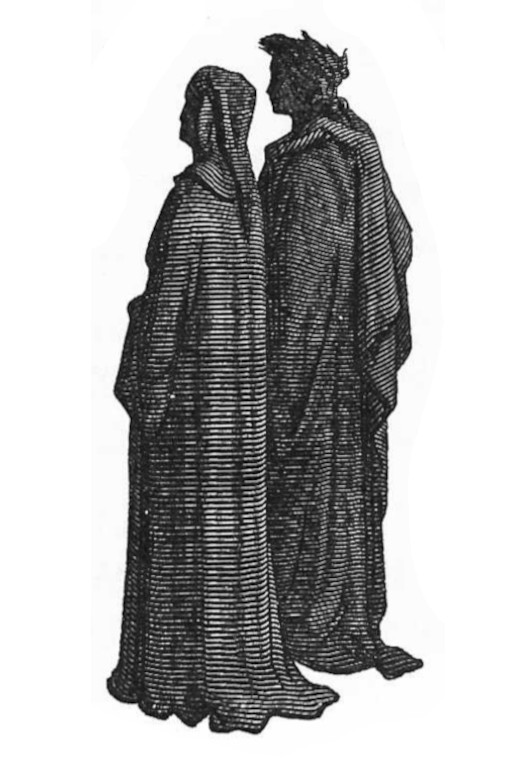
Dante and Virgil
Footnotes
1. Bear in mind that we have been walking to the right along the terraces–counterclockwise. The fiery sinners have been walking in the same direction. But now another group arrives going in the opposite direction, to the left. These are the only souls in Purgatory to do so. The implication should be obvious: they have sinned against nature. As they meet, they all embrace and kiss each other. Obviously, this has to do with reinforcing virtuous love as much as the flames cleanse the sinners from its opposite, which probably also involved hugging and kissing. In his Letter to the Romans, St. Paul urges his community to “Greet one another with a holy kiss.” While there is a reference to ants in the Aeneid (IV:402ff), where Virgil compares Aeneas and his men loading their ships to ants, the scene of crowds meeting and mingling would have been common in Dante’s time as it still is in our own. At the same time, ants are noted for their diligence, a virtue that the lustful sinners observe carefully as they carry out their purging.
2. But there’s more: we have only seen the first part of this “Hail, and well met!” ritual. After the hug and kiss, the sinners shout at each other making what they say much more audible and adding to their shame. Those who arrived from the left shout first: “ Sodom and Gomorrah!” reinforcing the nature of their sins. Those moving to the right then shout: “Pasiphaë enters the false cow so that the bull might satisfy her lust!” reinforcing the nature of their sins. The reader’s curiosity should be piqued b y this strange and lurid ritual, but we will withhold further explanation of these shouts until the sinner who has been talking with Dante has a chance to explain them to him.
3. Obviously, cranes (or other birds, for that matter) do not migrate to the north and the south in the same season. However, Dante may be making a connection here between these “birds” (the lustful souls) going off in different directions and the image of the lustful souls in Canto 5 of the Inferno, who were like birds being buffeted here and there by the winds of passion. Mark Musa offers a fascinating mythological insight here: “Dante probably uses the analogy to suggest more than a moral theme. In mythology, cranes are an ancient symbol for the origin of the alphabet. In flights to and from the Hyperborean Other World they were believed to carry the secrets of language, and their mating dance was said to trace the steps of the labyrinth.”Soon enough, the topic here will turn to poetry–-the highest form of language.
The mythical Riphean mountains in classical geography were said to be a range in the generic far north of Europe. After the souls meet and move on, they begin the ritual singing of the hymn Summae Deus Clementiae (see the previous canto).
4. Note that Dante doesn’t identify himself by name but more by his condition: he’s definitely alive (note his list: flesh, blood, and bones), he’s climbing the Mountain to be healed of his blindness at the behest of a blessed lady (this may be Beatrice or the Virgin Mary), and it’s quite miraculous that he’s here. Then he turns their question back at the fiery sinners and, to satisfy his (and our) curiosity, he definitely wants to know who the other group of sinners were. And in a clear reference to his Poe m, the Commedia, he tells them he will put their answers in his “book,” as though he’s taking notes and preparing his text. Recall that one of Dante’s purposes for including people’s names in his Poem is so that readers will remember them. And in the Purgatorio also, so that readers will be reminded to pray for them. Another loving gesture here on this terrace.
5. We surmised rightly, and as the soul speaking to Dante tells him, those who came from the left were guilty of unnatural sins, and their shout of “Sodom!” showed this to be the case. They are sodomites. The reference comes from Chapter 19 in the Book of Gene sis, where both the cities of Sodom and Gomorrah were destroyed because of their notorious sexual immorality. But the soul speaking to Dante adds an interesting piece of information. He tells the Poet: “They suffer here from the same sin that caused Caesar to be called ‘Queen’ as he passed along in triumph.” Most modern readers will find this to be an obscure reference. The Roman historian Suetonius (ca 69-ca 122 AD) wrote in his Life of the Caesars (49) that after his conquest of Bithynia (Turkey) Julius Caesar had sex with King Nicomedes. The problem with this is, on the one hand, that it might be true, and on the other hand, it might be hearsay or scurrilous nasty talk that soldiers might have shouted at their leader during one of his Roman triumphs. Soldiers apparently had permission to do this and were notorious for shouting vulgar epithets at their generals during triumphs. And Suetonius might have been reporting this. And he quotes this three-line ditty that soldiers were singing: “All the Gauls did Caesar vanquish, Nicomedes vanquished him. / Lo! Now Caesar rides in triumph, victor over all the Gauls, / Nicomedes does not triumph, who subdued the conqueror.”
6. Now, the speaker explains the shout made by his group of sinners. In contradistinction to the homosexuality of the sodomites, the sexual sins of this group are heterosexual. This is the only meaning of the word“hermaphroditic” here, and it’s an unusual choice of words–most likely because there wasn’t in medieval vocabulary a specific word for “heterosexual.” In Ovid’s Metamorphoses (IV:285-388), Hermaphroditus was, as his name suggests, the son of Hermes and Aphrodite. He was loved by the nymph Salamcis but h e did not return her advances. Once when he was swimming, she embraced him. Though he resisted, her wish to be merged with him was granted and the result was a creature that retained both sexual characteristics–half-man, half-woman.
7. Guido Guinicelli (1230-1276) was the most illustrious poet in Italy just prior to Dante, and direct forerunner of the “sweet new style” of which Dante became the not-to-be-exceeded master. Robert Hollander tells us: “His most famous poem is the canzone ‘Love always finds shelter in the noble heart.’ It sets out the doctrine, embraced by Dante … that true nobility is not determined by birth but by inner virtue.” Dante echoes this at various points in both the Purgatorio and the Paradiso. Guido was born and lived in Bologna, and like Dante he was exiled later in his life. As we will see, Dante held him in the highest esteem.
8. The source for Dante’s very condensed reference to King Lycurgus here is Statius’s Thebaid (V:499-730). The reader will recall how Dante and Virgil encountered the famous mythological argonaut, Jason, among the panders and seducers in Canto 18 of the Inferno. Jason seduced Hypsipyle, daughter of the king of Lemnos, and then abandoned her, leaving her pregnant with twin boys. Later, she was the nursemaid for the son of King Lycurgus of Nemea. One day, while caring for the boy out of doors, she left him for a moment to show some warriors (the Seven against Thebes) where to find a pool of water. In the meantime, the boy was bitten by a snake and died. Lycurgus was ready to kill Hypsipyle when her long-lost twin sons, now in the employ of Lycurgus, happened upon the scene and saved her.
9. Lethe, the river of oblivion and forgetfulness.
10. Dante is quite lavish with his praise here, and the image of the lasting ink highlights the power of poetry. Words take on the character of sacred relics. Without saying so directly, his Comedy itself is written with that ageless ink. The fact that the Comedy is a poetic journey through the afterlife, with great spiritual and theological underpinnings, and culminating in the eternal realm of Paradise, also shows us Dante pointing the mirror at himself, as it were.
11. Dante’s words of praise for Guido’s poetry lead Guido to deflect them onto an even greater poet than himself and whom he will allow to introduce himself shortly. Guido praises this poet as Dante praises Guido: this as-yet-unnamed poet is “better than all of them,” the love poets and the writers of verse.
Perhaps because Guido is a poet with such fame, Dante allows him to act the critic for a moment as he downplays “the poet from Limoges.” (Limoges is a city in central France about 100 miles from the coast, and about the same distance northeast of Bordeaux.) This is a reference to the famous Provençal poet Guiraut de Bornellh (1175-1220). During his lifetime he was known as “master of the Troubadours,” with a technically simpler style than many of his contemporaries. Dante praised him highly in both his D e vulgari eloquentia and his Convivio. And Guido’s remarks are really directed at Guiraut’s technique rather than at him personally. As one can see, Guido is concerned primarily about “the rules and principles of our art.”
12. The Guittone Guido refers to here was the poet Guittone d’Arezzo (1240-1294, see Canto 24). He was a member of the Jovial Friars mentioned in Canto 23 of the Inferno, lived most of his life in Florence, and was probably known by Dante. The harsh tone here is explained by Robert Hollander in his commentary:
“Dante, surely unfairly, is getting even, less perhaps with Guittone than with his admirers, who were many (and continue to exist today). It was not enough for him to have Bonagiunta (Purg. 24:56) include him, along with himself, among those who failed t o come up to Dante’s measure. Now Dante uses the great Guinizzelli (who had indeed come to dislike Guittone’s poetry in reality) to skewer Guittone a second time, and much more harshly. As early as his De vulgari eloquentia, Dante had been deprecating Guittone. One may sense a certain ‘anxiety of influence’ at work here, especially since Guittone did so many of the things that Dante himself took on as his own tasks: love lyrics, moral canzoni, and eventually religious poems.”
13. Translated from Italian to English:
So pleases me your courteous demand,
I cannot and I will not bide me from you.
I am Arnaut, who weep and singing go;
Contrite I see the folly of the past,
And joyous see the hoped-for day before me.
Therefore do I implore you, by that power
Which guides you to the summit of the stairs,
Be mindful to assuage my suffering!
14. As Guido fades into the flames, the soul of Arnaut Daniel (1150-1210) comes to the fore, already warmly welcomed in Dante’s heart. His poetry was, at the same time, elegant, intricate, and technically difficult. He is credited with inventing the sestina, a six-stanza form with six lines in each stanza, ending with a short three-line stanza.
In perhaps the most extraordinary linguistic moment in the Poem, Arnaut speaks with Dante entirely in his native Provençal language–the only place where this happens and a testimony to Dante’s high esteem for him. Not only that, keep in mind that Dante wrote the entire Comedy in the vernacular Italian–a first. His happy inclusion of Arnaut here in his own language is yet another way for Dante to show his great regard for the vernacular as a vehicle for high poetry. Is it too much to suggest that Dante spoke and understood the language of Provence? Arnaut’s actual words and a translation are included at the end of this commentary.
In spite of his greatness as a poet, Arnaut humbly admits his lustful past to Dante and, like so many others, begs our Poet to remember him when he reaches his goal. Already assured of salvation, notice how he doesn’t say a word about his own genius, his poetry, or the technical bravura his work was known for. It’s enough that Dante simply quote him in his own native tongue. At the same time, Dante had a great admiration for Arnaut and in his own way imitated and improved on his technical skill. This is the last time Dante will speak with a soul in Purgatory.
Top of page