Dante's Divine Comedy: Purgatorio
Canto XIV
Two blind souls detect Dante's presence with much excitement and ask the pilgrim his whereabouts. Hearing his accent, one of the Romagnol nobles, Guido del Duca of Brettinoro from the Onesti family of Ravenna, delivers an invective against the towns along the river Arno and accuses prominent local families of corruption. The other, Renier da Calboli, criticizes Romagna. As Dante and Virgil take their leave, they hear disembodied voices crying out examples that will serve as the Bridle of Envy: the stories of Cain who murdered his brother, Abel; and Aglaurus, the princess who was turned to stone because of envy.
"Who is this one that goes about our mountain,
Or ever Death has given him power of flight,
And opes his eyes and shuts them at his will?"
"I know not who, but know he's not alone;
Ask him thyself, for thou art nearer to him,
And gently, so that he may speak, accost him."
Thus did two spirits, leaning tow'rds each other,
Discourse about me there on the right hand;
Then held supine their faces to address me.
And said the one: "O soul, that, fastened still
Within the body, tow'rds the heaven art going,
For charity console us, and declare
Whence comest and who art thou; for thou mak'st us
As much to marvel at this grace of thine
As must a thing that never yet has been."
And I: "Through midst of Tuscany there wanders
A streamlet that is born in Falterona,
And not a hundred miles of course suffice it;[1]
From thereupon do I this body bring.
To tell you who I am were speech in vain,
Because my name as yet makes no great noise."
"If well thy meaning I can penetrate
With intellect of mine," then answered me
He who first spake, "thou speakest of the Arno."[2]
And said the other to him: "Why concealed
This one the appellation of that river,
Even as a man doth of things horrible?"[3]
And thus the shade that questioned was of this
Himself acquitted: "I know not; but truly
'Tis fit the name of such a valley perish;
For from its fountain-head (where is so pregnant
The Alpine mountain whence is cleft Peloro
That in few places it that mark surpasses)[4]
To where it yields itself in restoration
Of what the heaven doth of the sea dry up,
Whence have the rivers that which goes with them,
Virtue is like an enemy avoided
By all, as is a serpent, through misfortune
Of place, or through bad habit that impels them;
On which account have so transformed their nature
The dwellers in that miserable valley,
It seems that Circe had them in her pasture.[5]
'Mid ugly swine, of acorns worthier
Than other food for human use created,
It first directeth its impoverished way.
Curs findeth it thereafter, coming downward,
More snarling than their puissance demands,
And turns from them disdainfully its muzzle.[6]
It goes on falling, and the more it grows,
The more it finds the dogs becoming wolves,
This maledict and misadventurous ditch.[7]
Descended then through many a hollow gulf,
It finds the foxes so replete with fraud,
They fear no cunning that may master them.
Nor will I cease because another hears me;
And well 'twill be for him, if still he mind him
Of what a truthful spirit to me unravels.
Thy grandson I behold, who doth become
A hunter of those wolves upon the bank
Of the wild stream, and terrifies them all.[8]
He sells their flesh, it being yet alive;
Thereafter slaughters them like ancient beeves;
Many of life, himself of praise, deprives.
Blood-stained he issues from the dismal forest;
He leaves it such, a thousand years from now
In its primeval state 'tis not re-wooded."
As at the announcement of impending ills
The face of him who listens is disturbed,
From whate'er side the peril seize upon him;
So I beheld that other soul, which stood
Turned round to listen, grow disturbed and sad,
When it had gathered to itself the word.
The speech of one and aspect of the other
Had me desirous made to know their names,
And question mixed with prayers I made thereof,
Whereat the spirit which first spake to me
Began again: "Thou wishest I should bring me
To do for thee what thou'lt not do for me;
But since God willeth that in thee shine forth
Such grace of his, I'll not be chary with thee;
Know, then, that I Guido del Duca am.[9]
My blood was so with envy set on fire,
That if I had beheld a man make merry,
Thou wouldst have seen me sprinkled o'er with pallor.
From my own sowing such the straw I reap!
O human race! why dost thou set thy heart
Where interdict of partnership must be?
This is Renier; this is the boast and honor
Of the house of Calboli, where no one since
Has made himself the heir of his desert.[10]
And not alone his blood is made devoid,
Twixt Po and mount, and sea-shore and the Reno,
Of good required for truth and for diversion;[11]
For all within these boundaries is full
Of venomous roots, so that too tardily
By cultivation now would they diminish.
Where is good Lizio, and Arrigo Manardi,
Pier Traversaro, and Guido di Carpigna,
O Romagnuoli into bastards turned?[12]
When in Bologna will a Fabbro rise?
When in Faenza a Bernardin di Fosco,
The noble scion of ignoble seed?
Be not astonished, Tuscan, if I weep,
When I remember, with Guido da Prata,
Ugolin d' Azzo, who was living with us,[13]
Frederick Tignoso and his company,
The house of Traversara, and th' Anastagi,
And one race and the other is extinct;
The dames and cavaliers, the toils and ease
That filled our souls with love and courtesy,
There where the hearts have so malicious grown!
O Brettinoro! why dost thou not flee,
Seeing that all thy family is gone,
And many people, not to be corrupted?[14]
Bagnacaval does well in not begetting
And ill does Castrocaro, and Conio worse,
In taking trouble to beget such Counts.
Will do well the Pagani, when their Devil
Shall have departed; but not therefore pure
Will testimony of them e'er remain.[15]
O Ugolin de' Fantoli, secure
Thy name is, since no longer is awaited
One who, degenerating, can obscure it![16]
But go now, Tuscan, for it now delights me
To weep far better than it does to speak,
So much has our discourse my mind distressed."
We were aware that those beloved souls
Heard us depart; therefore, by keeping silent,
They made us of our pathway confident.
When we became alone by going onward,
Thunder, when it doth cleave the air, appeared
A voice, that counter to us came, exclaiming:
"Shall slay me whosoever findeth me!"
And fled as the reverberation dies
If suddenly the cloud asunder bursts.
As soon as hearing had a truce from this,
Behold another, with so great a crash,
That it resembled thunderings following fast:
"I am Aglaurus, who became a stone!"
And then, to press myself close to the Poet,
I backward, and not forward, took a step.[17]
Already on all sides the air was quiet;
And said he to me: "That was the hard curb
That ought to hold a man within his bounds;
But you take in the bait so that the hook
Of the old Adversary draws you to him,
And hence availeth little curb or call.
The heavens are calling you, and wheel around you,
Displaying to you their eternal beauties,
And still your eye is looking on the ground;
Whence He, who all discerns, chastises you."
Illustrations of Purgatorio
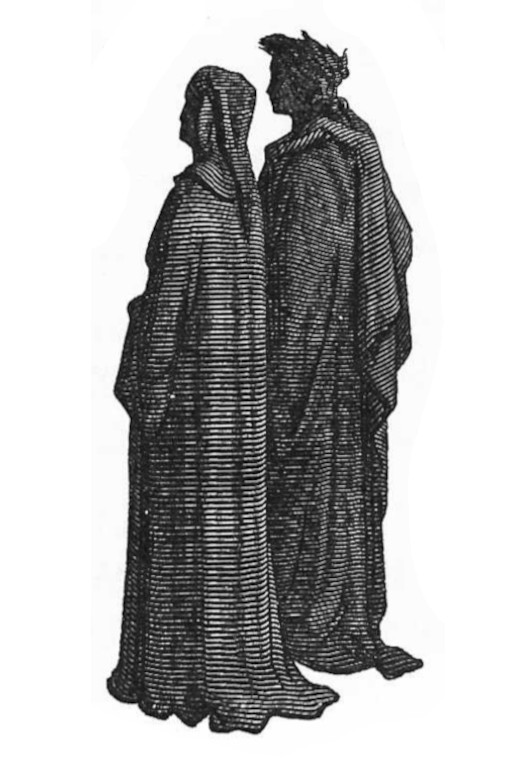
Dante and Virgil
Footnotes
1. The river, of course, is the Arno, which rises at Mt. Falterona, about 30 miles east northeast of Florence in the Casentino forest region of the Apennines. But with much winding along the way, the distance from its source to Pisa, where it empties into the sea, is about 150 miles–having passed near Arezzo and through Florence on its way.
2. This speaker is Guido del Duca (1170-1250), a Ghibelline nobleman from Bretinoro in the Romagna region of Italy. In 1218 he was part of a force that drove the Guelphs out of Ravenna. They later attacked Bretinoro and expelled him and other Ghibellines. Dante had answered the question about where he was from obliquely. However, Guido figures it out, saying in Italian: “‘Se ben lo ‘ntendimento tuo accarno con lo ‘ntelletto,’ allora mi rispuose quei che diceva pria, “tu parli d’Arno.” In other words, “If I ‘grasp’ (understand) the meaning of what you said … you’re speaking of the Arno.” The word he chooses for “grasp,” accarno, describes the action of one animal catching another and sinking its teeth into its flesh (carne). But Dante’s clever word choice shows t hat he knows the name of the river-–acc-arno.
3. This speaker is Rinier da Calboli (1225-1296), a Guelph leader from Forlì. Note how he is a Guelph and his companion, Guido, is a Ghibelline. There are no party affiliations after death. He served as podestà of many cities and was involved in several attack s and counter-attacks throughout his life–-at one point being spared from death by Guido da Montefeltro, whom we met in Canto 27 of the Inferno.
Continuing to speak together in hushed tones (lest Dante hear), Rinier still doesn’t seem to understand why mentioning the Arno is such a terrible thing.
4. Peloro, Italian, pelorus, name of Hannibal's pilot, meaning, a device used to take a bearing on a distant object.
5. In Greek mythology, Circe is an enchantress, sometimes considered a goddess or a nymph. Circe is the daughter of the sun god Helios and the Oceanid Perse. Circe was renowned for her vast knowledge of potions and herbs. Through the use of these and a magic w and or staff, she would transform her enemies, or those who offended her, into animals.
The best known of her legends is told in Homer's Odyssey when Odysseus visits her island of Aeaea on the way back from the Trojan War and she changes most of his crew into swine. He manages to persuade her to return them to human shape, lives with her for a year and has sons by her, including Latinus and Telegonus.
6. People talk of rivers as “snaking” along their course, and the Arno is no different. But notice how Dante changes the “snake” image into the reptile that people run away from. Those who live along the Arno are, according to Guido (Dante), so foul, corrupt, and cursed that they have been transformed into filthy pigs, just as Odysseus’ men were transformed into pigs by the sorceress Circe (see Homer’s Odyssey, Books X and XII, and Ovid’s Metamorphoses Book XIV).
7. Circe had the power to change people into various kinds of animals, and Dante follows the literature, calling the inhabitants of the Casentino (the region through which the first part of the Arno flows) pigs, those from Arezzo wild dogs, those from Florence wolves, and the Pisans foxes. The river itself becomes almost bestial or reptilian (see above).
8. Guido says that he sees Rinieri’s grandson hunting down wolves. This grandson was Fulcieri da Calboli, who became the chief magistrate (podestà) of Florence in 1302. Florence, remember, was inhabited by “wolves,” and this is around the time Dante was exiled . But Fulcieri was, indeed, a wicked and ruthless man. Florence’s citizens and its government were in constant turmoil at the time. Guelphs and Ghibellines were continually fighting for power, and the Guelph party itself split into two factions: the White Guelphs and the Black Guelphs (so-called for the colors of their banners). Many Italian cities at this time were in the same situation and, finding it impossible to settle their disagreements, chose outsiders to govern them-–hopefully impartially. Fulcieri, a Guelph from Forlì, set about arresting, torturing, and killing many White Guelphs (Dante’s party) to solidify his power. The few Ghibellines that were left in Florence received the same treatment. He was noted for handing his enemies over to their enemies to be killed for sport (selling them like cattle)! In terms of Guido’s imagery, these Whites were the “wolves” Fulcieri hunted and killed. The “forest” he emerges from all covered with blood is Florence itself. He himself has become a beast, and his predatory rule has almost literally deforested Florence-–which may never recover from such devastation. Some commentators note that this imagery may have come from Dante’s own memory of the “dark forest” he found himself in at the beginning of the Inferno. Dante himself was lucky to be away from that dark forest of Florence on diplomatic business in Rome when much of this happened or, most likely, he would have been caught up in it. Between the years 1297 and 1309 Fulcieri was also podestà of Milan, Parma, and Modena. He died in 1340.
9. Not much is known about Guido del Duca. He was born in the mid-to late 12th century and died around 1250. He was a Ghibelline of the noble Duchi family from Bertinoro, about 10 miles southwest of Forlì. In 1199 he is noted as a judge for the podestà of Rimini. Later he was a man of affairs in the Romagna region and drove the Guelphs from Ravenna in 1218 where he may have lived until he died.
10. Guido finally identifies the soul he has been talking to and about-–Rinieri dei Paolucci da Calboli di Forlì. He was a member of a noted Guelph family. He held the position of podestà in several cities. To counterbalance his dark prophecy about Rinieri’s grandson above, Guido here compliments his nobility, but laments that he had no heirs to match his worth. In Paradiso Canto 16:9-12, Dante will remark: “Nobility, a mantle quick to shrink! / Unless we add to it from day to day, / time with its shears will t rim off more and more.”
11. The Po is Italy’s major river. It stretches all the way across northern Italy from the northwestern Alps and empties into the Adriatic at Ravenna. It forms the northern boundary of the Romagna region. The Reno is a river that marks the boundary between the Romagna and Tuscany and, like the Po, empties into the Adriatic just north of Ravenna.
12. Guido’s apostrophe grows now as he mourns the loss of great families and leaders from the past in the face of present corruption and tyranny. Ronald Martinez offers a framework here to understand Guido’s catalog: “In nine tercets (ll. 97-121), Guido deploys seventeen names (of families and places), arranged in groups of two to four tercets. The first group (six names) denounces corrupt families; the second (five names) laments the loss of noble manners; the third (s ix again) praises the lack of new offspring as a blessing.”
All seventeen men were important figures in Romagna at some point in Guido’s life, and they were most likely highly regarded in Dante’s time. Lizio was a Guelph from Valbona (north of Lucca) and Arrigo Mainardi was a Ghibelline from Bertinoro (southwest of Forlì). The Traversi were a noted family from Ravenna, and Guido di Carpigna was a Guelph podestà in Ravenna and an opponent of Frederick II. Fabbro de’Lambertazzi was a Ghibelline leader in the Romagna. Bernardin di Fosco was a leader in Faenza and also fought against Frederick II.
13. Addressing Dante directly, Guido continues. Guido da Prata was a nobleman in Ravenna, and Ugolin d’Azzo was a Tuscan of the Ubaldini family who lived in the Romagna. Federigo di Tignoso, the Traversaro, and the Anastago families were all well-known Ghibellines of Ravenna. As he recalls so many noble families, Guido also remembers with regret their lifestyles as courtly knights and ladies with their tournaments and genteel manners-–all gone now. The last sentence here is, in fact, used by Lodovico Ariosto to o pen his great romance epic, Orlando Furioso, written in 1516: “Ladies and knights, weapons and love, courteous acts, bold-hearted deeds: all these I sing.”
14. Bertinoro, about ten miles southwest of Forlì, was a town known for its generous nobles and leaders. The Mainardi family had a castle there and Guido may be referring to them as having fled long ago. Bagnacavallo (literally “horsebath”) is 15 miles west of Ravenna. The Ghibelline Malvicini family were lords there. They were involved with the expulsion of Guido da Polenta and the Guelphs from Ravenna in 1249. Later on their reputation was tarnished by their often changing sides. Castrocaro and Conio were castles located to the southwest of Forlì in the valley of the Montone River. The Lords of Castrocaro were Ghibellines, those of Conio were Guelph.
15. The Pagani were Ghibelline lords of Imola and Faenza at the end of the thirteenth century. The worst offspring of the family was the notorious Maghinardo, known as “the demon,” a cruel and cunning warrior who frequently changed sides (see Inferno 27:50-51). He died in 1302, and is, therefore, the only person named in this canto who would have been alive at the imaginary date of the Poem (1300).
16. Ugolino de’ Fantolni of Faenza (d.1278) was a Guelph nobleman from Cerfugnano (modern Zerfognano di Brisighella, about 8 miles southwest of Faenza). He led a quiet and honorable life, and his line died out (and therefore can no longer be disgraced) when his sons were killed in campaigns against Guido da Montefeltro (Inferno 27). He was the podestà of Faenza several times and noted by Jacopo della Lana as a “brave, virtuous, and noble person,” and by Benvenuto da Imona as “a man of singular goodness and wisdom .”
17. The first voice is taken from the Old Testament (Genesis 4:14). Note that Adam and Eve committed the first great sin of pride. And now we hear the desperate voice of Cain, their oldest son, who killed his brother out of envy–-the next great sin. Frightened that anyone who saw him would recognize him as a murderer, he is marked by God so that he will not be recognized. The second voice is taken from classical mythology (Ovid, Metamorphoses II:737-832). This is a wonderfully narrated, but wicked story of envy told by Ovid. Cecrops, king of Athens, had two daughters, Herse and Aglauros. The god Mercury fell in love with Herse and bribed her sister, Aglauros, to arrange a place of assignation. However, because Aglauros had offended Minerva, the goddess went t o Envy’s cave and sent her to poison Auglauros’ heart with envy for her sister. When Mercury came for Herse, Auglauros refused to let him enter the house, and as he left he turned her into stone! Ovid ends by saying: “Nor was she white stone: her mind had stained it.”