Dante's Divine Comedy: Purgatorio
Canto XXVII
The three poets are met by the Angel of Chastity who chants the beatitude Beati mundo corde and tells them that they must first pass through the flames. Dante is filled with terror, but Virgil persuades him to go on. He emerges to the words "Venite, benedicti Patris mei" and an angel urges them to press on while it is light. When night falls, the trio stops to rest. Dante dreams of Leah (the Active Life) and Rachel (the Contemplative Life)—complimentary halves of the Christian whole. On gaining the final stair and reaching the Earthly Paradise, Virgil crowns Dante master of himself.
As when he vibrates forth his earliest rays,
In regions where his Maker shed his blood,
(The Ebro falling under lofty Libra,[1]
And waters in the Ganges burnt with noon,)
So stood the Sun; hence was the day departing,
When the glad Angel of God appeared to us.[2]
Outside the flame he stood upon the verge,
And chanted forth, "Beati mundo corde,"
In voice by far more living than our own.[3]
Then: "No one farther goes, souls sanctified,
If first the fire bite not; within it enter,
And be not deaf unto the song beyond."
When we were close beside him thus he said;
Wherefore e'en such became I, when I heard him,
As he is who is put into the grave.
Upon my clasped hands I straightened me,
Scanning the fire, and vividly recalling
The human bodies I had once seen burned.[4]
Towards me turned themselves my good Conductors,
And unto me Virgilius said: "My son,
Here may indeed be torment, but not death.
Remember thee, remember! and if I
On Geryon have safely guided thee,
What shall I do now I am nearer God?[5]
Believe for certain, shouldst thou stand a full
Millennium in the bosom of this flame,
It could not make thee bald a single hair.
And if perchance thou think that I deceive thee,
Draw near to it, and put it to the proof
With thine own hands upon thy garment's hem.
Now lay aside, now lay aside all fear
Turn hitherward, and onward come securely;"
And I still motionless, and 'gainst my conscience!
Seeing me stand still motionless and stubborn,
Somewhat disturbed he said: "Now look thou, Son,
Twixt Beatrice and thee there is this wall."[6]
As at the name of Thisbe oped his lids
The dying Pyramus, and gazed upon her,
What time the mulberry became vermilion,[7]
Even thus, my obduracy being softened,
I turned to my wise Guide, hearing the name
That in my memory evermore is welling.
Whereat he wagged his head, and said: "How now?
Shall we stay on this side?" then smiled as one
Does at a child who's vanquished by an apple.
Then into the fire in front of me he entered,
Beseeching Statius to come after me
Who a long way before divided us.
When I was in it, into molten glass
I would have cast me to refresh myself,
So without measure was the burning there!
And my sweet Father, to encourage me,
Discoursing still of Beatrice went on,
Saying: "Her eyes I seem to see already!"[8]
A voice, that on the other side was singing,
Directed us, and we, attent alone
On that, came forth where the ascent began.
"Venite, benedicti Patris mei,"
Sounded within a splendor, which was there
Such it o'ercame me, and I could not look.[9]
"The sun departs," it added, "and night cometh;
Tarry ye not, but onward urge your steps,
So long as yet the west becomes not dark."
Straight forward through the rock the path ascended
In such a way that I cut off the rays
Before me of the sun, that now was low.
And of few stairs we yet had made assay,
Ere by the vanished shadow the sun's setting
Behind us we perceived, I and my Sages.
And ere in all its parts immeasurable
The horizon of one aspect had become,
And Night her boundless dispensation held,
Each of us of a stair had made his bed;
Because the nature of the mount took from us
The power of climbing, more than the delight.[10]
Even as in ruminating passive grow
The goats, who have been swift and venturesome
Upon the mountain-tops ere they were fed,
Hushed in the shadow, while the sun is hot,
Watched by the herdsman, who upon his staff
Is leaning, and in leaning tendeth them;
And as the shepherd, lodging out of doors,
Passes the night beside his quiet flock,
Watching that no wild beast may scatter it,
Such at that hour were we, all three of us,
I like the goat, and like the herdsmen they,
Begirt on this side and on that by rocks.
Little could there be seen of things without;
But through that little I beheld the stars
More luminous and larger than their wont.
Thus ruminating, and beholding these,
Sleep seized upon me, sleep, that oftentimes
Before a deed is done has tidings of it.
It was the hour, I think, when from the East
First on the mountain Citherea beamed,
Who with the fire of love seems always burning;
Youthful and beautiful in dreams methought
I saw a lady walking in a meadow,
Gathering flowers; and singing she was saying:
"Know whosoever may my name demand
That I am Leah, and go moving round
My beauteous hands to make myself a garland.[11]
To please me at the mirror, here I deck me,
But never does my sister Rachel leave
Her looking-glass, and sitteth all day long.
To see her beauteous eyes as eager is she,
As I am to adorn me with my hands;
Her, seeing, and me, doing satisfies."
And now before the antelucan splendors
That unto pilgrims the more grateful rise,
As, home-returning, less remote they lodge,
The darkness fled away on every side,
And slumber with it; whereupon I rose,
Seeing already the great Masters risen.
"That apple sweet, which through so many branches
The care of mortals goeth in pursuit of,
To-day shall put in peace thy hungerings."[12]
Speaking to me, Virgilius of such words
As these made use; and never were there guerdons
That could in pleasantness compare with these.
Such longing upon longing came upon me
To be above, that at each step thereafter
For flight I felt in me the pinions growing.
When underneath us was the stairway all
Run o'er, and we were on the highest step,
Virgilius fastened upon me his eyes,
And said: "The temporal fire and the eternal,
Son, thou hast seen, and to a place art come
Where of myself no farther I discern.
By intellect and art I here have brought thee;
Take thine own pleasure for thy guide henceforth;
Beyond the steep ways and the narrow art thou.
Behold the sun, that shines upon thy forehead;
Behold the grass, the flowerets, and the shrubs
Which of itself alone this land produces.
Until rejoicing come the beauteous eyes
Which weeping caused me to come unto thee,
Thou canst sit down, and thou canst walk among them.
Expect no more or word or sign from me;
Free and upright and sound is thy free-will,
And error were it not to do its bidding;
Thee o'er thyself I therefore crown and miter!"[13]
Illustrations of Purgatorio
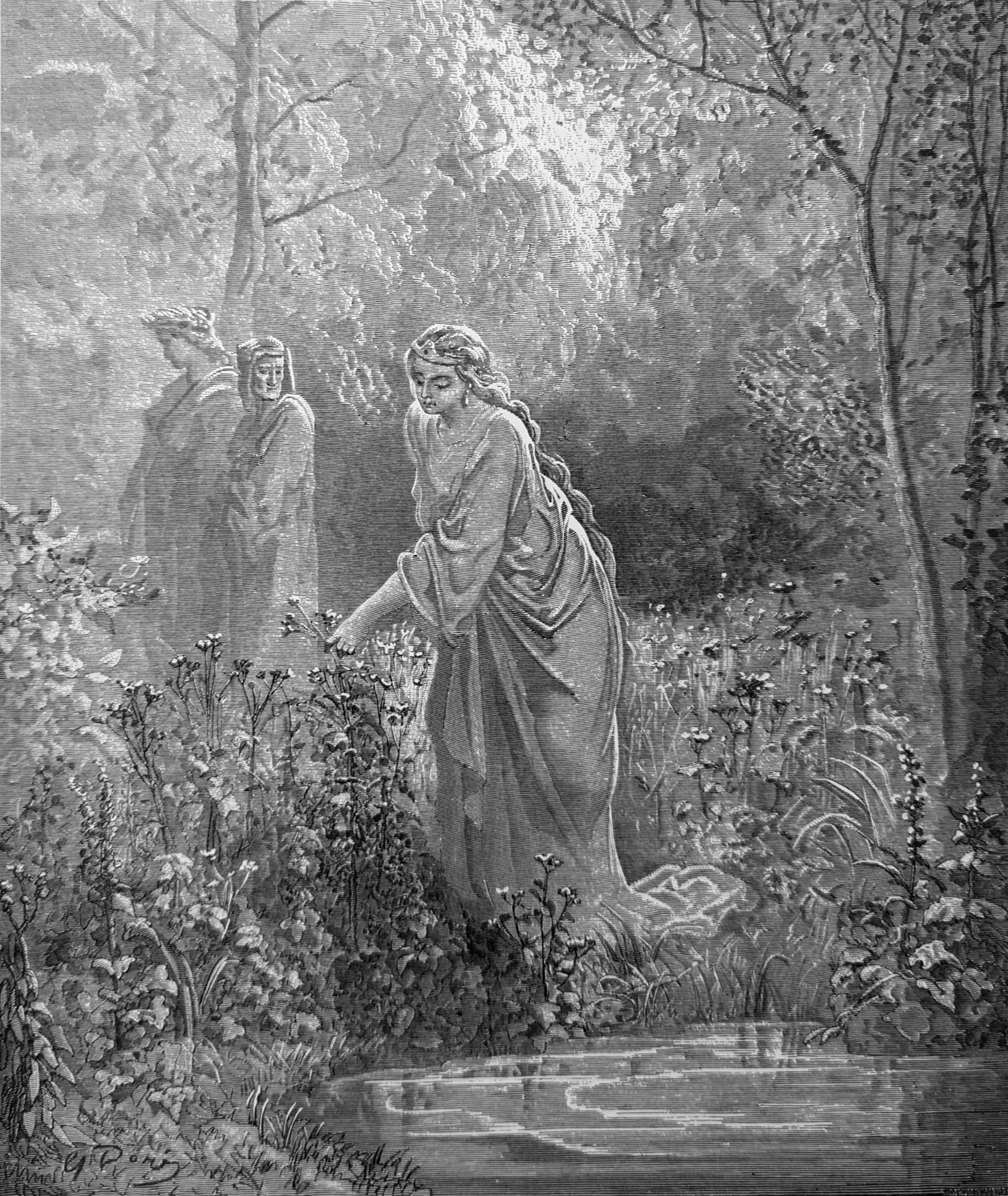
Youthful and beautiful in dreams methought / I saw a lady walking in a meadow, /Gathering flowers; Purg. XXVII, lines 97-99
Footnotes
1. Dante begins this canto on the Mountain’s highest terrace with his final time marker. It is 6 AM in Jerusalem which, recall, was considered the center of the world, directly opposite (the antipode) of the Mountain of Purgatory. In Spain, where the Ebro Rive r flows from the north central mountains to the sea between Barcelona and Valencia, it is midnight. And at the River Ganges in India, it is noontime. Here on the Terrace of Lust is the hour of sunset on the Tuesday following Easter. Dante’s mention of “the land where God’s Son shed His blood for us” leads Ronald Martinez to note in his commentary: “The mention of the four cardinal points (Ebro, Ganges, Jerusalem, Purgatory) evokes the image of the Cross.” Taking this further, Mark Musa tells us: “By naming Jerusalem as the place where the Creator of the sun shed his blood, Dante sets the whole action of the canto, in which the Pilgrim’s purgation is achieved, against the universal background of Christ’s redeeming death.” This is Dante’s last night on the Mounta in of Purgatory. After this, there will be no further references to the rising or setting of the sun.
2. The Angel of Chastity now appears. Standing near the flames, he welcomes the Pilgrims by singing the first part of a verse from the sixth Beatitude: “Blessed are the clean of heart for they shall see God” (Matthew 5:8). This last of Beatitudes obviously has special meaning here on the Terrace of the Lustful.
3. Beati mundo corde, Latin, "Blessed are the pure in heart".
Link: https://www.youtube.com/watch?v=xnA-kVXn5o0
4. Here is the baptism of fire—a moment of great testing for Dante the Pilgrim. At the Gate of Purgatory he had reached a wall that could only be passed through after his humble confession. Now, as a final point of purging, he must pass through the wall of flames, simply trusting that he will reach the other side unharmed. But his terror is a result of a moment of insight. He realizes that this experience will not be merely symbolic. He will feel pain. But he will not die and he will not be harmed. And yet, he fears, he might … be harmed … die. This crisis is compounded by the fact that he has seen people being buried alive upside down for great crimes of treachery. He has seen people being burned to death—most likely at the stake. He knows burning awaits him if he were ever caught in Florentine territory. And he is not a spirit like Virgil and Statius, or those he sees in the flames. Disembodied, they obviously suffer a kind of spiritual anguish. But he is not like them.
5. His mention of Geryon in Canto 17 of the Inferno recalls their flight down into the depths of Hell on the back of the monster of fraud. Virgil resorts to hyperbole, he even suggests an experiment with the hem of the Dante’s cloak to ease his fears. No doubt , the Poet has in mind here chapter 3 in the Book of Daniel (v.94): “…they saw that the fire had no power over the bodies of these men; not a hair of their heads had been singed, nor were their garments altered; there was not even a smell of fire about them .” All the while, of course, Statius is standing there silently observing the scene.
6. We read in St. Matthew’s Gospel: “…the spirit is willing but the flesh is weak.” Not only is Dante frightened, he’s ashamed. And with none of his coaxing or encouragements working, Virgil’s growing annoyance is evident. In the end, love prevails over reason , and the mention of Beatrice is all that’s needed to break Dante’s paralysis and revive his faith. One recalls here the line from the biblical Book of Canticles (8:6): “Love is strong as death.”
7. The tragic story of the Babylonian lovers Pyramus and Thisbe is found in Ovid’s Metamorphoses (IV:55-166) and later adapted by Shakespeare in his Romeo and Juliet. Forbidden by their parents to marry, their only opportunity to communicate was through a small hole in the wall that separated their gardens. They arranged to meet one night at the tomb of Ninus, the former king of Babylon (whose wicked wife, Semiramis, we read about in Canto 5: 58 in the Inferno). Thisbe arrived at the tomb first, but was frightened away by a lion who had just killed a cow. Dropping her cloak as she fled, the lion mauled and tore it with his bloodied paws and mouth. When Pyramus arrived and saw the blood-stained cloak he imagined the worst. Thinking that his lover was dead, he drew his sword and used it on himself. But Thisbe returned, and seeing the dying Pyramus she called out his name. He opened his eyes, recognized her, and then died. Grief-stricken, Thisbe took the sword and killed herself. This tragic scene took place near a mulberry tree. Until that time, mulberries were always white. But the lovers’ blood seeped down onto the roots of the tree, and ever after that its berries have been red.
8. Like Pyramus who revived when Thisbe called his name (though only for a moment), Dante’s faith and courage return when Virgil mentions the name of his beloved Beatrice. And Virgil’s (rare) humorous quip, which ends this scene, re-opens the circuit and the stalled action of the Poem resumes its pace.
9. Venite, benedicti Patris mei, Latin, "Come, blessed of my Father".
10. With the last light of the sunset behind him and his fading shadow in front, we can tell that Dante and his two companions are climbing toward the east. After this there will be no further mention of Dante’s shadow. Ronald Martinez notes here that “the disappearance of this sign of the pilgrim’s fleshliness coincides with the completion of his purgation.”
With the night arriving faster than they can climb, the three Pilgrims lose the will to climb further (one of the “rules” of the Mountain) and are forced to sleep on the stairs. As they settle down for the night, Dante compares himself to a goat guarded by shepherds–Virgil and Statius. Still “enclosing” Dante, Virgil is probably on the step above Dante, and Statius on the step just below him. And the high walls of the stairway enclose them all. The pastoral images here appeal to the imagination and highlight the safety of the place after the terror of the fires below. Technically, Virgil and Statius do not sleep because they are spirits.
11. The story of Leah and Rachel and their husband Jacob is a long and complicated one in the Book of Genesis, starting at chapter 29 and continuing on for several more chapters. Jacob, grandson of Abraham and son of Isaac, went to live with his uncle Laban aft er he tricked his father into giving him his brother’s birthright. Laban had two daughters, Leah and Rachel. Jacob fell in love with Rachel and wanted to marry her, but Laban required that he work for him for seven years before he would allow the marriage. Then, at the end of seven years, Laban insisted that Jacob marry Leah because she was the older of the two sisters and custom forbade the marriage of a younger sister before the older. The marriage took place, and Laban told Jacob that he would need to work for an additional seven years if he still wished to marry Rachel. This Jacob did.
As it happened, Leah was fertile and gave Jacob many children, whereas Rachel was barren. On the other hand, Leah had poor eyesight but Rachel could see perfectly. She eventually gave Jacob two sons, Joseph and Benjamin.
A very long Christian tradition equates Leah with the active life and Rachel with the contemplative life. As can be seen from the text here, Leah does all the talking, and we never actually meet Rachel. Spiritual teachers and guides have always agreed that neither the active nor the contemplative path is better than the another. The idea is to live a life of balance between them. Commentators on this passage agree that Leah, the active sister, represents the mysterious young woman Matelda whom we shall meet i n the next canto. She represents the happiness and joy of Eden which she will show to Dante. Rachel, on the other hand, represents Beatrice whom we shall meet in Canto 30. Rachel’s mirror is a symbol of contemplation, and she prefigures Beatrice who represents the divine revelation which leads all people to salvation in Paradise.
12. Virgil’s greeting with its reference to “the sweet fruit that mortals seek on many trees” points nowhere else but to the fruit of the Tree of Knowledge which Adam and Eve were commanded not to eat. Since that time, mortals have sought that fruit but not found it. Today, that symbolic fruit will fill Dante (and us) with a knowledge which he (or Adam) could not have imagined–-except in his Poem. Virgil’s words are like the wings of Dante’s desire which will soon be fulfilled.
13. The climax of Virgil’s service as the voice of Reason in the Commedia comes with his very last words in the Poem: “I place on you the crown and the miter, and I proclaim you lord of yourself.” With these words his commission by Beatrice in Canto 2 of the Inferno is finished. As kings and bishops are consecrated, so is Dante. As signs of that consecration, a crown is placed on the head of a king, and a miter on the head of a bishop. The crown represents the temporal realm, the miter the spiritual realm. Both symbolize the special status of the one receiving them, as well as the authority and responsibility which will mark their lives from now on. By the crown and the miter, Dante is enjoined to rule himself morally and spiritually. These gifts come to Dante from the hands of Reason. Soon they will be activated by the Divine Revelation which Beatrice will lead him to experience in the Paradiso.
Top of page