Dante's Divine Comedy: Purgatorio
Canto XII
Knowing he is guilty of being proud, Dante makes a point of stooping as he walks along the First Cornice looking at the carved images that depict the sin and fall of Pride (most notably Satan, Briareus, Thymbraeus, Pallas, Mars, Nimrod, Niobe, Saul, Arachne and Rehoboam). The shimmering Angel of Humility salutes the poets and erases one P with the gentle brush of its wings as it utters the beatitude, Beati Pauperes Spiritu. The pilgrim's feet suddenly feel lighter as he is escorted by the Pass of Pardon into the Second Cornice through a staircase in the rock.
Abreast, like oxen going in a yoke,
I with that heavy-laden soul went on,
As long as the sweet pedagogue permitted;
But when he said, "Leave him, and onward pass,
For here 'tis good that with the sail and oars,
As much as may be, each push on his barque;"
Upright, as walking wills it, I redressed
My person, notwithstanding that my thoughts
Remained within me downcast and abashed.
I had moved on, and followed willingly
The footsteps of my Master, and we both
Already showed how light of foot we were,
When unto me he said: "Cast down thine eyes;
'Twere well for thee, to alleviate the way,
To look upon the bed beneath thy feet."
As, that some memory may exist of them,
Above the buried dead their tombs in earth
Bear sculptured on them what they were before;
Whence often there we weep for them afresh,
From pricking of remembrance, which alone
To the compassionate doth set its spur;
So saw I there, but of a better semblance
In point of artifice, with figures covered
Whate'er as pathway from the mount projects.
I saw that one who was created noble
More than all other creatures, down from heaven
Flaming with lightnings fall upon one side.
I saw Briareus smitten by the dart
Celestial, lying on the other side,
Heavy upon the earth by mortal frost.[1]
I saw Thymbraeus, Pallas saw, and Mars,
Still clad in armor round about their father,
Gaze at the scattered members of the giants.
I saw, at foot of his great labor, Nimrod,
As if bewildered, looking at the people
Who had been proud with him in Sennaar.[2]
O Niobe! with what afflicted eyes
Thee I beheld upon the pathway traced,
Between thy seven and seven children slain![3]
O Saul! how fallen upon thy proper sword
Didst thou appear there lifeless in Gilboa,
That felt thereafter neither rain nor dew![4]
O mad Arachne! so I thee beheld
E'en then half spider, sad upon the shreds
Of fabric wrought in evil hour for thee![5]
O Rehoboam! no more seems to threaten
Thine image there; but full of consternation
A chariot bears it off, when none pursues![6]
Displayed moreo'er the adamantine pavement
How unto his own mother made Alcmaeon
Costly appear the luckless ornament;[7]
Displayed how his own sons did throw themselves
Upon Sennacherib within the temple,
And how, he being dead, they left him there;[8]
Displayed the ruin and the cruel carnage
That Tomyris wrought, when she to Cyrus said,
"Blood didst thou thirst for, and with blood I glut thee!"[9]
Displayed how routed fled the Assyrians
After that Holofernes had been slain,
And likewise the remainder of that slaughter.[10]
I saw there Troy in ashes and in caverns;
O Ilion! thee, how abject and debased,
Displayed the image that is there discerned![11]
Whoe'er of pencil master was or stile,
That could portray the shades and traits which there
Would cause each subtile genius to admire?
Dead seemed the dead, the living seemed alive;
Better than I saw not who saw the truth,
All that I trod upon while bowed I went.
Now wax ye proud, and on with looks uplifted,
Ye sons of Eve, and bow not down your faces
So that ye may behold your evil ways!
More of the mount by us was now encompassed,
And far more spent the circuit of the sun,
Than had the mind preoccupied imagined,
When he, who ever watchful in advance
Was going on, began: "Lift up thy head,
'Tis no more time to go thus meditating.
Lo there an Angel who is making haste
To come towards us; lo, returning is
From service of the day the sixth handmaiden.
With reverence thine acts and looks adorn,
So that he may delight to speed us upward;
Think that this day will never dawn again."
I was familiar with his admonition
Ever to lose no time; so on this theme
He could not unto me speak covertly.
Towards us came the being beautiful
Vested in white, and in his countenance
Such as appears the tremulous morning star.[12]
His arms he opened, and opened then his wings;
"Come," said he, "near at hand here are the steps,
And easy from henceforth is the ascent."[13]
At this announcement few are they who come!
O human creatures, born to soar aloft,
Why fall ye thus before a little wind?
He led us on to where the rock was cleft;
There smote upon my forehead with his wings,
Then a safe passage promised unto me.
As on the right hand, to ascend the mount
Where seated is the church that lordeth it
O'er the well-guided, above Rubaconte,[14]
The bold abruptness of the ascent is broken
By stairways that were made there in the age
When still were safe the ledger and the stave,
E'en thus attempered is the bank which falls
Sheer downward from the second circle there;
But on this, side and that the high rock graze.
As we were turning thitherward our persons,
"Beati pauperes spiritu," voices
Sang in such wise that speech could tell it not.[15]
Ah me! how different are these entrances
From the Infernal! for with anthems here
One enters, and below with wild laments.
We now were hunting up the sacred stairs,
And it appeared to me by far more easy
Than on the plain it had appeared before.
Whence I: "My Master, say, what heavy thing
Has been uplifted from me, so that hardly
Aught of fatigue is felt by me in walking?"
He answered: "When the Ps which have remained
Still on thy face almost obliterate
Shall wholly, as the first is, be erased,[16]
Thy feet will be so vanquished by good will,
That not alone they shall not feel fatigue,
But urging up will be to them delight."
Then did I even as they do who are going
With something on the head to them unknown,
Unless the signs of others make them doubt,
Wherefore the hand to ascertain is helpful,
And seeks and finds, and doth fulfill the office
Which cannot be accomplished by the sight;
And with the fingers of the right hand spread
I found but six the letters, that had carved
Upon my temples he who bore the keys;
Upon beholding which my Leader smiled.
Illustrations of Purgatorio
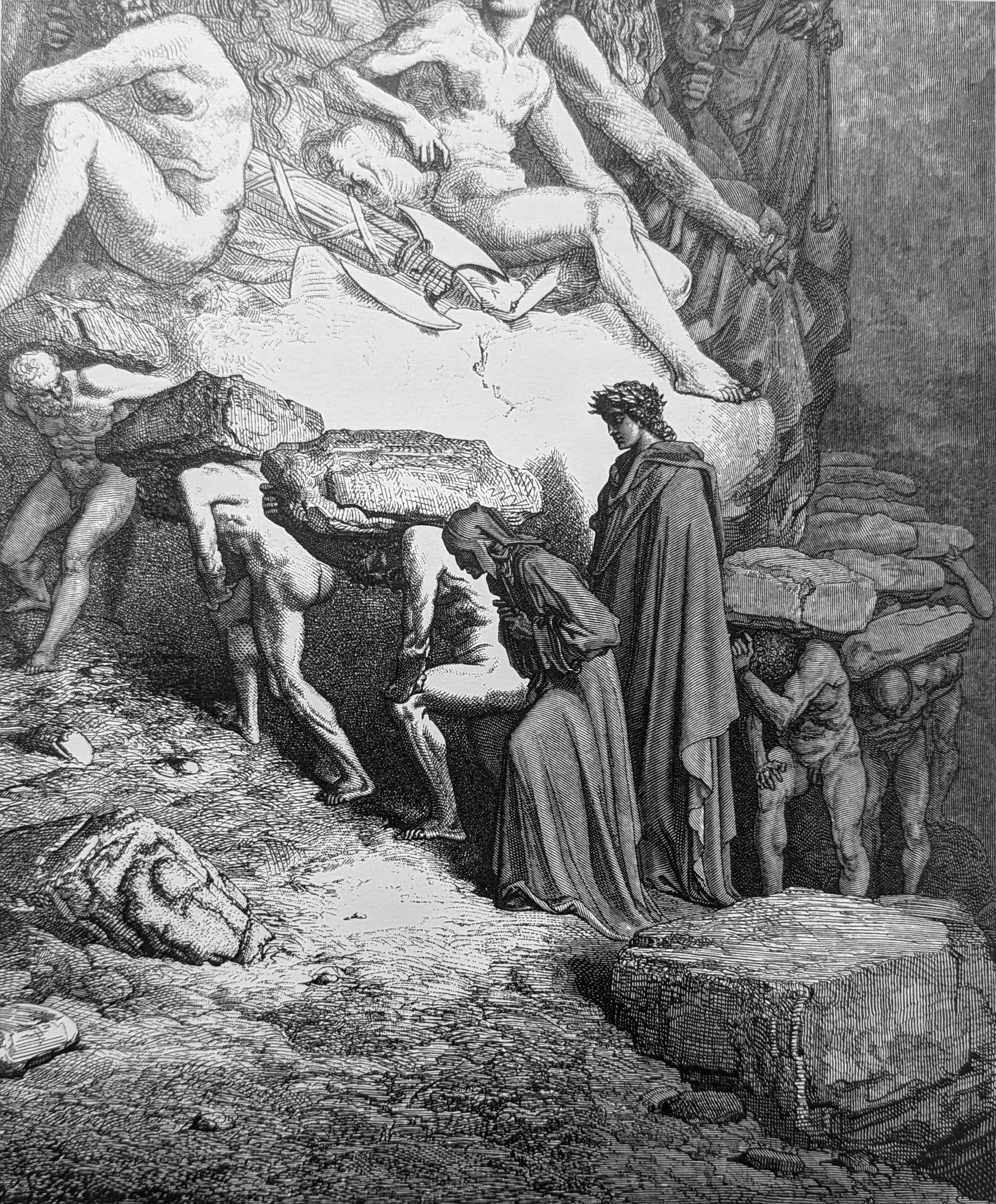
Abreast, like oxen going in a yoke, / I with that heavy-laden soul went on, Purg. XII, lines 1-2
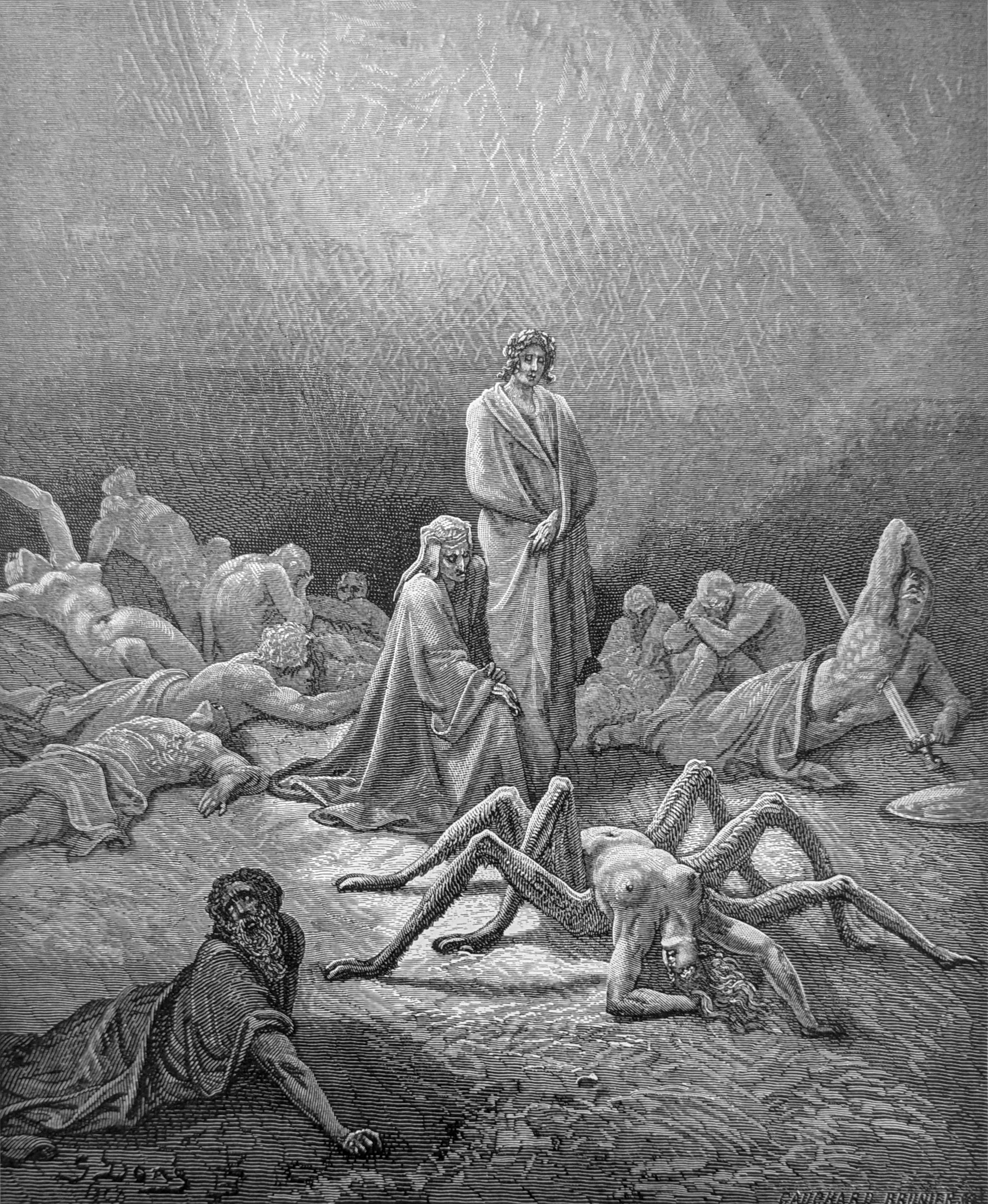
O mad Arachne! so I thee beheld / E'en then half spider, PAULHARD BRUNIER Purg. XII, lines 43-44
Footnotes
1. Lucifer (see Inferno 34) is said to have been the highest of the angels, and in his pride thought he could surpass God himself. Briareus, a kind of pagan counterpart of Lucifer, was one of the Giants who in his pride challenged the gods and was killed by a bolt of lightning. In Canto 31 of the Inferno, where Dante and Virgil encountered the Giants, Dante wanted to see Briareus but Virgil showed him other Giants instead. Apollo was sometimes called Thymbraeus because of his temple in Thymbra. Pallas was Athena/Minerva. Together with Mars they are pictured here witnessing the defeat and death of the Giants. Nimrod is named in the Book of Genesis (11:1-9) as the builder of the Tower of Babel at Shinar. Seeing that humans were thinking they could climb to heaven, God confused their languages and the project stopped. (See also Inferno 31 where Dante and Virgil encounter him babbling nonsense. Nimrod is a biblical counterpart to Thymbraeus, Pallas, and Mars. Nimrod befuddled at the failure of his project; Apollo, Pallas, and Mars left staring mutely at the death and destruction of the Giants.
2. Shin’ar, Hebrew: שִׁנְעָר, Greek: Σενναάρ, Romasn: Sennaár, is the name for the southern region of Mesopotamia used by the Hebrew Bible.
3. Niobe’s is a sad tale of overweening pride and mockery of the gods. She mocked the worship of Latona, the concubine of Jupiter because she had only a son and a daughter, whereas Niobe had seven of each! Her son and daughter, Apollo and Diana, took their bow s and Apollo killed each of Niobe’s sons. Then Diana killed each of her daughters. Weeping, Niobe turned to stone–-and the stone still weeps. Ovid recounts the story in his Metamorphoses (VI:206-312).
4. Saul preceded David as the first king of Israel. His story is told in the Bible in the First Book of Samuel. A miserable man and king, he died in battle at Mt. Gilboa. Badly wounded and surrounded by his enemies, he took his own life by falling on his sword .
5. Ovid again tells the story of Arachne in his Metamorphoses (VI:1-145). Skilled in the art of weaving, she proudly dared to challenge Minerva to a weaving contest and produced an amazing tapestry on which were depicted the love stories of the gods. Realizing that she could not produce a better entry, Minerva tore Arachne's tapestry to pieces. Despairing and frightened, Arachne hanged herself, but Minerva turned the rope into a web, and Arachne into a spider.
6. Rehoboam is a son of Solomon and the fourth king of Israel. His story is recounted in the Bible in 1 Kings 12:1-19. Sadly, he did not have the character of his grandfather, David, nor the wisdom of his father, Solomon. The people complained of their heavy t axes and asked Rehoboam to lighten them. Instead of listening to the advice of his older advisers who counseled him to lighten the burden, he listened to his younger peers who counseled just the opposite–-which he did. As a result, the kingdom of Israel split in two. Rehoboam was not killed by the angry crowd of petitioners, but got away in time to make a cowardly escape back to Jerusalem.
7. The story of Alcmaeon and his vain mother, Eriphyle, is found in the Thebaid of Statius (II:265-305 and IV:187-212). More than anything else, Eriphyle wanted a necklace made by Vulcan for the goddess Harmonia (a curse befell anyone else who wore it). Eriphyle's husband, the seer Amphiaraus (see Inferno 20), knew through his magic arts that he would die in the war at Thebes and went into hiding. He made Eriphyle vow that she would never reveal this secret. But, bribed with the fatal necklace by Polynices, the ruler of Thebes, she revealed her secret. Realizing that he would, in fact, die in the battle, and knowing that his secret had been revealed, Amphiaraus extracted a promise from his son, Alcmaeon, that he would take vengeance on his mother for his father’s death. Needless to say, there are several sins depicted in this floor panel: Eriphyle’s unrelenting vanity, her acceptance of a bribe, her violation of the oath to her husband resulting in her husband’s death, and the matricide by Alcmaeon. While he doesn’t excuse these sins, Dante’s focus is on Eriphyle’s vanity for an object fashioned by a god (Vulcan) and worn by a goddess (Harmonia). Her vanity-–a form of pride-–led to insert herself into what belonged to the gods. And this led to her death.
8. The story of Sennacherib, king of Assyria, and Hezekiah, king of Judah is found in 2 Kings 18-19. Sennacherib’s pride in thinking he could destroy Israel, and his blasphemy against Yahweh resulted in the army of Israel routing the Assyrians (with Yahweh’s help, of course). The Assyrian king was not killed in the battle, but his two sons later murdered him while he was at prayer in his temple.
9. Dante most likely read the story of Tomyris and Cyrus in Paulus Orosius’s Historiae adversus paganos (II.vii.6). Tomyris was the queen of the Scythians when Cyrus the Great, king of the Persians, set out to do battle with them. He had earlier sought to unite their kingdoms through marriage, but Tomyris refused. Cyrus built a bridge across the river separating the two kingdoms. His army crossed it, and Tomyris sent a third of her army under the command of her son to engage him. Instead of preparing for battle, however, Cyrus’ soldiers prepared a great banquet and then left it. Arriving at the deserted enemy camp, Tomyris’ soldiers filled themselves with the food that had been left and drank great quantities of wine (which they were not used to). Cyrus returned with his army and slaughtered Tomyris’ soldiers, but captured her son. Unwilling to be used as a pawn between Cyrus and his mother, he killed himself. Later, Tomyris and her army were victorious over the Persians and Cyrus was killed in battle. Later, Tomyris, over-proud of her victory, had him decapitated, took his head and threw it into a bucket of human blood, telling the blood-thirsty emperor to drink his fill!
10. The story of Holofernes, a general in the army of the Assyrian king, Nebuchadnezzar, is found in the Book of Judith, chapters 8-15. This biblical story–-well worth reading–-may be an entertaining fiction, but it tells of how God saved his people through the seeming weakness of a woman in the face of power and pride. Holofernes and his army surrounded the Israelite city of Bethulia, mocking the God of Israel and starving it into surrender. But a respected and beautiful widow, Judith, called the elders together and told them her plan. Agreeing to the ruse she proposed, they helped her and her maid sneak out of the city unseen by the enemy. Glamorously dressed, Judith allowed herself to be captured and she was brought before Holofernes and his council for interrogation. He was beguiled by her and listened to her feigned betrayal of her people. Claiming that her fellow citizens were about to commit a sacrilege (eating forbidden foods) in order to survive, and that God would punish them with immediate defeat, she convinced Holofernes to bide his time. A few days passed. On the fourth night Holofernes, overcome with passion for Judith, had a private banquet prepared, intending to ravish her afterward. Consumed with his lust, he drank more wine than he had ever done in hi s life! Unfortunately, he fell into a deep sleep. Seizing her opportunity, Judith took his sword and cut his head off. She put it in her purse and left with her maid. When they were stopped, they reminded the guard that they were allowed to go off a short distance from the camp to pray. Instead, they re-entered the city with their prize. The next morning, Holofernes was found dead and Judith was gone. The camp was thrown into chaos, and when they made their way to the city to destroy it, they were met with Holofernes’ head hanging from the wall. Demoralized, the army of Holofernes was slaughtered by the Bethulians and others from all the surrounding towns. Note the connection between these last two stories: an arrogant king and a besotted general were cut down by scheming women.
11. The thirteenth story depicts the proud city of Troy in ruins and Dante again takes his cue from Virgil’s Aeneid (III:1-3): “After the gods had seen fit to destroy Asia’s power and Priam’s innocent people, and proud Ilium had fallen, and all of Neptune’s Troy breathed smoke from the soil….” The series of floor carvings that began with the fall of Lucifer is now summed up by this last one depicting the fall of Troy, “whose ruin was the great classical example of the fall of pride” (Sayers). In the last book o f the Metamorphoses (XV:420-425), Ovid writes: “So we see times change, and these nations acquiring power and those declining. So Troy, that was so great in men and riches, who through ten years of war could give so freely of her blood, is humbled, and only reveals ancient ruins now, and, instead of wealth, the tombs of her ancestors.” An eloquent, but depressing, epitaph. In the end, pride brings nothing but ash! Ash to vain humans and ash to vain humans’ projects.
It might be fair to say that the fall of Troy began with an Olympian argument over beauty among three goddesses and the jealousy and revenge it unleashed. The abduction of Helen by Paris and the war it caused were the earthly counterpart. Vanity! Nevertheless, the Trojan war-–lasting 10 years–-was a watershed event in classical history and literature. Homer, Virgil, Ovid, and many others still provide long and vivid accounts with scores of heroes and villains, not to mention the interplay and interference of the gods. It was truly an event worthy of more than one epic, and what the age-old cliche says is not without significance here: “The higher you climb, the harder you fall.” In an extended sense, this saying applies to all the floor carvings Dante walked over. Even his walking over these images of pride is a way to reject the sin they stand for-–part of the sinners’ healing and as he will tell us, part of his own healing, too.
12. Dante structures the Purgatorio so that he and Virgil encounter an angel at the end of each terrace who shows them the way upward to the next one. For the first time, the Pilgrim can actually look at the angel without being blinded. That the angel is as radiant as the morning star is reminiscent of his first encounter with an angel at dawn in Canto 2–-the angel pilot of the ship of souls. Unlike the two angels we last saw in the Valley of the Kings, who were clad in green garments, this angel is clad in white . The angel at dawn wore garments that were ruddy in color, and those of the angel at the Gate were the color of ash. Hollander, in his commentary here, notes a detail we might miss: the morning star (Venus) is also called Lucifer (the bearer of light). This Angel of Humility is the opposite of the angel Lucifer (also the bearer of light–-and proud of it!).
13. The angel’s widespread arms and outstretched wings are positively welcoming after the travelers viewed the thirteen dark scenes of pride. And his words recall how, much further down the Mountain, Virgil told Dante that the climb would get easier the higher they went.
14. Lots of things seem to happen at once here. We haven’t been reminded of the seven Ps carved on Dante’s forehead until now. Bringing Dante and Virgil to the stairway, and with a brush of his wings, the Angel of Humility erases one of the marks of sin–-obviously of pride. This stairway, cut into the steep mountainside which, he reminds us, is still dangerous, reminds him of the stairs leading to the beautiful basilica of San Miniato al Monte in Florence. Begun in 1013, it sits at the top of a hill–-across the Arno-–to the south. It offers spectacular views of the city of Florence. The rough stairs leading up from the Terrace of Pride probably remind Dante of the much older stairway that led up from the river. It’s a long climb, but nowadays the stairs are wide an d the steps are spaced several feet from each other. The *"Rubaconte Bridge**, the next bridge to the east of the famous Ponte Vecchio, was named after the Podestà Rubaconte da Mandello da Milano, who built it in 1237. It was destroyed by the Nazis in 1944 and reconstructed and renamed Ponte alle Grazie in 1957. Keep in mind that this is the first stairway in Purgatory. Steep, rough, and perilous as it may be, it will make for an easier ascent than the climbing the two Pilgrims have been doing from the start. Easier, that is, for Dante’s live body as opposed to Virgil who is a spirit.
15. "Beati pauperes spiritu", Latin, "Blessed are the poor in spirit".
As the two travelers are being escorted to the stairs by the Angel of Humility, not only is the first P erased from Dante’s forehead, he sees the stairs cut into the rock face of the Mountain and is reminded of the rough stairs leading up the hillside to the basilica of San Miniato in Florence. Then he is reminded of past times (when he was younger) when the city administration was honest and just. Now at the stairs, he hears singing beyond his ability to describe it. This is a ritual that will be repeated on each of the terraces above. Voices are singing this first of the Beatitudes from the Sermon on the Mount (Matthew 5:3): “Blessed are the poor in spirit, for theirs is the kingdom of Heaven.” How appropriate for this Terrace where the Proud are redeemed.
16. Peccatum in Latin is sin. This first sin in Latin is "superbia", which in English is Pride.