Dante's Divine Comedy: Purgatorio
Canto VIII
At nightfall, the fretful souls of the Preoccupied sing Te Lucis Ante as they are still liable to temptation in Ante-Purgatory. Two green-robed angels with fiery swords descend as divine protection until the light of the sun can once again illuminate their path. Judge Nino Visconti recognizes Dante who notices that the Four Stars (Justice, Prudence, Temperance and Fortitude) seen before daybreak have now set and three new ones (Faith, Hope and Charity) have risen in their place. The angels drive out an intruding serpent. Dante speaks with Conrad Malaspina.
Twas now the hour that turneth back desire
In those who sail the sea, and melts the heart,
The day they've said to their sweet friends farewell,[1]
And the new pilgrim penetrates with love,
If he doth hear from far away a bell
That seemeth to deplore the dying day,
When I began to make of no avail
My hearing, and to watch one of the souls
Uprisen, that begged attention with its hand.
It joined and lifted upward both its palms,
Fixing its eyes upon the orient,
As if it said to God, "Naught else I care for."
"Te lucis ante" so devoutly issued
Forth from its mouth, and with such dulcet notes,
It made me issue forth from my own mind.[2]
And then the others, sweetly and devoutly,
Accompanied it through all the hymn entire,
Having their eyes on the supernal wheels.
Here, Reader, fix thine eyes well on the truth,
For now indeed so subtile is the veil,
Surely to penetrate within is easy.
I saw that army of the gentle-born
Thereafterward in silence upward gaze,
As if in expectation, pale and humble;
And from on high come forth and down descend,
I saw two Angels with two flaming swords,
Truncated and deprived of their points.
Green as the little leaflets just now born
Their garments were, which, by their verdant pinions
Beaten and blown abroad, they trailed behind.[3]
One just above us came to take his station,
And one descended to the opposite bank,
So that the people were contained between them.
Clearly in them discerned I the blond head;
But in their faces was the eye bewildered,
As faculty confounded by excess.[4]
"From Mary's bosom both of them have come,"
Sordello said, "as guardians of the valley
Against the serpent, that will come anon."[5]
Whereupon I, who knew not by what road,
Turned round about, and closely drew myself,
Utterly frozen, to the faithful shoulders.
And once again Sordello: "Now descend we
'Mid the grand shades, and we will speak to them;
Right pleasant will it be for them to see you."
Only three steps I think that I descended,
And was below, and saw one who was looking
Only at me, as if he fain would know me.
Already now the air was growing dark,
But not so that between his eyes and mine
It did not show what it before locked up.
Tow'rds me he moved, and I tow'rds him did move;
Noble Judge Nino! how it me delighted,
When I beheld thee not among the damned![6]
No greeting fair was left unsaid between us;
Then asked he: "How long is it since thou camest
O'er the far waters to the mountain's foot?"
"Oh!" said I to him, "through the dismal places
I came this morn; and am in the first life,
Albeit the other, going thus, I gain."
And on the instant my reply was heard,
He and Sordello both shrank back from me,
Like people who are suddenly bewildered.
One to Virgilius, and the other turned
To one who sat there, crying, "Up, Currado!
Come and behold what God in grace has willed!"[7]
Then, turned to me: "By that especial grace
Thou owest unto Him, who so conceals
His own first wherefore, that it has no ford,
When thou shalt be beyond the waters wide,
Tell my Giovanna that she pray for me,
Where answer to the innocent is made.[8]
I do not think her mother loves me more,
Since she has laid aside her wimple white,
Which she, unhappy, needs must wish again.
Through her full easily is comprehended
How long in woman lasts the fire of love,
If eye or touch do not relight it often.
So fair a hatchment will not make for her
The Viper marshaling the Milanese
A-field, as would have made Gallura's Cock."
In this wise spake he, with the stamp impressed
Upon his aspect of that righteous zeal
Which measurably burneth in the heart.
My greedy eyes still wandered up to heaven,
Still to that point where slowest are the stars,
Even as a wheel the nearest to its axle.[9]
And my Conductor: "Son, what dost thou gaze at
Up there?" And I to him: "At those three torches
With which this hither pole is all on fire."
And he to me: "The four resplendent stars
Thou sawest this morning are down yonder low,
And these have mounted up to where those were."
As he was speaking, to himself Sordello
Drew him, and said, "Lo there our Adversary!"
And pointed with his finger to look thither.
Upon the side on which the little valley
No barrier hath, a serpent was; perchance
The same which gave to Eve the bitter food.[10]
Twixt grass and flowers came on the evil streak,
Turning at times its head about, and licking
Its back like to a beast that smoothes itself.
I did not see, and therefore cannot say
How the celestial falcons 'gan to move,
But well I saw that they were both in motion.[11]
Hearing the air cleft by their verdant wings,
The serpent fled, and round the Angels wheeled,
Up to their stations flying back alike.
The shade that to the Judge had near approached
When he had called, throughout that whole assault
Had not a moment loosed its gaze on me.
"So may the light that leadeth thee on high
Find in thine own free-will as much of wax
As needful is up to the highest azure,"
Began it, "if some true intelligence
Of Valdimagra or its neighborhood
Thou knowest, tell it me, who once was great there.[12]
Currado Malaspina was I called;
I'm not the elder, but from him descended;
To mine I bore the love which here refineth."
"O," said I unto him, "through your domains
I never passed, but where is there a dwelling
Throughout all Europe, where they are not known?
That fame, which doeth honor to your house,
Proclaims its Signors and proclaims its land,
So that he knows of them who ne'er was there.[13]
And, as I hope for heaven, I swear to you
Your honored family in naught abates
The glory of the purse and of the sword.
It is so privileged by use and nature,
That though a guilty head misguide the world,
Sole it goes right, and scorns the evil way."
And he: "Now go; for the sun shall not lie
Seven times upon the pillow which the Ram
With all his four feet covers and bestrides,
Before that such a courteous opinion
Shall in the middle of thy head be nailed
With greater nails than of another's speech,
Unless the course of justice standeth still."
Illustrations of Purgatorio
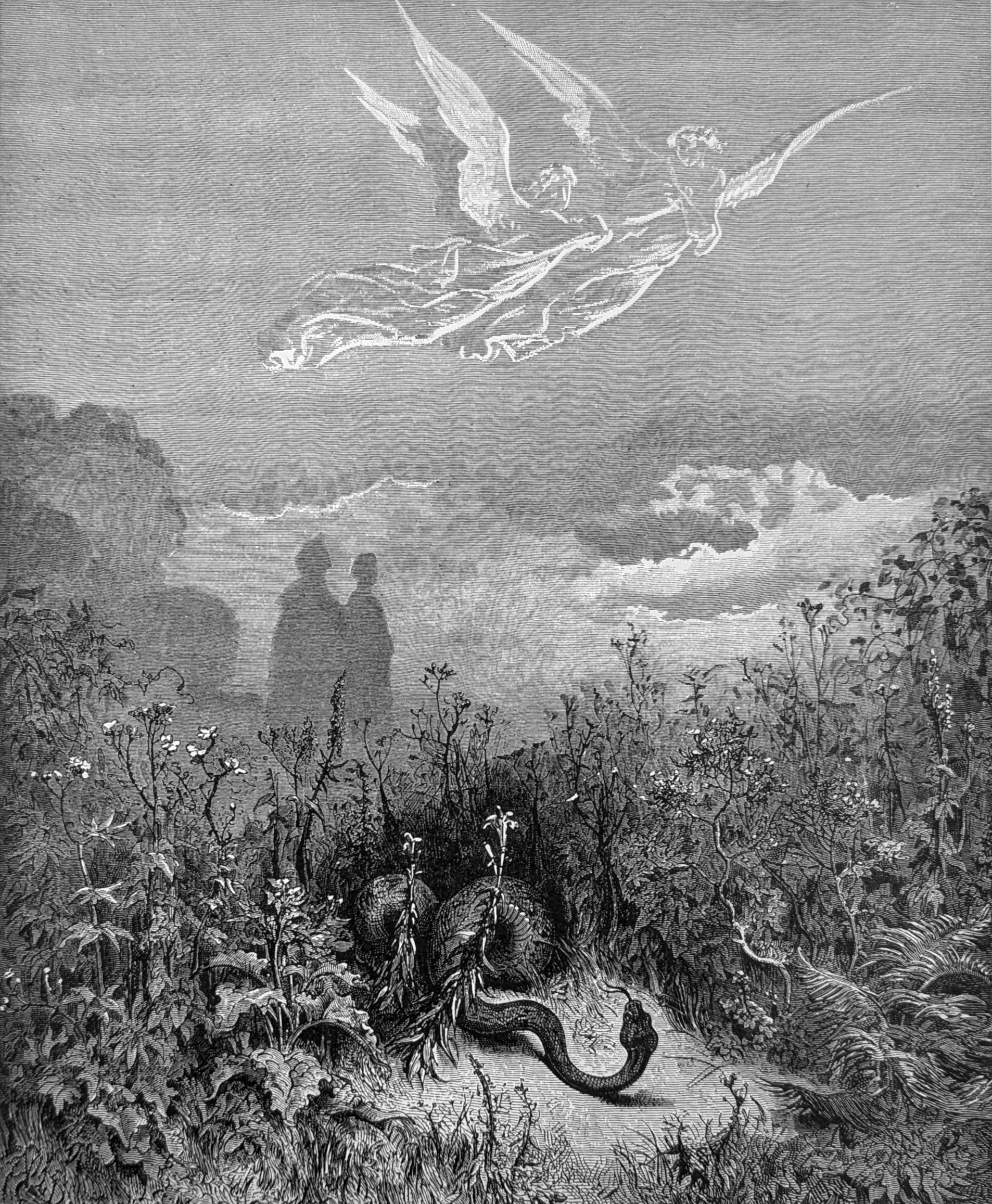
Hearing the air cleft by their verdant wings, / The serpent fled, and round the Angels wheeled, Purg. VIII, lines 106-107
Footnotes
1.We are at the end of the first day on the Mountain of Purgatory and the image of the tolling bell recalls to Dante’s mind the hour of Compline–the last daily prayer of the Church. And, as we shall see, this canto is filled with ritual. We have already heard the hymn Salve Regina sung by the souls in the Valley of the Kings as we listened to Sordello’s narration at the valley’s edge in the last canto. Now, with both the hymn and Sordello’s account of those souls finished, Dante, in a kind of dream-state, no longer hears Sordello but watches the kings as one of them (unnamed) stands and calls the others to rise with him in prayer. His hands, lifted toward Heaven, recalls the first verses of Psalm 134 which opens the service of Compline: “O come, bless the Lord, a ll you servants of the Lord. You who stand in the house of the Lord throughout the nights, lift up your hands toward the sanctuary and bless the Lord.” They all follow him and face East, the sacred direction of both sunrise (a symbol of Christ) and the grace of God. Medieval churches were often constructed on an east-west axis so that the Sacred Liturgy was always celebrated facing east. Interestingly, Medieval maps were laid out with east at the top. With the dying of the day, we join the souls in recalling that our journey toward ultimate salvation requires a dying (no longer listening) to those earthly things that hold us back as we look forward in hope to the glory of a new day illuminated by God.
2. The hymn, Te lucis ante terminum is traditionally attributed to St. Ambrose of Milan, and is sung at the beginning of the service of Compline at the end of the day:
Video: https://www.youtube.com/watch?v=OH0xMhMuwSE
3. Latin, penna, “feather”.
4. Keep in mind that Sordello, Virgil, and Dante are still on their “balcony” at the edge of the valley. Recall the first appearance of the angel-pilot guiding the ship of souls in Canto 2. This is the second appearance of angels and it has two parts. Here in the first part, the evening liturgy of Compline has already begun with the singing of the Salve Regina. Now, all the souls in this place stand, facing east as they join in prayer singing the Te lucis, and reciting the Psalms of the Church’s evening prayer. An aura of sacredness comes upon the souls including Sordello, Virgil, and Dante, and it goes without saying that we are also invited to participate. This ritual is repeated every evening.
Two great angels descend from the heavens and take their places at either side of the valley. They are dressed in gorgeous green robes symbolizing the virtue of hope, and each carries two flaming swords with blunted tips. The swords symbolize the justice of God tempered by His mercy, the flames symbolizing the love of God. Broken as they are, these swords aren’t intended to do any harm. In his commentary, Musa suggests that the blunted swords may represent that inability to move upward during the night that Sordello spoke of earlier. He also notes that golden hair was often used in icons and paintings as a symbol of blessedness. That the swords are flaming reminds us of the scene in chapter 3 of the Book of Genesis where Adam and Eve are driven from the Garden of Eden. An angel (perhaps two) is stationed at the entrance with a flaming sword which turns in every direction to prevent them from returning. See Psalm 91.
5. In Christian theology, Mary is seen as the opposite of Eve. Her “Yes!” to the angel’s message that she would be the mother of Jesus canceled once and for all the effects of Eve’s sin in the Garden of Eden. Hollander, in his commentary, takes his cue here f rom the earliest commentary we have on the Commedia, written in 1340 by Pietro di Dante, Dante’s second son. He quotes from that commentary: “‘And the holy men say that, just as sickness was born from that most prideful one, that is, Eve, just so its cure springs from that most humble one, that is, Mary.’ And thus, Pietro continues, the ‘Ave” of the ‘Hail Mary’ counters the effect of Eve, whose name it spells backward.’”
As for the serpent, Sordello’s almost matter-of-fact announcement adds to the fact that what is taking place in the Valley of the Kings is a nightly ritual/drama that includes the arrival of a real snake, which they will see, but that the angels stand guard against it. Recall the second verse of the Te lucis above which names it as “our ghostly foe.” “From all ill dreams defend our eyes, / From nightly fears and fantasies; / Tread under foot our ghostly foe, / That no pollution we may know.”
6. What earlier seemed like quite a distance (the view of a small valley, the gathering of the kings, the descent of the angels) is actually only a few short steps for the threesome to find themselves amid those they had been watching moments before. Immediately, Dante is recognized, and soon enough he recognizes his good friend Nino de’Visconti from Pisa. Nino, short for Ugolino, was a grandson of Count Ugolino della Gherardesca whose tragic death is immortalized in Canto 33 of the Inferno. He was a leader of t he Guelf party in Pisa and a judge for the region of Gallura in Sardinia which was at that time a possession of Pisa. The reader will recall him from the story of Fra Gomita in the Inferno (22:81ff). Gomita was a monk and Visconti’s chancellor in Gallura. Gomita was notorious for his bribe-taking and was eventually hanged by Visconti. Nino and his grandfather, Count Ugolino fell out politically in 1288 (Guelf vs Ghibelline) and he was expelled from Pisa. He lived for a time in Lucca and Genoa, most likely became friends with Dante in Florence, and died in 1296 in Gallura.
Dante’s immediate response on meeting Nino–great pleasure at seeing him here in Purgatory and not in Hell–might be misleading. The Pilgrim definitely met souls in Hell that he had cared about or admired when they were alive. But if we recall that the realm of Ante-Purgatory is for people who postponed their conversion till late, or repented at the last minute of their lives, and knowing him well, Dante might have had cause to wonder about the strength of Nino's religious faith amid the numerous political struggles he was party to when he was in Pisa and afterward. Nevertheless, he is among the saved and he presumes that Dante is too.
7. Nino spreads the good news to his friend Corrado Malaspina and calls him over to share in seeing the miracle of grace that Dante’s presence represents to them.
Dante knew Corrado through his cousin, Moroello Malaspina, with whom he was good friends. Early in his exile Dante was hosted by the Malaspinas in Lunigiana for whom he acted as a diplomat. Lunigiana is a mountainous region at the far northwestern tip of Tuscany stretching from the Apennines to the Mediterranean Sea. In modern times this ancient territory belongs partly to Tuscany and partly to Liguria.
8. This request of Nino de’Visconti is both long and heart-felt, and it momentarily interrupts the evening prayer ritual. Nino died in 1296 and four years later his wife (whom he never names), Beatrice d’Este, married Galeazzo I Visconti, Lord of Milan–but not before jilting Alberto Scotti, the Lord of Piacenza. (The two Visconti families were not related.) Beatrice was the daughter of Opizzio d’Este (a notorious and violent man, who boils in the river of blood in Inferno Canto 12:111. Nino is right in prophesying that she would regret her marriage to Galeazzo. Two years after their marriage, he was driven out of Milan in abject poverty, having been ruined by his wife’s former lover, Alberto of Piacenza. Beatrice was forced to share his ruin, but after Alberto’s death she was later restored in 1328 by her son, Azzo, the new Lord of Milan. All of this “drama,” it would seem, reinforces Nino’s reflection that the flame of marital love will go out if it is not continually attended to. He speaks with experience, and thus asks Dante to go to his daughter, Giovanna, and ask her to pray for the salvation of her father’s soul (because her mother seems to have abandoned him from her prayers). The serpent and the cock were emblems on the Visconti coats of arms: a serpent swallowing a Saracen on Galeazzo’s and a rooster on Nino’s. (Interestingly, the cock/rooster is a symbol of Christ and his Resurrection which announces the dawn of hope and salvation.) Wives’ tombs had the coat of arms of their latest husband on them.
9. Early this first day in Purgatory, the travelers saw the four great stars in the dawn sky as they emerged from Hell. They represent the Four Cardinal Virtues: Prudence, Temperance, Justice, and Fortitude. In the course of the day, these morning stars never really set in Purgatory. They slowly moved to the other side of the Mountain and now Dante sees a different group of three rising, which represent the Three Theological Virtues: Faith, Hope, and Love. On the spiritual level we see the theological virtues re place the moral virtues as the ancient world was eclipsed by the Christian era in which these three virtues have the power to lead a soul directly to God. And given where we are on the Mountain, these three virtues point to the end of Ante-Purgatory and entrance into Purgatory proper.
10. At last the serpent makes its appearance. We’ve been distracted by moving into the Valley of the Princes, meeting and speaking with Nino de’Visconti, and looking at the new stars in the evening sky. Note how, once again, Dante seems to be slighted by Sordello: it’s Virgil’s arm he clutches to warn him of the serpent’s arrival. On the spiritual level, the use of the possessive pronoun in “our adversary” is designed to caution not just the souls in the valley, but Dante, Virgil, and ourselves, the readers. The Poet used the same inclusive device in the first line of the Poem: “In the middle of the journey of our life…”
Dante’s description of the serpent as la malastriscia–an evil streak–is masterful. No reaction from the Pilgrim Dante is mentioned. Our focus is completely on this strange creature that slithers quietly along, stopping once in a while–and here I think Dante is delightfully over the top–to preen itself. This is no ordinary snake! And then just the slightest hint that this might be the same serpent that tempted Eve to eat the fruit of our downfall. Singleton quotes the venerable Scartazzini to great effect: “T he viper licking and sleeking itself represents the wile of the tempter, who comes with an air of nonchalance toward everything about him. He does not even look at those he already contemplates attacking, so that his evil intention may not be revealed at all.”
11. In the Italian, Dante calls these angels li astor celestïali, heavenly falcons. In art, the falcon often represents Christ, and the astor (the northern goshawk) was said to be particularly aggressive against snakes.
12. Corrado’s homeland is the Val di Magra, sometimes spelled Valdimagra (Valley of the Magra River). The valley lies about 20 miles down from the rising of the Magra River from which it gets its name. The river itself rises in the mountains about 40 miles to t he northeast of La Spezia and empties into the Ligurian Sea below La Spezia (about midway between Genoa and Pisa. Part of the valley – the region of Lunigiana – lies in Tuscany and part in Liguria. This was the territory of the Malaspina family whose castle was in Villafranca. Corrado’s statement that he was held in high esteem might be taken with tongue in cheek since he is most likely here in Purgatory – as he actually admits – because he paid too much attention to his family’s titles and fortunes and not a s much as he should have to his own soul.
13. If we know the story of Dante’s travels when he was exiled from Florence, we know that it’s not true that he was never in the territory of the Malaspinas. However, if we remember that Dante sets the Commedia in the spring of 1300, then his statement is true . (Does Dante want to make sure we’re paying attention?) As a matter of fact, Dante’s more than gracious words to Corrado are really a homage of thanksgiving to the noble Malaspina family for their generous hospitality to him in the early years of his exile . During his time with them he acted as an ambassador for the Malaspina family in their dispute with the Bishop of Luni and settled what is known, even today as La Pace di Dante – the Peace of Dante. Perhaps of the highest importance is the debt of gratitude Dante owed to Corrado’s cousin, Moroello, who is said by Boccaccio in his Life of Dante to have received the first seven cantos of the Inferno, which were locked in a family trunk for a few years after Dante was exiled. They were found by one of Dante’s nephews and given to an esteemed poet named Dino Lambertucci. This man, knowing that Dante was in the Lunigiana, gave the manuscript to Moroello and asked him to beg Dante to finish what he had started several years earlier. While some scholars claim that Boccaccio’s account is unreliable, it is, nevertheless, amazing and entertaining.
Top of page