Dante's Divine Comedy: Purgatorio
Canto I
Having emerged from Hell, Dante and Virgil find themselves on the shores of Purgatory. They are gruffly challenged by the guardian of the mountain, Cato of Utica, a Roman statesman famous for his Stoic virtue. Mistaking them for doomed souls escaped from Hell, be asks whether there has been a shift in the order of the universe. Virgil explains that Dante still lives and is there at the command of a lady from Heaven. He then prepares Dante for his ascent by washing his face and tying a reed girdle around bis waist to safeguard him against Pride, the source of all sin.
To run o'er better waters hoists its sail
The little vessel of my genius now,
That leaves behind itself a sea so cruel;
And of that second kingdom will I sing
Wherein the human spirit doth purge itself,
And to ascend to heaven becometh worthy.
But let dead Poesy here rise again,
O holy Muses, since that I am yours,
And here Calliope somewhat ascend,[1]
My song accompanying with that sound,
Of which the miserable magpies felt
The blow so great, that they despaired of pardon.
Sweet color of the oriental sapphire,
That was upgathered in the cloudless aspect
Of the pure air, as far as the first circle,[2]
Unto mine eyes did recommence delight
Soon as I issued forth from the dead air,
Which had with sadness filled mine eyes and breast.
The beauteous planet, that to love incites,
Was making all the orient to laugh,
Veiling the Fishes that were in her escort.
To the right hand I turned, and fixed my mind
Upon the other pole, and saw four stars
Ne'er seen before save by the primal people.[3]
Rejoicing in their flamelets seemed the heaven.
O thou septentrional and widowed site,
Because thou art deprived of seeing these!
When from regarding them I had withdrawn,
Turning a little to the other pole,
There where the Wain had disappeared already,
I saw beside me an old man dome,
Worthy of so much reverence in his look;
That more owes not to fader any son.
A long beard and with white hair intermingled
He wore, in semblance like unto the tresses,
Of which a double list fell on his breast.
The rays of the four consecrated stars
Did so adorn his countenance with light,
That him I saw as were the sun before him.[4]
"Who are you? ye who, counter the Mind river,
Have fled away from the eternal prison?"
Moving those venerable plumes, he said.
"Who guided you? or who has been your lamp
In issuing forth out of the night profound,
That ever black makes the infernal valley?
The laws of the abyss, are they thus broken?
Or is there changed in heaven some council new,
That being damned ye come unto my crags"
Then did my Leader lay his grasp upon me,
And with his words, and with his hands and signs,
Reverent he made in me my knees and brow;
Then answered him: "I came not of myself;
A Lady from Heaven descended, at whose prayers
I aided this one with my company.
But since it is thy will more be unfolded
Of our condition, how it truly is,
Mine cannot be that this should be denied thee.[5]
This one has never his last evening seen,
But by his folly was so near to it
That very little time was there to turn.
As I have said, I unto him was sent
To rescue him, and other way was none
Than this to which I have myself betaken.
I've shown him all the people of perdition,
And now those spirits I intend to show
Who purge themselves beneath thy guardianship.
How I have brought him would be long to tell thee.
Virtue descendeth from on high that aids me
To lead him to behold thee and to hear thee.
Now may it please thee to vouchsafe his coming;
He seeketh Liberty, which is so dear,
As knoweth he who life for her refuses.
Thou know'st it; since, for her, to thee not bitter
Was death in Utica, where thou didst leave
The vesture, that will shine so, the great day.
By us the eternal edicts are not broken;
Since this one lives, and Minos binds not me;
But of that circle I, where are the chaste[6]
Eyes of thy Marcia, who in looks still prays thee,
O holy breast, to hold her as thine own;
For her love, then, incline thyself to us.[7]
Permit us through thy sevenfold realm to go;
I will take back this grace from thee to her,
If to be mentioned there below thou deignest."
"Marcia so pleasing was unto mine eyes
While I was on the other side," then said he,
"That every grace she wished of me I granted;
Now that she dwells beyond the evil river,
She can no longer move me, by that law
Which, when I issued forth from there, was made.
But if a Lady of Heaven do move and rule thee,
As thou dost say, no flattery is needful;
Let it suffice thee that for her thou ask me.
Go, then, and see thou gird this one about
With a smooth rush, and that thou wash his face,
So that thou cleanse away all stain therefrom,
For 'twere not fitting that the eye o'ercast
By any mist should go before the first
Angel, who is of those of Paradise.
This little island round about its base
Below there, yonder, where the billow beats it,
Doth rushes bear upon its washy ooze;
No other plant that putteth forth the leaf,
Or that doth indurate, can there have life,
Because it yieldeth not unto the shocks.[8]
Thereafter be not this way your return;
The sun, which now is rising, will direct you
To take the mount by easier ascent."
With this he vanished; and I raised me up
Without a word, and wholly drew myself
Unto my Guide, and turned mine eyes to him.
And he began: "Son, follow thou my steps;
Let us turn back, for on this side declines
The plain unto its lower boundaries."
The dawn was vanquishing the matin hour
Which fled before it, so that from afar
I recognized the trembling of the sea.
Along the solitary plain we went
As one who unto the lost road returns,
And till he finds it seems to go in vain.
As soon as we were come to where the dew
Fights with the sun, and, being in a part
Where shadow falls, little evaporates,
Both of his hands upon the grass outspread
In gentle manner did my Master place;
Whence I, who of his action was aware,
Extended unto him my tearful cheeks;
There did he make in me uncovered wholly
That hue which Hell had covered up in me.
Then came we down upon the desert shore
Which never yet saw navigate its waters
Any that afterward had known return.
There he begirt me as the other pleased;
O marvelous! for even as he culled
The humble plant, such it sprang up again
Suddenly there where he uprooted it.
Illustrations of Purgatorio
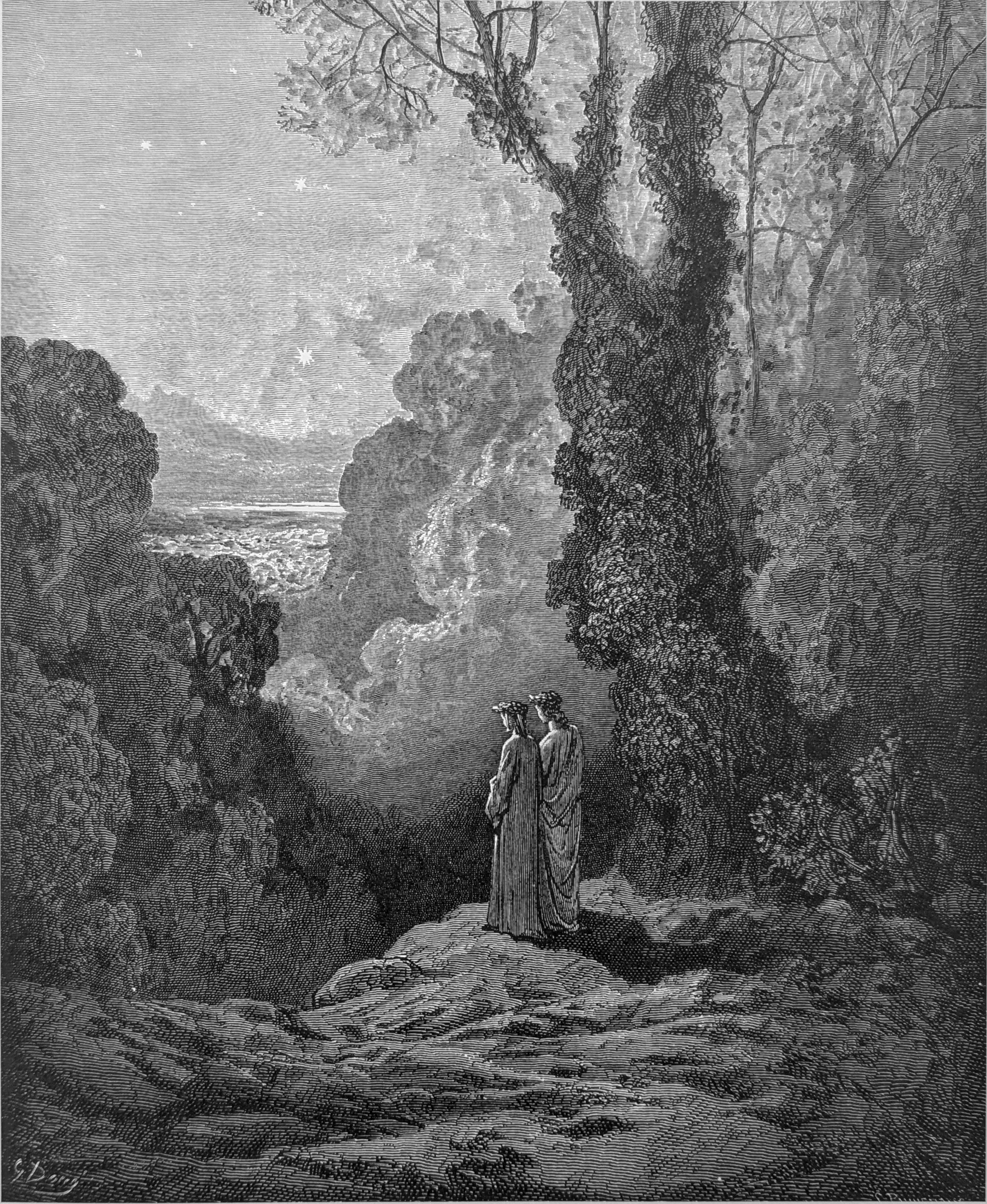
The beauteous planet, that to love incites, / Was making all the orient to laugh, / Veiling the Fishes that were in her escort. Purg. I, lines 19-21
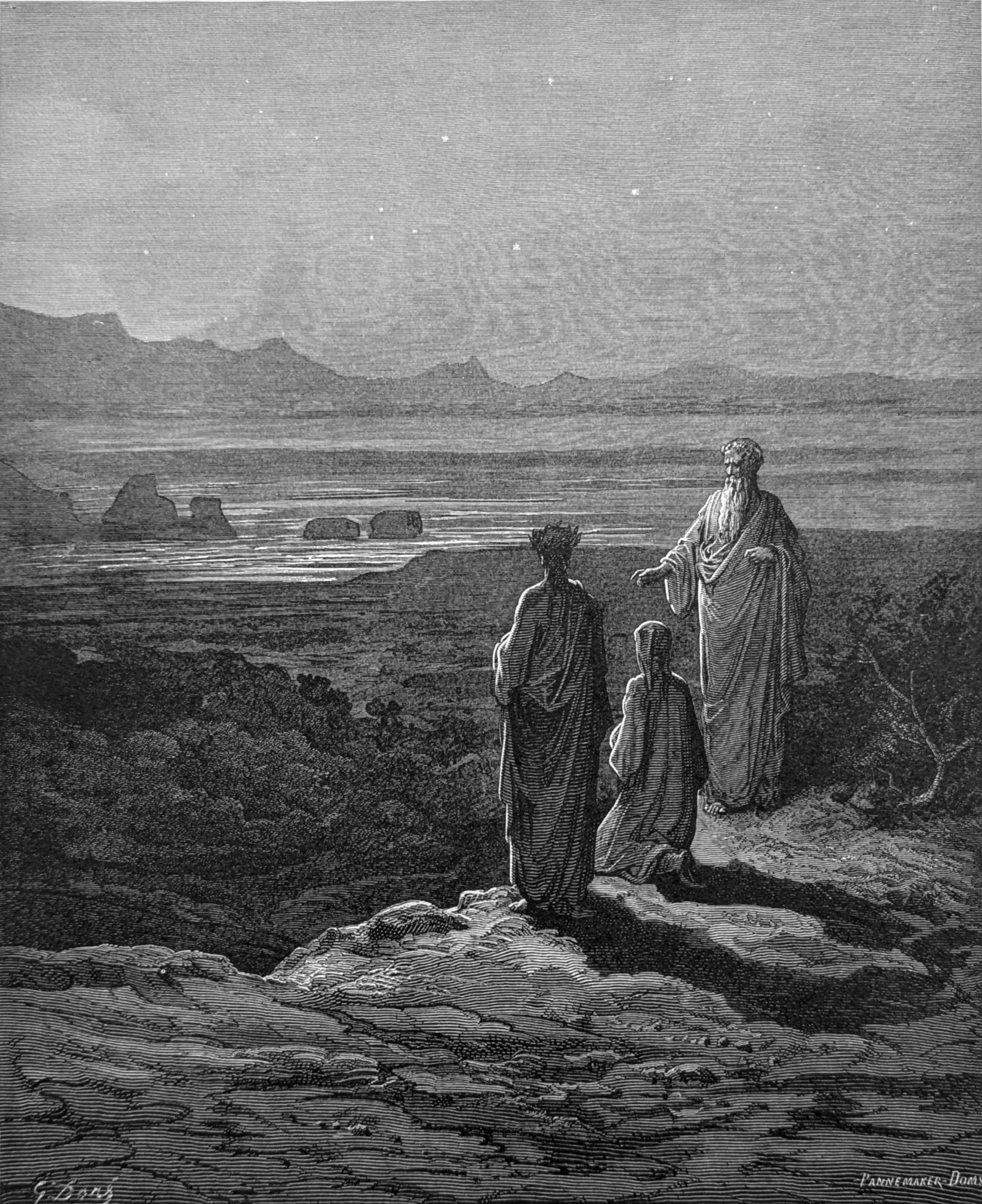
I saw beside me an old man alone, / Worthy of so much reverence in his look, / That more owes not to father any son. Purg. I, lines 31-33
Footnotes
1. The invocation of the sacred Muses is a standard device used by classical poets seeking the guidance of these sacred sisters and as an act of dedication to them. Recall that Dante invoked them near the beginning of the Inferno in Canto 2. And Dante himself is recalling how his poetic mentors (Virgil in Book IX of the Aeneid, and Ovid in Book V of his Metamorphoses) refer to the Muses. After invoking the aid of Calliope, the Muse of epic poetry, Dante refers to Ovid’s story of King Pierus of Macedonia who had nine daughters. Unwisely, he named them after each of the Muses. In their pride they challenged the Muses to a singing contest. Chosen by the Muses to represent them, Calliope defeated the nine foolish daughters of the king and turned them into magpies– -a fitting punishment for their pride. By using this particular story, Dante the Poet humbly begs the patronage and inspiration of this Muse of epic poetry to support him in his own epic undertaking-–imagining, perhaps, what a squawking failure it might be without divine assistance.
2. The thick darkness of the underworld is replaced by an almost infinite view of the sapphire sky. This is a fitting start to Easter–-the celebration of resurrection, of hope, and of eternal life. The presence of Venus reminds us of love, the most precious of the virtues; and the mention of sapphire reminds us of the precious stone and Medieval symbol of heaven in this cosmic display of eternal Love. Finally, as though to symbolize our having done with the realm of sin and death, Venus, representing Love, rises with the constellation of Pisces, the last of the twelve signs of the Zodiac, and outshines it. In a moment, the Sun will rise in Aries on the first day of Spring.
3. Dante turns right toward the south and observes four great stars in that part of the sky. He tells us that the only human ever to see them, up to this point, was Adam (and, by association, Eve). After the Fall, we must assume that they lived in the northern hemisphere. In Dante’s time, it was known that the earth was round, but the southern regions had not yet been explored.
4. Although this dignified elder is not named, Dante will subtly disclose his identity as Cato of Utica. He is the guardian of the lower region of Purgatory. Ancient Utica (now in ruins) was located near Carthage in present day Tunisia in Northern Africa. When it was founded by the Phoenicians in the eighth century BC, it was then a coastal city. It eventually came into the Roman Empire with its defeat by the forces of Julius Caesar. Refusing to submit to the tyranny of Caesar, Cato committed suicide in 46 BC. D ante admired this ancient Roman for his integrity, his virtuous character, and as a champion of freedom and liberty. It is, perhaps, in the context of this admiration that the Poet actually “saves” this noble pagan suicide and describes the travelers’ first encounter with him in such a striking manner. He is distinguished not only by his graying hair and beard but also by the light of the four stars (Cardinal Virtues) which illuminate his countenance. Although Cato’s face is lighted from the outside, the symbolism of virtue at work here clearly implies that it also enlightens one from within. Furthermore, as Dante states at the outset of this Canticle, all who come to Purgatory will strive to clear the darkness of sin within their souls so that the Divine Light can shine through them.
5. Virgil has had to explain the purpose of their journey before, and he proceeds to answer each of Cato’s questions, but not before he quickly makes Dante kneel down as a sign of submission and respect. Though he is clearly in charge, by virtue of his heavenly mandate, Virgil’s answers are both respectful and informative. As he offers his explanations, it is curious, however, that he sees the need to tell Cato that Dante is alive. One would think that Cato would have seen or known the difference between them al ready. As Virgil continues, though, he makes it abundantly clear that Dante was on the verge of moral death, and that he (Virgil) was sent to rescue him at the last minute. Guiding him through the depths of Hell and showing him the consequences sin was the only way to save him—a kind of moral shock therapy. Recall how, at the beginning of the Inferno, Dante had hoped to escape from the (his) moral wilderness, symbolized by the dark forest, by climbing the sun-lit mountain (of Purgatory?)–only to be driven back down by the three beasts of pride (the leopard), violence (the lion), and lust (the she-wolf). Virgil told him the only way climb out of his moral darkness was to go down into the depths of that darkness and face his sins head-on so that he could arrive here on the shore of Purgatory with a new moral purpose.
6. Continuing to exonerate Dante and himself, Virgil, attempts to make it clear to Cato that they haven’t broken any laws to get here by reminding him that Dante is alive and that he, Virgil, has not been judged by Minos. Recalling the structure of upper Hell, the souls are judged by Minos at the beginning of Canto 5. Virgil, however, resides in Limbo (along with Marcia), which is in Canto 4. And here, perhaps, he treads on thin ice in his attempt to move Cato by appealing to Cato’s love for his second wife, Marcia.
7. The story of Cato and Marcia is a touching one. She was born in 80 BC, the daughter of the Roman Consul Lucius Marcius Philippus. Apparently, Cato’s first wife was unfaithful and he divorced her. He later married Marcia, a woman of great virtue. They lived happily and had two (possibly three) children. Cato’s close friend, Quintus Hortensius Hortalus, was a famed orator and praised by Cicero. Following his wife’s death, and hoping to bring their families even closer, Hortensius asked Cato for his daughter’s h and in marriage. However, because there was a considerable age difference between them (nearly 40 years), Cato refused Hortensius’ request. However, not to be deterred, Hortensius asked to marry Marcia instead, on the grounds that they were close in age and that Marcia had already borne children and heirs to Cato’s name and estate. Because of their close friendship Cato agreed, but stipulated that Marcia’s father had to approve of the union–-which he did. Hortensius died in the year 50 BC after six years of marriage to Marcia, leaving her a very wealthy woman. When the civil war broke out the following year, Marcia returned to Cato.
8. They are to go down to the shore where they will find pliant reeds growing in the sand. Virgil will take one of the reeds and wrap it around Dante’s waist as a sign of humility and symbolic of one’s readiness to submit to the will of God. One of the marks o f humility is flexibility, and note how Cato remarked on the pliant nature of this plant. Ordinarily, reed plants wouldn’t be found growing at the edge of the sea. But the harsh conditions in which these reeds flourish points to how virtue both survives and surpasses a negative environment.
Top of page