Dante's Divine Comedy: Inferno
Canto XXX
This canto conveys the mental and physical corruption of Fraud in its multiple forms. Two mad Impersonators, Gianni Schicchi, member of the powerful Florentine Cavalcanti family, and Myrrha, incestuous daughter of King Cinyras of Cyprus, dash on to the scene. One bites into Capocchio's neck and drags him away. An immobile, dehumanized Counterfeiter, Master Adam, explains how his practice was positively encouraged by his patrons and points to the feverish shadows of two Liars, Potiphar's wife and Sinon the Greek. The latter argues with Master Adam. The pilgrim is once again chided for his fascination with such lowly creatures.
'Twas at the time when Juno was enraged,
For Semele, against the Theban blood,
As she already more than once had shown,[1]
So reft of reason Athamas became,
That, seeing his own wife with children twain
Walking encumbered upon either hand,
He cried: "Spread out the nets, that I may take
The lioness and her whelps upon the passage;"
And then extended his unpitying claws,
Seizing the first, who had the name Learchus,
And whirled him round, and dashed him on a rock;
And she, with the other burthen, drowned herself;--
And at the time when fortune downward hurled
The Trojan's arrogance, that all things dared,
So that the king was with his kingdom crushed,
Hecuba sad, disconsolate, and captive,
When lifeless she beheld Polyxena,
And of her Polydorus on the shore[2]
Of ocean was the dolorous one aware,
Out of her senses like a dog she barked,
So much the anguish had her mind distorted;
But not of Thebes the furies nor the Trojan
Were ever seen in any one so cruel
In goading beasts, and much more human members,
As I beheld two shadows pale and naked,
Who, biting, in the manner ran along
That a boar does, when from the sty turned loose.
One to Capocchio came, and by the nape
Seized with its teeth his neck, so that in dragging
It made his belly grate the solid bottom.[3]
And the Aretine, who trembling had remained,
Said to me: "That mad sprite is Gianni Schicchi,
And raving goes thus harrying other people."[4]
"O," said I to him, "so may not the other
Set teeth on thee, let it not weary thee
To tell us who it is, ere it dart hence."
And he to me: "That is the ancient ghost
Of the nefarious Myrrha, who became
Beyond all rightful love her father's lover.[5]
She came to sin with him after this manner,
By counterfeiting of another's form;
As he who goeth yonder undertook,
That he might gain the lady of the herd,
To counterfeit in himself Buoso Donati,
Making a will and giving it due form."[6]
And after the two maniacs had passed
On whom I held mine eye, I turned it back
To look upon the other evil-born.
I saw one made in fashion of a lute,
If he had only had the groin cut off
Just at the point at which a man is forked.
The heavy dropsy, that so disproportions
The limbs with humors, which it ill concocts,
That the face corresponds not to the belly,
Compelled him so to hold his lips apart
As does the hectic, who because of thirst
One tow'rds the chin, the other upward turns.
"O ye, who without any torment are,
And why I know not, in the world of woe,"
He said to us, "behold, and be attentive
Unto the misery of Master Adam;
I had while living much of what I wished,
And now, alas! a drop of water crave.[7]
The rivulets, that from the verdant hills
Of Cassentin descend down into Arno,
Making their channels to be cold and moist,
Ever before me stand, and not in vain;
For far more doth their image dry me up
Than the disease which strips my face of flesh.
The rigid justice that chastises me
Draweth occasion from the place in which
I sinned, to put the more my sighs in flight.
There is Romena, where I counterfeited
The currency imprinted with the Baptist,
For which I left my body burned above.[8]
But if I here could see the tristful soul
Of Guido, or Alessandro, or their brother,
For Branda's fount I would not give the sight.
One is within already, if the raving
Shades that are going round about speak truth;
But what avails it me, whose limbs are tied?
If I were only still so light, that in
A hundred years I could advance one inch,
I had already started on the way,
Seeking him out among this squalid folk,
Although the circuit be eleven miles,
And be not less than half a mile across.
For them am I in such a family;
They did induce me into coining florins,
Which had three carats of impurity."
And I to him: "Who are the two poor wretches
That smoke like unto a wet hand in winter,
Lying there close upon thy right-hand confines?"
"I found them here," replied he, "when I rained
Into this chasm, and since they have not turned,
Nor do I think they will for evermore.
One the false woman is who accused Joseph,
The other the false Sinon, Greek of Troy;
From acute fever they send forth such reek."[9]
And one of them, who felt himself annoyed
At being, peradventure, named so darkly,
Smote with the fist upon his hardened paunch.
It gave a sound, as if it were a drum;
And Master Adam smote him in the face,
With arm that did not seem to be less hard,
Saying to him: "Although be taken from me
All motion, for my limbs that heavy are,
I have an arm unfettered for such need."
Whereat he answer made: "When thou didst go
Unto the fire, thou hadst it not so ready:
But hadst it so and more when thou wast coining."
The dropsical: "Thou sayest true in that;
But thou wast not so true a witness there,
Where thou wast questioned of the truth at Troy."
"If I spake false, thou falsifiedst the coin,"
Said Sinon; "and for one fault I am here,
And thou for more than any other demon."
"Remember, perjurer, about the horse,"
He made reply who had the swollen belly,
"And rueful be it thee the whole world knows it."
"Rueful to thee the thirst be wherewith cracks
Thy tongue," the Greek said, "and the putrid water
That hedges so thy paunch before thine eyes."
Then the false-coiner: "So is gaping wide
Thy mouth for speaking evil, as 'tis wont;
Because if I have thirst, and humor stuff me
Thou hast the burning and the head that aches,
And to lick up the mirror of Narcissus
Thou wouldst not want words many to invite thee."
In listening to them was I wholly fixed,
When said the Master to me: "Now just look,
For little wants it that I quarrel with thee."
When him I heard in anger speak to me,
I turned me round towards him with such shame
That still it eddies through my memory.
And as he is who dreams of his own harm,
Who dreaming wishes it may be a dream,
So that he craves what is, as if it were not;
Such I became, not having power to speak,
For to excuse myself I wished, and still
Excused myself, and did not think I did it.
"Less shame doth wash away a greater fault,"
The Master said, "than this of thine has been;
Therefore thyself disburden of all sadness,
And make account that I am aye beside thee,
If e'er it come to pass that fortune bring thee
Where there are people in a like dispute;
For a base wish it is to wish to hear it."
Illustrations
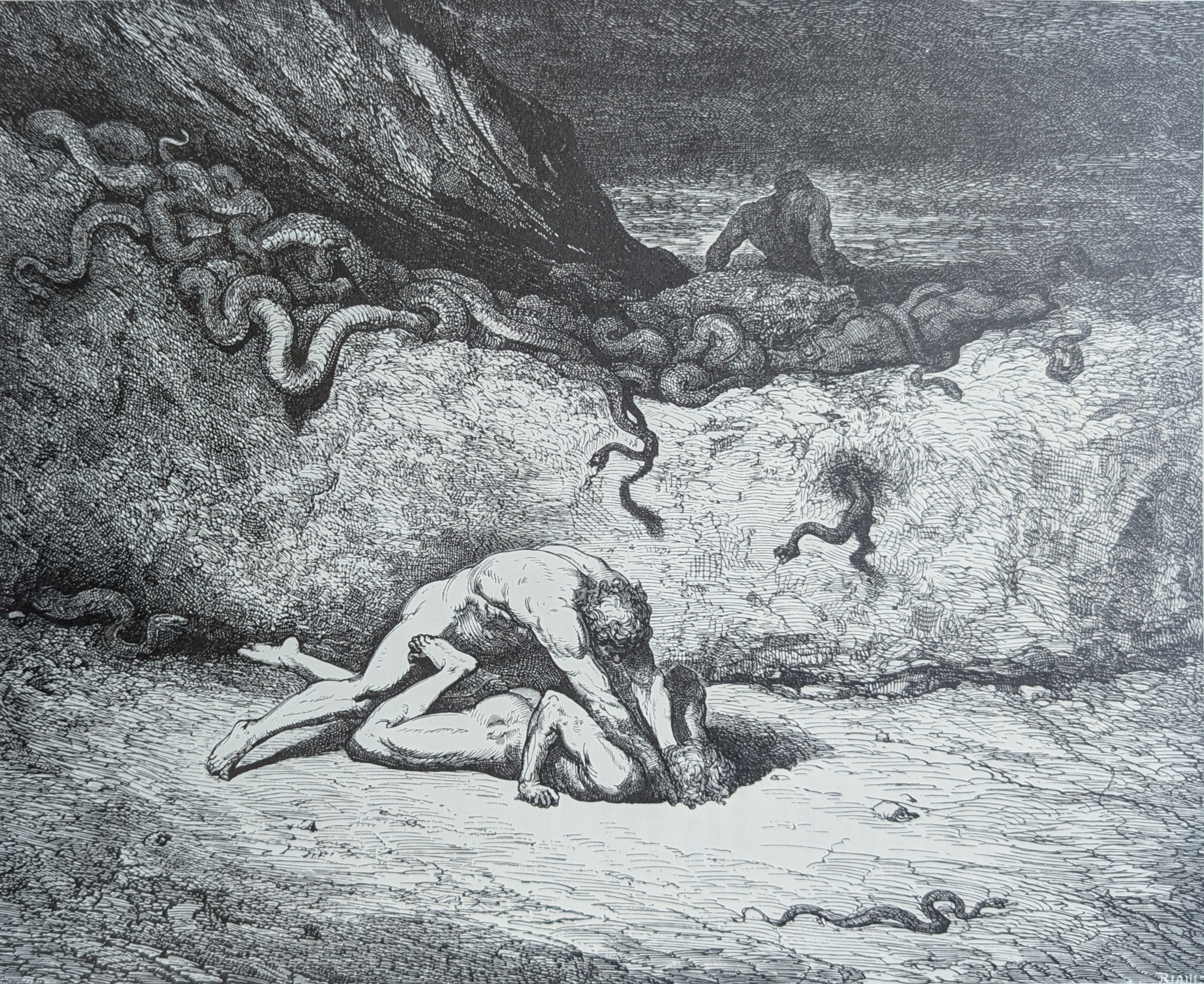
"That mad sprite is Gianni Schicchi, / And raving goes thus harrying other people." Inf. XXX, lines 32-33
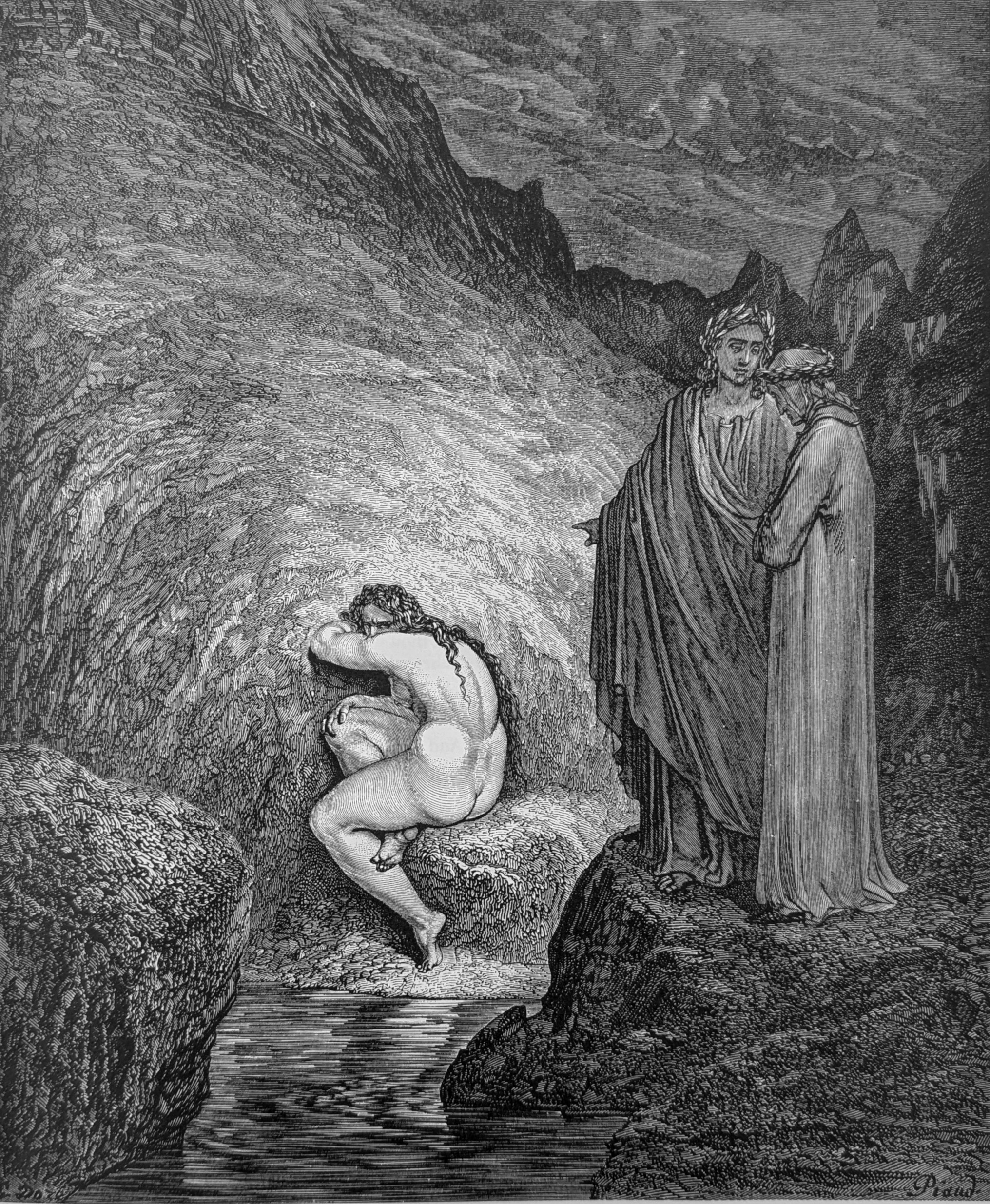
"That is the ancient ghost / Of the nefarious Myrrha, who became / Beyond all rightful love her father's lover." Inf. XXX, lines 37-39
Footnotes
1. Dante continues in the same vein, adapting his story from Ovid. Jupiter (Juno) had an affair with Semele, the daughter of King Cadmus of Thebes, and she gave birth to Bacchus. In a rage of jealousy Juno had Semele killed by lightning, and then sent Tisiphone (one of the Furies; recall them from Canto 9) to strike Athamas, King of Boeotia, with madness. One day, Athamas saw his wife, Ino (sister of Semele), bringing him his two sons. In what seems to have been a fit of hallucination, he thought she was a lioness with her cubs. Athamas then killed Learchus and following that, the grief-stricken Ino threw herself off a cliff into the sea with her other son, Melicertes.
2. In the aftermath of the Trojan war, Hecuba, queen of Troy, and her daughter, Polyxena, were taken captive by the Greeks. Polyxena was later slain as a funeral offering for Achilles, and Hecuba, mourning for her by the seashore, there also discovered the washed-up body of her murdered son, Polydorus. She went mad with grief and her mournful cries were like those of a mad dog.
3. Capocchio, who seemed so chatty in the previous canto, is dragged away by the nape of his neck like the prey of some wild beast. And to drop whatever may be left of human dignity at this point, Dante adds the rather embarrassing note that Capocchio’s fat belly scraped along the ground as he was dragged away.
4. Gianni Schicchi, along with Myrrha whom we will soon meet, are here because they were impersonators-–falsifiers of people. Gianni Schicchi (d. 1280) was a member of the famous Cavalcanti family of Florence (recall Cavalcante dei Cavalcanti and his son, Guido, in Canto 10. Guido was probably Dante’s closest friend.). He was a notorious impersonator. Cleverly, madness is the contrapasso for Gianni Schicchi the impersonator. He’s lost his real identity and rushes about like a rabid animal.
5. Myrrha and Gianni were falsifiers by impersonation and they are “the only two sinners in the Commedia who are mentally deranged.” Myrrha was the daughter of Cinyras, the King of Cyprus (thus Dante, who borrows this story from Ovid’s Metamorphoses, refers to her as an “ancient” shade). She developed an unquenchable sexual passion for her father, and with the help of her old nurse, and in the absence of her mother, fooled the king-–on several nights-–into thinking she was someone else. Realizing one night that his mate was, in fact, his daughter, Cinyras ran for his sword in attempt to kill her. By now, already pregnant, Myrrah ran away and escaped the horrified king’s wrath. She prayed to the gods to take her from this life and was transformed into a myrtle tree.
6. Gianni’s uncle, Buoso Donati (1180-1250), died, but his death was concealed for a bit. His son, Simone, feared that he would be cut out of his father’s estate. Gianni was a good friend of Simone, who engaged him to impersonate the dying old man, call for the notaries, and change his will in Simone’s favor on his deathbed. This Gianni did with such perfection that the fraud apparently was never discovered. And before signing the false document, Gianni willed to himself a prized she-mule.
7. We now come to the third group of falsifiers, those who falsified money. Counterfeiting money is a way of bloating out of proportion something that is already rotten. The end product seems to have value but, as the saying goes, it’s not worth the paper it’s printed on. Dante’s description of Master Adamo portrays his mid-body as so bloated by fluid (dropsy) that it might burst at any moment. He’s a physical representation of his sin. His comparison to a lute is both a nasty comment and appropriate. Adamo suffers physical pain because of his disease, but he suffers a deeper “dis-ease” as he remembers happier times in a world where he enjoyed all the comforts. All of these together comprise his contrapasso. Edema or fluid retention in the body is often caused by congestive heart failure, among other organ failures. In Dante’s time this would have been unknown, but the idea of “failure of the heart” is a good image for what Adamo’s counterfeiting has done to the currency. His edema is also ironic. He’s so filled wit h fluid that he could burst, but he’s also dying of thirst caused by his remembrance of the lovely Casentino region southeast of Florence where the Arno has its source.
8. Dante calls Adam maestro Adamo (Master Adam) because he was known as a consummate counterfeiter whose coins bore the same weight as an original gold florin. And, interestingly, it was the Florentines who eventually caught him and had him burned at the stake for his crimes. The Florentine florin was made of 24-carat gold and was first minted by the Republic in 1252. Because Florentine banks and businesses had operations all over Europe, the florin soon became one of the major currencies of Europe for the next three hundred years. One side of the coin had an image of St. John the Baptist, patron saint of Florence; and on the other side was a fleur-de-lis, the heraldic lily flower of Florence. The name fiorino or “florin” comes from the word fiore which means “f lower” in Italian.
Adamo worked as a counterfeiter for the Counts of Guidi (Guido, Alessandro, Aghinolfo, and Ildebrandino) at their castle at Romena in the Casentino region. The brother already here in Hell is most likely Guido, who died before 1300, the date the Poem is said to have taken place. The others were alive after that. Adamo, blaming the Guidi brothers for his crime (typical in Hell), strikes a vengeful note when he tells Dante that he would go looking for Guido if it weren’t for his incapacitating dropsy – even if he could only go an inch every hundred years. In the mean time, he dreams of drinking from the cool waters of the spring of Branda near Romena.
Top of page