Dante's Divine Comedy: Inferno
Canto II
The end of the day has come and Dante is having doubts. He does not feel worthy enough to undertake his journey. Virgil accuses him of cowardice and tells of how the Virgin Mary turned to Saint Lucia, who in turn asked for Beatrice, Dante's love, to go down into Limbo, where Virgil resides. There Beatrice, with 'voice angelical', asked Virgil to assist Dante, whose way was impeded. At this, Dante is heartened, and declares to Virgil that 'one sole will is in us both'.
Day was departing, and the embrowned air
Released the animals that are on Earth
From their fatigues; and I the only one
Made myself ready to sustain the war,
Both of the way and likewise of the woe,
Which memory that errs not shall retrace.
O Muses, O high genius, now assist me!
O memory, that didst write down what I saw,
Here thy nobility shall be manifest![1]
And I began: "Poet, who guidest me,
Regard my manhood, if it be sufficient,
Ere to the arduous pass thou dost confide me.
Thou sayest, that of Silvius the parent,
While yet corruptible, unto the world
Immortal went, and was there bodily.
But if the adversary of all evil
Was courteous, thinking of the high effect
That issue would from him, and who, and what,
To men of intellect unmeet it seems not;
For he was of great Rome, and of her empire
In the empyreal heaven as father chosen;
The which and what, wishing to speak the truth,
Were established as the holy place, wherein
Sits the successor of the greatest Peter.
Upon this journey, whence thou givest him vaunt,
Things did he hear, which the occasion were
Both of his victory and the papal mantle.
Thither went afterwards the Chosen Vessel,
To bring back comfort thence unto that Faith,
Which of salvation's way is the beginning.
But I, why thither come, or who concedes it?
I not Aeneas am, I am not Paul,
Nor I, nor others, think me worthy of it.[2]
Therefore, if I resign myself to come,
I fear the coming may be ill-advised;
Thou'rt wise, and knowest better than I speak."
And as he is, who unwills what he willed,
And by new thoughts doth his intention change,
So that from his design he quite withdraws,
Such I became, upon that dark hillside,
Because, in thinking, I consumed the emprise,
Which was so very prompt in the beginning.
"If I have well thy language understood,"
Replied that shade of the Magnanimous,
"Thy soul attainted is with cowardice,
Which many times a man encumbers so,
It turns him back from honored enterprise,
As false sight doth a beast, when he is shy.
That thou mayst free thee from this apprehension,
I'll tell thee why I came, and what I heard
At the first moment when I grieved for thee.
Among those was I who are in suspense,
And a fair, saintly Lady called to me
In such wise, I besought her to command me.
Her eyes were shining brighter than the Star;
And she began to say, gentle and low,
With voice angelical, in her own language:
'O spirit courteous of Mantua,
Of whom the fame still in the world endures,
And shall endure, long-lasting as the world;[3]
A friend of mine, and not the friend of fortune,
Upon the desert slope is so impeded
Upon his way, that he has turned through terror,
And may, I fear, already be so lost,
That I too late have risen to his succor,
From that which I have heard of him in Heaven.
Bestir thee now, and with thy speech ornate,
And with what needful is for his release,
Assist him so, that I may be consoled.
Beatrice am I, who do bid thee go;
I come from there, where I would fain return;
Love moved me, which compelleth me to speak.[3]
When I shall be in presence of my Lord,
Full often will I praise thee unto him.'
Then paused she, and thereafter I began:
'O Lady of virtue, thou alone through whom
The human race exceedeth all contained
Within the heaven that has the lesser circles,
So grateful unto me is thy commandment,
To obey, if 'twere already done, were late;
No farther need'st thou ope to me thy wish.
But the cause tell me why thou dost not shun
The here descending down into this center,
From the vast place thou burnest to return to.'
'Since thou wouldst fain so inwardly discern,
Briefly will I relate,' she answered me,
'Why I am not afraid to enter here.
Of those things only should one be afraid
Which have the power of doing others harm;
Of the rest, no; because they are not fearful.
God in his mercy such created me
That misery of yours attains me not,
Nor any flame assails me of this burning.
A gentle Lady is in Heaven, who grieves
At this impediment, to which I send thee,
So that stern judgment there above is broken.
In her entreaty she besought Lucia,
And said, "Thy faithful one now stands in need
Of thee, and unto thee I recommend him."
Lucia, foe of all that cruel is,
Hastened away, and came unto the place
Where I was sitting with the ancient Rachel.
"Beatrice" said she, "the true praise of God,
Why succorest thou not him, who loved thee so,
For thee he issued from the vulgar herd?[5]
Dost thou not hear the pity of his plaint?
Dost thou not see the death that combats him
Beside that flood, where ocean has no vaunt?"
Never were persons in the world so swift
To work their weal and to escape their woe,
As I, after such words as these were uttered,
Came hither downward from my blessed seat,
Confiding in thy dignified discourse,
Which honors thee, and those who've listened to it.'
After she thus had spoken unto me,
Weeping, her shining eyes she turned away;
Whereby she made me swifter in my coming;
And unto thee I came, as she desired;
I have delivered thee from that wild beast,
Which barred the beautiful mountain's short ascent.
What is it, then? Why, why dost thou delay?
Why is such baseness bedded in thy heart?
Daring and hardihood why hast thou not,
Seeing that three such Ladies benedight
Are caring for thee in the court of Heaven,
And so much good my speech doth promise thee?"
Even as the flowerets, by nocturnal chill,
Bowed down and closed, when the sun whitens them,
Uplift themselves all open on their stems;
Such I became with my exhausted strength,
And such good courage to my heart there coursed,
That I began, like an intrepid person:
"O she compassionate, who succored me,
And courteous thou, who hast obeyed so soon
The words of truth which she addressed to thee!
Thou hast my heart so with desire disposed
To the adventure, with these words of thine,
That to my first intent I have returned.
Now go, for one sole will is in us both,
Thou Leader, and thou Lord, and Master thou."
Thus said I to him; and when he had moved,
I entered on the deep and savage way.
Illustrations
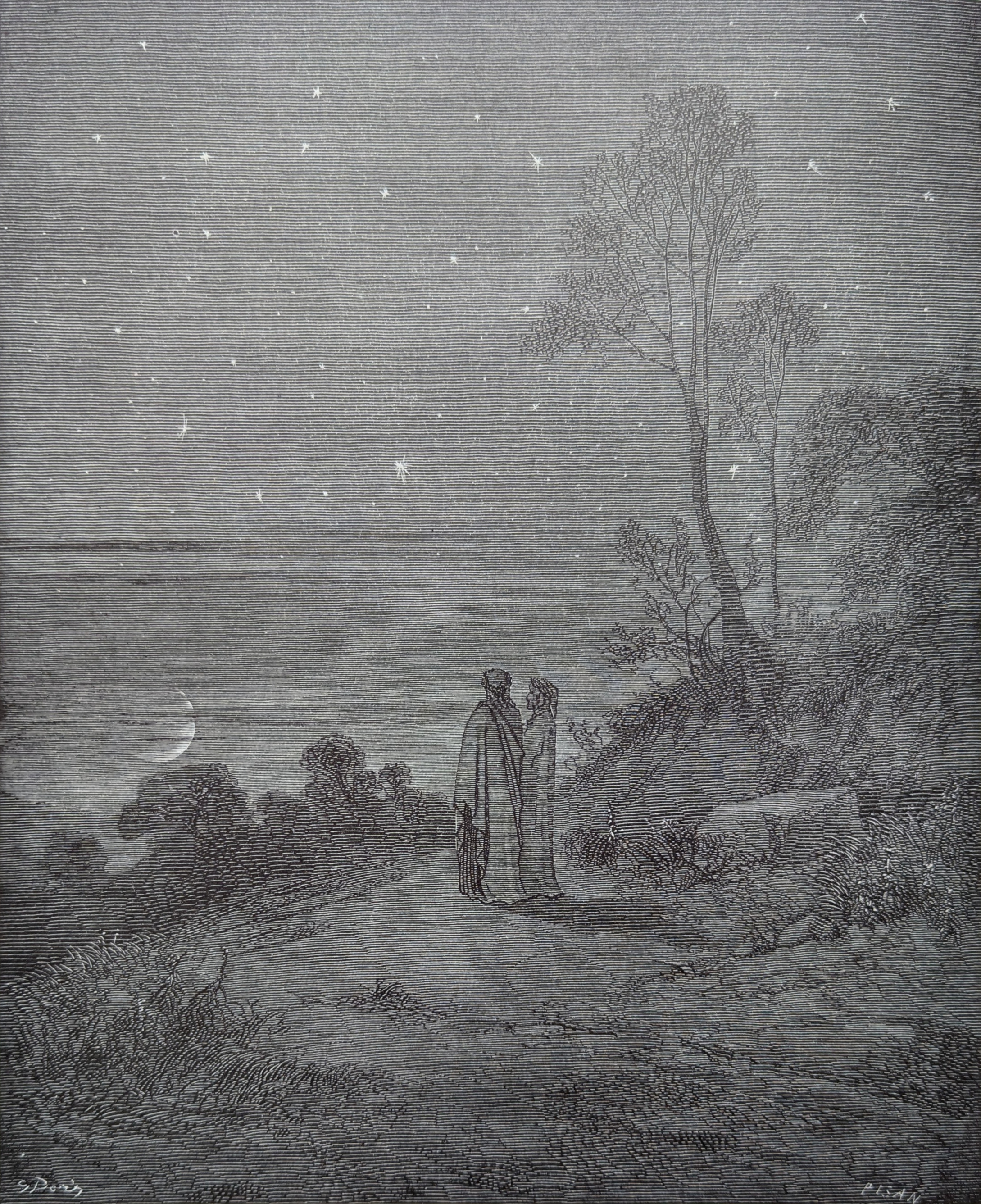
Day was departing, Inf. II, line 1
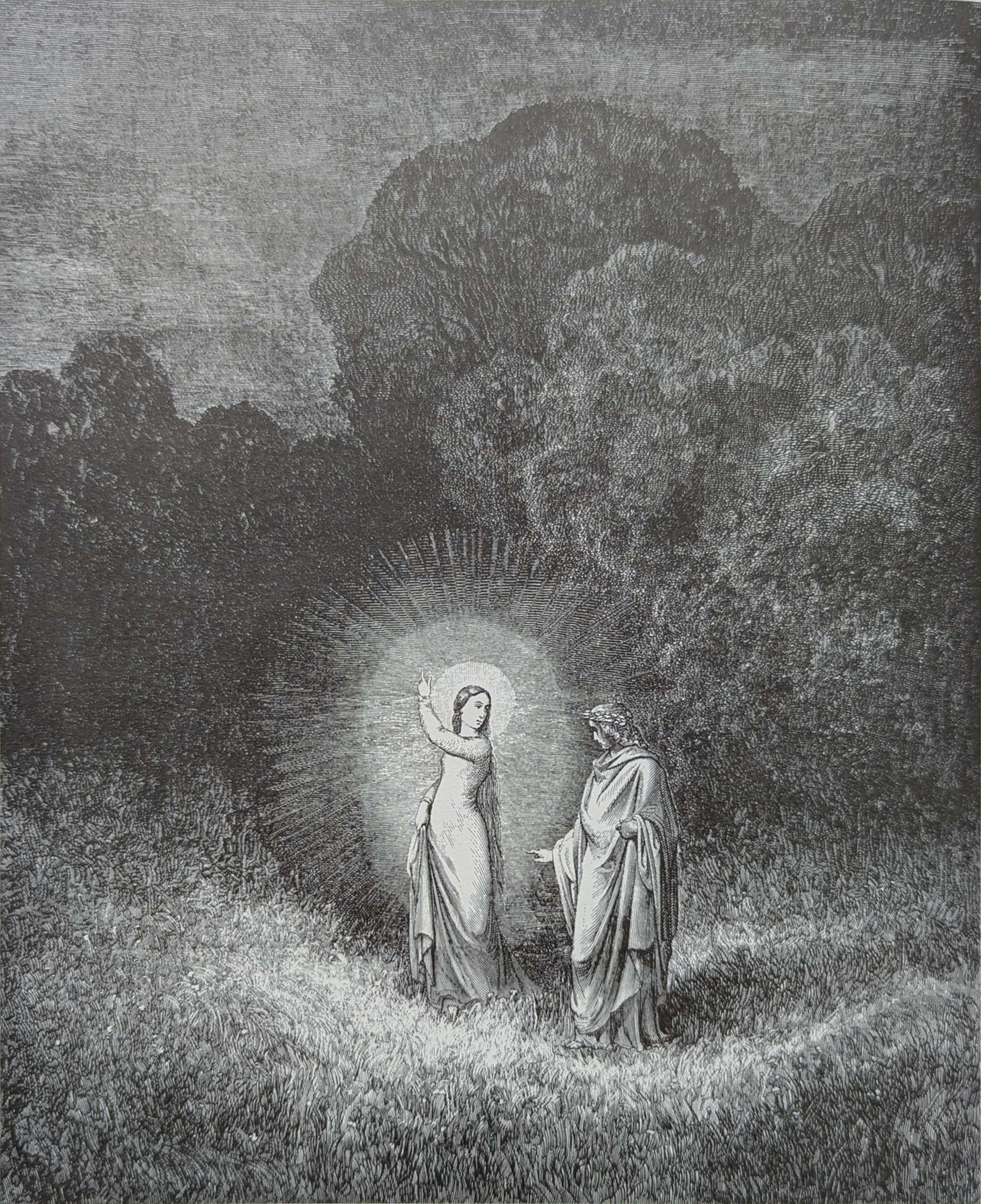
"Beatrice am I, who do bid thee go;" Inf. II, line 70
Footnotes
1. The invocation of the Muses from Greek antiquity – who inspired and personified the various arts and sciences – was a common feature of classical writing, particularly the great epics of Homer and Virgil. And since Dante was particularly inspired and mentored by Virgil’s Aeneid, he brings this literary flourish into his own epic poem and thus links his poem with those of the great classical tradition. As a matter of fact, he will invoke the Muses nine times throughout his poem. And while they are figures from the pagan past, Dante clearly has in mind his Christian God as the “high genius” who inspires him. Is there, perhaps, also an advertisement here of Dante’s genius?
2. One might think of Dante as the new Aeneas, and while Aeneas was Virgil’s protagonist, Dante is Dante’s protagonist.
For Dante, the Roman Empire (Rome) was ordained by God to be the place where, after the Christian faith was established, St. Peter and his successor popes would govern the Church. Dante will touch on this theme several more times in his poem.
3. In a few lines we will discover that it is Beatrice who is speaking to Virgil. His description of her loveliness here is but a foretaste of how Dante will continually expound on her beauty till the end of the poem – once he meets her in person.
4. Tradition has it that Virgil was born near the city of Mantua in north central Italy.
5. Beatrice Portinari was a contemporary and neighbor of Dante, born in Florence in 1265 (the same year as Dante) and died in 1290. Let me state unequivocally from the outset: Beatrice and Dante were not lovers! This being said, a careless reader of the Comedy might be tempted to assume the opposite, seeing the significant role she plays in the poem and the ever more affectionate manner in which Dante describes her right to the very end. Nevertheless, he tells us that from his youth and until she died at the age of 25, she entered his heart and never left it. But this is the stuff of poetry, and in 1295, Dante would, in fact, publish a significant collection of poems and commentary about this lovely young woman which he called the Vita Nuova (the New Life). As I mentioned in an earlier note, Beatrice was the motivation, the energy that fueled Dante’s Comedy from beginning to end. She was his Muse, his inspiration, and she represented for him all that was good and beautiful and virtuous. Just as Virgil represents human reason as far as it can go, Beatrice represents the truth of divine revelation, which takes up where reason leaves off. More than just a symbol, though, she is, like Dante, quite real. While there was considerable “fire” on Dante’s part when they were young, he seems to have encountered Beatrice rather infrequently, though she certainly made her mark on him. When she was 20, she married a wealthy banker and died a few years later. Dante married Gemma Donati when he, too, was 20, and had a daughter and three sons with her.
Top of page