Dante's Divine Comedy: Inferno
Canto VI
The Gluttons, denizens of the Third Circle, are sunk in fetid mud and pelted by hail, rain and snow. Virgil placates the three-headed Cerberus, their bellicose guardian, by feeding his appetite with fistfuls of earth. Ciacco, a contemporary of Dante, approaches the pair of travelers and makes a political prophecy about Florence. Dante asks Virgil about the Last Judgment as the two poets approach the next circle.[1]
At the return of consciousness, that closed
Before the pity of those two relations,
Which utterly with sadness had confused me,
New torments I behold, and new tormented
Around me, whichsoever way I move,
And whichsoever way I turn, and gaze.
In the third circle am I of the rain
Eternal, maledict, and cold, and heavy;
Its law and quality are never new.
Huge hail, and water somber-hued, and snow,
Athwart the tenebrous air pour down amain;
Noisome the earth is, that receiveth this.
Cerberus, monster cruel and uncouth,
With his three gullets like a dog is barking
Over the people that are there submerged.[2]
Red eyes he has, and unctuous beard and black,
And belly large, and armed with claws his hands;
He rends the spirits, flays, and quarters them.
Howl the rain maketh them like unto dogs;
One side they make a shelter for the other;
Oft turn themselves the wretched reprobates.[3]
When Cerberus perceived us, the great worm!
His mouths he opened, and displayed his tusks;
Not a limb had he that was motionless.
And my Conductor, with his spans extended,
Took of the earth, and with his fists well filled,
He threw it into those rapacious gullets.
Such as that dog is, who by barking craves,
And quiet grows soon as his food he gnaws,
For to devour it he but thinks and struggles,
The like became those muzzles filth-begrimed
Of Cerberus the demon, who so thunders
Over the souls that they would fain be deaf.
We passed across the shadows, which subdues
The heavy rain-storm, and we placed our feet
Upon their vanity that person seems.
They all were lying prone upon the earth,
Excepting one, who sat upright as soon
As he beheld us passing on before him.
"O thou that art conducted through this Hell,"
He said to me, "recall me, if thou canst;
Thyself wast made before I was unmade."
And I to him: "The anguish which thou hast
Perhaps doth draw thee out of my remembrance,
So that it seems not I have ever seen thee.
But tell me who thou art, that in so doleful
A place art put, and in such punishment,
If some are greater, none is so displeasing."
And he to me: "Thy city, which is full
Of envy so that now the sack runs over,
Held me within it in the life serene.
You citizens were wont to call me Ciacco;
For the pernicious sin of gluttony
I, as thou seest, am battered by this rain.[4]
And I, sad soul, am not the only one,
For all these suffer the like penalty
For the like sin;" and word no more spake he.
I answered him: "Ciacco, thy wretchedness
Weighs on me so that it to weep invites me;
But tell me, if thou knowest, to what shall come
The citizens of the divided city;
If any there be just; and the occasion
Tell me why so much discord has assailed it."
And he to me: "They, after long contention,
Will come to bloodshed; and the rustic party
Will drive the other out with much offense.
Then afterwards behooves it this one fall
Within three suns, and rise again the other
By force of him who now is on the coast.
High will it hold its forehead a long while,
Keeping the other under heavy burdens,
Howe'er it weeps thereat and is indignant.
The just are two, and are not understood there;
Envy and Arrogance and Avarice
Are the three sparks that have all hearts enkindled."[5]
Here ended he his tearful utterance;
And I to him: "I wish thee still to teach me,
And make a gift to me of further speech.
Farinata and Tegghiaio, once so worthy,
Jacopo Rusticucci, Arrigo and Mosca,
And others who on good deeds set their thoughts,[6]
Say where they are, and cause that I may know them;
For great desire constraineth me to learn
If Heaven doth sweeten them, or Hell envenom."
And he: "They are among the blacker souls;
A different sin down-weighs them to the bottom;
If thou so far descendest, thou canst see them.
But when thou art again in the sweet world,
I pray thee to the mind of others bring me;
No more I tell thee and no more I answer."
Then his straightforward eyes he turned askance,
Eyed me a little, and then bowed his head;
He fell therewith prone like the other blind.
And the Guide said to me: "He wakes no more
This side the sound of the angelic trumpet;
When shall approach the hostile Potentate,
Each one shall find again his dismal tomb,
Shall reassume his flesh and his own figure,
Shall hear what through eternity re-echoes."
So we passed onward o'er the filthy mixture
Of shadows and of rain with footsteps slow,
Touching a little on the future life.
Wherefore I said: "Master, these torments here,
Will they increase after the mighty sentence,
Or lesser be, or will they be as burning?"
And he to me: "Return unto thy science,
Which wills, that as the thing more perfect is,
The more it feels of pleasure and of pain.
Albeit that this people maledict
To true perfection never can attain,
Hereafter more than now they look to be."
Round in a circle by that road we went,
Speaking much more, which I do not repeat;
We came unto the point where the descent is;
There we found Plutus the great enemy.
Illustrations
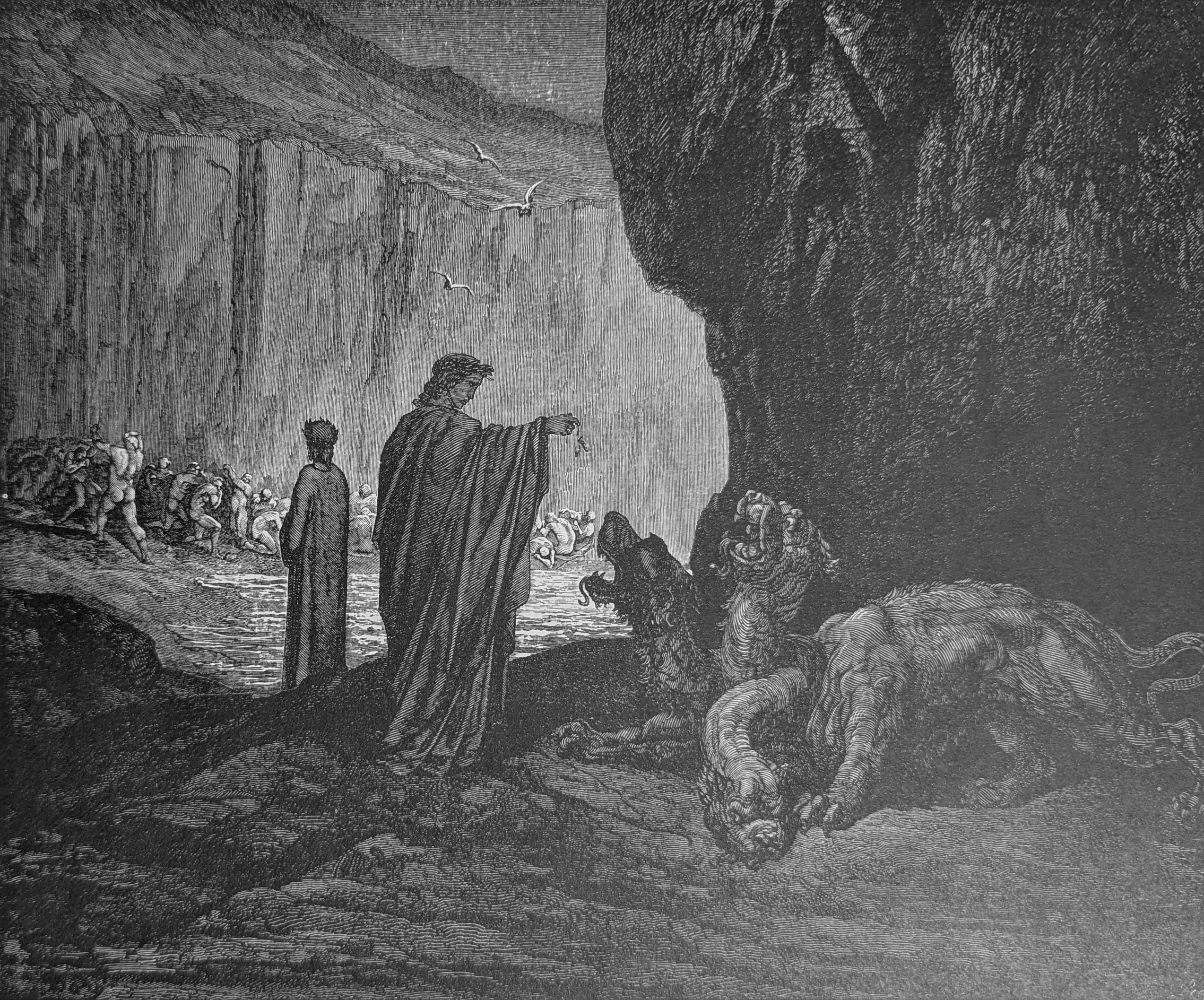
And my Conductor, with his spans extended, /Took of the earth, and with his fists well filled, / He threw it into those rapacious gullets. Inf. VI, lines 25-27
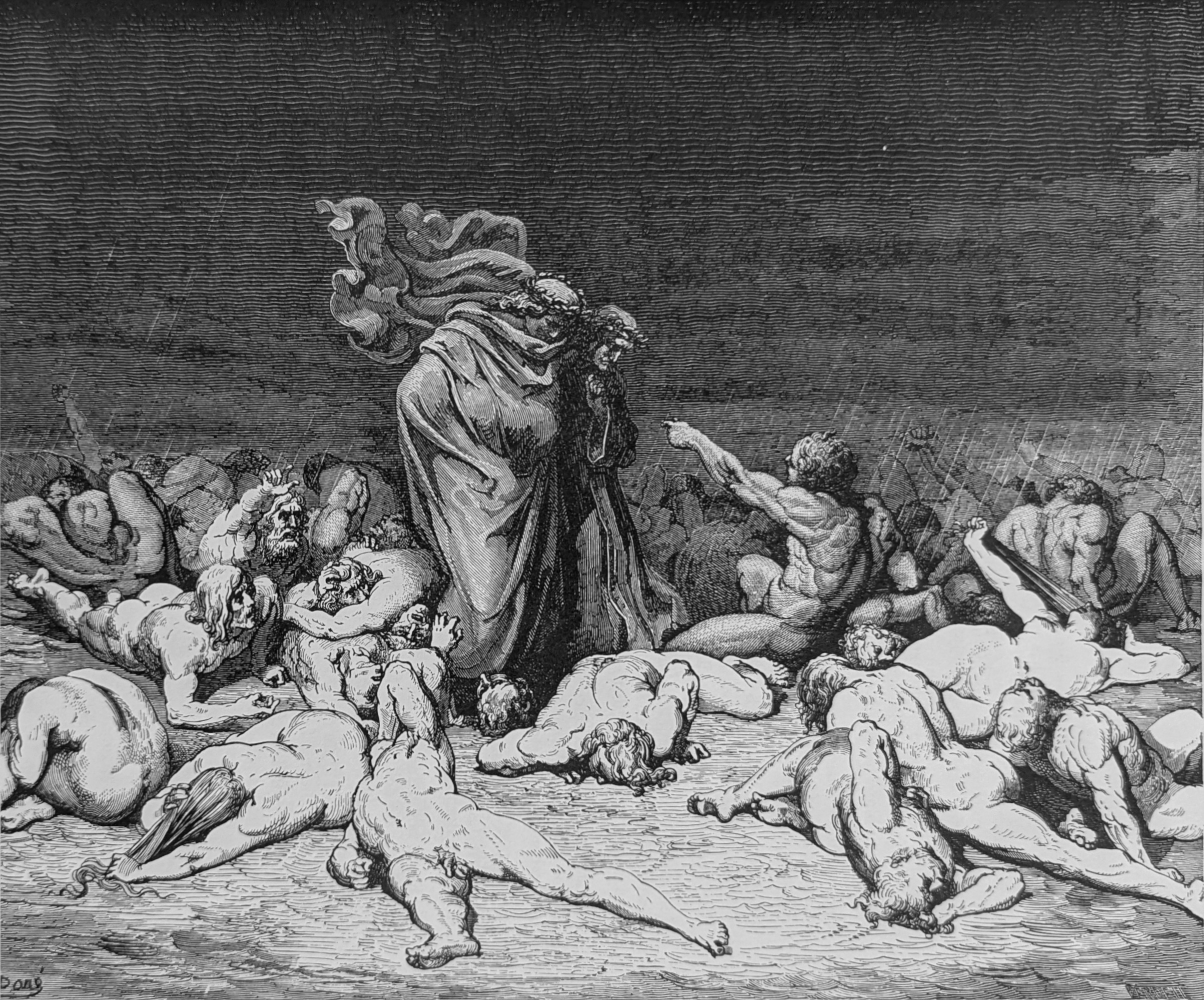
"For the pernicious sin of gluttony / I, as thou seest, am battered by this rain." Inf. VI, lines 53-54
Footnotes
1. Dante’s transitions are sometimes mysterious. Recall that he had also fainted at the end of Canto 3 and we weren’t told how he and Virgil arrived in Limbo in Canto 4. The same thing happens here: after Dante’s swoon at the end of the previous canto, we are not told how he arrives here.
In this third circle of Hell, Dante will encounter another group of incontinent sinners who enslaved their reasons with their appetites--literally. The gluttons. It is no accident that the “weather” has changed drastically here. The torrential and eternal rain, snow, slush--and stench--are all part of the contrapasso for Gluttony, which often seems like a kind of convivial sin of partying, eating, drinking, merry-making, relaxing, making yourself at home. Instead of rich foods, these sinners feast on muck!
2. In classical mythology, Cerberus was the three-headed dog who guarded the entrance to the Underworld. He allowed souls to enter, but none could leave. He appears in the epics of Homer and Virgil. Some legends made him even more terrible as a ravening beast that eats the bodies of the dead. Cerberus is another guardian of Hell that Dante has adapted from classical mythology. Furthermore, one cannot miss the parody of the Trinity in this three-headed monster.
3. Ah! This is an additional aspect of the contrapasso in this place. The sinners are ripped and mangled, just as they ripped and mangled the food they ate, acting like ravenous dogs.
4. Ciacco’s phrase that Florence is “overflowing with envy” is ironic. Ciacco the glutton knows well the meaning of “overflowing.” That he led the “high-life” contrasts with his eternal punishment to live the “low-life” in the muck and slop of Hell. That he first identifies himself with his bestial nickname indicates that his attachment to his sin virtually erased his true identity--such that Dante tells him he doesn’t recognize him because he is “completely misshaped.”
Ciacco identified himself by his rather disgusting nickname--Hog. Dante must have known him, or known of him because here he calls him by name. Hardly a thing is known about this person, except that--if we take Dante at his word here--he lived in Florence and was well-known there as a bon vivant.
5. This is the first of many occasions throughout the poem that the wickedness of Dante’s (former) hometown will be highlighted—either by souls he meets or by himself. Ciacco’s phrase that Florence is “overflowing with envy” is ironic. Ciacco the glutton knows well the meaning of “overflowing.” That he led the “high-life” contrasts with his eternal punishment to live the “low-life” in the muck and slop of Hell. That he first identifies himself with his bestial nickname indicates that his attachment to his sin virtually erased his true identity—such that Dante tells him he doesn’t recognize him because he is “completely misshaped.”
6. Farinata degli Uberti was a member of the Ghibelline party and was involved twice in expelling the Guelphs from Florence. He is in the circle of the heretics and we will meet him in Canto 10. Tegghiaio Aldobrandi was a member of the Guelph party and fought in the famous battle of Montaperti in which Florence was defeated, though he had tried to persuade them not to engage the Sienese. Not much is known of Jacopo Rusticucci, who was also a member of the Guelph faction and may have been a diplomat. Both Tegghaio and Jacopo will be found in the circle of the sodomites in Canto 16. Mosca dei Lamberti is a particularly despicable character in Florentine history because the long period of civil strife between the Guelphs and Ghibellines is owing to a murder of revenge that he instigated. He is among the sowers of discord in Canto 28. Unfortunately, we know nothing of Arrigo but his name, and he is never mentioned after this.
Top of page