Dante's Divine Comedy: Inferno
Canto XXII
Dante compares Malacoda's salute to the kinds of military signals be knows. Any Barrators who are seen squatting in the pitch dive underneath the surface as soon as any devil comes near. A sinner from Navarre falls into the clutches of Graffiacan and is torn apart. Questioned by Virgil during these antics, the Navarrese sinner tricks the devils into momentarily looking away on the promise that he will lure others, like Friar Gomita and Michael Zanche, to the surface. As he plunges into the pitch and escapes, two devils rush in after him and have to be rescued by Barbarricia. A fight ensues.
I have erewhile seen horsemen moving camp,
Begin the storming, and their muster make,
And sometimes starting off for their escape;
Vaunt-couriers have I seen upon your land,
O Aretines, and foragers go forth,
Tournaments stricken, and the joustings run,[1]
Sometimes with trumpets and sometimes with bells,
With kettle-drums, and signals of the castles,
And with our own, and with outlandish things,
But never yet with bagpipe so uncouth
Did I see horsemen move, nor infantry,
Nor ship by any sign of land or star.
We went upon our way with the ten demons;
Ah, savage company! but in the church
With saints, and in the tavern with the gluttons!
Ever upon the pitch was my intent,
To see the whole condition of that Bolgia,
And of the people who therein were burned.
Even as the dolphins, when they make a sign
To mariners by arching of the back,
That they should counsel take to save their vessel,
Thus sometimes, to alleviate his pain,
One of the sinners would display his back,
And in less time conceal it than it lightens.
As on the brink of water in a ditch
The frogs stand only with their muzzles out,
So that they hide their feet and other bulk,
So upon every side the sinners stood;
But ever as Barbariccia near them came,
Thus underneath the boiling they withdrew.[2]
I saw, and still my heart doth shudder at it,
One waiting thus, even as it comes to pass
One frog remains, and down another dives;
And Graffiacan, who most confronted him,
Grappled him by his tresses smeared with pitch,
And drew him up, so that he seemed an otter.[3]
I knew, before, the names of all of them,
So had I noted them when they were chosen,
And when they called each other, listened how.
"O Rubicante, see that thou do lay
Thy claws upon him, so that thou mayst flay him,"
Cried all together the accursed ones.[4]
And I: "My Master, see to it, if thou canst,
That thou mayst know who is the luckless wight,
Thus come into his adversaries' hands."[5]
Near to the side of him my Leader drew,
Asked of him whence he was, and he replied:
"I in the kingdom of Navarre was born;
My mother placed me servant to a lord,
For she had borne me to a ribald knave,
Destroyer of himself and of his things.
Then I domestic was of good King Thibault,
I set me there to practice barratry,
For which I pay the reckoning in this heat."[6]
And Ciriatto, from whose mouth projected,
On either side, a tusk, as in a boar,
Caused him to feel how one of them could rip.[7]
Among malicious cats the mouse had come;
But Barbariccia clasped him in his arms,
And said: "Stand ye aside, while I enfork him."
And to my Master he turned round his head;
"Ask him again," he said, "if more thou wish
To know from him, before some one destroy him."
The Guide: "Now tell then of the other culprits;
Knowest thou any one who is a Latian,
Under the pitch?" And he: "I separated
Lately from one who was a neighbor to it;
Would that I still were covered up with him,
For I should fear not either claw nor hook!"
And Libicocco: "We have borne too much;"
And with his grapnel seized him by the arm,
So that, by rending, he tore off a tendon.[8]
Eke Draghignazzo wished to pounce upon him
Down at the legs; whence their Decurion
Turned round and round about with evil look.[9]
When they again somewhat were pacified,
Of him, who still was looking at his wound,
Demanded my Conductor without stay:
"Who was that one, from whom a luckless parting
Thou sayest thou hast made, to come ashore?"
And he replied: "It was the Friar Gomita,[10]
He of Gallura, vessel of all fraud,
Who had the enemies of his Lord in hand,
And dealt so with them each exults thereat;
Money he took, and let them smoothly off,
As he says; and in other offices
A barrator was he, not mean but sovereign.
Foregathers with him one Don Michael Zanche
Of Logodoro; and of Sardinia
To gossip never do their tongues feel tired.[11]
O me! see that one, how he grinds his teeth;
Still farther would I speak, but am afraid
Lest he to scratch my itch be making ready."
And the grand Provost, turned to Farfarello,
Who rolled his eyes about as if to strike,
Said: "Stand aside there, thou malicious bird."[12]
"If you desire either to see or hear,"
The terror-stricken recommenced thereon,
"Tuscans or Lombards, I will make them come.
But let the Malebranche cease a little,
So that these may not their revenges fear,
And I, down sitting in this very place,
For one that I am will make seven come,
When I shall whistle, as our custom is
To do whenever one of us comes out."
Cagnazzo at these words his muzzle lifted,
Shaking his head, and said: "Just hear the trick
Which he has thought of, down to throw himself!"[13]
Whence he, who snares in great abundance had,
Responded: "I by far too cunning am,
When I procure for mine a greater sadness."
Alichin held not in, but running counter
Unto the rest, said to him: "If thou dive,
I will not follow thee upon the gallop,[14]
But I will beat my wings above the pitch;
The height be left, and be the bank a shield
To see if thou alone dost countervail us."
O thou who readest, thou shalt hear new sport!
Each to the other side his eyes averted;
He first, who most reluctant was to do it.
The Navarrese selected well his time;
Planted his feet on land, and in a moment
Leaped, and released himself from their design.
Whereat each one was suddenly stung with shame,
But he most who was cause of the defeat;
Therefore he moved, and cried: "Thou art o'ertakern."
But little it availed, for wings could not
Outstrip the fear; the other one went under,
And, flying, upward he his breast directed;
Not otherwise the duck upon a sudden
Dives under, when the falcon is approaching,
And upward he returneth cross and weary.
Infuriate at the mockery, Calcabrina
Flying behind him followed close, desirous
The other should escape, to have a quarrel.[15]
And when the barrator had disappeared,
He turned his talons upon his companion,
And grappled with him right above the moat.
But sooth the other was a doughty sparhawk
To clapperclaw him well; and both of them
Fell in the middle of the boiling pond.
A sudden intercessor was the heat;
But ne'ertheless of rising there was naught,
To such degree they had their wings belimed.
Lamenting with the others, Barbariccia
Made four of them fly to the other side
With all their gaffs, and very speedily
This side and that they to their posts descended;
They stretched their hooks towards the pitch-ensnared,
Who were already baked within the crust,
And in this manner busied did we leave them.
Illustrations
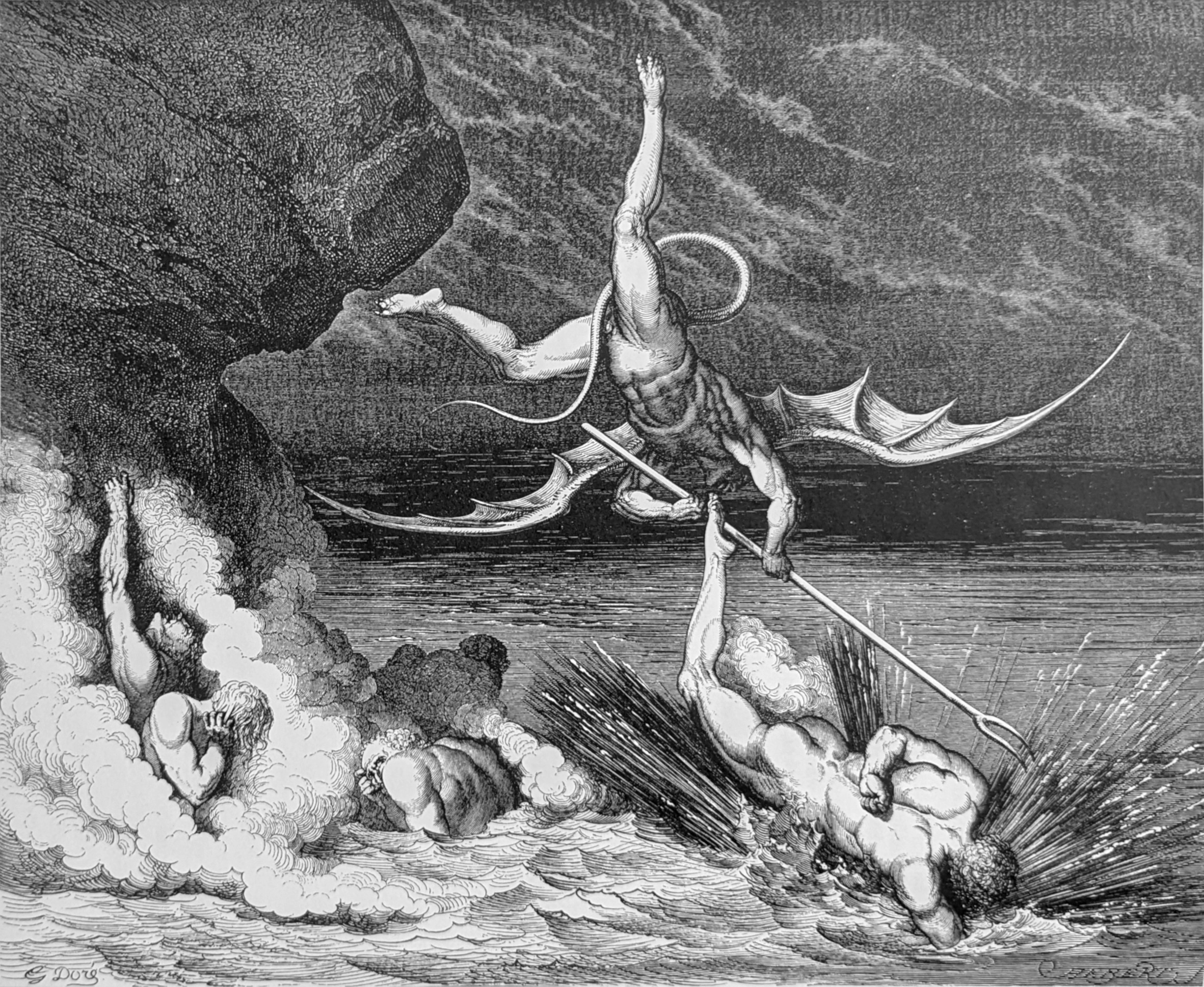
Therefore he moved, and cried: "Thou art o'ertakern." Inf. XXII, lines 126
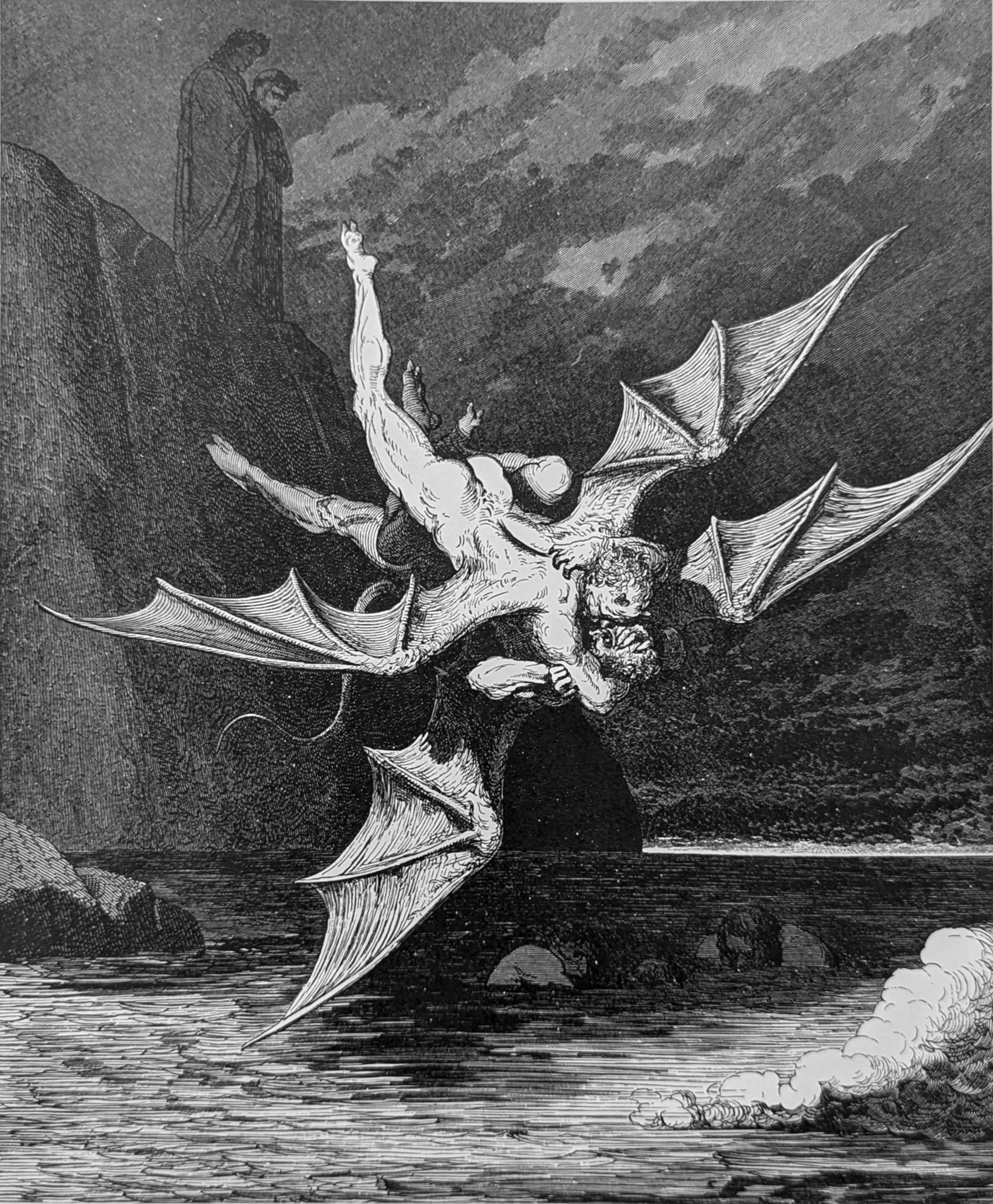
But sooth the other was a doughty sparhawk / To clapperclaw him well; and both of them / Fell in the middle of the boiling pond. Inf. XXII, lines 139-141
Footnotes
1. Latin, ārrētīnus, from Ārrētium, or “Arezzo”, meaning a person from Arezzo, in Tuscany, central Italy.
2. Barbariccia is a female Malebranche, whose job is to guard Bolia 5 in the eighth circle of hell.
3. Dante noted earlier his interested in seeing how the sinners were “cooked,” and he also used the image of a great kitchen where the chef’s helpers poked big chunks of meat back down into the boiling pots. Now, it seems, this poor sinner is “done”—in more ways than one, as Grafficane jabs him with his trident and pulls him up out of the pot. Note here also that Dante frequently uses animals to describe the sinners in this bolgia—a way to highlight how their crimes have degraded them. So far, we have had dolphins, frogs, and now otters. Stay tuned.
4. With all that has gone on already, Dante manages to remember the names of all those devils from when each of them was called forth in the previous canto. And now the weather changes. The “storm” predicted by the dolphins is about to break. To “skin” this sinner would be doing to him literally what he did to his victims figuratively.
5. Middle English, wight, Old English, wiht, “thing, creature”, Proto-West Germanic, wihti, Proto-Germanic, wihtiz, “thing, creature”, Proto-Indo-European, wekti, “cause, sake, thing”.
6. Things are starting to get slightly out of hand here, but this doesn’t stop Dante’s curiosity about the otter-sinner (Ciampolo) who has become the devils’ toy. And Virgil immediately complies with the Pilgrim’s request. The hapless sinner here does what no living grafter would do: he identifies himself. Otherwise, like a good grafter, he tells us virtually nothing about himself except the bare essentials, and this seems to be all that history knows of him as well. He was born and lived a reckless life in northern Spain, he seems to have followed in his father’s footsteps, and he must have held some position of responsibility in the court of Thibault II where he “learned [his] craft.” Thibault was a son-in-law of King Louis IX of France and was king of Navarre i n northern Spain during the middle part of the thirteenth century. Ever the accountant of his pilfered sums, he adds his own grim humor to the scene by noting that he’s now “paying [the] bill” for what he did when he was alive.
7. This torture is over and above what the contrapasso for this canto calls for. And we have more animal imagery here: Ciriatto looking like a boar, the grafter as a mouse, and the rest as “bad cats.” But for once one of the devils seems to be helpful. Barbariccia, in charge of the troop, stops Ciriatto's attack and allows Virgil to put more questions to Ciampolo. In Tuscan slang, ciriatto meant pig, and one will recall more slang with Ciacco the hog in Canto 6.
8. Libicocco is another Malebranche. Note how Dante turns up the torture here. The devils have no real interest in Dante’s journey, and one gets the sense that, in spite of the supposed military order of this squad, their real purpose is to do as much harm as possible and pay only grudging heed to their leader’s orders.
9. A decurion was a commander of a squadron of cavalrymen in the Roman army.
10. Friar Gomita—obviously a wicked monk—was a native of Sardinia which, at the time, was a part of the Republic of Pisa. The Pisans divided the island into four provinces, one of which was Gallura, administered by Friar Gomita. Ciampolo’s description of him may be exaggerated, but Gomita was apparently well-known for his frauds. He also happened to be the chaplain to the Governor of Gallura, Nino Visconti, an honorable man who, during his early exile, was one of Dante’s patrons. Dante places him in Canto 8 of the Purgatorio. Visconti held Gomita in high regard and would not give credence to the many accusations made against him. But when it came to his attention that Gomita was taking bribes to get various notorious prisoners released—some of them Visconti’s enemies—Visconti had him hanged.
11. Of Michele Zanche of Logodoro there is little documentary evidence, but he is thought to have been the governor of Logodoro, another of Sardinia’s four provinces. When Enzo the king of Sardinia went to war, he left Zanche in charge. Zanche, like Friar Gomita, was noted for his frauds. In 1249 Enzo was captured by the Bolognese and imprisoned in their city until he died in 1271. In the meantime, Enzo’s wife, Adelaisa, was granted a divorce and Zanche married her. It should be noted that before Adelaisa married Enzo and became queen she had previously been married into Genoa’s nobility, the powerful d’Oria family. Following Zanche’s marriage (and many more frauds), he managed to govern the entire island until he was murdered by his son-in-law, Branca d’Oria, in 1290. This act of treachery is memorialized in Canto 33 where Branca will be found–-at the bottom of Hell!
12. Farfarello, another Malebranche.
13. Cagnazzo, another Malebranche, has it exactly right, and even he is fooled by Ciampolo’s admission because Ciampolo cleverly admits as much, but he immediately deflects the devil’s suspicion toward the sinners that will be brought up by the trick. If, as the saying goes, “There is no honor among thieves,” it works for grafters too.
14. If Cagnazzo was the first to fall for Ciampolo’s trick, even though he believed it was a trick, poor Alichino actually thought it would work. They all fell for it, and most likely Dante and Virgil did too. But Alichino thinks he can make it right by doing w hat he warned he would do: take flight and catch the sinner in the act of trying to escape. Here Dante rounds out his references to the animal kingdom: Alichino is like a falcon swooping down on Ciampolo who is like a duck.
15. As the canto ends and as the trick ends—badly for the devils—note how Dante has Alichino and Calcabrina hauled up out of the boiling tar the same way as Ciampolo was. The “cooks” got cooked! Though it was unexpected, in hindsight it becomes clear that the devils seem as anxious to harm each other as they are to harm the sinners, thus very much acting like grafters themselves. That the two devils end up stuck in the boiling tar is clever. Using bird lime is an ancient way of catching birds and common in the Middle Ages. A very sticky substance is prepared and smeared on tree limbs and branches, thus trapping birds who land on it. Flying like falcons chasing a duck, the two devils not only ended up fighting, but smeared and stuck with tar. In the end, the final trick wasn’t just a lie, it also enabled Ciampolo, the master grafter, to subject the two devils to the same contrapasso as the sinners themselves.
Top of page