Dante's Divine Comedy: Inferno
Canto XXVI
The rocky rise above the eighth bolgia is characterized by flickering flames, each of which contains the soul of a Deceiver. One of the flames, curiously split in two, catches Dante's attention. He is told that it houses a pair of Trojan warriors, Ulysses and Diomed, who are being jointly punished for fraudulent counseling. Virgil interrogates the pair for Dante's benefit. Ulysses recalls his final voyage, on which he sailed past the Pillars of Hercules (Strait of Gibraltar) and into the forbidden sea (Atlantic Ocean), where a whirlwind rose up and spun his vessel around before sinking it.
Rejoice, O Florence, since thou art so great,
That over sea and land thou beatest thy wings,
And throughout Hell thy name is spread abroad!
Among the thieves five citizens of thine
Like these I found, whence shame comes unto me,
And thou thereby to no great honor risest.
But if when morn is near our dreams are true,
Feel shalt thou in a little time from now
What Prato, if none other, craves for thee.[1]
And if it now were, it were not too soon;
Would that it were, seeing it needs must be,
For 'twill aggrieve me more the more I age.
We went our way, and up along the stairs
The bourns had made us to descend before,
Remounted my Conductor and drew me.
And following the solitary path
Among the rocks and ridges of the crag,
The foot without the hand sped not at all.
Then sorrowed I, and sorrow now again,
When I direct my mind to what I saw,
And more my genius curb than I am wont,
That it may run not unless virtue guide it;
So that if some good star, or better thing,
Have given me good, I may myself not grudge it.
As many as the hind (who on the hill
Rests at the time when he who lights the world
His countenance keeps least concealed from us,
While as the fly gives place unto the gnat)
Seeth the glow-worms down along the valley,
Perchance there where he ploughs and makes his vintage;
With flames as manifold resplendent all
Was the eighth _Bolgia_, as I grew aware
As soon as I was where the depth appeared.
And such as he who with the bears avenged him
Beheld Elijah's chariot at departing,
What time the steeds to heaven erect uprose,
For with his eye he could not follow it
So as to see aught else than flame alone,
Even as a little cloud ascending upward,
Thus each along the gorge of the entrenchment
Was moving; for not one reveals the theft,
And every flame a sinner steals away.
I stood upon the bridge uprisen to see,
So that, if I had seized not on a rock,
Down had I fallen without being pushed.
And the Leader, who beheld me so attent,
Exclaimed: "Within the fires the spirits are;
Each swathes himself with that wherewith he burns."
"My Master," I replied, "by hearing thee
I am more sure; but I surmised already
It might be so, and already wished to ask thee
Who is within that fire, which comes so cleft
At top, it seems uprising from the pyre
Where was Eteocles with his brother placed."[2]
He answered me: "Within there are tormented
Ulysses and Diomed, and thus together
They unto vengeance run as unto wrath.[3]
And there within their flame do they lament
The ambush of the horse, which made the door
Whence issued forth the Romans' gentle seed;
Therein is wept the craft, for which being dead
Deidamia still deplores Achilles,
And pain for the Palladium there is borne."
"If they within those sparks possess the power
To speak," I said, "thee, Master, much I pray,
And re-pray, that the prayer be worth a thousand,
That thou make no denial of awaiting
Until the horned flame shall hither come:
Thou seest that with desire I lean towards it."
And he to me: "Worthy is thy entreaty
Of much applause, and therefore I accept it;
But take heed that thy tongue restrain itself.
Leave me to speak, because I have conceived
That which thou wishest; for they might disdain
Perchance, since they were Greeks, discourse of thine."
When now the flame had come unto that point,
Where to my Leader it seemed time and place,
After this fashion did I hear him speak:
"O ye, who are twofold within one fire,
If I deserved of you, while I was living,
If I deserved of you or much or little
When in the world I wrote the lofty verses,
Do not move on, but one of you declare
Whither, being lost, he went away to die."
Then of the antique flame the greater horn,
Murmuring, began to wave itself about
Even as a flame doth which the wind fatigues.
Thereafterward, the summit to and fro
Moving as if it were the tongue that spake,
It uttered forth a voice, and said: "When I
From Circe had departed, who concealed me
More than a year there near unto Gaeta,
Or ever yet Aeneas named it so,[4]
Nor fondness for my son, nor reverence
For my old father, nor the due affection
Which joyous should have made Penelope,
Could overcome within me the desire
I had to be experienced of the world,
And of the vice and virtue of mankind;
But I put forth on the high open sea
With one sole ship, and that small company
By which I never had deserted been.
Both of the shores I saw as far as Spain,
Far as Morocco, and the isle of Sardes,
And the others which that sea bathes round about.
I and my company were old and slow
When at that narrow passage we arrived
Where Hercules his landmarks set as signals,
That man no farther onward should adventure.
On the right hand behind me left I Seville,
And on the other already had left Ceuta.
'O brothers, who amid a hundred thousand
Perils,' I said, 'have come unto the West,
To this so inconsiderable vigil
Which is remaining of your senses still
Be ye unwilling to deny the knowledge,
Following the sun, of the unpeopled world.
Consider ye the seed from which ye sprang;
Ye were not made to live like unto brutes,
But for pursuit of virtue and of knowledge.'
So eager did I render my companions,
With this brief exhortation, for the voyage,
That then I hardly could have held them back.
And having turned our stern unto the morning,
We of the oars made wings for our mad flight,
Evermore gaining on the larboard side.[5]
Already all the stars of the other pole
The night beheld, and ours so very low
It did not rise above the ocean floor.
Five times rekindled and as many quenched
Had been the splendor underneath the moon,
Since we had entered into the deep pass,
When there appeared to us a mountain, dim
From distance, and it seemed to me so high
As I had never any one beheld.
Joyful were we, and soon it turned to weeping;
For out of the new land a whirlwind rose,
And smote upon the fore part of the ship.
Three times it made her whirl with all the waters,
At the fourth time it made the stern uplift,
And the prow downward go, as pleased Another,
Until the sea above us closed again."
Illustration
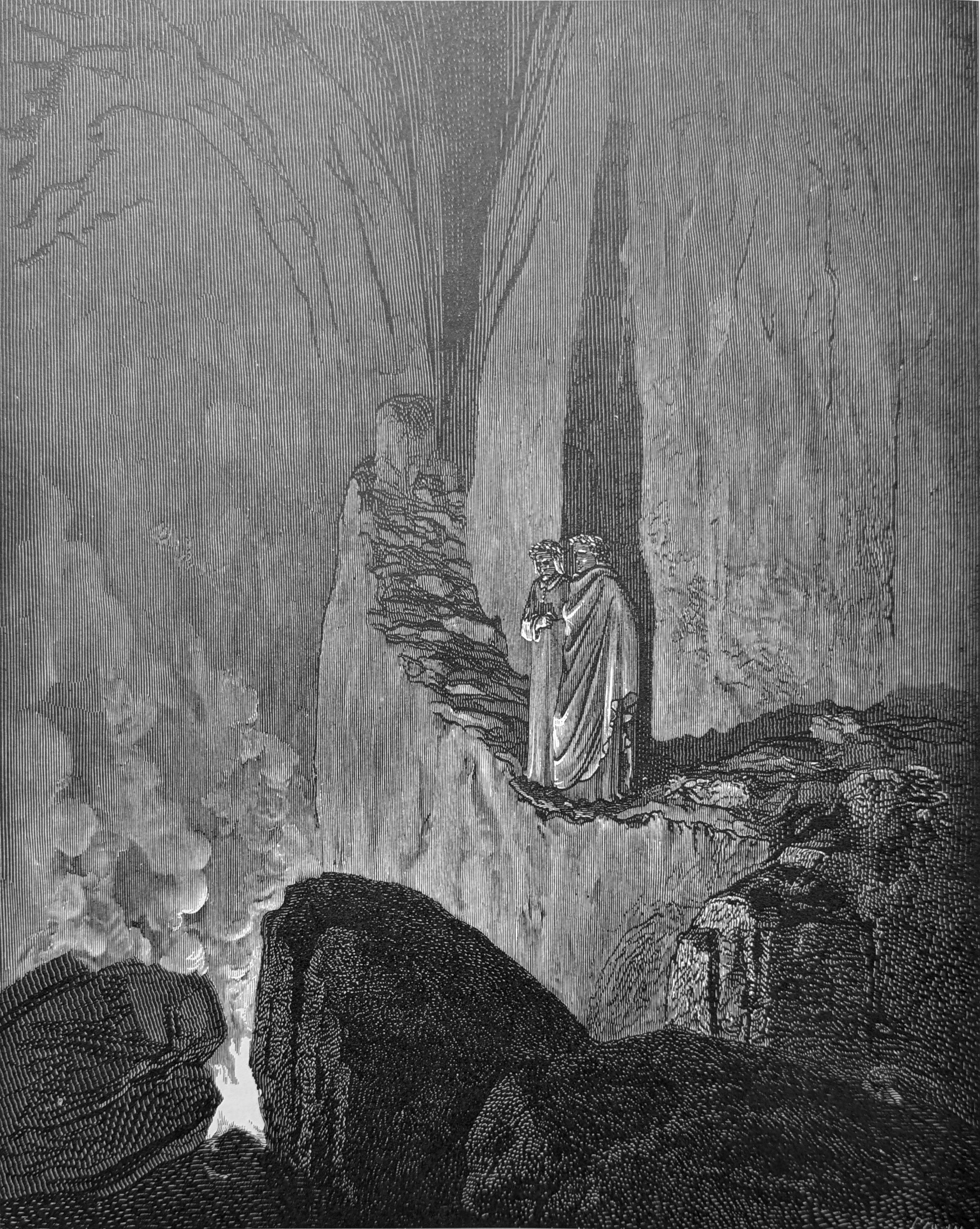
"Within the fires the spirits are; / Each swathes himself with that wherewith he burns" Inf. XXVI, lines 47-48
Footnotes
1. Dante wrote the Inferno in 1307 but sets it in 1300, he can speak for the dark hopes Florence’s neighbors (e.g., Prato) harbored for her. Not only this, but another event Dante may have had in mind took place in 1304 (around the time Dante was exiled). In t hat year, Pope Benedict XI sent his legate, Cardinal Niccolò da Prato, to Florence to try to settle its incessant political feuding. Unable to do so, he cursed the city, saying:
“Since you want to be at war and under a curse, and will neither hear nor obey the messenger of the Vicar of God, or have peace and quiet among yourselves, you will be left with the curse of God and of the Holy Church.”
And thereupon he excommunicated the city and placed it under interdict, which meant that the celebration of the Catholic Liturgy and other sacraments of the Church were suspended. Later, a series of calamities came upon Florence and many linked them with the Cardinal’s curse.
2. Dante’s powers of observation are growing so that he already knows the tongues of flame contain sinners. But his curiosity leads him forward because he notices a tongue that has two tips, and he immediately references the classical story of the two sons of Oedipus who jointly succeeded their father to the throne of Thebes. But after his appointed term, Eteocles refused to relinquish power, so Polyneices fomented a bloody war (the famous Seven Against Thebes, one of whom was Capaenus the blasphemer from Canto 14). In a one-on-one contest, the two brothers slew each other. When laid together upon a single funeral pyre, it was said that even there their flames separated into two great tongues.
3. From the list of “sins” that Virgil outlines for Dante, it’s difficult to find an obvious connection among them that will give the reader a clear sense of why these two famous classical figures are here. They were, of course, among Homer’s great warrior-heroes, known for courage, strength, and cunning. As the canto proceeds, we will see how cunning connects the three “sins,” and Dante will show how the wiliness of Ulysses, in particular, led to his downfall. In Dante’s eyes, his cunning was another form of fr aud, and thus deserving of being punished in this bolgia where, we will discover, are punished those who gave fraudulent advice. Here, Singleton notes that “the principle of contrapasso is evident in the punishing flame’s being likened to a tongue, for the sin punished in this bolgia is fraudulent counsel—false advice given by the tongue.” All three “sins,” of course, are connected to the fall of Troy which, as Virgil appropriately points out, gives rise to his own great epic which begins with that fall an d ends with the founding of Rome. And one cannot miss the fact that it is Virgil—author of the Aeneid—who speaks.
The three “sins,” by the way, are famous in both Homer and Virgil: the first was the clever ambush on Troy by means of the iconic Trojan Horse. The second involved the “trick” of bringing Achilles into the war. His mother had disguised him as a girl and brought him to the court of King Lycomedes to live with his daughters so that he wouldn’t have to fight. Pretending to bring gifts to the king’s daughters, Ulysses hid among the gifts a shield and a lance which the disguised Achilles payed too much attention to and gave himself away – but not before he had seduced one of the king’s daughters, Deïdamia, and then abandoned her and her newborn child. The third involved the theft of the sacred Palladium, a gold statue of Pallas Athena that guaranteed the safety of Troy as long as it remained in the city.
4. Ulysses begins his speech by recollecting the episode in the Odyssey when he and his crew were held captive by Circe, the sorceress/Siren who turned his men into pigs. This locates us momentarily within the epic story he (Dante) is about to change; and he a dds to this a geographical location, Gaeta, an ancient coastal city about 50 miles north of Naples. In ancient times, the city had been called Caieta after Aeneas’ nurse whom he buried there (see Aeneid VII, 1-4). But the seemingly casual mention of Circe, Gaeta, and Aeneas here is not without importance. Circe lived on a mythical island off the coast of Gaeta called Aeaea. Dante wants to set up a contrast between Homer’s Ulysses, who was drawn to Circe’s island and Virgil’s Aeneas, who passed it safely on h is way north. And more than this, when Ulysses speaks of his fondness for his son, Telemachus, and honor for his father, Laertes, Dante uses the phrase “la pieta del vecchio padre.” But by pieta he doesn’t mean “pity” in this case, but the more classical meaning of “duty” toward his father, something that Ulysses (sinfully?) neglected. This kind of neglect was frowned on among the classical ancients. On the other hand, in the Aeneid Virgil refers to Aeneas as “pious” Aeneas because he was a dutiful son toward his father and dutiful in his honor of the gods.
5. Larboard was the side of the ship upon which cargo was loaded, usually the starboard side.
Top of page