Dante's Divine Comedy: Inferno
Canto XX
The Soothsayers or Sorcerers, a group of weeping shadows, mournfully make their way along the valley of the fourth bolgia. On Earth, they claimed they could look into the future but, in the afterlife, their heads are twisted around so completely that their tears fall on their buttocks. Virgil recognizes Amphiaraus, Tiresias, Aruns and Manto (the last one a former citizen of his Mantuan birthplace). After discussing the founding of the city, be names more of the damned.
Of a new pain behooves me to make verses
And give material to the twentieth canto
Of the first song, which is of the submerged.
I was already thoroughly disposed
To peer down into the uncovered depth,
Which bathed itself with tears of agony;
And people saw I through the circular valley,
Silent and weeping, coming at the pace
Which in this world the Litanies assume.
As lower down my sight descended on them,
Wondrously each one seemed to be distorted
From chin to the beginning of the chest;
For tow'rds the reins the countenance was turned,
And backward it behooved them to advance,
As to look forward had been taken from them.
Perchance indeed by violence of palsy
Some one has been thus wholly turned awry;
But I ne'er saw it, nor believe it can be.
As God may let thee, Reader, gather fruit
From this thy reading, think now for thyself
How I could ever keep my face unmoistened,
When our own image near me I beheld
Distorted so, the weeping of the eyes
Along the fissure bathed the hinder parts.
Truly I wept, leaning upon a peak
Of the hard crag, so that my Escort said
To me: "Art thou, too, of the other fools?
Here pity lives when it is wholly dead;
Who is a greater reprobate than he
Who feels compassion at the doom divine?
Lift up thy head, and see for whom
Opened the earth before the Thebans' eyes;
Wherefore they all cried: 'Whither rushest thou,[1]
Amphiaraus? Why dost leave the war?'
And downward ceased he not to fall amain
As far as Minos, who lays hold on all.[2]
See, he has made a bosom of his shoulders!
Because he wished to see too far before him
Behind he looks, and backward goes his way:
Behold Tiresias, who his semblance changed,
When from a male a female he became,
His members being all of them transformed;[3]
And afterwards was forced to strike once more
The two entangled serpents with his rod,
Ere he could have again his manly plumes.
That Aruns is, who backs the other's belly,
Who in the hills of Luni, there where grubs
The Carrarese who houses underneath,[4]
Among the marbles white a cavern had
For his abode; whence to behold the stars
And sea, the view was not cut off from him.
And she there, who is covering up her breasts,
Which thou beholdest not, with loosened tresses,
And on that side has all the hairy skin,
Was Manto, who made quest through many lands,
Afterwards tarried there where I was born;
Whereof I would thou list to me a little.[5]
After her father had from life departed,
And the city of Bacchus had become enslaved,
She a long season wandered through the world.[6]
Above in beauteous Italy lies a lake
At the Alp's foot that shuts in Germany
Over Tyrol, and has the name Benaco.[7]
By a thousand springs, I think, and more, is bathed,
"Twixt Garda and Val Camonica, Pennino,
With water that grows stagnant in that lake.
Midway a place is where the Trentine Pastor,
And he of Brescia, and the Veronese
Might give his blessing, if he passed that way.
Sitteth Peschiera, fortress fair and strong,
To front the Brescians and the Bergamasks,
Where round about the bank descendeth lowest.
There of necessity must fall whatever
In bosom of Benaco cannot stay,
And grows a river down through verdant pastures.
Soon as the water doth begin to run,
No more Benaco is it called, but Mincio,
Far as Governo, where it falls in Po.
Not far it runs before it finds a plain
In which it spreads itself, and makes it marshy,
And oft 'tis wont in summer to be sickly.
Passing that way the virgin pitiless
Land in the middle of the fen descried,
Untilled and naked of inhabitants;
There to escape all human intercourse,
She with her servants stayed, her arts to practice
And lived, and left her empty body there.
The men, thereafter, who were scattered round,
Collected in that place, which was made strong
By the lagoon it had on every side;
They built their city over those dead bones,
And, after her who first the place selected,
Mantua named it, without other omen.
Its people once within more crowded were,
Ere the stupidity of Casalodi
From Pinamonte had received deceit.[8]
Therefore I caution thee, if e'er thou hearest
Originate my city otherwise,
No falsehood may the verity defraud."
And I: "My Master, thy discourses are
To me so certain, and so take my faith,
That unto me the rest would be spent coals.
But tell me of the people who are passing,
If any one note-worthy thou beholdest,
For only unto that my mind reverts."
Then said he to me: "He who from the cheek
Thrusts out his beard upon his swarthy shoulders
Was, at the time when Greece was void of males,
So that there scarce remained one in the cradle,
An augur, and with Calchas gave the moment,
In Aulis, when to sever the first cable.[9]
Eryphylus his name was, and so sings
My lofty Tragedy in some part or other;
That knowest thou well, who knowest the whole of it.
The next, who is so slender in the flanks,
Was Michael Scott, who of a verity
Of magical illusions knew the game.
Behold Guido Bonatti, behold Asdente,
Who now unto his leather and his thread
Would fain have stuck, but he too late repents.[10]
Behold the wretched ones, who left the needle,
The spool and rock, and made them fortune-tellers;
They wrought their magic spells with herb and image.
But come now, for already holds the confines
Of both the hemispheres, and under Seville
Touches the ocean-wave, Cain and the thorns,[11]
And yesternight the moon was round already;
Thou shouldst remember well it did not harm thee
From time to time within the forest deep."
Thus spake he to me, and we walked the while.
Illustration
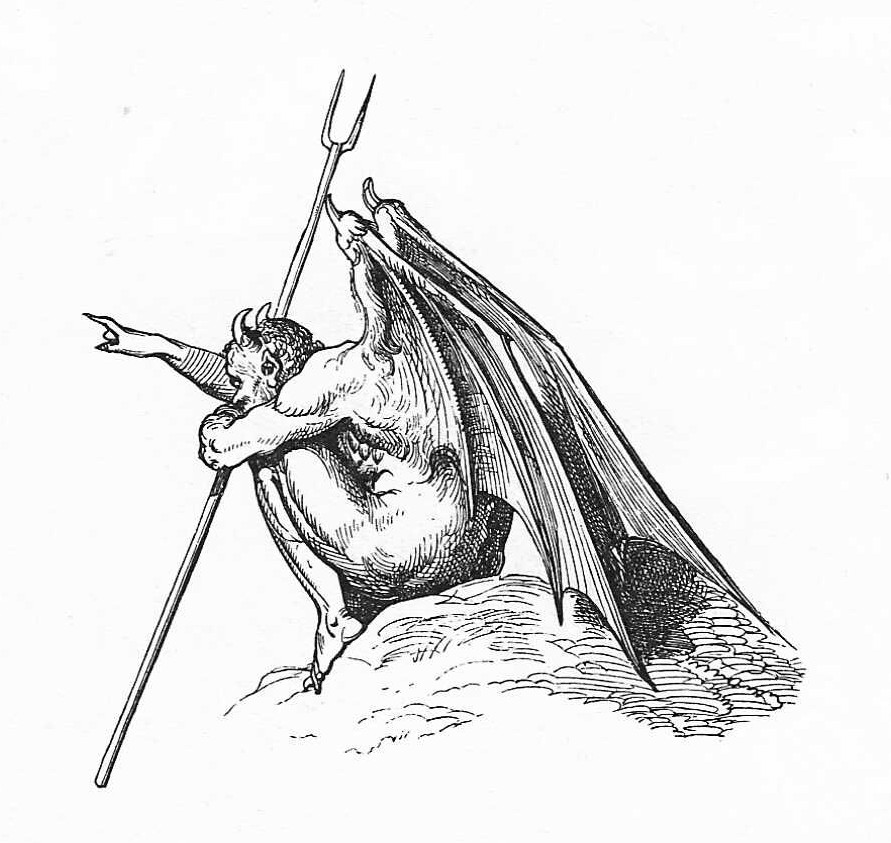
Malebolge
Footnotes
1. Dante’s source for this story is the Thebiad of Statius. Amphiaraus was both a seer and a king of Argos. He and Capaenus (the blasphemer in Canto 14) were among the famous seven who set out to ravage the city of Thebes. As a seer, he foreknew that he would die in the battle and hid. His wife, however, betrayed his hiding place and he was forced to join. During the battle, the ground opened up and swallowed him and his chariot as he fled. Minos was waiting for him! Mark Musa, in his wonderful commentary, notes that at this point in Dante’s text, the Poet (it’s actually Virgil who speaks here) cleverly describes the earthquake that swallowed Capaenus by separating the verb s’aperse from its noun terra. He writes: s’aperse a li occhi d’i Teban la terra (literall y, “opened before the eyes of the Thebans the earth”). Again, cleverly, Virgil ends his observations about Amphiaraus that, because his head is twisted around as it is, he both walks backwards and looks backwards. Implied is the fact that any attempt to loo k into the future is questionable. Is he actually walking backward or forward? Is he actually looking backward or forward?
2. In the Middle Ages, divination, astrology, and all their cousins—near and distant—were commonplace. It was even more common in the ancient world, as Dante highlights in the first part of this canto four famed characters from four great classical literary sources that he was quite familiar with: Amphiaraus figures in the Thebiad of Statius, Tiresias in the Metamorphoses of Ovid, Manto from Virgil’s Aeneid, and Aruns in Lucan’s Pharsalia. For centuries, Virgil himself was considered by many to have been a magician, and this belief was current even in Dante’s time. There was a kind of magic known as sortes virgilanae which involved opening the text of his Aeneid to random places and making predictions based on the particular text that was highlighted. (St. Augustine himself recounts in his Confessions that he did this with the Bible shortly before his conversion.) Benvenuto da Imola, his early commentator, notes that Dante himself “to some degree took pleasure in astrology.” Later, in the Paradiso, we will encounter Dante wrestling with the Platonic teaching that our lives are governed by the stars. All of this—and there is much more fascinating commentary on this canto to be found—stands as a kind of context and stage-setting for this canto where by condemning the fortune-tellers and their ilk to Hell, the Poet clearly stands in opposition to them. Interestingly, though there is slight mention of others, Virgil spends most of his time telling Dante about soothsayers from the classical era. The fact that Dante the Poet gives him 97 lines of speech in which to do this, compared with only 6 of his own, may also be Dante’s way of removing his mentor from any complicity with their sin.
3. Tiresias was a famous soothsayer who lived in Thebes. There are several different stories involving him and Virgil’s observations come from Ovid, who writes that the seer once saw two snakes wrapped together as he walked in the forest. With his staff he separated them, but was immediately transformed into a woman. For seven years he remained this way until, once again, he walked in the forest and came upon the same intertwined snakes. Once again he separated them and was immediately transformed back into a ma n. It is curious that Dante doesn’t include the rest of the story which accounts for why Tiresias is included among the sinners in this bolgia. Some time after this episode with the snakes, an argument broke out between Jupiter and Juno. At issue was whether women or men had more pleasure during sex. Jupiter felt it was women who had the most enjoyment, and Juno felt it was men. They decided to question Tiresias because he had the experience of being both a man and a woman. Tiresias answered in favor of women . But then, in a fit of pique, Juno struck him blind. Unable to undo what another god had done, Jupiter compensated the blind Tiresias with the gift of prophecy and foresight. The play on words here with Tiresias as a blind “seer” works well because, in spite of their efforts to see into the future, all the sinners in this ditch are virtually blind to the future because their heads are twisted around backwards. And poor Tiresias is doubly blind! Nevertheless, Dante is not finished with the famed seer yet. A large section of this canto will soon be devoted to his daughter, Manto.
4. Aruns was an Etruscan soothsayer who lived in the hills near Luni and present-day Carrara, north of Pisa and famous for its beautiful marble. Noted in Book I of Lucan’s Pharsalia, he predicted the Roman Civil War and Julius Caesar’s triumph.
5. This long digression, which comprises 42 lines in the Poem, serves several purposes. It gives Virgil an opportunity to recount his version of the story of Manto of Thebes, daughter of Tiresias; and, by way of a long geography lesson (21 lines), we learn that the ancient city of Mantua, named after Manto, is also his home town. (The reader might have forgotten that in Canto 1 Virgil told Dante that he was a Lombard and that his parents were from Mantua.) There are several different ancient sources for Manto. I n this account, Virgil identifies her as the prophetess of Thebes. After her father, Tiresias, died, her travels ended at a naturally secluded region of north-central Italy eventually named for her by her followers, “without recourse to any sorcery.” Interestingly, some commentators point out the difference between the origin of Mantua as told by Virgil in Book 10 of his Aeneid and the story he presents here as the true one. Dante certainly knew Virgil’s epic well enough to avoid this, but it may also be that Virgil’s account, which is one of many, might, with his emphasis on the truth, be a false one in keeping with where he and Dante are at the moment – among sinners whose stock and trade were basically lies. Moreover, one can be fooled by the seemingly most reliable of sources. And so, we might ask ourselves, in what sense are we to take Virgil’s last admonition: “don’t be fooled”? In the end, perhaps, the key question of this canto may be “Who can you actually believe?”
6. In ancient Greek religion and myth, Dionysus is the god of wine-making, orchards and fruit, vegetation, fertility, festivity, insanity, ritual madness, religious ecstasy, and theater. He was also known as Bacchus by the Greeks for a frenzy he is said to induce called baccheia. His wine, music, and ecstatic dance were considered to free his followers from self-conscious fear and care, and subvert the oppressive restraints of the powerful.
The Homeric Hymn 7 to Dionysus recounts how, while he sat on the seashore, some sailors spotted him, believing him a prince. They attempted to kidnap him and sail away to sell him for ransom or into slavery. No rope would bind him. The god turned into a fierce lion and unleashed a bear on board, killing all in his path. Those who jumped ship were mercifully turned into dolphins. The only survivor was the helmsman, Acoetes, who recognized the god and tried to stop his sailors from the start.
7. Lake Benaco is the Latin name for Lake Garda, the largest lake in Italy and one of its most beautiful scenic locations. Virgil’s description 700 years ago, as it were, is still accurate today. The long lake reaches northward toward the German alpine border and surrounded, except along the south, by high mountains, it is filled by countless streams. Three different provinces border on the Lake (Virgil refers to three Church dioceses): Trento on the north, Verona on the south-east, and Brescia on the south-west . Val Camonica is one of the longest valleys (almost 60 miles) in the central alpine region west of Lake Garda. The reference to an island in the middle of the lake where the three provinces or diocese meet is problematic. There are just a handful of very s mall islands in the lake, none in the middle. The best possibility is Isola del Garda on the southwest side near San Felice del Benaco. A small monastery built on the island by the Franciscan monks in 1220 might have been the place where the three bishops could celebrate Mass together. And there is a local legend that Dante himself visited the island in 1304. The great Fortress of Peschiera sits at the very southern part of the lake guarding its only outlet which becomes the River Mencio. In his commentary on this canto, Musa notes that this was the main fortress of the Della Scala family of Verona who hosted Dante for several years during his exile. It was to the young Can Grande Della Scalla that Dante dedicated the Paradiso. More than likely, Dante would have been familiar with this site and its environs. Not far from Mantua to the southeast is where the Mencio joins the Po at Governolo. Backing up several miles from that confluence would be the area of Mantua that Virgil is referring to. The distance from Mantua to Peschiera is about 25 miles. In all of these geographical observations, it’s also clear that Virgil was quite familiar with the region where he grew up and which he describes with subtle affection.
8. The final reference in this section is to Count Alberto Casalodi. He was among the Guelf Counts of Brescia who had made themselves lords of Mantua. However, they were extremely unpopular. Foolishly taking the advice of the ambitious Pinamonte de Buonaccorsi , he banished most of his nobles thinking that this would keep him in power. Pinamonte, in the mean time, mounted a rebellion, killed the remaining nobles, and ousted Casalodi from power.
9. Latin, augurō, “interpret omens”.
Dante (Virgil) seems to make an error here with Eurypylus and Calchas. When the Greeks sailed from Aulis to Troy, only Calchas the augur was there, and it was he who advised Agamemnon to sacrifice his daughter, Iphigenia. Eurypylus, however, was not an augur. According to the Aeneid (Book 2), he was a soldier sent to get a message from the oracle of Phoebus. When he returns with a dark message, Calchas the augur is brought in to determine what must be done. Thus, while they appear in the same part of the epic , but they do not play exactly the same role. Eurypylus is sent to get the message of Phoebus, but it is Calchas who must interpret it. Apart from this, one cannot miss the great compliment Virgil pays Dante for his mastery of Virgil’s epic.
10. Guido Bonatti was a famous thirteenth-century soothsayer from Forlì. He was the author of several texts and was the private astrologer to Guido da Montefeltro, the lord of that region, who will feature prominently in Canto 27.
In Italian, asdente means “toothless.” He was a poor shoemaker from Parma who was said to have considerable prophetic powers.
11. Seville, Southern Spain.
Top of page