Dante's Divine Comedy: Inferno
Canto I
In the middle of his life, Dante has left the 'straightforward pathway' and is lost in a dark forest. He tries to regain the path by climbing a mountain but his way is barred by a Leopard, a Lion and a She-Wolf. Each creature represents a different sin. Virgil appears and offers to show him another way, one that leads through Hell and Purgatory. After that, a 'more worthy' guide (Beatrice) will lead him to Paradise: Virgil, as a Pagan, is not allowed to go there. Dante gladly adopts Virgil as his leader.[1]
Midway upon the journey of our life
I found myself within a forest dark,
For the straightforward pathway had been lost.[2]
Ah me! how hard a thing it is to say
What was this forest savage, rough, and stern,
Which in the very thought renews the fear.
So bitter is it, death is little more;
But of the good to treat, which there I found,
Speak will I of the other things I saw there.
I cannot well repeat how there I entered,
So full was I of slumber at the moment
In which I had abandoned the true way.
But after I had reached a mountain's foot,
At that point where the valley terminated,
Which had with consternation pierced my heart,
Upward I looked, and I beheld its shoulders,
Vested already with that planet's rays
Which leadeth others right by every road.[3]
Then was the fear a little quieted
That in my heart's lake had endured throughout
The night, which I had passed so piteously.
And even as he, who, with distressful breath,
Turns to the water perilous
Forth issued from the sea upon the shore,
And lo! almost where the ascent began,
A panther light and swift exceedingly,
Which with a spotted skin was covered o'er!
And never moved she from before my face,
Nay, rather did impede so much my way,
That many times I to return had turned.
The time was the beginning of the morning,
And up the sun was mounting with those stars
That with him were, what time the Love Divine
At first in motion set those beauteous things;
So were to me occasion of good hope,
The variegated skin of that wild beast,[4]
The hour of time, and the delicious season;
But not so much, that did not give me fear
A lion's aspect which appeared to me.
He seemed as if against me he were coming
With head uplifted, and with ravenous hunger,
So that it seemed the air was afraid of him;
And a she-wolf, that with all hungerings
Seemed to be laden in her meagerness,
And many folk has caused to live forlorn![5]
She brought upon me so much heaviness,
With the affright that from her aspect came,
That I the hope relinquished of the height.
And as he is who willingly acquires,
And the time comes that causes him to lose,
Who weeps in all his thoughts and is despondent,
E'en such made me that beast withouten peace,
Which, coming on against me by degrees
Thrust me back thither where the sun is silent.
While I was rushing downward to the lowland,
Before mine eyes did one present himself,
Who seemed from long-continued silence hoarse.
When I beheld him in the desert vast,
"Have pity on me," unto him I cried,
"Whiche'er thou art, or shade or real man!"
He answered me: "Not man; man once I was,
And both my parents were of Lombardy,
And Mantuans by country both of them.
'Sub Julio' was I born, though it was late,
And lived at Rome under the good Augustus,
During the time of false and lying gods.
A poet was I, and I sang that just
Son of Anchises, who came forth from Troy,
After that Ilion the superb was burned.
But thou, why goest thou back to such annoyance?
Why climb'st thou not the Mount Delectable,
Which is the source and cause of every joy?"
"Now, art thou that Virgilius and that fountain
Which spreads abroad so wide a river of speech?"
I made response to him with bashful forehead.[6]
"O, of the other poets honor and light,
Avail me the long study and great love
That have impelled me to explore thy volume!
Thou art my master, and my author thou,
Thou art alone the one from whom I took
The beautiful style that has done honor to me.
Behold the beast, for which I have turned back;
Do thou protect me from her, famous Sage,
For she doth make my veins and pulses tremble."
"Thee it behooves to take another road,"
Responded he, when he beheld me weeping,
"If from this savage place thou wouldst escape;
Because this beast, at which thou criest out,
Suffers not any one to pass her way,
But so doth harass him, that she destroys him;
And has a nature so malign and ruthless,
That never doth she glut her greedy will,
And after food is hungrier than before.
Many the animals with whom she weds,
And more they shall be still, until the Greyhound
Comes, who shall make her perish in her pain.[7]
He shall not feed on either earth or pelf,
But upon wisdom, and on love and virtue;
'Twixt Feltro and Feltro shall his nation be;[8]
Of that low Italy shall he be the savior,
On whose account the maid Camilla died,
Euryalus, Turnus, Nisus, of their wounds;[9]
Through every city shall he hunt her down,
Until he shall have driven her back to Hell,
There from whence envy first did let her loose.
Therefore I think and judge it for thy best
Thou follow me, and I will be thy guide,
And lead thee hence through the eternal place,
Where thou shalt hear the desperate lamentations,
Shalt see the ancient spirits disconsolate,
Who cry out each one for the second death;
And thou shalt see those who contented are
Within the fire, because they hope to come,
Whene'er it may be, to the blessed people;
To whom, then, if thou wishest to ascend,
A soul shall be for that than I more worthy;
With her at my departure I will leave thee;
Because that Emperor, who reigns above,
In that I was rebellious to his law,
Wills that through me none come into his city.
He governs everywhere, and there he reigns;
There is his city and his lofty throne;
O happy he whom thereto he elects!"
And I to him: "Poet, I thee entreat,
By that same God whom thou didst never know,
So that I may escape this woe and worse,
Thou wouldst conduct me there where thou hast said,
That I may see the portal of Saint Peter,
And those thou makest so disconsolate."
Then he moved on, and I behind him followed.
Illustrations
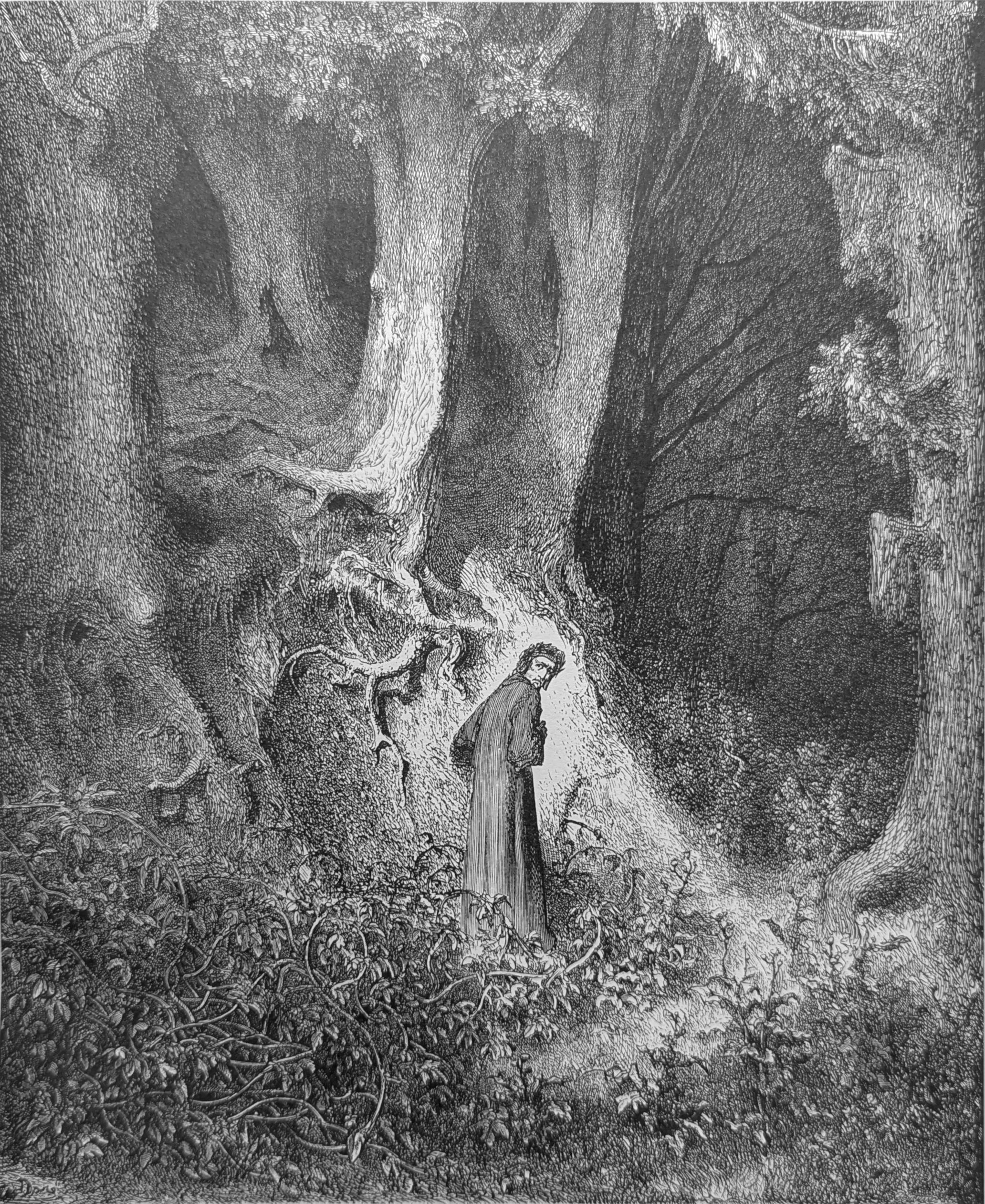
Midway upon the journey of our life / I found myself within a forest dark,/ For the straightforward pathway had been lost. Inf. I, lines 1-3
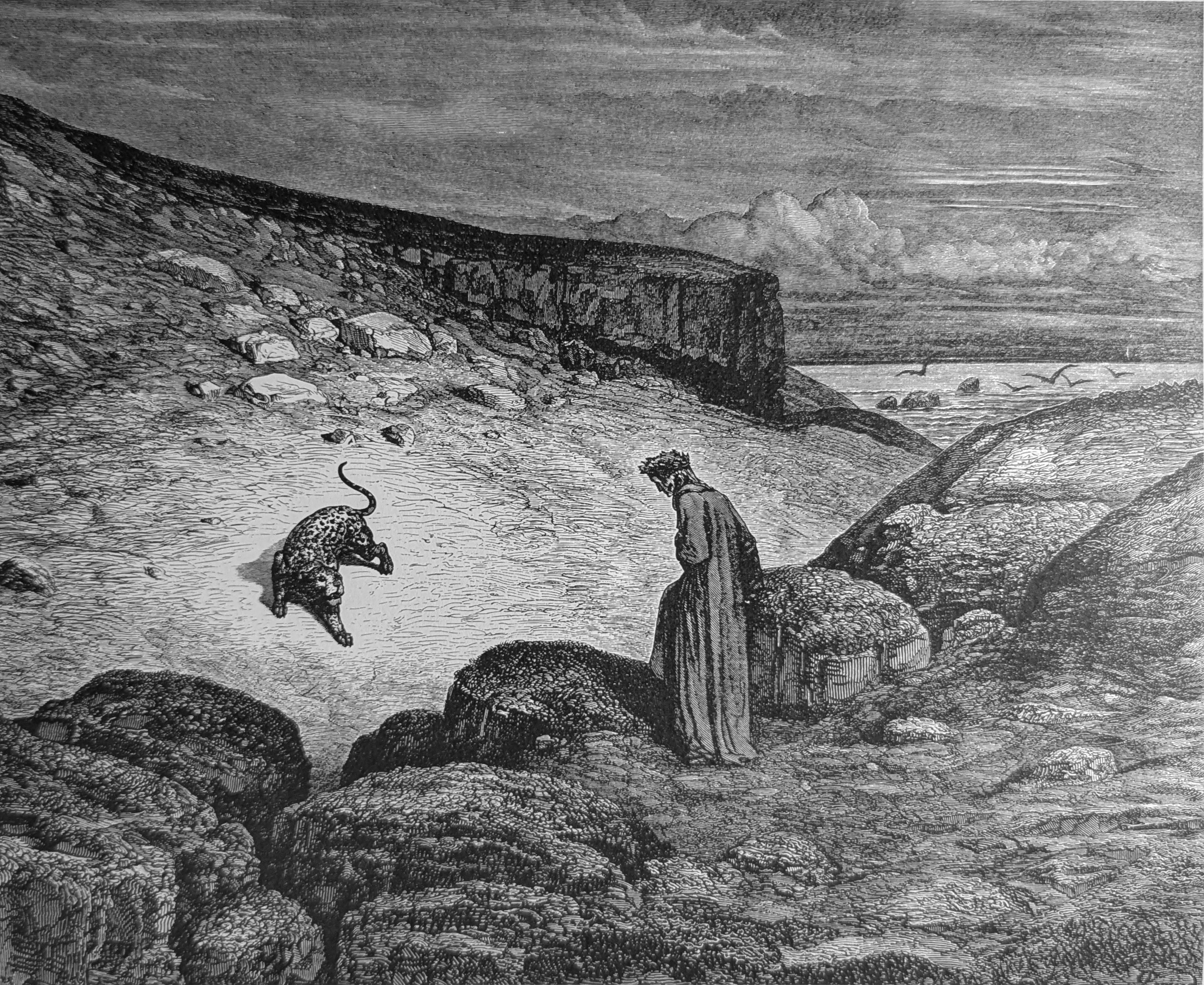
And lo! almost where the ascent began, / A panther light and swift exceedingly, / Which with a spotted skin was covered o'er! Inf. 1, lines 31-33
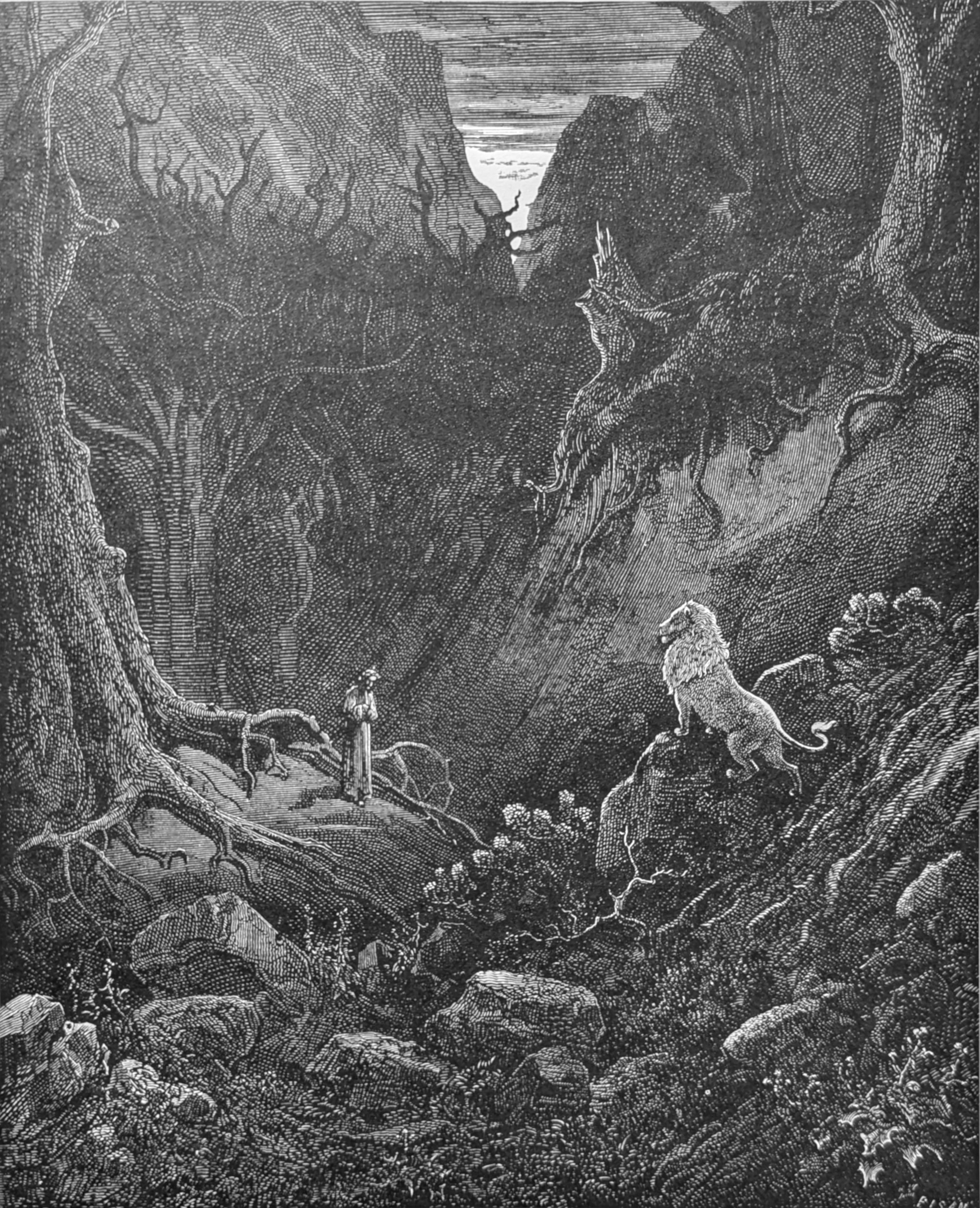
He seemed as if against me he were coming / With head uplifted, and with ravenous hunger, Inf. I, lines 46-47
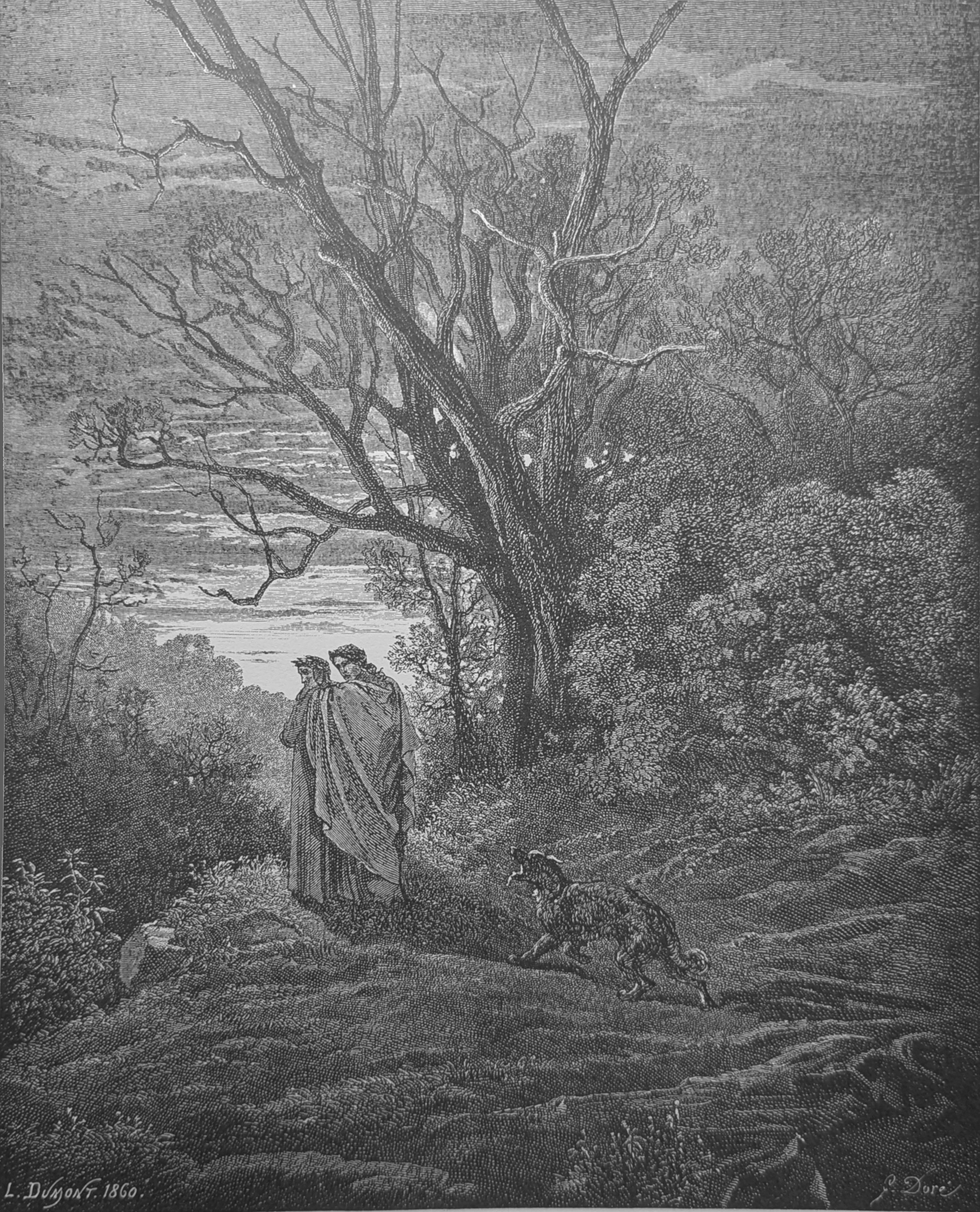
"Behold the beast, for which I have turned back; / Do thou protect me from her, famous Sage," Inf. 1, lines 88-89

Then he moved on, and I behind him followed. Inf. 1, line 136
Footnotes
1. Dante’s poem consists of 100 cantos (think of chapters or sections). This first canto is considered an introduction to the rest of the poem. Following this one, then, there are 99 more cantos – 33 more in the Inferno, 33 in the Purgatorio, and 33 in the Paradiso, for a total of 100. Each of the three major parts of the poem is called a canticle (song).
2. A dark forest, wild beasts, shadows, and unexpected terrors – Dante heightens our expectations with this image of sin and its effects which some commentators refer to as a “moral wilderness,” or “the wood of error.” In a kind of “mid-life crisis,” Dante has lost his way because he has not been attentive to the right path. In Proverbs 2:10ff, we read that wisdom, knowledge, and understanding will save those who are upright “…from those who have left the straight paths to walk in the ways of darkness.” Later in the poem, he will suggest that righteousness or virtue is something that must be attended to continually or it will fade away.
3. Dante refers to the sun as a “planet.” In his poem, he uses the Ptolemaic system of the cosmos in which the Earth is at the center with the sun and all the other planets revolving around it.
4. While there are differences among commentators on the symbolism of this leopard, the most reasonable interpretation is that it represents fraud, which makes things appear what they’re not. Covered with a lovely hide, this swift and stealthy creature is really extremely dangerous. And it forces Dante to flee back down into the dark forest.
5. This she-wolf, greedy and ravenous, represents the sins of unbridled lust and sensuality.
6. Virgil lived from 70BC-19BC. Dante meets Virgil, the greatest of the Roman poets of the Augustan Age and author of Rome’s greatest epic, the Aeneid. One cannot overestimate Dante’s admiration of Virgil, as he will tell us, and the influence the Roman poet had on him. Interestingly, the protagonists in both Virgil’s and Dante’s poems are destined to make journeys of world-shaping significance.
7. This “dog” has baffled commentators for centuries, and there are many different explanations. I agree with several who see either or both a spiritual and temporal ruler, someone who will save Italy and set her on the right path. Certainly one definite person could be Can Grande Della Scala (or “Big Dog”), a young nobleman of an illustrious family in Verona who offered Dante their hospitality after he was exiled from Florence, and to whom he dedicated the Paradiso.
8. The location and/or meaning of these two places has been problematic for centuries. If the greyhound is Can Grande, then the Feltros might be a reference to or boundaries of lands controlled by him in the region around Verona.
9. This is an interesting mingling of enemies in ancient Italian history. Camilla and Turnus were natives who fought against the invading Trojans, among whom were Nisus and Eurylaus. All four of them were brave and valiant warriors, their deeds noted in the latter part of Virgil’s epic.
Top of page