Dante's Divine Comedy: Inferno
Canto XII
Dante and Virgil enter the Seventh Circle by means of a landslide created by Christ when he harrowed Hell. The Minotaur, guardian of the Violent, breaks into a fit of rage on seeing the poets. Fleeing past him, the poets reach Phlegethon, a river of boiling blood that is filled with those that have inflicted violence on others. Three fierce Centaurs shoot arrows at souls attempting to rise above the level commensurate with their punishment. Virgil asks Chiron, their leader, to lend one of his band to them, so that they might ford the river. Nessus is chosen, who points out sinners along the way.
The place where to descend the bank we came
Was alpine, and from what was there, moreover,
Of such a kind that every eye would shun it.
Such as that ruin is which in the flank
Smote, on this side of Trent, the Adige,
Either by earthquake or by failing stay,[1]
For from the mountain's top, from which it moved,
Unto the plain the cliff is shattered so,
Some path 'twould give to him who was above;
Even such was the descent of that ravine,
And on the border of the broken chasm
The infamy of Crete was stretched along,
Who was conceived in the fictitious cow;
And when he us beheld, he bit himself,
Even as one whom anger racks within.
My Sage towards him shouted: "Peradventure
Thou think'st that here may be the Duke of Athens,
Who in the world above brought death to thee?
Get thee gone, beast, for this one cometh not
Instructed by thy sister, but he comes
In order to behold your punishments."
As is that bull who breaks loose at the moment
In which he has received the mortal blow,
Who cannot walk, but staggers here and there,
The Minotaur beheld I do the like;
And he, the wary, cried: "Run to the passage;
While he wroth, 'tis well thou shouldst descend."
Thus down we took our way o'er that discharge
Of stones, which oftentimes did move themselves
Beneath my feet, from the unwonted burden.
Thoughtful I went; and he said: "Thou art thinking
Perhaps upon this ruin, which is guarded
By that brute anger which just now I quenched.
Now will I have thee know, the other time
I here descended to the nether Hell,
This precipice had not yet fallen down.
But truly, if I well discern, a little
Before His coming who the mighty spoil
Bore off from Dis, in the supernal circle,
Upon all sides the deep and loathsome valley
Trembled So, that I thought the Universe
Was thrilled with love, by which there are who think
The world ofttimes converted into chaos;
And at that moment this primeval crag
Both here and elsewhere made such overthrow.
But fix thine eyes below; for draweth near
The river of blood, within which boiling is
Whoe'er by violence doth injure others."
O blind cupidity, O wrath insane,
That spurs us onward so in our short life,
And in the eternal then so badly steeps us!
I saw an ample moat bent like a bow,
As one which all the plain encompasses,
Conformable to what my Guide had said.
And between this and the embankment's foot
Centaurs in file were running, armed with arrows,
As in the world they used the chase to follow.
Beholding us descend, each one stood still,
And from the squadron three detached themselves,
With bows and arrows in advance selected;
And from afar one cried: "Unto what torment
Come ye, who down the hillside are descending?
Tell us from there; if not, I draw the bow."
My Master said: "Our answer will we make
To Chiron, near you there; in evil hour,
That will of thine was evermore so hasty."
Then touched he me, and said: "This one is Nessus,
Who perished for the lovely Dejanira,
And for himself, himself did vengeance take.
And he in the midst, who at his breast is gazing,
Is the great Chiron, who brought up Achilles;
That other Pholus is, who was so wrathful.
Thousands and thousands go about the moat
Shooting with shafts whatever soul emerges
Out of the blood, more than his crime allots."
Near we approached unto those monsters fleet;
Chiron an arrow took, and with the notch
Backward upon his jaws he put his beard.
After he had uncovered his great mouth,
He said to his companions: "Are you ware
That he behind moveth whate'er he touches?
Thus are not wont to do the feet of dead men."
And my good Guide, who now was at his breast,
Where the two natures are together joined,
Replied: "Indeed he lives, and thus alone
Me it behoves to show him the dark valley;
Necessity, and not delight, impels us.
Some one withdrew from singing Halleluja,
Who unto me committed this new office;
No thief is he, nor I a thievish spirit.
But by that virtue through which I am moving
My steps along this savage thoroughfare,
Give us some one of thine, to be with us,
And who may show us where to pass the ford,
And who may carry this one on his back;
For 'tis no spirit that can walk the air."
Upon his right breast Chiron wheeled about,
And said to Nessus: "Turn and do thou guide them,
And warn aside, if other band may meet you."
We with our faithful escort onward moved
Along the brink of the vermilion boiling,
Wherein the boiled were uttering loud laments.
People I saw within up to the eyebrows,
And the great Centaur said: "Tyrants are these,
Who dealt in bloodshed and in pillaging.
Here they lament their pitiless mischiefs; here
Is Alexander, and fierce Dionysius
Who upon Sicily brought dolorous years.[2]
That forehead there which has the hair so black
Is Azzolin; and the other who is blond,
Obizzo is of Esti, who, in truth,[3]
Up in the world was by his stepson slain."
Then turned I to the Poet; and he said,
"Now he be first to thee, and second I."
A little farther on the Centaur stopped
Above a folk, who far down as the throat
Seemed from that boiling stream to issue forth.
A shade he showed us on one side alone,
Saying: "He cleft asunder in God's bosom
The heart that still upon the Thames is honoured."
Then people saw I, who from out the river
Lifted their heads and also all the chest;
And many among these I recognized.
Thus ever more and more grew shallower
That blood, so that the feet alone it covered;
And there across the moat our passage was.
"Even as thou here upon this side beholdest
The boiling stream, that aye diminishes,"
The Centaur said, "I wish thee to believe
That on this other more and more declines
Its bed, until it reunites itself
Where it behoveth tyranny to groan.
Justice divine, upon this side, is goading
That Attila, who was a scourge on Earth,
And Pyrrhus, and Sextus; and for ever milks[4]
The tears which with the boiling it unseals
In Rinier da Corneto and Rinier Pazzo,
Who made upon the highways so much war."[5]
Then back he turned, and passed again the ford.
Illustrations
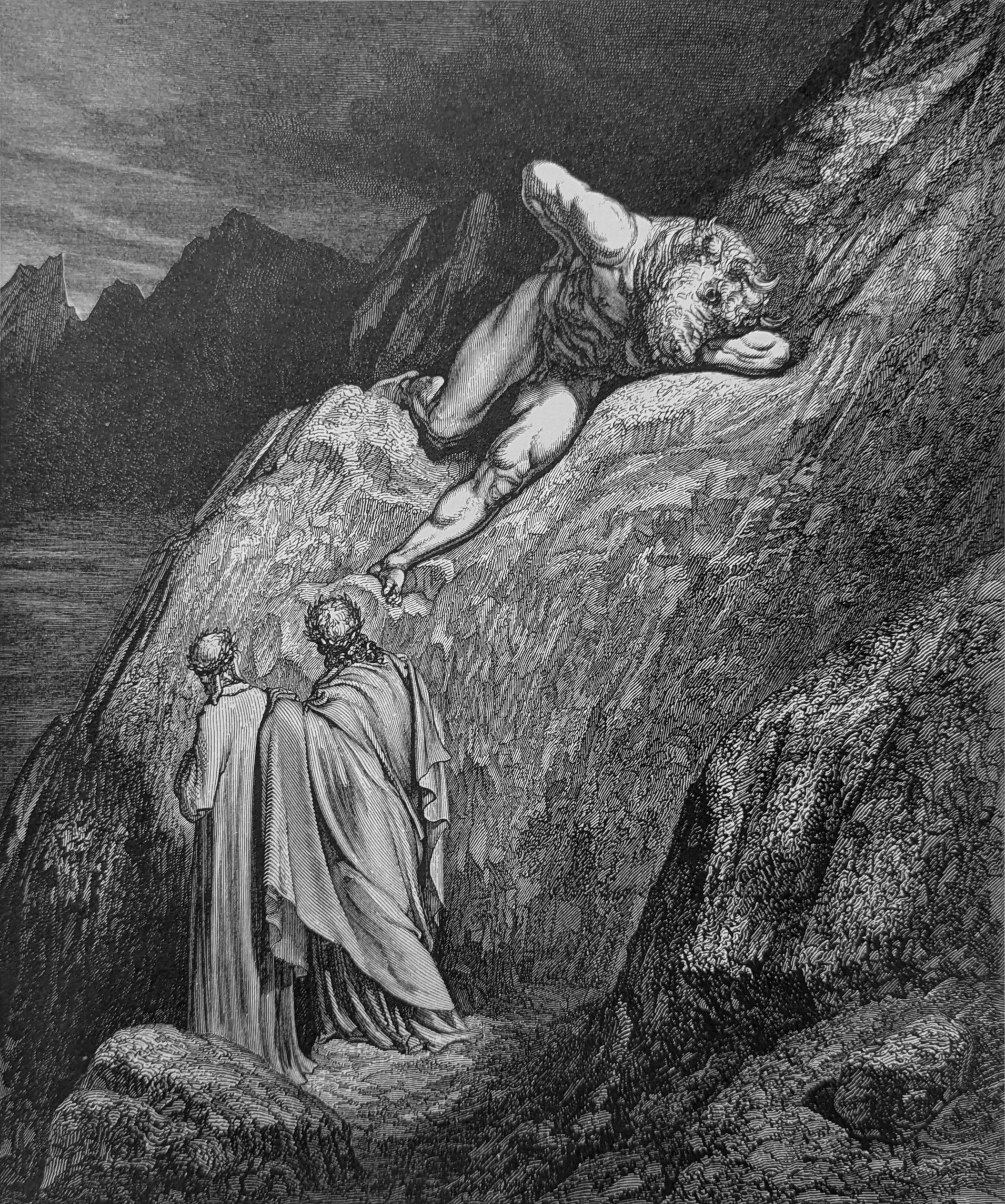
And on the border of the broken chasm / The infamy of Crete was stretched along, / Who was conceived in the fictitious cow; Inf. XII, line 11-13
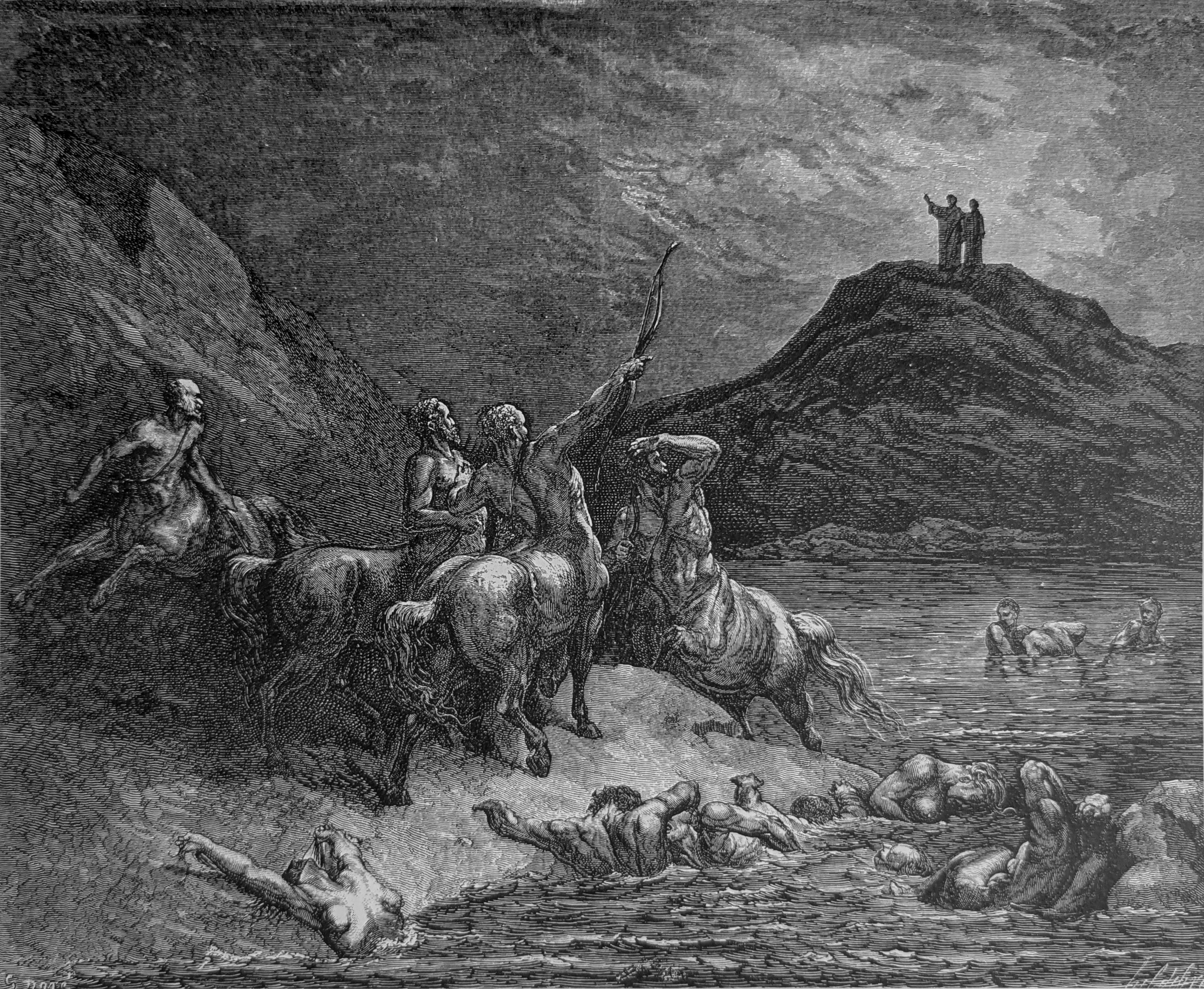
Beholding us descend, each one stood still, / And from the squadron three detached themselves, / With bows and arrows in advance selected; Inf. XII, lines 58-60
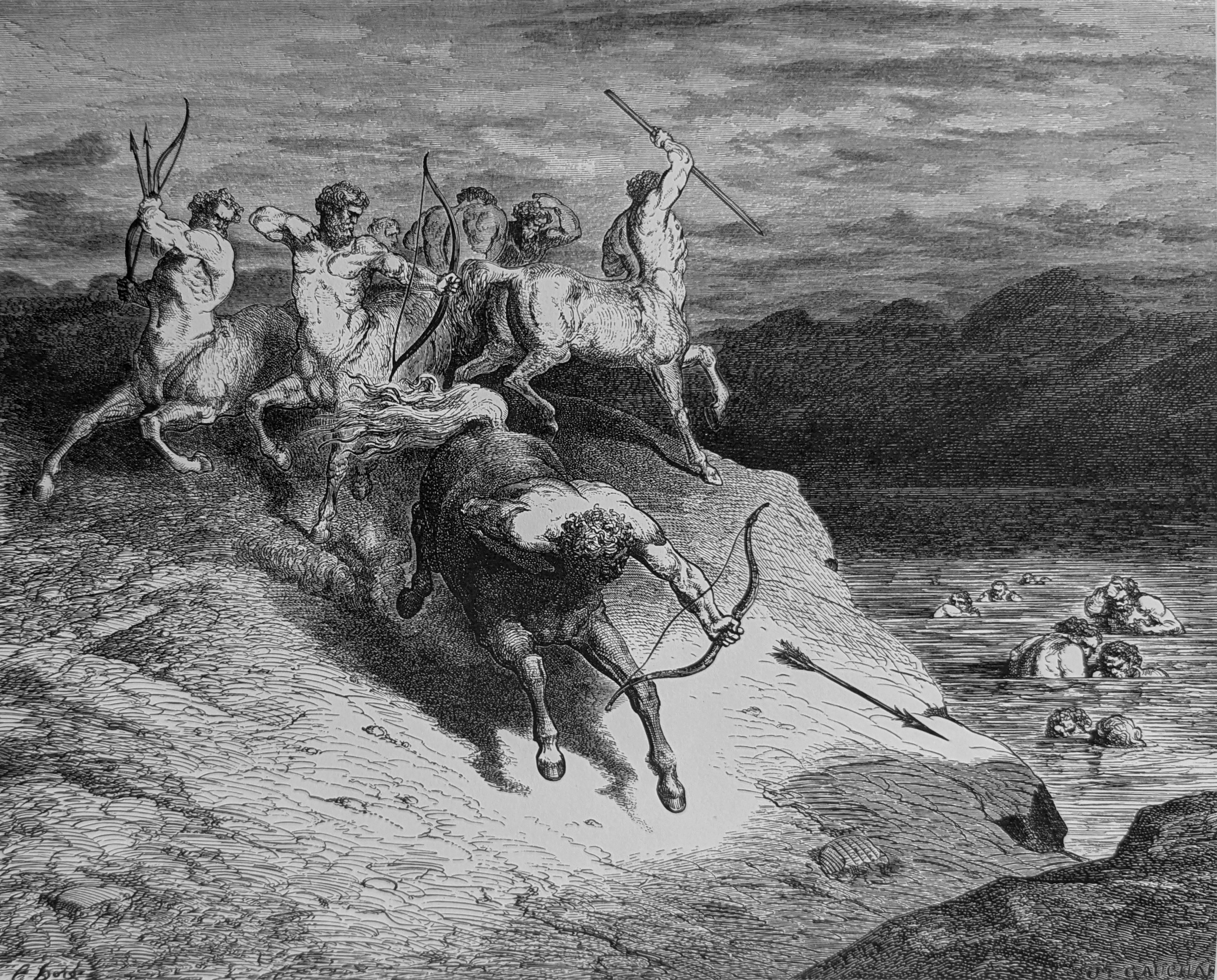
Chiron an arrow took, and with the notch / Backward upon his jaws he put his beard. Inf. XII, lines 77-78
Footnotes
1. Trento, in Northern Italy, lies along the Adige River.
2. Dionysius was the 14th Pope and Patriarch of Alexandria from 248-264 AD.
3. Obizzo II d'Este (1247–1293) was Marquis of Ferrara and Ancona. He was a bastard who was banished from his home town, Ferrara, who fought his way to power. His mother was drowned in the Adriatic Sea.
4. Attila (406–453), Attila the Hun, was the ruler of the Huns from 434-453. His empire included the Huns, Ostrogoths, Alans, and Gepids in Central and Eastern Europe.
Pyrrhus (318–272 BC) was a Greek king of the Hellenistic period and king of the Molossians of the royal house of Aeacid house. Later he became king of Epirus. He was one of the strongest opponents of early Rome, and had been regarded as one of the greatest generals of antiquity. Several of his victorious battles caused him unacceptably heavy losses, from which the phrase "Pyrrhic victory" was coined.
Sextus Pompeius Magnus Pius (67–35 BC), was a Roman military leader who fought against Julius Caesar during the last civil wars of the Roman Republic. He formed Sicily as a separate state.
5. Rinier da Corneto was a notorious highway robber who, in Dante's day, terrorized the Maremma Region (coastal area of western central Italy), where he also had his castle (at Corneto). Apparently, he enjoyed fleecing pilgrims and travelers on their way to Rome.
Rinier Pazzo was also a notorious bandit in Dante's day, who "worked" the area between Florence and Arezzo to the south, and whose specialty seems to have been robbing traveling clerics--for which he was excommunicated. Some accounts suggest that he and Rinier da Corneto were hired by Frederick II to rob the Roman bishops. The Pazzi family were well known, but after his excommunication Florence enacted laws depriving them of their rights.
Top of page