Dante's Divine Comedy: Inferno
Canto XVI
Still in the Circle of Violence, Dante hears the roar of a distant waterfall. Having recognized a fellow Florentine, three warrior Sodomites edge forward, all the while moving around him in a circle like a turning wheel. Their spokesman introduces himself as Jacopo Rusticucci and his two compatriots as Guido Guerra and Tegghiaio Aldobrand, both Guelf party leaders. These illustrious citizens of Florence ask for news of their city before moving away. The rush of the water is now deafening. Virgil removes the cord from around Dante's waist and throws it into the abyss. Some creature stirs below before swimming upwards.
Now was I where was heard the reverberation
Of water falling into the next round,
Like to that humming which the beehives make,
When shadows three together started forth,
Running, from out a company that passed
Beneath the rain of the sharp martyrdom.
Towards us came they, and each one cried out:
"Stop, thou; for by thy garb to us thou seemest
To be some one of our depraved city."
Ah me! what wounds I saw upon their limbs,
Recent and ancient the flames burnt in!
It pains me still but to remember it.
Unto their cries my Teacher paused attentive;
He turned his face towards me, and "Now wait,"
He said; "to these we should be courteous.
And if it were not for the fire that darts
The nature of this region, I should say
That haste were more becoming thee than them."
As soon as we stood still, they recommenced
The old refrain, and when they overtook us,
Formed of themselves a wheel, all three of them.
As champions stripped and oiled are wont to do,
Watching for their advantage and their hold,
Before they come to blows and thrusts between them,
Thus, wheeling round, did every one his visage
Direct to me, so that in opposite wise
His neck and feet continual journey made.
And, "If the misery of this soft place
Bring in disdain ourselves and our entreaties,"
Began one, "and our aspect black and blistered,
Let the renown of us thy mind incline
To tell us who thou art, who thus securely
Thy living feet dost move along through Hell.
He in whose footprints thou dost see me treading,
Naked and skinless though he now may go,
Was of a greater rank than thou dost think;
He was the grandson of the good Gualdrada;
His name was Guido Guerra, and in life
Much did he with his wisdom and his sword.[1]
The other, who close by me treads the sand,
Tegghiaio Aldobrandi is, whose fame
Above there in the world should welcome be.[2]
And I, who with them on the cross am placed,
Jacopo Rusticucci was; and truly
My savage wife, more than aught else, doth harm me."[3]
Could I have been protected from the fire,
Below I should have thrown myself among them,
And think the Teacher would have suffered it;
But as I should have burned and baked myself,
My terror overmastered my good will,
Which made me greedy of embracing them.
Then I began: "Sorrow and not disdain
Did your condition fix within me so,
That tardily it wholly is stripped off,
As soon as this my Lord said unto me
Words, on account of which I thought within me
That people such as you are {were} approaching.
I of your city am; and evermore
Your labors and your honorable names
I with affection have retraced and heard.
I leave the gall, and go for the sweet fruits
Promised to me by the veracious Leader;
But to the center first I needs must plunge."
"So may the soul for a long while conduct
Those limbs of thine," did he make answer then,
"And so may thy renown shine after thee,
Valor and courtesy, say if they dwell
Within our city, as they used to do,
Or if they wholly have gone out of it;
For Guglielmo Borsier, who is in torment
With us of late, and goes there with his comrades,
Doth greatly mortify us with his words."[4]
"The new inhabitants and the sudden gains,
Pride and extravagance have in thee engendered,
Florence, so that thou weep'st thereat already!"
In this wise I exclaimed with face uplifted;
And the three, taking that for my reply,
Looked at each other, as one looks at truth.
"If other times so little it doth cost thee,"
Replied they all, "to satisfy another,
Happy art thou, thus speaking at thy will!
Therefore, if thou escape from these dark places,
And come to rebehold the beauteous stars,
When it shall pleasure thee to say, "I was,'
See that thou speak of us unto the people."
Then they broke up the wheel, and in their flight
It seemed as if their agile legs were wings.
Not an Amen could possibly be said
So rapidly as they had disappeared;
Wherefore the Master deemed best to depart.
I followed him, and little had we gone,
Before the sound of water was so near us,
That speaking we should hardly have been heard.
Even as that stream which holdeth its own course
The first from Monte Veso tow'rds the East,
Upon the left-hand slope of Apennine,[5]
Which is above called Acquacheta, ere
It down descendeth into its low bed,
And at Forli is vacant of that name,
Reverberates there above San Benedetto
From Alps, by falling at a single leap,
Where for a thousand there were room enough;
Thus downward from a bank precipitate,
We found resounding that dark-tinted water,
So that it soon the ear would have offended.
I had a cord around about me girt,
And therewithal I whilom had designed
To take the panther with the painted skin.
After I this had all from me unloosed,
As my Conductor had commanded me,
I reached it to him, gathered up and coiled,
Whereat he turned himself to the right side,
And at a little distance from the verge,
He cast it down into that deep abyss.
"It must needs be some novelty respond,"
I said within myself, "to the new signal
The Master with his eye is following so."
Ah me! how very cautious men should be
With those who not alone behold the act,
But with their wisdom look into the thoughts!
He said to me: "Soon there will upward come
What I await; and what thy thought is dreaming
Must soon reveal itself unto thy sight."
Aye to that truth which has the face of falsehood,
A man should close his lips as far as may be,
Because without his fault it causes shame;
But here I cannot; and, Reader, by the notes
Of this my Comedy to thee I swear,
So may they not be void of lasting favor,
Athwart that dense and darksome atmosphere
I saw a figure swimming upward come,
Marvelous unto every steadfast heart,
Even as he returns who goeth down
Sometimes to clear an anchor, which has grappled
Reef, or aught else that in the sea is hidden,
Who upward stretches, and draws in his feet.
Illustration
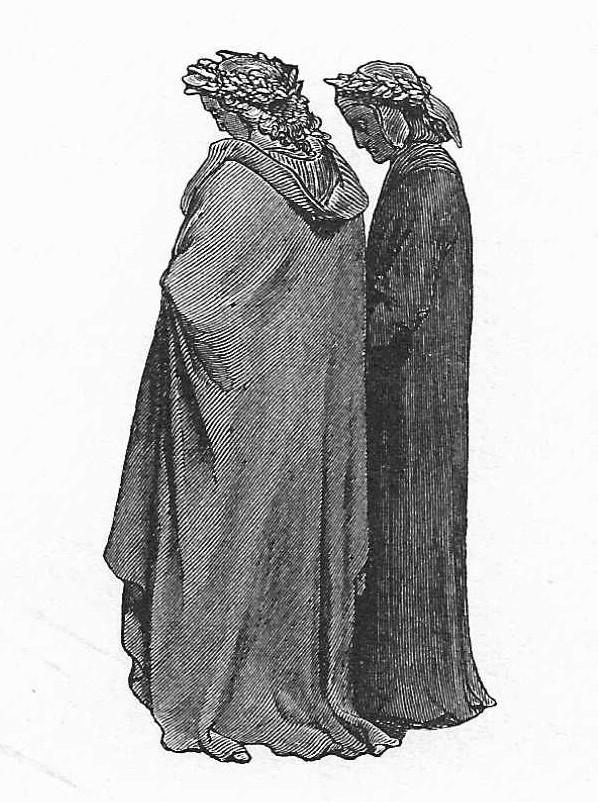
Virgil and Dante
Footnotes
1. Guido Guerra was the lovely daughter of Bellincion Berti, an honorable citizen of "old" Florence. The Emperor Otto IV was taken with her beauty when he visited Florence, offered her in marriage to one of his noblemen, and endowed them with considerable riches. In reality, she was already married to another nobleman named Guido Guerra. The Guido here in this canto would have been her grandson. (In a patriarchal often the father picks the same name as he for the first male born in a lineage, and this may have been perpetuated over two generations.) Born around 1220, he died in 1272 when Dante was 7 years old. Guido was a well-known Guelf who earned his "last name" as a great soldier—guerra means "war" in Italian.
2. Tegghiaio Aldobrandi's (-1266) was a notable leader of the Guelfs and was known for his wise strategic advice. That advice—if listened to—would have saved the Florentine army from a disastrous defeat against Siena.
3. Jacopo Rusticucci's was a knight in the Florentine army and most likely a well-heeled merchant. As noted earlier, Dante is the only one to suggest that the characters in Cantos 15 and 16 were sodomites, and there are no historical sources to verify his claim. It may be that, while they were already notable Florentines in Dante's time, their fame gave them life only in the history books, but not eternally--a moral Dante will bring home again and again in his Poem. Nevertheless, a few early commentators shed a bit of light on Jacopo's admission that it was his wife who drove him to sodomy. One notes that she was unruly (some translators call her fierce) and was sent back to her family. Perhaps he was impotent in his sexual relations with her. Perhaps he was already gay. We simply don't know for sure. Benvenuto da Imola, in his early commentary, puts the whole matter rather bluntly: "Indeed his wife was ferocious, and it was impossible to live with her. Thus he gave himself over to this vice."
4. These gracious and generous words to honor Dante highlight Jacopo's question about the virtues of courtesy and valor. Note that he also wonders (cleverly) whether, like Dante, the virtues of courtesy and valor have been banished from Florence. And to validate his surmise he introduces the testimony of another notable Florentine, now added to Dante's unverified list of sodomites. Little is known about Guglielmo Borsier (whose last name means "pursemaker"), though he probably died around the year 1300 for him to be mentioned here. Nevertheless, Boccaccio praises him highly.
5. As noted earlier, Dante likes to give us geographical details along his journey and, like this one, there is a connection with the geography of the "real world" above. Getting closer to where the Phlegethon plunges into the great central Abyss of Hell (moving from the Seventh to the Eighth Circle), Dante is reminded of another great cataract. But to make the best sense of what he's referring to, we have to untangle several confusing parts of what he is alluding to. To begin with, about 40 miles southwest of Turin, and not far from the French border, Ties Monte Viso (Vesc), the highest peak in the Cottian Alps that form the border between Italy and France. The Po River, the longest in Italy, has its headwaters at Monte Viso and flows across north central Italy until it empties into the Adriatic Sea just north of Ravenna. Several other rivers also rise in this alpine region, many of which eventually flow into the Po. However, the Acquacheta (meaning "quiet water" in Italian), which also rises in the Cottian Alps, is not a tributary of the Po. Note the contrast, by the way, between the quiet waters of the Acquacheta and the deafening roar of the Phlegethon. To make matters somewhat more confusing, the Acquacheta becomes the Montone at Forlì, not far from Ravenna, and thereafter also empties into the Adriatic. In the mountainous region between Florence and Forli is a large monastery of the Benedictine monks known as San Benedetto in Alpe. To the northwest of this monastery is a famous waterfall of the Acquacheta and this is what Dante is referring to here. Today it is a tourist attraction along the Florence-Forli route, and it is quite probable that Dante saw it when it was falling at full force.
Top of page