Dante's Divine Comedy: Inferno
Canto XXVII
Another flame draws near, having recognized Virgil's Lombard accent. It asks for tidings of its native region and pleads that its identity and life story remain undisclosed but it is none other than Guido Da Montefeltro. This well-known deceiver joined the Franciscan order in old age after a high-profile military career as a Ghibelline captain. Breaking his vows, be adopted military fraud to guide Pope Boniface VIII to victory against the Colonna family and uttered a fraudulent repentance on his deathbed, trusting in the pontificate's fake absolution.
Already was the flame erect and quiet,
To speak no more, and now departed from us
With the permission of the gentle Poet;
When yet another, which behind it came,
Caused us to turn our eyes upon its top
By a confused sound that issued from it.
As the Sicilian bull (that bellowed first
With the lament of him, and that was right,
Who with his file had modulated it)
Bellowed so with the voice of the afflicted,
That, notwithstanding it was made of brass,
Still it appeared with agony transfixed;
Thus, by not having any way or issue
At first from out the fire, to its own language
Converted were the melancholy words.
But afterwards, when they had gathered way
Up through the point, giving it that vibration
The tongue had given them in their passage out,
We heard it said: "O thou, at whom I aim
My voice, and who but now wast speaking Lombard,
Saying, 'Now go thy way, no more I urge thee,'
Because I come perchance a little late,
To stay and speak with me let it not irk thee;
Thou seest it irks not me, and I am burning.
If thou but lately into this blind world
Hast fallen down from that sweet Latian land,
Wherefrom I bring the whole of my transgression,[1]
Say, if the Romagnuols have peace or war,
For I was from the mountains there between
Urbino and the yoke whence Tiber bursts."[2]
I still was downward bent and listening,
When my Conductor touched me on the side,
Saying: "Speak thou: this one a Latian is."
And I, who had beforehand my reply
In readiness, forthwith began to speak:
"O soul, that down below there art concealed,
Romagna thine is not and never has been
Without war in the bosom of its tyrants;
But open war I none have left there now.
Ravenna stands as it long years has stood;
The Eagle of Polenta there is brooding,
So that she covers Cervia with her vans.[3]
The city which once made the long resistance,
And of the French a sanguinary heap,
Beneath the Green Paws finds itself again;
Verrucchio's ancient Mastiff and the new,
Who made such bad disposal of Montagna,
Where they are wont make wimbles of their teeth.[4]
The cities of Lamone and Santerno
Governs the Lioncel of the white lair,
Who changes sides 'twixt summer-time and winter;[5]
And that of which the Savio bathes the flank,
Even as it lies between the plain and mountain,
Lives between tyranny and a free state.[6]
Now I entreat thee tell us who thou art;
Be not more stubborn than the rest have been,
So may thy name hold front there in the world."
After the fire a little more had roared
In its own fashion, the sharp point it moved
This way and that, and then gave forth such breath:
"If I believed that my reply were made
To one who to the world would e'er return,
This flame without more flickering would stand still;
But inasmuch as never from this depth
Did any one return, if I hear true,
Without the fear of infamy I answer,
I was a man of arms, then Cordelier,
Believing thus begirt to make amends;
And truly my belief had been fulfilled[7]
But for the High Priest, whom may ill betide,
Who put me back into my former sins;
And how and wherefore I will have thee hear.
While I was still the form of bone and pulp
My mother gave to me, the deeds I did
Were not those of a lion, but a fox.
The machinations and the covert ways
I knew them all, and practiced so their craft,
That to the ends of Earth the sound went forth.
When now unto that portion of mine age
I saw myself arrived, when each one ought
To lower the sails, and coil away the ropes,
That which before had pleased me then displeased me;
And penitent and confessing I surrendered,
Ah woe is me! and it would have bestead me;
The Leader of the modern Pharisees
Having a war near unto Lateran,
And not with Saracens nor with the Jews,[8]
For each one of his enemies was Christian,
And none of them had been to conquer Acre,
Nor merchandising in the Sultan's land,[9]
Nor the high office, nor the sacred orders,
In him regarded, nor in me that cord
Which used to make those girt with it more meager;
But even as Constantine sought out Sylvester
To cure his leprosy, within Soracte,
So this one sought me out as an adept[10]
To cure him of the fever of his pride.
Counsel he asked of me, and I was silent,
Because his words appeared inebriate.
And then he said: 'Be not thy heart afraid;
Henceforth I thee absolve; and thou instruct me
How to raze Palestrina to the ground.
Heaven have I power to lock and to unlock,
As thou dost know; therefore the keys are two,
The which my predecessor held not dear.'
Then urged me on his weighty arguments
There, where my silence was the worst advice;
And said I: 'Father, since thou washest me
Of that sin into which I now must fall,
The promise long with the fulfillment short
Will make thee triumph in thy lofty seat.'
Francis came afterward, when I was dead,
For me; but one of the black Cherubim
Said to him: 'Take him not; do me no wrong;[11]
He must come down among my servitors,
Because he gave the fraudulent advice
From which time forth I have been at his hair;
For who repents not cannot be absolved,
Nor can one both repent and will at once,
Because of the contradiction which consents not.'
O miserable me! how I did shudder
When he seized on me, saying: 'Peradventure
Thou didst not think that I was a logician!'
He bore me unto Minos, who entwined
Eight times his tail about his stubborn back,
And after he had bitten it in great rage,[12]
Said: 'Of the thievish fire a culprit this;'
Wherefore, here where thou seest, am I lost,
And vested thus in going I bemoan me."
When it had thus completed its recital,
The flame departed uttering lamentations,
Writhing and flapping its sharp-pointed horn.
Onward we passed, both I and my Conductor,
Up o'er the crag above another arch,
Which the moat covers, where is paid the fee
By those who, sowing discord, win their burden.
Illustration
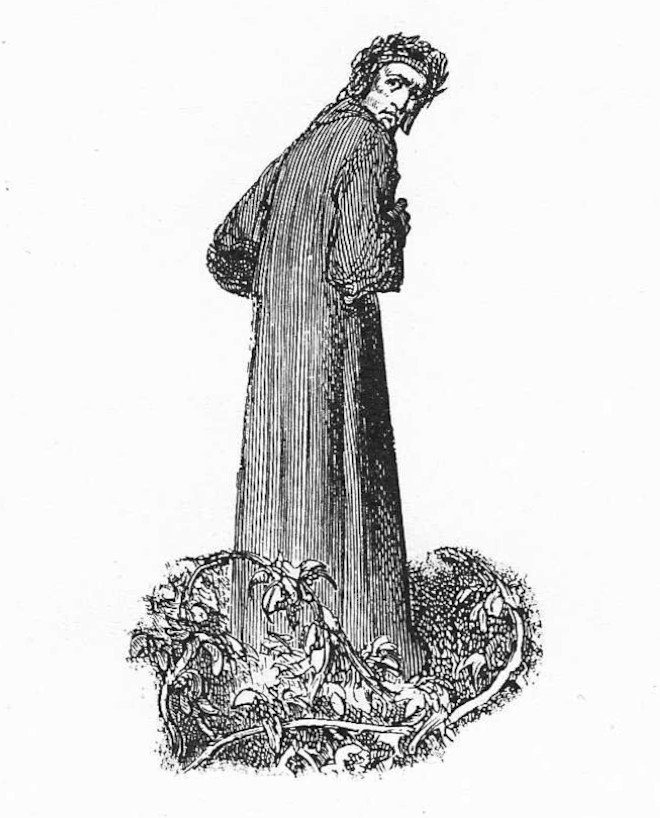
Dante Alligieri
Footnotes
1. Latvian, synonym of Latin.
2. Everyone knows Ulysses, but not everyone knows this newly-arrived sinner until Dante answers his question – a clever device on the Poet’s part. Geographically speaking, here is where this sinner is referring to as “home.” Modern Emilia Romagna was originally two separate regions of north central Italy along the northern border of Tuscany. It stretches from the Adriatic northwestward almost across the entire Italian peninsula, with Emilia inland on the western side of the region, bordered by Romagna on the eastern side, ending at the Adriatic. Its capital is Bologna near its center, with Ravenna along its eastern coast. Ravenna was the earlier capital of Romagna, and before that it was, for many years, seat of the western Roman Empire. The two regions were eventually joined into what has become one of the richest economic areas of modern Italy. Montefeltro is a beautiful mountainous area within the southeastern part of Romagna.
With all this said, the reader will want to know which soul inhabits this new tongue of flame. Though he will soon (carelessly) reveal much about himself, as noted above he never tells his name. And if he hadn’t asked about Romagna, he would be virtually unknown. But with so much surrounding information, Dante makes this discovery a simple one. This sinner is Guido da Montefeltro, one of the most famous military strategists of his time, and his being in the same bolgia as Ulysses and Diomedes will become obvious. But whereas Ulysses’ story is epic, Guido’s is a sad one. He was born in 1230 and died in 1298. The war in Romagna ended in 1299, the year after his death, and thus his question about whether there was war or peace in the region. Guido was a notable Ghibelline leader, and in 1275 was made head of all Ghibelline forces in Romagna, leading them to victory over the Guelfs. This ran him afoul of Pope Martin IV, whose French-led army was eventually defeated by Guido’s Ghibelline forces at Forlì. Martin excommunicated Guido, but this was lifted by his successor, Pope Honorius IV, who sent him into exile near Turin in 1286. Two years later saw him as leader of Pisa and its forces (for which he was again excommunicated!). Saving Pisa and capturing several other cities from the Guelfs, his excommunication was lifted by Pope Boniface VIII in 1296 and he became a monk in the Franciscan Order until his death two years later. More of his biography will unfold as the canto itself moves onward.
3. Present: Ravenna seems to be at peace, ruled by the Polenta family (they would be Dante’s gracious patrons during his final years). Cervia lies just to the south of Ravenna.
Past: Forlì (led by Guido’s forces in 1282) was victorious over the French forces of Pope Martin IV, which Guido would happily know.
Future: The “green lion” refers to the coat of arms of the Ordelaffi family who, by 1300 (two years after Guido died) were now the cruel tyrants of Forlì (with war in their hearts). Commenting on this line, Singleton reports: “It is probable that Dante was at Forlì early in his years of exile, in 1303, as aide and secretary to Scarpetta degli Ordelaffi, who was head of the family at the time and leader of the Bianchi forces there in 1302-1303.“ So, he would have first-hand information for Guido.
4. Past: The “elder and younger mastiffs of Verrucchio” is a reference to the Malatestas—father and son – who lived in the castle of Verrucchio. The elder Malatesta was the lord of Rimini from 1295 to 1312. It has been suggested by commentators that they may have had a large dog (mastiff) on their coat of arms, and they were well-known for their wickedness and cruelty. In 1295, the elder Malatesta defeated the Ghibellines of Rimini. He captured the head of their party, Montagna de’Parcitati, and imprisoned him in the castle. Malatestino later murdered him in the castle dungeon. (Recall that Francesca, in Canto 5, was married to Gianciotto Malatesta and fell in love with his younger brother. The older Malatesta noted here was their father.)
Present: The Malatestas are wicked rulers who, as Dante notes in the Italian, are like wild dogs (mastiffs) chewing on their victims!
5. Present: In his text, Dante refers to two rivers and, by implication, two cities along their shores: the Santerno (the city of Imola) and the Lamone (the city of Faenza). Their “fickle ruler” is Maghinardo di Pagano da Susinana (whom Dante refers to by his coat of arms: a blue lion on a white field. Recall the usurers in Canto 17.). He “changes sides like the weather” because he supported the Ghibellines when he was in the north, and the Guelfs when he was in the south.
6. Present: The last city in Dante’s “news report” is Cesena. Again, Dante uses its nearby river, the Savio, to identify it. The reason Dante says that it enjoys “relative peace” is because it was at that time (1300) ruled by a kind of organized government, no t by a tyrant. In earlier years, it had gone back and forth. The present leader (is this why Dante saved Cesena for the last?) was Guido’s cousin, Galasso da Montefeltro. Bear in mind that through this entire “report” Dante the Pilgrim has no idea of the id entity or the fame of the sinner he’s talking to.
7. Cordelier, French, corde, “rope”, from the girdle of knotted cord worn by the Franciscans.
8. Guido’s remark about Saracens and Jews is yet another insult directed at Boniface who, all this time, was waging war against his Christian enemies in the region of Rome instead of in the Holy Land like other crusades. Sadly, these wars of Boniface were not waged out of high ideals or principles of faith. They were shameful and blatant attacks against his personal enemies and tarnished the reputation of the papacy. But Guido’s seeming concern for his “monks’ cord” tarnishes him as well.
9. Acre, Israel.
10. Finally, Guido ends with clever role-reversals: Pope Sylvester became the emperor’s “doctor” and Guido (like Sylvester) becomes Boniface’s (like the emperor) “doctor.” What Guido alludes to here is a widely-circulated Medieval legend that the emperor Constantine contracted leprosy and sent for Pope Sylvester I to cure him, which he did. Sylvester had apparently been in hiding near Mount Soracte, about 40 miles north of Rome. Shortly afterward, the emperor became a Christian and was baptized. In gratitude, Constantine became involved in the construction or enlargement of what is now the great Basilica of St. John Lateran, the principal church of Rome (St. Peter’s being the principal church of the Christian world). The Lateran Palace (noted above) had already com e into his hands through his second wife, Fausta. This particular legend about Constantine’s leprosy and subsequent baptism seems to have sprung up to counteract the historical fact that, near death, Constantine (who was ill but did not have leprosy) was converted to the faith of Christianity and was baptized by the Arian bishop Eusebius of Nicomedia. In spite of Constantine’s efforts to unite the Roman Church, the Arian heresy caused a major division during his lifetime. Arians (named after the priest Arius) did not believe in the Trinity and believed that Jesus was not God but created by God. Thus, the legend seems to have been a later attempt to sanitize Constantine’s baptism, though it was valid regardless of who performed it. Later, Dante will place Constantine in his Paradiso, and the emperor is considered a Saint in the Orthodox Church.
11. Guido died in September of 1298, the same month in which Boniface’s forces razed the city of Palestrina. As noted above, Guido doesn’t tell us what followed from his advice to Pope Boniface because that was already known by the time Dante wrote the Inferno. What he does instead is tell us the story we could not have known: about the drama between St. Francis and the devil and their fight for his soul. Note that in Canto 5 of the Purgatorio, Guido’s son, Buonconte, will have a similar experience at his death—but with a positive outcome.
The appearance here of this beloved Saint offers a moment of consolation in the turbulent story of Guido’s life and his encounter with Pope Boniface. This would be any Franciscan monk’s holy hope—including Guido’s—that St. Francis personally would bring his soul into the arms of his Savior in Heaven. After all, Guido told us that he exchanged his fox-like life for that of a humble monk. Though Guido admitted that he chose the lesser of two evils in suggesting a solution to Boniface’s problem with Palestrina, he never admits that his choice to speak was a sinful one; nor does he question the false claims the pope makes about the sacrament he so casually ravished. True, he had the power to give or refuse absolution. But no one, not even a pope, can grant absolution for a sin before it is committed.
12. Guido seems to take stock of his situation as he reiterates the cascading effect of his sin. He may be showing off when he includes Minos biting his tail because, though he wraps his tail around himself when we first meet him in Canto 5, he does not bite it . Is Guido inflating his sin by giving us this bit of information? On the other hand, biting a hand or an arm is an ancient Italian gesture of anger. We saw this with Filippo Argenti who turned his rage upon his own body in Canto 8, and even the Minotaur bi t himself in Canto 12.
Top of page