Dante's Divine Comedy: Paradiso
Canto XXXII
Saint Bernard guides Dante's gaze across the Rose's symmetry. A line of saintly women, then men, extends from the throne of the Virgin, between Peter and Adam, to that of John the Baptist, between Lucy and Saint Anne. On the left are the thrones of the New Covenant saints (who believe in the coming of Christ) and the children saved by baptism. On the right are the thrones of the Old Covenant saints (who believed Christ had already come) and the pre-Christian children saved by Love. Saint Bernard calls on Dante to join him in a prayer to the Virgin.[1]
Absorbed in his delight, that contemplator
Assumed the willing office of a teacher,
And gave beginning to these holy words:
"The wound that Mary closed up and anointed,
She at her feet who is so beautiful,
She is the one who opened it and pierced it.
Within that order which the third seats make
Is seated Rachel, lower than the other,
With Beatrice, in manner as thou seest.[2]
Sarah, Rebecca, Judith, and her who was
Ancestress of the Singer, who for dole
Of the misdeed said, 'Miserere mei,'[3]
Canst thou behold from seat to seat descending
Down in gradation, as with each one's name
I through the Rose go down from leaf to leaf.
And downward from the seventh row, even as
Above the same, succeed the Hebrew women,
Dividing all the tresses of the flower;
Because, according to the view which Faith
In Christ had taken, these are the partition
By which the sacred stairways are divided.
Upon this side, where perfect is the flower
With each one of its petals, seated are
Those who believed in Christ who was to come.
Upon the other side, where intersected
With vacant spaces are the semicircles,
Are those who looked to Christ already come.
And as, upon this side, the glorious seat
Of the Lady of Heaven, and the other seats
Below it, such a great division make,
So opposite doth that of the great John,
Who, ever holy, desert and martyrdom
Endured, and afterwards two years in Hell.
And under him thus to divide were chosen
Francis, and Benedict, and Augustine,
And down to us the rest from round to round.
Behold now the high providence divine;
For one and other aspect of the Faith
In equal measure shall this garden fill.
And know that downward from that rank which cleaves
Midway the sequence of the two divisions,
Not by their proper merit are they seated;
But by another's under fixed conditions;
For these are spirits one and all assoiled
Before they any true election had.
Well canst thou recognize it in their faces,
And also in their voices puerile,
If thou regard them well and hearken to them.
Now doubtest thou, and doubting thou art silent;
But I will loosen for thee the strong bond
In which thy subtile fancies hold thee fast.
Within the amplitude of this domain
No casual point can possibly find place,
No more than sadness can, or thirst, or hunger;
For by eternal law has been established
Whatever thou beholdest, so that closely
The ring is fitted to the finger here.
And therefore are these people, festinate
Unto true life, not 'sine causa' here
More and less excellent among themselves.[4]
The King, by means of whom this realm reposes
In so great love and in so great delight
That no will ventureth to ask for more,
In his own joyous aspect every mind
Creating, at his pleasure dowers with grace
Diversely; and let here the effect suffice.
And this is clearly and expressly noted
For you in Holy Scripture, in those twins
Who in their mother had their anger roused.[5]
According to the color of the hair,
Therefore, with such a grace the light supreme
Consenteth that they worthily be crowned.
Without, then, any merit of their deeds,
Stationed are they in different gradations,
Differing only in their first acuteness.
'Tis true that in the early centuries,
With innocence, to work out their salvation
Sufficient was the faith of parents only.
After the earlier ages were completed,
Behooved it that the males by circumcision
Unto their innocent wings should virtue add;
But after that the time of grace had come
Without the baptism absolute of Christ,
Such innocence below there was retained.
Look now into the face that unto Christ
Hath most resemblance; for its brightness only
Is able to prepare thee to see Christ."
On her did I behold so great a gladness
Rain down, borne onward in the holy minds
Created through that altitude to fly,
That whatsoever I had seen before
Did not suspend me in such admiration,
Nor show me such similitude of God.
And the same Love that first descended there,
"Ave Maria, gratia plena," singing,
In front of her his wings expanded wide.[6]
Unto the canticle divine responded
From every part the court beatified,
So that each sight became serener for it.
"O holy father, who for me endurest
To be below here, leaving the sweet place
In which thou sittest by eternal lot,
Who is the Angel that with so much joy
Into the eyes is looking of our Queen,
Enamored so that he seems made of fire?"
Thus I again recourse had to the teaching
Of that one who delighted him in Mary
As doth the star of morning in the sun.
And he to me: "Such gallantry and grace
As there can be in Angel and in soul,
All is in him; and thus we fain would have it;
Because he is the one who bore the palm
Down unto Mary, when the Son of God
To take our burden on himself decreed.
But now come onward with thine eyes, as I
Speaking shall go, and note the great patricians
Of this most just and merciful of empires.
Those two that sit above there most enrapture
As being very near unto Augusta,
Are as it were the two roots of this Rose.
He who upon the left is near her placed
The father is, by whose audacious taste
The human species so much bitter tastes.
Upon the right thou seest that ancient father
Of Holy Church, into whose keeping Christ
The keys committed of this lovely flower.
And he who all the evil days beheld,
Before his death, of her the beauteous bride
Who with the spear and with the nails was won,
Beside him sits, and by the other rests
That leader under whom on manna lived
The people ingrate, fickle, and stiff-necked.
Opposite Peter seest thou Anna seated,
So well content to look upon her daughter,
Her eyes she moves not while she sings Hosanna.[7]
And opposite the eldest household father
Lucia sits, she who thy Lady moved
When to rush downward thou didst bend thy brows.[8]
But since the moments of thy vision fly,
Here will we make full stop, as a good tailor
Who makes the gown according to his cloth,
And unto the first Love will turn our eyes,
That looking upon Him thou penetrate
As far as possible through his effulgence.
Truly, lest peradventure thou recede,
Moving thy wings believing to advance,
By prayer behooves it that grace be obtained;
Grace from that one who has the power to aid thee;
And thou shalt follow me with thy affection
That from my words thy heart turn not aside."
And he began this holy orison.
Footnotes
1. Saint Bernard now points out other notable figures in the court of Heaven, whose ranks are divided into two sets of hemispheres. Women, including not only Mary, but Eve, Rachel, and other biblical figures, sit above the divine presence at the circles' c enter. Men are enthroned below it. Laterally, the court is divided between "those who showed belief in Christ to come" and "those / who turned their countenance to Christ now come." The ranks of the former—the faithful from before the coming of Christ—logically are now full, with no room for new additions. The ranks of the latter still contain some vacancies. The souls of baptized children, "spirits loosed from earth / before they ... could conceive free choice," sit along the midline.
Expecting Dante to take issue with the justice of saving some children and not others, Bernard prepares an answer. In the earliest days, he says, children of the faithful were saved automatically, but since the coming of Christ baptism has been requisite fo r salvation. Unbaptized souls from this time onward have been allocated to Limbo, a painless border region of Hell. This fate cannot be understood rationally, Bernard warns, but must be chalked up to the mysteriousness of God's will. Bernard next directs Dante's gaze once more to the Virgin Mary, who—he says—is alone able to make Dante fit to look upon God. As Dante watches, the archangel Gabriel flits through the heavenly court singing Ave Maria gratia plena—"Hail Mary, full of grace."
2. Rachel is the second wife of Jacob and the mother of Joseph and Benjamin. Rachel is also considered a foremother of the Jewish people, as Joseph was one of the twelve tribes of Israel. Rachel is remembered for her devotion to her children and her faith in G od. In the Bible, Rachel is described as being a woman of great beauty, but also of great piety and compassion.
According to tradition, St. Rachel died in childbirth while giving birth to her son Benjamin, She is said to have been buried on the road to Efrat, also known as Bethlehem, which is considered the traditional birthplace of Jesus. It is believed that her tom b was visited by many people over the centuries, who sought her intercession and protection, especially travelers.
In the Catholic Church, St. Rachel is invoked as a protector of travelers and converts, as well as a helper in times of need. Her feast day is celebrated on September 23. She is also considered the patron saint of pregnant women.
3. Sarah, Rebecca, and Judith are significant biblical figures seated in the heavenly Rose. They are part of a hierarchy of blessed souls, with Sarah being the wife of Abraham, Rebecca being Isaac's wife, and Judith known for her bravery in saving her people.
Rebekah was the wife of Isaac and the mother of Jacob and Esau, as described in the Hebrew Bible. She was chosen by Abraham's servant at a well, where she demonstrated kindness by offering water to him and his camels, fulfilling a sign that indicated sh e was the right choice for Isaac.
Judith is a Jewish widow who uses her beauty and charm to kill an Assyrian general who has besieged her city, Bethulia. With this act, she saves nearby Jerusalem from total destruction. The name Judith, in Hebrew meaning "praised" or "Jewess", is the feminine form of Judah.
Miserere mei, Latin "Have mercy on me".
4. sine causa, Latin "without reason".
5. The twins refer to Jacob's sons, Jacob and Esau, who are significant figures in the biblical narrative. Their mention highlights themes of duality and the complexities of human nature within the context of divine grace and order.
The Book of Genesis depicts of the relationship between fraternal twins Jacob and Esau, sons of Isaac and Rebekah. The story focuses on Esau's loss of his birthright to Jacob and the conflict that ensued between their descendant nations because of Jacob's deception of their aged and blind father, Isaac, in order to receive Esau's birthright/blessing from Isaac.
This conflict was paralleled by the affection the parents had for their favored child: "Isaac, who had a taste for wild game, loved Esau, but Rebekah loved Jacob." Even since conception, their conflict was foreshadowed: "And the children struggled together within her; and she said, If it be so, why am I thus? And she went to inquire of the Lord. And the Lord said unto her, Two nations are in thy womb, and two manner of people shall be separated from thy bowels; and the one people shall be stronger than the other people; and the elder shall serve the younger."
Genesis 25:26 states that Esau was born before Jacob, who came out holding on to his older brother's heel as if he was trying to pull Esau back into the womb so that he could be firstborn. The name Jacob means "he grasps the heel" which is a Hebrew idiom fo r deceptive behavior.
6. gratia plena, Latin "full of grace".
7. Anne was the mother of Mary, the wife of Joachim and the maternal grandmother of Jesus. Mary's mother is not named in the Bible's canonical gospels. In writing, Anne's name and that of her husband Joachim come from New Testament apocrypha, of which the Gospel of James (written perhaps around 150 AD) seems to be the earliest that mentions them. The mother of Mary is mentioned but not named in the Quran.
8. Lucy is a significant figure who represents light and sight. She plays a crucial role in guiding Dante, as she is the one who intercedes with Beatrice to help him on his journey towards salvation.
Lucia of Syracuse (283–304 AD), also called Santa Lucia or Saint Lucy, was a Roman Christian martyr who died during the Diocletianic Persecution. She is venerated as a saint in Catholic, Anglican, Lutheran, Eastern Orthodox and Oriental Orthodox Christianity. She is one of eight women (including the Virgin Mary) explicitly commemorated by Catholics in the Canon of the Mass. Her traditional feast day, known in Europe as Saint Lucy's Day, is observed by Western Christians on December 13. Lucia of Syracuse was honored in the Middle Ages and remained a well-known saint in early modern England. She is one of the best known virgin martyrs, along with Agatha of Sicily, Agnes of Rome, Cecilia of Rome, and Catherine of Alexandria.
Illustrations of Paradiso
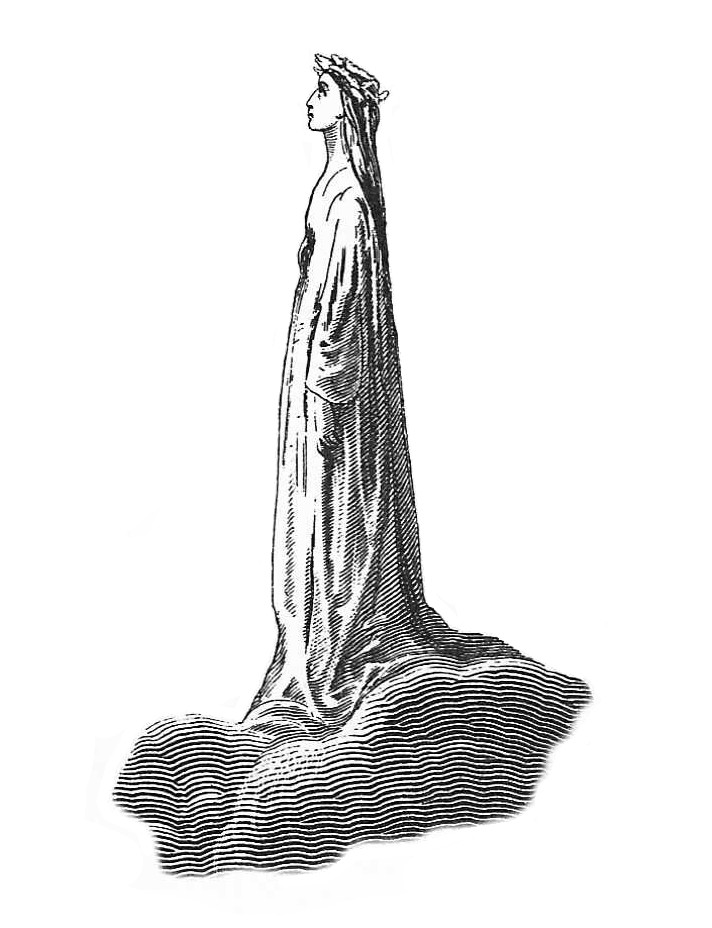
Beatrice
Top of page