Dante's Divine Comedy: Paradiso
Canto VII
Justinian and the other spirits spin out of sight. Beatrice explains that just vengeance was exacted for the Fall through the Crucifixion, but that even though Christ's human nature was justly punished, his divinity had been wronged. Dante begins to understand that God wished to accomplish the redemption of mankind through the gift of his only son. A discussion follows about the mystery of the Resurrection of the Body: what God created as first matter—life, the angels and the spheres—is eternal; what decays are things not directly made by his hand.[1]
"Osanna sanctus Deus Sabaoth,
Superillustrans claritate tua
Felices ignes horum malaboth!"
In this wise, to his melody returning,
This substance, upon which a double light
Doubles itself, was seen by me to sing,
And to their dance this and the others moved,
And in the manner of swift-hurrying sparks
Veiled themselves from me with a sudden distance.
Doubting was I, and saying, "Tell her, tell her,"
Within me, "tell her," saying, "tell my Lady,"
Who slakes my thirst with her sweet effluences;
And yet that reverence which doth lord it over
The whole of me only by B and ICE,
Bowed me again like unto one who drowses.[2]
Short while did Beatrice endure me thus;
And she began, lighting me with a smile
Such as would make one happy in the fire:
"According to infallible advisement,
After what manner a just vengeance justly
Could be avenged has put thee upon thinking,
But I will speedily thy mind unloose;
And do thou listen, for these words of mine
Of a great doctrine will a present make thee.
By not enduring on the power that wills
Curb for his good, that man who ne'er was born,
Damning himself damned all his progeny;
Whereby the human species down below
Lay sick for many centuries in great error,
Till to descend it pleased the Word of God
To where the nature, which from its own Maker
Estranged itself, he joined to him in person
By the sole act of his eternal love.
Now unto what is said direct thy sight;
This nature when united to its Maker,
Such as created, was sincere and good;
But by itself alone was banished forth
From Paradise, because it turned aside
Out of the way of truth and of its life.
Therefore the penalty the cross held out,
If measured by the nature thus assumed,
None ever yet with so great justice stung,
And none was ever of so great injustice,
Considering who the Person was that suffered,
Within whom such a nature was contracted.
From one act therefore issued things diverse;
To God and to the Jews one death was pleasing;
Earth trembled at it and the Heaven was opened.
It should no longer now seem difficult
To thee, when it is said that a just vengeance
By a just court was afterward avenged.
But now do I behold thy mind entangled
From thought to thought within a knot, from which
With great desire it waits to free itself.
Thou sayest, 'Well discern I what I hear;
But it is hidden from me why God willed
For our redemption only this one mode.'
Buried remaineth, brother, this decree
Unto the eyes of every one whose nature
Is in the flame of love not yet adult.
Verily, inasmuch as at this mark
One gazes long and little is discerned,
Wherefore this mode was worthiest will I say.
Goodness Divine, which from itself doth spurn
All envy, burning in itself so sparkles
That the eternal beauties it unfolds.
Whate'er from this immediately distils
Has afterwards no end, for ne'er removed
Is its impression when it sets its seal.
Whate'er from this immediately rains down
Is wholly free, because it is not subject
Unto the influences of novel things.
The more conformed thereto, the more it pleases;
For the blest ardor that irradiates all things
In that most like itself is most vivacious.
With all of these things has advantaged been
The human creature; and if one be wanting,
From his nobility he needs must fall.
'Tis sin alone which doth disfranchise him,
And render him unlike the Good Supreme,
So that he little with its light is blanched,
And to his dignity no more returns,
Unless he fill up where transgression empties
With righteous pains for criminal delights.
Your nature when it sinned so utterly
In its own seed, out of these dignities
Even as out of Paradise was driven,
Nor could itself recover, if thou notest
With nicest subtilty, by any way,
Except by passing one of these two fords:
Either that God through clemency alone
Had pardon granted, or that man himself
Had satisfaction for his folly made.
Fix now thine eye deep into the abyss
Of the eternal counsel, to my speech
As far as may be fastened steadfastly!
Man in his limitations had not power
To satisfy, not having power to sink
In his humility obeying then,
Far as he disobeying thought to rise;
And for this reason man has been from power
Of satisfying by himself excluded.
Therefore it God behooved in his own ways
Man to restore unto his perfect life,
I say in one, or else in both of them.
But since the action of the doer is
So much more grateful, as it more presents
The goodness of the heart from which it issues,
Goodness Divine, that doth imprint the world,
Has been contented to proceed by each
And all its ways to lift you up again;
Nor 'twixt the first day and the final night
Such high and such magnificent proceeding
By one or by the other was or shall be;
For God more bounteous was himself to give
To make man able to uplift himself,
Than if he only of himself had pardoned;
And all the other modes were insufficient
For justice, were it not the Son of God
Himself had humbled to become incarnate.
Now, to fill fully each desire of thine,
Return I to elucidate one place,
In order that thou there mayst see as I do.
Thou sayst: 'I see the air, I see the fire,
The water, and the earth, and all their mixtures
Come to corruption, and short while endure;[3]
And these things notwithstanding were created;'
Therefore if that which I have said were true,
They should have been secure against corruption.
The Angels, brother, and the land sincere
In which thou art, created may be called
Just as they are in their entire existence;
But all the elements which thou hast named,
And all those things which out of them are made,
By a created virtue are informed.
Created was the matter which they have;
Created was the informing influence
Within these stars that round about them go.
The soul of every brute and of the plants
By its potential temperament attracts
The ray and motion of the holy lights;
But your own life immediately inspires
Supreme Beneficence, and enamors it
So with herself, it evermore desires her.
And thou from this mayst argue furthermore
Your resurrection, if thou think again
How human flesh was fashioned at that time
When the first parents both of them were made."
Footnotes
1. Justinian (482-565 AD) is regarded as one of the most prominent and influential Roman emperors, and historians have often characterized him as a workaholic who worked tirelessly to expand the Byzantine Empire. One of the most enduring aspects of his legacy was the uniform rewriting of Roman law, the Corpus Juris Civilis, which was first applied throughout Continental Europe and is still the basis of civil law in many modern states. His reign also marked a blossoming of Byzantine culture, and his building prog ram yielded works such as the Hagia Sophia.
Justinian's speech breaks off into a song of praise to God. This is soon accompanied by a flourish of light as other souls of the second heaven join in. Confused, Dante calls out for Beatrice, who speaks to him about the nature of original sin, redemption, and Christ's sacrifice on the Cross. She tells him Adam, "the unborn first of men," "damned all born to him" when he first sinned by disobeying God. Eventually, after many generations, God came to Earth in human form to set things right. In dying on the Cross, Christ—as both God and man—settled the debt humankind had incurred through Adam's sin.
Dante, being an educated Christian of his times, already knows all this. What he wants to know is why Christ's sacrifice was necessary. Such an act, Beatrice says, "was right and finest" because the enormity of Adam's sin prevented humankind from ever sufficiently atoning by itself. Thus, God was left to remedy the sin "by His own means." He chose to do so in human form because this not only revealed His humility and generosity but also restored humanity's dignity.
2. Latin translation:
Osanna the Holy God of Sabaoth
Super-illustrating Your Brightness
Happy fires of these malaboth!
Osanna of Mantua (1449–1505) was an Italian Dominican tertiary, Third Order of Saint Dominic, who gained notice as a stigmatic and mystic. Osanna was the daughter of the nobles Niccolò Andreasi, whose family had originated in Hungary, and of Agnese Gonzaga. She was reported to have had a vision of angels at age six. Feeling called to consecrated life, she rejected a marriage arranged by her father. Unable to explain her attraction to religious life to her father, in 1463, at the age of 14, she secretly received the religious habit of the Third Order of St. Dominic. She had been drawn to this Order from her admiration of two members of the Order, Catherine of Siena, and her contemporary, Friar Girolamo Savonarola, who both represented to her lives of strict self-denial.
Latin, Sabaoth, Greek, Σαβαώθ, Hebrew, צְבָאוֹת, meaning armies. In Judaism, it is an epithet of God in His role as protector of the Israelite army, usually translated as "Lord of Hosts".
malachoth refers to a concept associated with the heavenly realms, often linked to the idea of divine illumination and the happy fires of paradise. It appears in the context of praising God and signifies the joy and light of the saved souls in heaven.
2. B and ICE appear to be a cryptic reference to a divine or celestial law, which can be understood through an acronym. In the case of B, it may represent Beatrice. Beatrice is Dante’s symbol of divine love and knowledge. Her name itself has theological significance, being derived from the Latin beatus (meaning blessed) and atrice (meaning bringer of joy or blessings). In Paradiso, she serves as the one who enlightens Dante’s understanding of divine truth.
ICE could represent a type of symbolic contrast to fire—a state of purity or clarity. This may emphasize the balance of purity and light in heavenly realms, aligning with the divine truth Dante encounters. Ice is often used in literature as a symbol of coldness, stillness, and even death, but in Dante's Paradiso, it may symbolize a type of purification, or even the clarity that comes from divine insight. The ice could also be the perfection of the celestial realms, as coldness (ICE) might refer to the humility and calmness that come with divine purity.
3. Beatrice now turns to a related point: the apparent temporariness of the created universe. Physical matter, she admits, changes and decays, but neither angels nor human souls do so. These immortal creatures, she says, were made directly by God, whereas plan ts, animals, and ordinary matter were made indirectly, at His command. Thus, Beatrice maintains, humankind can expect a bodily resurrection prior to the Last Judgment—the end of the world—since Adam and Eve's bodies were formed by God's direct intervention.
Illustrations of Paradiso
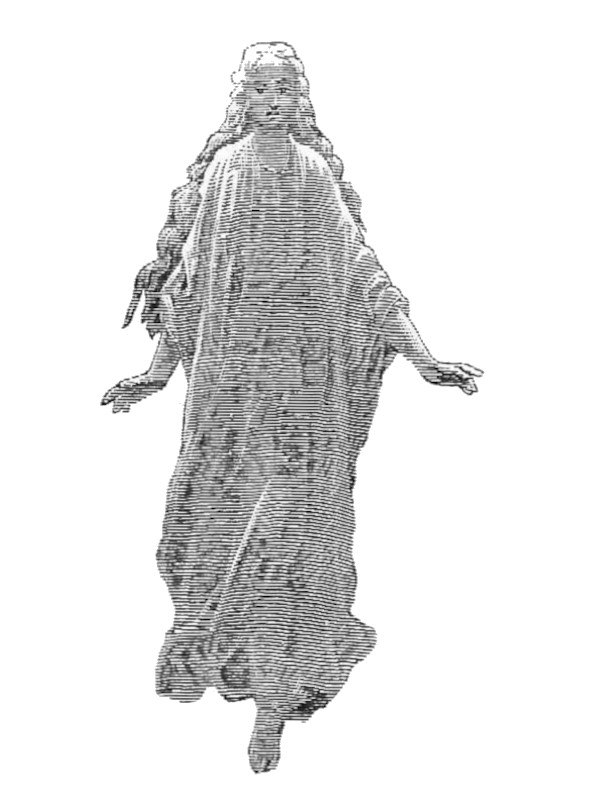
Beatrice
Top of page