Dante's Divine Comedy: Paradiso
Canto XX
As the eagle falls silent, its multiple voices rise up in an angelic chorus. A murmuring from deep inside the bird's neck becomes a single, clear utterance asking Dante to observe how the pupil and the upper curve of its eye socket are composed of six lights. These are the souls of the world's greatest justiciaries: King David (the eye), Trajan, Hezekiah, Constantine, William II of Sicily and Ripheus (the arch above). Dante is surprised to see Trajan and Ripheus among such exalted company but the eagle assures him that, though pagan, they died in true faith.[1]
When he who all the world illuminates
Out of our hemisphere so far descends
That on all sides the daylight is consumed,
The heaven, that erst by him alone was kindled,
Doth suddenly reveal itself again
By many lights, wherein is one resplendent.
And came into my mind this act of heaven,
When the ensign of the world and of its leaders
Had silent in the blessed beak become;
Because those living luminaries all,
By far more luminous, did songs begin
Lapsing and falling from my memory.
O gentle Love, that with a smile dost cloak thee,
How ardent in those sparks didst thou appear,
That had the breath alone of holy thoughts!
After the precious and pellucid crystals,
With which begemmed the sixth light I beheld,
Silence imposed on the angelic bells,
I seemed to hear the murmuring of a river
That clear descendeth down from rock to rock,
Showing the affluence of its mountain-top.
And as the sound upon the cithern's neck
Taketh its form, and as upon the vent
Of rustic pipe the wind that enters it,[2]
Even thus, relieved from the delay of waiting,
That murmuring of the eagle mounted up
Along its neck, as if it had been hollow.
There it became a voice, and issued thence
From out its beak, in such a form of words
As the heart waited for wherein I wrote them.
"The part in me which sees and bears the sun
In mortal eagles," it began to me,
"Now fixedly must needs be looked upon;
For of the fires of which I make my figure,
Those whence the eye doth sparkle in my head
Of all their orders the supremest are.
He who is shining in the midst as pupil
Was once the singer of the Holy Spirit,
Who bore the ark from city unto city;
Now knoweth he the merit of his song,
In so far as effect of his own counsel,
By the reward which is commensurate.
Of five, that make a circle for my brow,
He that approacheth nearest to my beak
Did the poor widow for her son console;
Now knoweth he how dearly it doth cost
Not following Christ, by the experience
Of this sweet life and of its opposite.
He who comes next in the circumference
Of which I speak, upon its highest arc,
Did death postpone by penitence sincere;
Now knoweth he that the eternal judgment
Suffers no change, albeit worthy prayer
Maketh below to-morrow of to-day.
The next who follows, with the laws and me,
Under the good intent that bore bad fruit
Became a Greek by ceding to the pastor;
Now knoweth he how all the ill deduced
From his good action is not harmful to him,
Although the world thereby may be destroyed.
And he, whom in the downward arc thou seest,
Guglielmo was, whom the same land deplores
That weepeth Charles and Frederick yet alive;[3]
Now knoweth he how heaven enamored is
With a just king; and in the outward show
Of his effulgence he reveals it still.
Who would believe, down in the errant world,
That e'er the Trojan Ripheus in this round
Could be the fifth one of the holy lights?
Now knoweth he enough of what the world
Has not the power to see of grace divine,
Although his sight may not discern the bottom."
Like as a lark that in the air expatiates,
First singing and then silent with content
Of the last sweetness that doth satisfy her,
Such seemed to me the image of the imprint
Of the eternal pleasure, by whose will
Doth everything become the thing it is.
And notwithstanding to my doubt I was
As glass is to the color that invests it,
To wait the time in silence it endured not,
But forth from out my mouth, "What things are these?"
Extorted with the force of its own weight;
Whereat I saw great joy of coruscation.
Thereafterward with eye still more enkindled
The blessed standard made to me reply,
To keep me not in wonderment suspended:
"I see that thou believest in these things
Because I say them, but thou seest not how;
So that, although believed in, they are hidden.
Thou doest as he doth who a thing by name
Well apprehendeth, but its quiddity
Cannot perceive, unless another show it.
'Regnum coelorum' suffereth violence
From fervent love, and from that living hope
That overcometh the Divine volition;[4]
Not in the guise that man o'ercometh man,
But conquers it because it will be conquered,
And conquered conquers by benignity.
The first life of the eyebrow and the fifth
Cause thee astonishment, because with them
Thou seest the region of the angels painted.
They passed not from their bodies, as thou thinkest,
Gentiles, but Christians in the steadfast faith
Of feet that were to suffer and had suffered.
For one from Hell, where no one e'er turns back
Unto good will, returned unto his bones,
And that of living hope was the reward,--
Of living hope, that placed its efficacy
In prayers to God made to resuscitate him,
So that 'twere possible to move his will.
The glorious soul concerning which I speak,
Returning to the flesh, where brief its stay,
Believed in Him who had the power to aid it;
And, in believing, kindled to such fire
Of genuine love, that at the second death
Worthy it was to come unto this joy.
The other one, through grace, that from so deep
A fountain wells that never hath the eye
Of any creature reached its primal wave,
Set all his love below on righteousness;
Wherefore from grace to grace did God unclose
His eye to our redemption yet to be,
Whence he believed therein, and suffered not
From that day forth the stench of paganism,
And he reproved therefore the folk perverse.
Those Maidens three, whom at the right-hand wheel
Thou didst behold, were unto him for baptism
More than a thousand years before baptizing.[5]
O thou predestination, how remote
Thy root is from the aspect of all those
Who the First Cause do not behold entire!
And you, O mortals! hold yourselves restrained
In judging; for ourselves, who look on God,
We do not know as yet all the elect;
And sweet to us is such a deprivation,
Because our good in this good is made perfect,
That whatsoe'er God wills, we also will."
After this manner by that shape divine,
To make clear in me my short-sightedness,
Was given to me a pleasant medicine;
And as good singer a good lutanist
Accompanies with vibrations of the chords,
Whereby more pleasantness the song acquires,
So, while it spake, do I remember me
That I beheld both of those blessed lights,
Even as the winking of the eyes concords,
Moving unto the words their little flames.
Footnotes
1. Five Holy Lights: In Canto 20 of Dante's Paradiso, the Eagle, which symbolizes justice and authority, identifies five blessed souls that make up its eyebrow. These souls are recognized for their virtuous lives and contributions to justice.
| Pos | Name | Notable Contributions |
|---|---|---|
| 1 | Trajan | Known for his justice and compassion |
| 2 | Hezekiah | The Hebrew king noted for his piety |
| 3 | Constantine | The Roman emperor who embraced Christianity |
| 4 | William the Good | The just ruler of Sicily |
| 5 | Ripheus the Trojan | A pagan known for his righteousness |
King David (800s BC) was a king of ancient Israel and Judah, according to the Hebrew Bible and Old Testament.
The Tel Dan stele, an Aramaic-inscribed stone erected by a king of Aram-Damascus in the late 9th or early 8th centuries BC to commemorate a victory over two enemy kings, contains the phrase bytdwd (𐤁𐤉𐤕𐤃𐤅𐤃), which is translated as "House of David" by most scholars. The Mesha Stele, erected by King Mesha of Moab in the 9th century BC, may also refer to the "House of David", although this is disputed. According to Jewish works such as the Seder Olam Rabbah, Seder Olam Zutta, and Sefer ha-Qabbalah, David ascended the throne as the king of Judah in 885 BC. Apart from this, all that is known of David comes from biblical literature, the historicity of which has been extensively challenged, and there is little detail about David that is concrete and undisputed. Debates persist over several controversial issues: the exact time-frame of David's reign and the geographical boundaries of his kingdom; whether the story serves as a political defense of David's dynasty against accusations of tyranny, murder and regicide; the homo erotic relationship between David and Jonathan; whether the text is a Homer-like heroic tale adopting elements from its Ancient Near East parallels; and whether elements of the text date as late as the Hasmonean period.
1. Trajan (53–117 AD) was a Roman emperor from 98 to 117 AD, remembered as the second of the Five Good Emperors of the Nerva—Antonine dynasty. He was a philanthropic ruler and a successful soldier-emperor who presided over one of the greatest military expansions in Roman history, during which, by the time of his death, the Roman Empire reached its maximum territorial extent. He was given the title of Optimus ('the best') by the Roman Senate.
Trajan was born in the municipium of Italica in the present-day Andalusian province of Seville in southern Spain, an Italic settlement in Hispania Baetica; his relatives came from the town of Tuder in the Umbria region of central Italy. His namesake father , Marcus Ulpius Traianus, was a general and distinguished senator. Trajan rose to prominence during the reign of Domitian; in 89 AD, serving as a legatus legionis in Hispania Tarraconensis, he supported the emperor against a revolt on the Rhine led by Antonius Saturninus. He then served as governor of Germania and Pannonia. In September 96, Domitian was succeeded by the elderly and childless Nerva, who proved to be unpopular with the army. After a revolt by members of the Praetorian Guard, Nerva decided to ad opt as his heir and successor the more popular Trajan, who had distinguished himself in military campaigns against Germanic tribes.
2. Hezekiah (741–686 BC), was the son of Ahaz and the thirteenth king of Judah according to the Hebrew Bible. He is described as "the best-attested figure in biblical history," due to the extensive documentation of his reign in biblical texts and extern al sources (notably Assyrian inscriptions). His reign was marked by his significant religious reforms and his revolt against the Assyrian Empire. He witnessed the destruction of the northern Kingdom of Israel by the Assyrians under Sargon II in 722 BC and later faced the Assyrian siege of Jerusalem by King Sennacherib in 701 BC.
Hezekiah's changes to the official Yahweh worship, especially his centralization of worship in Jerusalem and his efforts to rid Judah of the worship of other cult gods and goddesses, are a major focus of biblical accounts. He is considered a very righteous king in both the Second Book of Kings and the Second Book of Chronicles. His efforts to consolidate worship around the God of Israel and his destruction of other cult objects, such as the bronze serpent made by Moses, are seen as his way of consolidating power and temple resources during a turbulent time. His reign was marked by prophetic activity, with prophets such as Isaiah and Micah delivering their messages during his time.
3. Constantine (272–337 AD), also known as Constantine the Great, was Roman emperor from AD 306 to 337 and the first Roman emperor to convert to Christianity. He played a pivotal role in elevating the status of Christianity in Rome, the Edict of Milan decriminalizing Christian practice and ceasing Christian persecution. This was a turning point in the Christianization of the Roman Empire. He founded the city of Constantinople (now Istanbul) and made it the capital of the Empire, which it remained for over a millennium.
Born in Naissus, a city located in the province of Moesia Superior (now Niš, Serbia), Constantine was the son of Flavius Constantius, a Roman army officer from Moesia Superior, who would become one of the four emperors of the Tetrarchy. His mother, Helena, was a woman of low birth, probably from Bithynia. Later canonized as a saint, she is credited for the conversion of her son in some traditions, though others believe that Constantine converted her. He served with distinction under emperors Diocletian and Galerius. He began his career by campaigning in the eastern provinces against the Persians, before being recalled to the west in 305 AD to fight with his father in the province of Britannia. After his father's death in 306, Constantine was proclaimed as augustus (emperor) by his army at Eboracum (York, England). He eventually emerged victorious in Civil wars of the Tetrarchy against the emperors Maxentius and Licinius to become the sole ruler of the Roman Empire by 324.
4. William II of Sicily (1153–1189 AD), called the Good, was king of Sicily from 1166 to 1189. From surviving sources William's character is indistinct. Lacking in military enterprise, secluded and pleasure-loving, he seldom emerged from his palace life at Palermo. Yet his reign is marked by an ambitious foreign policy and a vigorous diplomacy. Champion of the papacy and in secret league with the Lombard cities, he was able to defy the common enemy, Frederick Barbarossa.
William was nicknamed "the Good" only in the decades following his death. It is due less to his character than to the cessation of the internal troubles that plagued his father's reign and the wars that erupted under his successor. Under the Staufer dynasty his reign was characterized as a golden age of peace and justice.
5. Ripheus, also known as Rhipeus, Rifeo and Rupheo, was a Trojan hero and the name of a figure from the Aeneid of Virgil. A comrade of Aeneas, he was a Trojan who was killed defending his city against the Greeks. "Ripheus also fell," Virgil writes, " uniquely the most just of all the Trojans, the most faithful preserver of equity; but the gods decided otherwise" (Virgil, Aeneid II, 426–8). Ripheus's righteousness was not rewarded by the gods.
In the sixth sphere of Jupiter, , Ripheus provides an interesting foil to Virgil himself—whom Dante places in the first circle of Hell, with the pagans and the unbaptized—even though Virgil is a major character in the Commedia and for much of it remains D ante's guide through Hell and Purgatory. Although Ripheus would historically have been a pagan, in Dante's work he is portrayed as having been given a vision of Jesus over a thousand years before Christ's first coming, and was thus converted to Christianity in the midst of the Trojan War.
Why is Dante surprised to see Trajan and Ripheus in Paradise but not surprised to see David and Hezekiah? None of these four men, after all, were Christians-at least during their earthly lifetimes. The answer brings together concepts scattered throughout the Divine Comedy, beginning with the Inferno. Early on in his visit to Hell, Dante travels through Limbo, where the souls of "virtuous pagans"-including many Greek and Roman philosophers-reside. Though "virtuous" in that they exemplified the cardinal virtues -prudence, courage, temperance, and justice-these souls lacked the benefit of divine revelation. They thus could not cultivate the theological virtues of faith, hope, and charity and attain the moral perfection required to enter Heaven. This is why Virgil, the Roman poet who leads Dante through Hell and into Purgatory, must turn back rather than proceeding to Paradise.
David and Hezekiah are not "pagans" in this sense, despite having lived before the coming of Christ. They worshiped the monotheistic God of the Hebrew Bible, whom Dante and his fellow Christians identify with God the Father-the first person of the Trinity. The ranks of the heavenly court are later (see Canto 32) revealed to be full of people from the Hebrew scriptures (the Old Testament in the Christian tradition). In fact, an entire hemisphere of the court is populated with "those who believed in Christ to come." These figures, in Dante's reasoning, are "honorary Christians" because they trust in God's promise of a savior.
Trajan and Ripheus, however, are "pagans" as Dante defines the term. Both-as far as Dante and his contemporaries knew-were polytheists who did not have the chance to embrace the Gospel during their lifetimes. Yet both men were also exemplars of the virtue o f justice. Trajan, as Dante indicates in this canto, according to a popular myth once halted his war preparations to pursue justice for a poor widow whose son had been murdered. The episode is commemorated in Purgatory 10, where it appears in a marble relief carved into the mountainside. Centuries later, according to a medieval legend, Pope Gregory the Great was moved to pray for the salvation of Trajan's soul. God, hearing his plea, brought Trajan back to life just long enough for Gregory to baptize him. Thu s, his appearance in Paradise is not quite as shocking as it may seem, and finds its place even in Dante's rules.
Ripheus, about whom much less is known, is a minor figure of Virgil cited for his sense of justice in the Aeneid. According to Dante—though it is nowhere mentioned in the pre-Christian Aeneid—God favored Ripheus with foreknowledge of the coming of Christ. He was therefore able to "convert" to Christianity, even though the religion would not exist until 12 centuries after his death. Thus, in each case, a non-Judeo-Christian character who models the virtue of justice is rewarded by God's miraculous intervention, allowing him to participate in the joys of Heaven. God's will may, in Dante's view, be inscrutable, but it isn't random. Yet we recall that Dante himself writes his epic according to his own decisions and plans, not following any specific single work of Church dogma. This humanistic element of the poem moves it past medieval limitations and into a world changing and moving in Dante's own time. He sets the poem considerably before the time he writes it so that he can dramatize his own fate and deal wit h the punishments and difficulties of his life and cope with them as an artist, knowing what is in store for him. There is thus a "good news" and "bad news" structure of catastrophe and resolution both contained in the poem.
2. cithern, archaic form of cittern, cither + gittern, a stringed instrument (chordophone), played with a plectrum (a pick), and most commonly possessing four wire strings and chromatic frets, which is a precursor to the modern day guitar.
3. Guglielmo II da Verona (died 1275 AD) was a Lombard noble from the triarchy of Negroponte (Euboea), considered by earlier historians as a triarch and a marshal of the principality of Achaea in Frankish Greece. He was the second son of Guglielmo I da Verona, ruler of the southern third ("triarchy") of Euboea. He married Catherine, a niece of William II of Villehardouin, with whom he had no known child.
According to earlier historians following K. Hopf, he succeeded to this position upon his father's death in 1263 or 1266. He was also thought to have become Baron of Passavant and marshal in the Principality of Achaea from an hypothetical marriage to Margaret de Neuilly, because he was improperly called "marshal" in Sanudo's Istoria di Romania. Guglielmo was killed in the Battle of Demetrias, which took place either in 1273 or in 1275 in the area of modern Volos.
Charles I (1226–1285 AD), commonly called Charles of Anjou or Charles d'Anjou, was King of Sicily from 1266 to 1285. He was a member of the Capetian dynasty and the founder of the House of Anjou-Sicily. Between 1246 and 1285, he was Count of Provence an d Forcalquier in the Holy Roman Empire and Count of Anjou and Maine in France. In 1272 he was proclaimed King of Albania, in 1277 he purchased a claim to the Kingdom of Jerusalem, and in 1278 he became Prince of Achaea after the previous ruler, William of V illehardouin, died without heirs.
The youngest son of Louis VIII of France and Blanche of Castile, Charles was destined for a church career until the early 1240s. He acquired Provence and Forcalquier through his marriage to Beatrice. His attempts to restore central authority brought him int o conflict with his mother-in-law, Beatrice of Savoy, and the nobility. He relinquished control of Forcalquier to his mother-in-law in 1248, although she returned it to him in 1256. Charles received Anjou and Maine from his brother, Louis IX of France, in appanage. He accompanied Louis during the Seventh Crusade to Egypt. Shortly after he returned to Provence in 1250, Charles forced three wealthy autonomous cities—Marseille, Arles and Avignon—to acknowledge his suzerainty.
Frederick II (1194 –1250 AD) was King of Sicily from 1198, King of Germany from 1212, King of Italy and Holy Roman Emperor from 1220 and King of Jerusalem from 1225. He was the son of Emperor Henry VI of the Hohenstaufen dynasty (the second son of Emperor Frederick Barbarossa) and Queen Constance I of Sicily of the Hauteville dynasty.
Frederick was one of the most brilliant and powerful figures of the Middle Ages and ruled a vast area, beginning with Sicily and stretching through Italy all the way north to Germany. Viewing himself as a direct successor to the Roman emperors of antiquity, he was Emperor of the Romans from his papal coronation in 1220 until his death; he was also a claimant to the title of King of the Romans from 1212 and unopposed holder of that monarchy from 1215. As such, he was King of Germany, of Italy, and of Burgundy. At the age of three, he was crowned King of Sicily as co-ruler with his mother, Constance, Queen of Sicily, the daughter of Roger II of Sicily. His other royal title was King of Jerusalem by virtue of marriage and his connection with the Sixth Crusade. Frequently at war with the papacy, which was hemmed in between Frederick's lands in northern Italy and his Kingdom of Sicily (the Regno) to the south, he was "excommunicated four times between 1227 and his own death in 1250", and was often vilified in pro-papa l chronicles of the time and after. Pope Innocent IV went so far as to declare him preambulus Antichristi (forerunner of the Antichrist).
4. Regnum coelorum, Latin, "The kingdom of heaven".
5. The three Maidens represent significant theological virtues and play a crucial role in the narrative. The Maidens are depicted as guiding figures who assist Dante in his spiritual journey. They are associated with the theme of baptism and divine grace, emphasizing the importance of faith and redemption.
| Maiden | Role/Significance |
|---|---|
| Virgin Mary | Represents divine grace and intercession. |
| Saint Lucia | Symbolizes illumination and divine insight. |
| Beatrice | Embodies divine love and theological wisdom. |
Illustrations of Paradiso
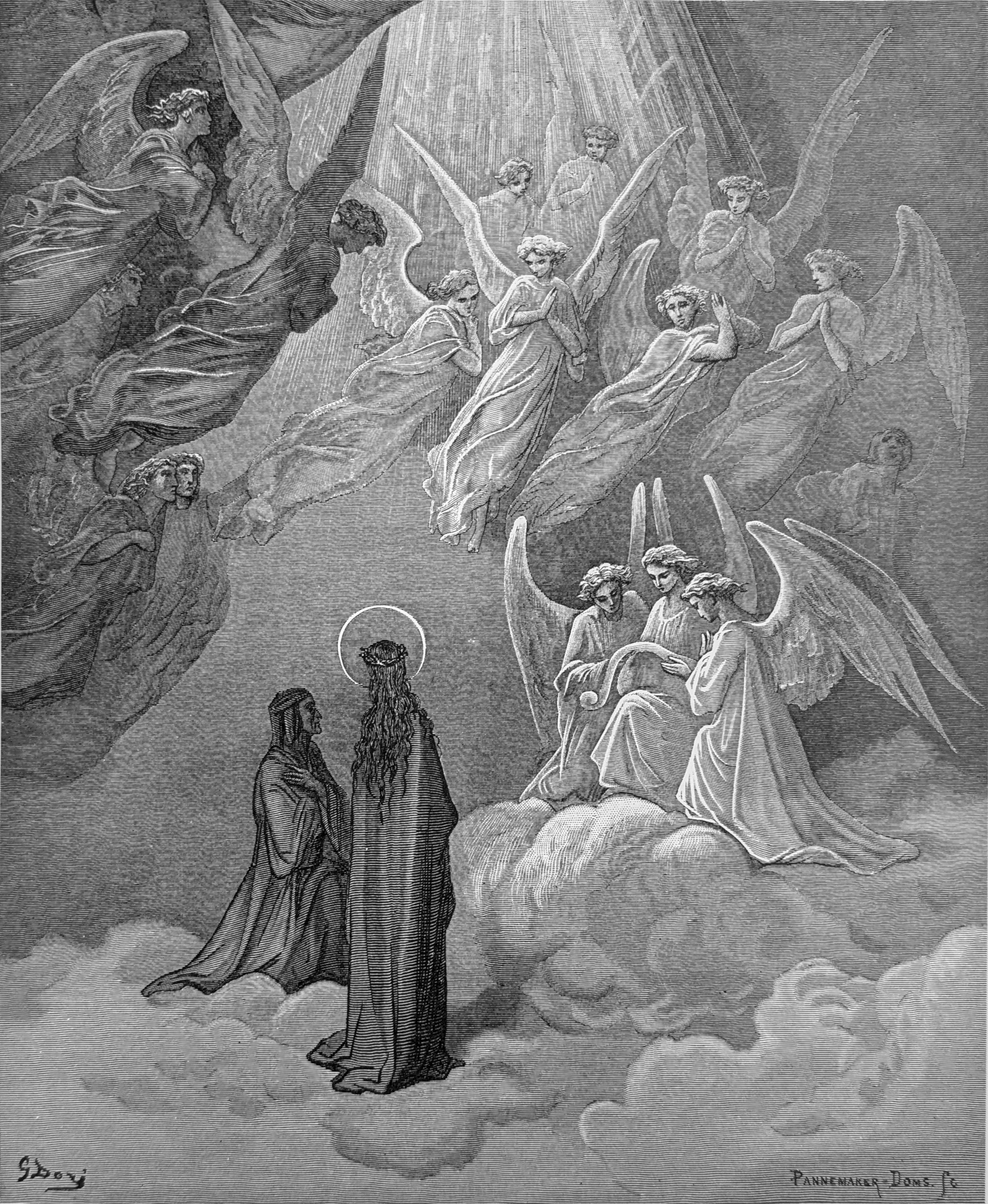
Because those living luminaries all, / By far more luminous, did songs begin / Lapsing and falling from my memory. Par. XX, lines 10-12
Top of page