Dante's Divine Comedy: Paradiso
Canto VIII
Dante and Beatrice ascend into the orbit of Venus, the Third Heaven, he is awed by the increasing loveliness of her face. Here they encounter the souls of those who loved with a passion so ardent it verged on madness. Chastened, they celebrate their place in the hierarchy of bliss. Charles Martel discourses on the way in which heredity is subservient to the workings of Providence, so that ancestors are not the only factor in a person's character. He ends by speaking of how men would not go astray if they followed what is laid down for them by nature.
The world used in its peril to believe
That the fair Cypria delirious love
Rayed out, in the third epicycle turning;[1]
Wherefore not only unto her paid honor
Of sacrifices and of votive cry
The ancient nations in the ancient error,
But both Dione honored they and Cupid,
That as her mother, this one as her son,
And said that he had sat in Dido's lap;[2]
And they from her, whence I beginning take,
Took the denomination of the star
That woos the sun, now following, now in front.
I was not ware of our ascending to it;
But of our being in it gave full faith
My Lady whom I saw more beauteous grow.
And as within a flame a spark is seen,
And as within a voice a voice discerned,
When one is steadfast, and one comes and goes,
Within that light beheld I other lamps
Move in a circle, speeding more and less,
Methinks in measure of their inward vision.
From a cold cloud descended never winds,
Or visible or not, so rapidly
They would not laggard and impeded seem
To any one who had those lights divine
Seen come towards us, leaving the gyration
Begun at first in the high Seraphim.
And behind those that most in front appeared
Sounded "_Osanna_!" so that never since
To hear again was I without desire.
Then unto us more nearly one approached,
And it alone began: "We all are ready
Unto thy pleasure, that thou joy in us.
We turn around with the celestial Princes,
One gyre and one gyration and one thirst,
To whom thou in the world of old didst say,
'Ye who, intelligent, the third heaven are moving;'
And are so full of love, to pleasure thee
A little quiet will not be less sweet."
After these eyes of mine themselves had offered
Unto my Lady reverently, and she
Content and certain of herself had made them,
Back to the light they turned, which so great promise
Made of itself, and "Say, who art thou?" was
My voice, imprinted with a great affection.
O how and how much I beheld it grow
With the new joy that superadded was
Unto its joys, as soon as I had spoken!
Thus changed, it said to me: "The world possessed me
Short time below; and, if it had been more,
Much evil will be which would not have been.
My gladness keepeth me concealed from thee,
Which rayeth round about me, and doth hide me
Like as a creature swathed in its own silk.
Much didst thou love me, and thou hadst good reason;
For had I been below, I should have shown thee
Somewhat beyond the foliage of my love.
That left-hand margin, which doth bathe itself
In Rhone, when it is mingled with the Sorgue,
Me for its lord awaited in due time,
And that horn of Ausonia, which is towned
With Bari, with Gaeta and Catona,
Whence Tronto and Verde in the sea disgorge.[3]
Already flashed upon my brow the crown
Of that dominion which the Danube waters
After the German borders it abandons;
And beautiful Trinacria, that is murky
Twixt Pachino and Peloro, (on the gulf
Which greatest scath from Eurus doth receive,)[4]
Not through Typhoeus, but through nascent sulphur,
Would have awaited her own monarchs still,
Through me from Charles descended and from Rudolph,[5]
If evil lordship, that exasperates ever
The subject populations, had not moved
Palermo to the outcry of 'Death! death!'[6]
And if my brother could but this foresee,
The greedy poverty of Catalonia
Straight would he flee, that it might not molest him;[7]
For verily 'tis needful to provide,
Through him or other, so that on his bark
Already freighted no more freight be placed.
His nature, which from liberal covetous
Descended, such a soldiery would need
As should not care for hoarding in a chest."
"Because I do believe the lofty joy
Thy speech infuses into me, my Lord,
Where every good thing doth begin and end
Thou seest as I see it, the more grateful
Is it to me; and this too hold I dear,
That gazing upon God thou dost discern it.
Glad hast thou made me; so make clear to me,
Since speaking thou hast stirred me up to doubt,
How from sweet seed can bitter issue forth."
This I to him; and he to me: "If I
Can show to thee a truth, to what thou askest
Thy face thou'lt hold as thou dost hold thy back.
The Good which all the realm thou art ascending
Turns and contents, maketh its providence
To be a power within these bodies vast;
And not alone the natures are foreseen
Within the mind that in itself is perfect,
But they together with their preservation.
For whatsoever thing this bow shoots forth
Falls foreordained unto an end foreseen,
Even as a shaft directed to its mark.
If that were not, the heaven which thou dost walk
Would in such manner its effects produce,
That they no longer would be arts, but ruins.
This cannot be, if the Intelligences
That keep these stars in motion are not maimed,
And maimed the First that has not made them perfect.
Wilt thou this truth have clearer made to thee?"
And I: "Not so; for 'tis impossible
That nature tire, I see, in what is needful."
Whence he again: "Now say, would it be worse
For men on Earth were they not citizens?"
"Yes," I replied; "and here I ask no reason."
"And can they be so, if below they live not
Diversely unto offices diverse?
No, if your master writeth well for you."
So came he with deductions to this point;
Then he concluded: "Therefore it behooves
The roots of your effects to be diverse.
Hence one is Solon born, another Xerxes,
Another Melchisedec, and another he
Who, flying through the air, his son did lose.[8]
Revolving Nature, which a signet is
To mortal wax, doth practice well her art,
But not one inn distinguish from another;
Thence happens it that Esau differeth
In seed from Jacob; and Quirinus comes
From sire so vile that he is given to Mars.[9]
A generated nature its own way
Would always make like its progenitors,
If Providence divine were not triumphant.
Now that which was behind thee is before thee;
But that thou know that I with thee am pleased,
With a corollary will I mantle thee.
Evermore nature, if it fortune find
Discordant to it, like each other seed
Out of its region, maketh evil thrift;
And if the world below would fix its mind
On the foundation which is laid by nature,
Pursuing that, 'twould have the people good.
But you unto religion wrench aside
Him who was born to gird him with the sword,
And make a king of him who is for sermons;
Therefore your footsteps wander from the road."
Footnotes
1. The Cypria described the wedding of Peleus and Thetis; in the Judgment of Paris among the goddesses Athena, Hera, and Aphrodite: Paris awards the prize for beauty to Aphrodite, and as a prize is awarded Helen, wife of Menelaus.
Peleus married the sea-nymph Thetis. He was able to win her over with the aid of Proteus, who instructed Peleus to hold onto her tightly through all of her physical transformations she used to try to escape. Their wedding feast was attended by many of the Olympian gods. As wedding presents, Poseidon gave Peleus two immortal horses: Balius and Xanthus, Hephaestus gave him a knife, Aphrodite a bowl with an embossed Eros, Hera a chlamys, Athena a flute, Nereus a basket of the divine salt which has an irresistible virtue for overeating, appetite and digestion and Zeus gave Thetis the wings of Arke.
The planet Venus (the Morning and Evening Star) is traditionally associated with the Goddess of Love, and so Dante makes this the planet of the lovers, who were deficient in the virtue of temperance.
2. Dione is an oracular goddess, a Titaness primarily known from Book V of Homer's Iliad, where she tends to the wounds suffered by her daughter Aphrodite. Dione is presented as either an Oceanid, daughter of Oceanus and Tethys, or the thirteenth Titan, daughter of Gaia and Uranus.
Cupid (Latin, Cupīdō, meaning "passionate desire") is the god of desire, erotic love, attraction and affection. He is often portrayed as the son of the love goddess Venus and the god of war Mars. His Greek counterpart is Eros. Although Eros is generally portrayed as a slender winged youth in Classical Greek art, during the Hellenistic period, he was increasingly portrayed as a chubby boy. During this time, his iconography acquired the bow and arrow that represent his source of power. A person, or even a deity, who is shot by Cupid's arrow is filled with uncontrollable desire. In myths, Cupid is a minor character who serves mostly to set the plot in motion. He is a main character only in the tale of Cupid and Psyche, in which he is wounded by his own weapons and experiences the ordeal of love.
In the Aeneid, written by the poet Virgil, Cupid disguises himself as Ascanius (Iulus), the son of Aeneas who was in turn the son of Venus herself, and in this form he beguiles Queen Dido of Carthage to fall in love with the hero. She gives safe harbor to Aeneas and his band of refugees from Troy, only to be abandoned by him as he fulfills his destiny to found Rome. Ascanius becomes the mythical founder of the Julian family from which is born Julius Caesar.
Genealogy:
	        Oceanus─┬─Theys
	                │
	Caelus (sky)─┬─Dione
	     ┌───────────────┐
	     │               │
	 Aphrodite  Mars─┬─Venus
	              ┌──────┐
	              │      │
	           Aeneas  Cupid
3. Ausonia is a town in southern Lazio, central Italy. It takes its name from the Ausones-Aurunci, whose ancient town Ausona (member of the Auruncan Pentapolis), located nearby, was destroyed by the Romans in 314 BC.
The "Horn of Ausonia" typically refers to the Italian Horn, or Cornicello, which is an amulet believed to protect against the evil eye and bring good luck. It symbolizes strength, fertility, and virility, and is often worn as a charm in Italian culture.
Bari is the capital city of the Metropolitan City of Bari and of the Apulia region, on the Adriatic Sea in southern Italy. It is one of the most important economic centers of mainland southern Italy. It is a port and university city as well as the city of Saint Nicholas.
Gaeta is a seaside resort in the province of Latina in Lazio, Italy. Set on a promontory stretching towards the Gulf of Gaeta, it is 133 kilometers from Rome and 96.5 kilometers from Naples.
Catona is an urban district of Reggio Calabria, Italy, as part of the 8th district with neighborhoods Salice, Villa San Giuseppe and Rosalì. It overlooks the Strait of Messina.
Through the story of Charles Martel of Anjou, Dante describes the kingdom as a triangle between Bari East, West and Gaeta Catona South.
The Tronto is a 115-kilometer long Italian river that arises at Monti della Laga and ends in the Adriatic Sea at Porto d'Ascoli, San Benedetto del Tronto. It traverses the Lazio, Marche, and Abruzzo regions of Italy.
La Verde is a river whose source is on Montalto in the Aspromonte National Park, in Calabria, southern Italy. From there, the river flows southeast and then flows east before emptying into the Ionian Sea north of Cape Bruzzano.
4. The island of Sicilia was given to the Roman province in 241 BC. It is named after the Sicels, who inhabited the eastern part of the island during the Iron Age. The ancient name of the island is Trinacria (Greek, Τρινακρία, "having three headlands") for its triangular shape, likely a re-interpretation of earlier (Homeric) Thrinacia. The Greek name was rendered as Trīnācrĭa in classical Latin (Virgil, Ovid).
Pachino is a town in the Province of Syracuse, Sicily,Italy. The name derives from the Latin word bacchus, which is the Roman god of wine, and the word vinum, which means wine in Latin; originally the town was named Bachino which eventually was changed to Pachino when, in Sicily, Italian became the official spoken and written language.
Capo Peloro Lighthouse (Italian, Faro di Capo Peloro) is an active lighthouse located in Punta del Faro on the Strait of Messina, the most north-eastern promontory of Sicily, settled in the Province of Messina, the place closest to Calabria.
Eurus is the god and personification of the east wind, although sometimes he is also said to be southeast specifically. He is one of the four principal wind gods, the Anemoi, alongside his brothers Boreas (north wind), Zephyrus (west wind) and Notus (south wind).
5. Typhon, also Typhoeus, Typhaon or Typhos, was a monstrous serpentine giant and one of the deadliest creatures in Greek mythology. According to Hesiod, Typhon was the son of Gaia and Tartarus. However, one source has Typhon as the son of Hera alone, while an other makes Typhon the offspring of Cronus. Typhon and his mate Echidna were the progenitors of many famous monsters.
Charles, particularly Charles the Fat (reign: 881-887 A, was a Carolingian emperor, while Rudolf II (reign: 1576-1612) was a Holy Roman Emperor from the Habsburg family, which succeeded the Carolingians in ruling over parts of Europe. Charles's inability to manage Viking threats and internal dissent led to his downfall. Rudolf's reign was marred by religious conflicts that eventually contributed to the outbreak of the Thirty Years' War. Both rulers left a legacy of fragmentation in their respective empires. Charles's deposition led to the division of the Carolingian Empire, while Rudolf's reign set the stage for significant religious and political upheaval in Europe.
6. The Ostrogothic conquest under Theodoric the Great began in 488; Theodoric supported Roman culture and government unlike the Germanic Goths. The Gothic War took place between the Ostrogoths and the Eastern Roman Empire, also known as the Byzantine Empire. S icily was the first part of Italy to be taken under control of General Belisarius who was commissioned by the Eastern Emperor. In late 535 his Byzantine army of 7,500–9,000 and a fleet laid siege to the city in the Siege of Panormus, which had refused to surrender unlike all the other Ostrogothic-held cities in Sicily, and eventually prevailed.
Belisarius landed at Sicily, between Roman Africa and Italy, whose population was well disposed toward the Empire. The island was quickly captured, with the only determined resistance, at Palermo, overcome by late December. Belisarius prepared to cross to Italy and Theodahad sent envoys to Justinian, proposing at first to cede Sicily and recognize his over-lordship but later to cede all of Italy.
7. Catalonia refers to the Catalan people of northeastern Spain. Justinian is recounting the history of the Roman Empire and the spread of the imperial eagle. He is describing the conflicts that arose as the Roman Empire expanded, particularly in the Mediterranean.
Dante's mention is part of his grand historical sweep, illustrating how the Roman Empire spread and asserting its divine legitimacy. The Catalans are one of many groups touched upon, not singled out for particular praise or blame, but included in the tapestry of Roman conquests and struggles.
8. Solon (630-560 BC) was an archaic Athenian statesman, lawmaker, political philosopher, and poet. He was one of the Seven Sages of Greece and is credited with laying the foundations for Athenian democracy. Solon's efforts to legislate against political, economic and moral decline resulted in his constitutional reform overturning most of Draco's laws.
Solon's reforms included debt relief later known and celebrated among Athenians as the seisachtheia (shaking off of burdens). He is described by Aristotle in the Athenian Constitution as "the first people's champion". Demosthenes credited Solon's reforms with starting a golden age.
Xerxes I (518–465 BC), commonly known as Xerxes the Great, was a Persian ruler who served as the fourth King of Kings of the Achaemenid Empire, reigning from 486 BC until his assassination in 465 BC. He was the son of Darius the Great and Atossa, a daughter of Cyrus the Great.
In the Hebrew Bible, Melchizedek was the king of Salem and priest of El Elyon (often translated as 'God Most High'). He is first mentioned in Genesis 14:18–20, where he brings out bread and wine and blesses Abraham, subsequent to Abraham's victory in the Battle of the Vale of Siddim. For Melchizedek he did not bear a son and there is no record of any of his ancestors. He was never born and he never died but his life is like that of the Son of God—a priest forever.
9. Esau is the elder twin son of Isaac in the Hebrew Bible. He is mentioned in the Book of Genesis and by the prophets Obadiah and Malachi. The story of Esau and Jacob reflects the historical relationship between Edom and Israel, to explain why Edom was dominated by Israel, despite Israel being a younger kingdom. Esau and Jacob were the sons of Isaac and Rebecca, and the grandsons of Abraham and Sarah.
Genealogy:
	Abraham─┬─Sarah
	        │
	      Isaac─┬─Rebecca
	            │
	         ┌──────┐
	       Esau   Jacob
	      (Edom) (Israel)
Quirinus is an early god of the Roman state. In Augustan Rome, Quirinus was also an epithet of Janus, Mars, and Jupiter. Quirinus shares a close relationship with Mars, embodying the qualities of strength, courage, and protection inherent to warfare . However, contrary to Mars, who epitomizes the tumult of battle, Quirinus emphasizes the safeguarding of the Roman people, representing the stability of martial existence.
Illustrations of Paradiso
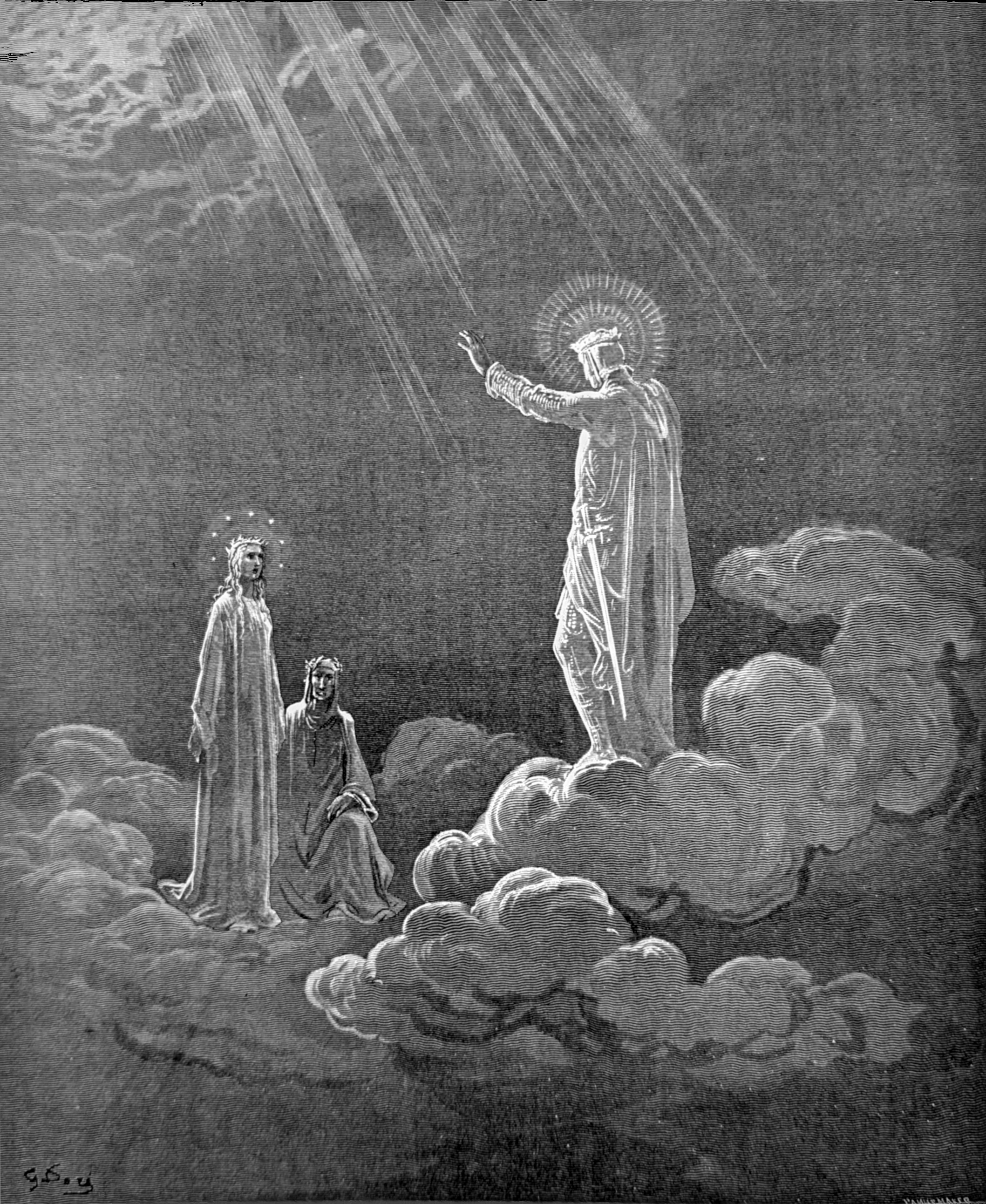
"That left-hand margin, which doth bathe itself / In Rhone, when it is mingled with the Sorgue, / Me for its lord awaited in due time," Par. VIII, lines 58-60
Top of page