Dante's Divine Comedy: Paradiso
Canto XXVII
The assembly of the Church Triumphant congratulates Dante on his progress. Saint Peter flushes with anger as he denounces all the evil popes, declaring the papal see 'vacant'. Heaven blushes in sympathy. The Apostle asks the pilgrim to repeat what he has just heard to his fellow men. As the gathering whirls out of sight, Dante realizes that he is standing above the point between Jerusalem and Spain. As Beatrice takes him up through the Primum Mobile, the crystalline Ninth Heaven, she discusses the origin of Time and foresees order being restored both in the Church and in the world.
"Glory be to the Father, to the Son,
And Holy Ghost!" all Paradise began,
So that the melody inebriate made me.
What I beheld seemed unto me a smile
Of the universe; for my inebriation
Found entrance through the hearing and the sight.
O joy! O gladness inexpressible!
O perfect life of love and peacefulness!
O riches without hankering secure!
Before mine eyes were standing the four torches
Enkindled, and the one that first had come
Began to make itself more luminous;
And even such in semblance it became
As Jupiter would become, if he and Mars
Were birds, and they should interchange their feathers.
That Providence, which here distributeth
Season and service, in the blessed choir
Had silence upon every side imposed.
When I heard say: "If I my color change,
Marvel not at it; for while I am speaking
Thou shalt behold all these their color change.
He who usurps upon the Earth my place,
My place, my place, which vacant has become
Before the presence of the Son of God,
Has of my cemetery made a sewer
Of blood and stench, whereby the Perverse One,
Who fell from here, below there is appeased!"
With the same color which, through sun adverse,
Painteth the clouds at evening or at morn,
Beheld I then the whole of heaven suffused.
And as a modest woman, who abides
Sure of herself, and at another's failing,
From listening only, timorous becomes,
Even thus did Beatrice change countenance;
And I believe in heaven was such eclipse,
When suffered the supreme Omnipotence;
Thereafterward proceeded forth his words
With voice so much transmuted from itself,
The very countenance was not more changed.[1]
"The spouse of Christ has never nurtured been
On blood of mine, of Linus and of Cletus,
To be made use of in acquest of gold;[2]
But in acquest of this delightful life
Sixtus and Pius, Urban and Calixtus,
After much lamentation, shed their blood.[3]
Our purpose was not, that on the right hand
Of our successors should in part be seated
The Christian folk, in part upon the other;
Nor that the keys which were to me confided
Should e'er become the escutcheon on a banner,
That should wage war on those who are baptized;
Nor I be made the figure of a seal
To privileges venal and mendacious,
Whereat I often redden and flash with fire.
In garb of shepherds the rapacious wolves
Are seen from here above o'er all the pastures!
O wrath of God, why dost thou slumber still?
To drink our blood the Caorsines and Gascons
Are making ready. O thou good beginning,
Unto how vile an end must thou needs fall![4]
But the high Providence, that with Scipio
At Rome the glory of the world defended,
Will speedily bring aid, as I conceive;[5]
And thou, my son, who by thy mortal weight
Shalt down return again, open thy mouth;
What I conceal not, do not thou conceal."
As with its frozen vapors downward falls
In flakes our atmosphere, what time the horn
Of the celestial Goat doth touch the sun,[6]
Upward in such array saw I the ether
Become, and flaked with the triumphant vapors,
Which there together with us had remained.
My sight was following up their semblances,
And followed till the medium, by excess,
The passing farther onward took from it;
Whereat the Lady, who beheld me freed
From gazing upward, said to me: "Cast down
Thy sight, and see how far thou art turned round."
Since the first time that I had downward looked,
I saw that I had moved through the whole arc
Which the first climate makes from midst to end;
So that I saw the mad track of Ulysses
Past Gades, and this side, well nigh the shore
Whereon became Europa a sweet burden.[7]
And of this threshing-floor the site to me
Were more unveiled, but the sun was proceeding
Under my feet, a sign and more removed.
My mind enamored, which is dallying
At all times with my Lady, to bring back
To her mine eyes was more than ever ardent.
And if or Art or Nature has made bait
To catch the eyes and so possess the mind,
In human flesh or in its portraiture,
All joined together would appear as nought
To the divine delight which shone upon me
When to her smiling face I turned me round.
The virtue that her look endowed me with
From the fair nest of Leda tore me forth,
And up into the swiftest heaven impelled me.[8]
Its parts exceeding full of life and lofty
Are all so uniform, I cannot say
Which Beatrice selected for my place.
But she, who was aware of my desire,
Began, the while she smiled so joyously
That God seemed in her countenance to rejoice:
"The nature of that motion, which keeps quiet
The center and all the rest about it moves,
From hence begins as from its starting point.
And in this heaven there is no other Where
Than in the Mind Divine, wherein is kindled
The love that turns it, and the power it rains.
Within a circle light and love embrace it,
Even as this doth the others, and that precinct
He who encircles it alone controls.
Its motion is not by another meted,
But all the others measured are by this,
As ten is by the half and by the fifth.
And in what manner time in such a pot
May have its roots, and in the rest its leaves,
Now unto thee can manifest be made.
O Covetousness, that mortals dost ingulf
Beneath thee so, that no one hath the power
Of drawing back his eyes from out thy waves!
Full fairly blossoms in mankind the will;
But the uninterrupted rain converts
Into abortive wildings the true plums.
Fidelity and innocence are found
Only in children; afterwards they both
Take flight or e'er the cheeks with down are covered.
One, while he prattles still, observes the fasts,
Who, when his tongue is loosed, forthwith devours
Whatever food under whatever moon;
Another, while he prattles, loves and listens
Unto his mother, who when speech is perfect
Forthwith desires to see her in her grave.
Even thus is swarthy made the skin so white
In its first aspect of the daughter fair
Of him who brings the morn, and leaves the night.
Thou, that it may not be a marvel to thee,
Think that on Earth there is no one who governs;
Whence goes astray the human family.
Ere January be unwintered wholly
By the centesimal on Earth neglected,
Shall these supernal circles roar so loud
The tempest that has been so long awaited
Shall whirl the poops about where are the prows;
So that the fleet shall run its course direct,
And the true fruit shall follow on the flower."
Footnotes
1. Adam concludes his speech, Heaven erupts into another hymn of praise. For Dante, the sound is "the laughter of the universe," a song of joy untainted by any sorrow. Suddenly, the soul of Saint Peter turns from white to red and begins uttering a harsh speech against the modern papacy. As the heavens redden around him and Beatrice blushes, Peter recounts the great sacrifices of the early popes, many of them martyrs. He complains of the "ravening wolves" who have occupied the papacy and other high Church offices in Dante's time. God, he reassures Dante, will soon right these wrongs.
With this, the souls change their hue again and sweep upward like flakes of snow. Dante follows them with his eyes until he loses sight of them entirely. He then, at Beatrice's instruction, once more turns down toward Earth to see how far the Fixed Stars have turned since he arrived. While he is looking back at the solar system, he ascends to the Primum Mobile, the outermost sphere of Heaven. This, Beatrice explains, is the invisible sphere moved directly by the will of God, setting into motion all the rest-s tars, planets, sun, and moon. She ends the canto with a speech lamenting humankind's fall from innocence in great detail, which she construes as a loss of spiritual sight.
2. Linus and Cletus are early popes mentioned by St. Peter in Dante's "Paradiso" Canto 27. They are referenced in the context of discussing the true foundation of the Church, emphasizing that it was not built on their blood but rather on the sacrifices of late r martyrs. Linus is considered the second pope after St. Peter, Linus is believed to have served during the first century AD. He is often associated with the establishment of the early Church. Cletus, also known as Anacletus, is regarded as the third pope and is thought to have succeeded Linus. His papacy is also placed in the first century AD, and he is credited with furthering the Church's growth.
3. Popes:
| Name | Notable Contributions |
|---|---|
| Sixtus | Known for his efforts in reforming the Church and promoting the arts. |
| Pius | Recognized for his commitment to the Church's moral integrity. |
| Urban | Notable for his role in the Crusades and efforts to strengthen the Church's influence. |
| Calixtus | Remembered for his attempts to address issues of corruption within the Church. |
Dante uses these figures to highlight the contrast between the noble intentions of past popes and the corruption he perceives in the contemporary Church. This serves to emphasize the need for reform and the true purpose of the papacy, which should focus on spiritual leadership rather than material gain.
4. The Caorsines and Gascons refer to groups from Italy and France, respectively, who are depicted as threatening the Church and its followers. They symbolize the corrupting influences and violence that Dante perceives in the political and religious landscape of his time.
Caorsines: Inhabitants of Caorle, a town in Italy, often associated with treachery and conflict. They are depicted as preparing to "drink the blood" of others, symbolizing violence and betrayal.
Gascons: People from Gascony, a region in France. They are similarly portrayed as aggressive and treacherous, contributing to the theme of moral decay in the Church and society.
5. Scipio refers to Scipio Africanus, a Roman general known for his victory over Hannibal in the Second Punic War. He is mentioned as a symbol of providence and strength, representing the hope that divine assistance will come to restore justice.
6. The "celestial Goat" refers to the constellation Capricornus, which is associated with the goat and is one of the zodiac signs. Capricornus is traditionally linked to the winter solstice and represents the transition from darkness to light. This aligns with the themes of enlightenment and spiritual ascent in Paradiso. Dante describes the ether becoming flaked with triumphant vapors as the celestial Goat touches the sun. This imagery symbolizes the divine light and the joy of the souls in Paradise.
Somehow Dante has moved from Taurus, to Cancer, and now to Capricorn: from April, to June, to January, respectively. It is as almost the passage of time has accelerated.
7. Ulysses is a classical hero from Greek mythology, known for his adventurous journey in Homer's "Odyssey." He represents the quest for knowledge and experience, and his story is referenced as a significant part of Dante's exploration of human ambition and the consequences of overreaching.
The Odyssey is one of two major epics of ancient Greek literature attributed to Homer. It is one of the oldest surviving works of literature and remains popular with modern audiences. Like the Iliad, the Odyssey is divided into 24 books. It follows the heroic king of Ithaca, Odysseus, also known by the Latin variant Ulysses, and his homecoming journey after the ten-year long Trojan War. His journey from Troy to Ithaca lasts an additional ten years, during which time he encounters many perils and all of his crewmates are killed. In Odysseus's long absence, he is presumed dead, leaving his wife Penelope and son Telemachus to contend with a group of unruly suitors competing for Penelope's hand in marriage.
After Odysseus returns, there is a famous scene. Penelope announces she is ready to remarry, and that she will choose whoever wins an archery contest with Odysseus's bow. After each suitor fails to even string the bow, Odysseus successfully strings it and fires an arrow through a series of ax heads. Having won the contest, he kills the suitors; Telemachus also hangs a group of slaves who had sex with them. Odysseus reveals his identity to Penelope, who tests him by asking to move their bed. He correctly stat es that the bed, which he carved from the trunk of an olive tree, is immovable, and the two lovingly reunite.
Gades refers to the ancient city located in present-day Cádiz, Spain, which is near Gibraltar. It is mentioned in the context of Ulysses' journey, symbolizing exploration and the limits of human experience. Dante reflects on Ulysses' adventurous spirit as he sailed past Gades. This moment symbolizes exploration and the pursuit of knowledge. Ulysses is portrayed as a figure who ventured beyond the known world, seeking new experiences and understanding.
Dante uses Gades to illustrate the theme of human ambition and the quest for enlightenment. The mention of Ulysses' "mad track" past Gades serves as a metaphor for the broader human desire to push boundaries and explore the unknown, which resonates with Dante's own spiritual journey throughout the Divine Comedy. This reference highlights the contrast between earthly pursuits and the divine enlightenment that Dante seeks in Heaven.
8. Leda, also rendered Lede, was an Aetolian princess who became queen consort of Sparta through her marriage to King Tyndareus. Zeus fell in love with Leda, and to avoid his wife Hera's jealousy, seduced her while disguised as a swan. Leda was named as the mother of four famous children in Greek mythology: Helen of Troy, Clytemnestra, and the twins Castor and Pollux. Leda and the Swan was a popular motif in the visual arts, particularly during the Renaissance.
Illustrations of Paradiso
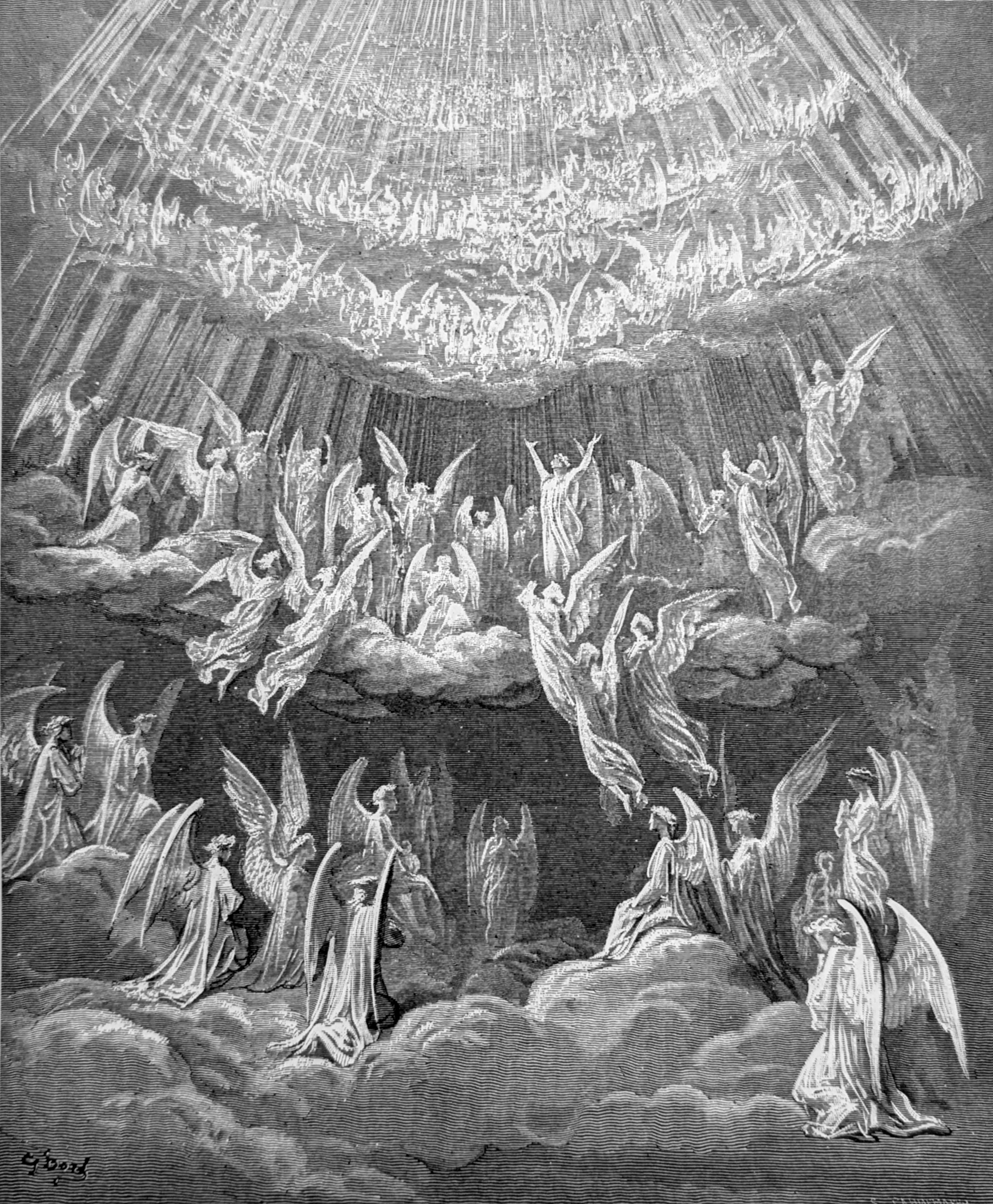
"Glory be to the Father, to the Son, / And Holy Ghost!" all Paradise began, / So that the melody inebriate made me. Par XXVII, lines 1-3
Angel
Top of page