Dante's Divine Comedy: Paradiso
Canto XIII
The twin circles of lights whirl around Dante and Beatrice while praising the Trinity and Christ's divine and human status. Dante tries to describe this phenomenon by comparing it with the heavenly constellations. Saint Thomas Aquinas speaks about Solomon's kingly wisdom and then warns Dante against making hasty moral judgments. He gives another warning about predicting the actions of God. A mortal cannot automatically suppose that if one person steals and another makes offerings the first one will be damned and the second one saved. God may see things differently.
Let him imagine, who would well conceive
What now I saw, and let him while I speak
Retain the image as a steadfast rock,
The fifteen stars, that in their divers regions
The sky enliven with a light so great
That it transcends all clusters of the air;[1]
Let him the Wain imagine unto which
Our vault of heaven sufficeth night and day,
So that in turning of its pole it fails not;[2]
Let him the mouth imagine of the horn
That in the point beginneth of the axis
Round about which the primal wheel revolves,—[3]
To have fashioned of themselves two signs in heaven,
Like unto that which Minos' daughter made,
The moment when she felt the frost of death;[4]
And one to have its rays within the other,
And both to whirl themselves in such a manner
That one should forward go, the other backward;
And he will have some shadowing forth of that
True constellation and the double dance
That circled round the point at which I was;
Because it is as much beyond our wont,
As swifter than the motion of the Chiana
Moveth the heaven that all the rest outspeeds.[5]
There sang they neither Bacchus, nor Apollo,
But in the divine nature Persons three,
And in one person the divine and human.[6]
The singing and the dance fulfilled their measure,
And unto us those holy lights gave need,
Growing in happiness from care to care.
Then broke the silence of those saints concordant
The light in which the admirable life
Of God's own mendicant was told to me,
And said: "Now that one straw is trodden out
Now that its seed is garnered up already,
Sweet love invites me to thresh out the other.
Into that bosom, thou believest, whence
Was drawn the rib to form the beauteous cheek
Whose taste to all the world is costing dear,
And into that which, by the lance transfixed,
Before and since, such satisfaction made
That it weighs down the balance of all sin,
Whate'er of light it has to human nature
Been lawful to possess was all infused
By the same power that both of them created;
And hence at what I said above dost wonder,
When I narrated that no second had
The good which in the fifth light is enclosed.
Now ope thine eyes to what I answer thee,
And thou shalt see thy creed and my discourse
Fit in the truth as center in a circle.
That which can die, and that which dieth not,
Are nothing but the splendor of the idea
Which by his love our Lord brings into being;
Because that living Light, which from its fount
Effulgent flows, so that it disunites not
From Him nor from the Love in them intrined,
Through its own goodness reunites its rays
In nine subsistences, as in a mirror,
Itself eternally remaining One.
Thence it descends to the last potencies,
Downward from act to act becoming such
That only brief contingencies it makes;
And these contingencies I hold to be
Things generated, which the heaven produces
By its own motion, with seed and without.
Neither their wax, nor that which tempers it,
Remains immutable, and hence beneath
The ideal signet more and less shines through;
Therefore it happens, that the selfsame tree
After its kind bears worse and better fruit,
And ye are born with characters diverse.
If in perfection tempered were the wax,
And were the heaven in its supremest virtue,
The brilliance of the seal would all appear;
But nature gives it evermore deficient,
In the like manner working as the artist,
Who has the skill of art and hand that trembles.
If then the fervent Love, the Vision clear,
Of primal Virtue do dispose and seal,
Perfection absolute is there acquired.
Thus was of old the Earth created worthy
Of all and every animal perfection;
And thus the Virgin was impregnate made;
So that thine own opinion I commend,
That human nature never yet has been,
Nor will be, what it was in those two persons.
Now if no farther forth I should proceed,
"Then in what way was he without a peer?'
Would be the first beginning of thy words.
But, that may well appear what now appears not,
Think who he was, and what occasion moved him
To make request, when it was told him, 'Ask.'
I've not so spoken that thou canst not see
Clearly he was a king who asked for wisdom,
That he might be sufficiently a king;
'Twas not to know the number in which are
The motors here above, or if 'necesse'
With a contingent e'er 'necesse' make,
'Non si est dare primum motum esse,"
Or if in semicircle can be made
Triangle so that it have no right angle.[7]
Whence, if thou notest this and what I said,
A regal prudence is that peerless seeing
In which the shaft of my intention strikes.
And if on 'rose' thou turnest thy clear eyes,
Thou'lt see that it has reference alone
To kings who're many, and the good are rare.
With this distinction take thou what I said,
And thus it can consist with thy belief
Of the first father and of our Delight.
And lead shall this be always to thy feet,
To make thee, like a weary man, move slowly
Both to the Yes and No thou seest not;
For very low among the fools is he
Who affirms without distinction, or denies,
As well in one as in the other case;
Because it happens that full often bends
Current opinion in the false direction,
And then the feelings bind the intellect.
Far more than uselessly he leaves the shore,
(Since he returneth not the same he went,)
Who fishes for the truth, and has no skill;
And in the world proofs manifest thereof
Parmenides, Melissus, Brissus are,
And many who went on and knew not whither;[8]
Thus did Sabellius, Arius, and those fools
Who have been even as swords unto the Scriptures
In rendering distorted their straight faces.[9]
Nor yet shall people be too confident
In judging, even as he is who doth count
The corn in field or ever it be ripe.
For I have seen all winter long the thorn
First show itself intractable and fierce,
And after bear the rose upon its top;
And I have seen a ship direct and swift
Run o'er the sea throughout its course entire,
To perish at the harbor's mouth at last.
Let not Dame Bertha nor Ser Martin think,
Seeing one steal, another offering make,
To see them in the arbitrament divine;[10]
For one may rise, and fall the other may."
Footnotes
1. In Dante's Paradiso, the 15 stars represent the souls of blessed individuals who are arranged in a celestial dance around Dante. This arrangement symbolizes the harmony and order of the heavenly realm, reflecting the divine light and joy of the blessed in Paradise.
2. Wain, also known as the Great Bear (Ursa Major), refers to a constellation in Dante's "Paradiso." It symbolizes the divine order and is associated with the celestial hierarchy that Dante explores during his journey through Heaven.
3. Thomas's discussion of King Solomon and his wisdom is complicated, to say the least. To make his point he leads Dante into a long, philosophical detour, offering a broad-strokes theory to account for the workings of the entire created universe. God, Thomas claims, created some parts of the universe directly and others indirectly. Directly created beings include angels and human souls, while physical bodies, plants and animals, and so forth fall under the indirect heading.
This point will resurface in later cantos as Dante describes the structure of the cosmos. The outermost "sphere" of the universe, Dante imagines, is the Primum Mobile ("first moved"), so named because it is directly moved by God. All the other spheres, including the orbits of the various planets, fit inside the Primum Mobile and are moved by it, without direct divine action.
This nesting-doll view of the physical universe may seem tangential, even trivial. Does it matter whether God whirls Earth along in its orbit or delegates the job to angels? For Dante, it absolutely does. The distinction between direct and indirect divine agency allows him to account for phenomena that would otherwise be hard to explain in a medieval Christian context. How, for example, can souls be immortal when everything in observable nature seems destined to change or perish? How can the world seem so ran dom and imperfect if it is really the work of an omnipotent, omniscient being? For Dante, the answers depend critically on this notion of direct versus indirect. Souls, Dante reasons, are immortal because they are the direct handiwork of God, whereas flower s and mountains are indirectly created, and thus transient.
4. Cretan princess, the daughter of King Minos of Crete. There are variations of Ariadne's myth, but she is known for helping Theseus escape from the Minotaur and being abandoned by him on the island of Naxos. There, Dionysus saw Ariadne sleeping, fell in love with her, and later married her. Many versions of the myth recount Dionysus throwing Ariadne's jeweled crown into the sky to create a constellation, the Corona Borealis.
5. The Chiani is a river in the Italian region of Tuscany. It is 42 km long. It begins in the Apennines of Arezzo, runs through the valley of Chiusi, and discharges into Paglia near Orvieto. Historically, they often caused substantial flooding in the valley of Clusium (Chiusi), which was felt even up to Rome. In the Middle Ages, the entire valley between Arezzo and Chiusi was an uninhabitable swamp.
6. Bacchus, also known as Dionysus, is the god of wine-making, orchards and fruit, vegetation, fertility, festivity, insanity, ritual madness, religious ecstasy, and theater. He was known for a frenzy he is said to induce called baccheia.
When Theseus abandoned Ariadne sleeping on Naxos, Bacchus (Dionysus) found and married her. They had a son named Oenopion, but she committed suicide or was killed by Perseus. In some variants, Bacchus had her crown put into the heavens as the constellation Corona; in others, he descended into Hades to restore her to the gods on Olympus. Another account claims Bacchus ordered Theseus to abandon Ariadne on the island of Naxos, for Bacchus had seen her as Theseus carried her onto the ship and had decided to marry her. Psalacantha, a nymph, promised to help Dionysus court Ariadne in exchange for his sexual favors; but Bacchus refused, so Psalacantha advised Ariadne against going with him. For this Bacchus turned her into the plant with the same name.
7. Non si est dare primum motum esse, "Not if it is given that the first movement is to be". }
8. Parmenides of Elea (515 to early 400s BC) was a pre-Socratic Greek philosopher from Elea in Magna Graecia (Southern Italy). Parmenides was born in the Greek colony of Elea to a wealthy and illustrious family. Parmenides is thought to have been in his prime around 475 BC.
The single known work by Parmenides is a philosophical poem in dactylic hexameter verse which is often referred to as On Nature. Only fragments of it survive, but the integrity of the poem is remarkably higher than what has come down to us from the works of almost all other pre-Socratic philosophers, and therefore classicists can reconstruct the philosophical doctrines with greater precision. In his poem, Parmenides prescribes two views of reality. The first, the way of "Aletheia" or truth, describes how al l reality is one, change is impossible, and existence is timeless and uniform. The second view, the way of "Doxa" or opinion, describes the world of appearances, in which one's sensory faculties lead to conceptions which are false and deceitful.
Parmenides has been considered the founder of ontology and has, through his influence on Plato, influenced the whole history of Western philosophy. He is also considered to be the founder of the Eleatic school of philosophy, which also included Zeno of Elea and Melissus of Samos. Zeno's paradoxes of motion were developed to defend Parmenides's views. In contemporary philosophy, Parmenides's work has remained relevant in debates about the philosophy of time.
Melissus of Samos (400s BC) was the third and last member of the ancient school of Eleatic philosophy, whose other members included Zeno and Parmenides. Little is known about his life, except that he was the commander of the Samian fleet in the Samian W ar. Melissus’s contribution to philosophy was a treatise of systematic arguments supporting Eleatic philosophy. Like Parmenides, he argued that reality is ungenerated, indestructible, indivisible, changeless, and motionless. In addition, he sought to show t hat reality is wholly unlimited, and infinitely extended in all directions; and since existence is unlimited, it must also be one.
Bryson, mentioned here using an older spelling, “Brissus” is a little-known ancient Greek thinker. He is mentioned by Aristotle in the Sophistical Refutations and Posterior Analytics as a sophist or mathematician who purportedly attempted to square the circle.
In the context of Dante’s line, Bryson is grouped with two other Eleatic philosophers: Parmenides and Melissus—both of whom proposed radical metaphysical ideas and were critiqued by Aristotle. Dante uses them as examples of thinkers who set out to “fish for truth”, to investigate, to reason, but lacked the proper “art” (method, distinction) and so ended up in error—“who went their way but knew not whither.”
9. Sabellius (ca. 215 AD) was a third-century priest and theologian who most likely taught in Rome, but may have been a North African from Libya. Basil and others call him a Libyan from Pentapolis, but this seems to rest on the fact that Pentapolis was a p lace where the teachings of Sabellius thrived, according to Dionysius of Alexandria, c. 260. What is known of Sabellius is drawn mostly from the polemical writings of his opponents. Sabellius' opposition to the idea of the Trinity led to his excommunication as a heretic by Callixtus in AD 220. Wace and Bunsen have both suggested that Calixtus' action was motivated more by a desire for unity rather than by conviction. Sabellius taught that God was single and indivisible, with Father, Son, and Holy Spirit being three modes or manifestations of one divine Person.
Arius Didymus (1st century BC) was a Stoic philosopher and teacher of Augustus. Fragments of his handbooks summarizing Stoic and Peripatetic doctrines are preserved by Stobaeus and by Eusebius of Caesarea.
Arius Didymus is usually identified with the Arius whose works are quoted at length by Stobaeus, summarizing Stoic, Peripatetic and Platonist philosophy. That his full name is Arius Didymus we know from Eusebius, who quotes two long passages of his concerning Stoic views on God, the conflagration of the Universe, and the soul: Chapter XV, 18–20. One of Heraclitus' river fragments, "On those who enter the same rivers, ever different waters flow—and souls are exhaled from the moist things", is referred to by the philosopher Cleanthes, successor of Zeno of Citium. Arius Didymus observes that Cleanthes held that Heraclitus and Zeno shared similar views about the soul: Eusebius quotes Arius Didymus, Chapter XX, 2 and so a link to Heraclitus's teaching can be traced.
10. Dame Berta is not a major character—she’s actually mentioned briefly and symbolically rather than appearing in person. Dante uses names like Berta and Ser Martin (Martino) as examples of ordinary, everyday people—common folk, not famous saints or philosophers.
Essentially, “la Berta” represents the average person, someone who lives by hearsay or superficial faith rather than deep understanding. It’s a rhetorical device Dante often uses: he’ll name a generic peasant or townsman to contrast the divine intellect or moral insight of the blessed souls.
Illustrations of Paradiso
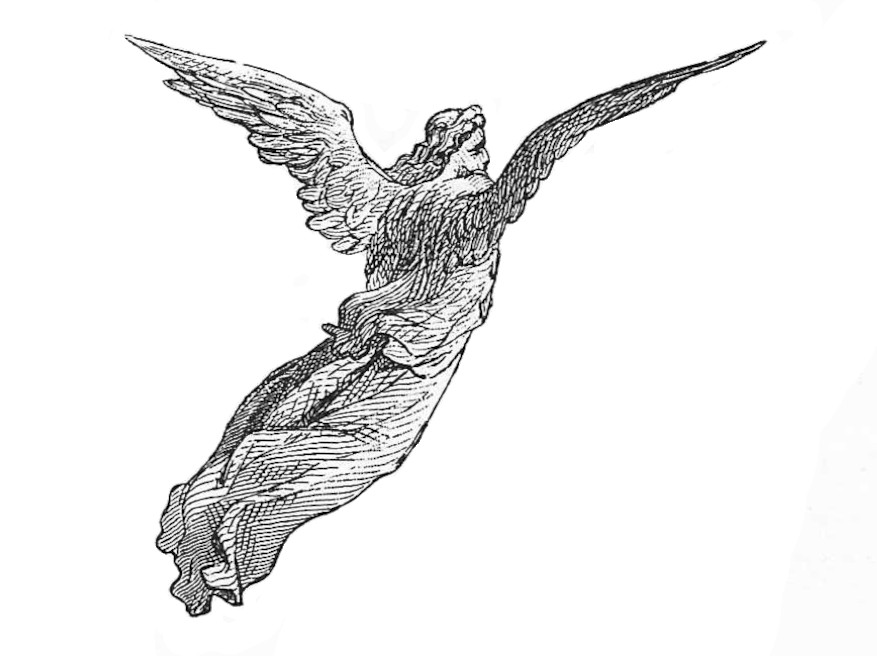
Angel
Top of page