Dante's Divine Comedy: Paradiso
Canto XII
After Saint Thomas' speech, the lights are encircled by a fainter circle—the followers of Saint Francis—as they resume their motion. The twin circles symbolize the interdependence of Love and learning and the unity between orders. Just as the Dominican eulogized Francis of Assisi back in Canto XI, the Franciscan Bonaventure now extols the life and works of Dominic de Guzman, founder of the Dominicans, who removed false doctrine using zeal and true wisdom. Introducing himself, he names Illuminato da Rieti, Fra Agostino, Hugh of St Victor, Peter Mangiador, Peter of Spain, Nathan, Chrysostom, Anselm, Donatus, Rabanus and Joachim of Flora.
Soon as the blessed flame had taken up
The final word to give it utterance,
Began the holy millstone to revolve,
And in its gyre had not turned wholly round,
Before another in a ring enclosed it,
And motion joined to motion, song to song;
Song that as greatly doth transcend our Muses,
Our Sirens, in those dulcet clarions,
As primal splendor that which is reflected.
And as are spanned athwart a tender cloud
Two rainbows parallel and like in color,
When Juno to her handmaid gives command,
(The one without born of the one within,
Like to the speaking of that vagrant one
Whom love consumed as doth the sun the vapors,)
And make the people here, through covenant
God set with Noah, presageful of the world
That shall no more be covered with a flood,
In such wise of those sempiternal roses
The garlands twain encompassed us about,
And thus the outer to the inner answered.
After the dance, and other grand rejoicings,
Both of the singing, and the flaming forth
Effulgence with effulgence blithe and tender,
Together, at once, with one accord had stopped,
(Even as the eyes, that, as volition moves them,
Must needs together shut and lift themselves,)
Out of the heart of one of the new lights
There came a voice, that needle to the star
Made me appear in turning thitherward.
And it began: "The love that makes me fair
Draws me to speak about the other leader,
By whom so well is spoken here of mine.
'Tis right, where one is, to bring in the other,
That, as they were united in their warfare,
Together likewise may their glory shine.
The soldiery of Christ, which it had cost
So dear to arm again, behind the standard
Moved slow and doubtful and in numbers few,
When the Emperor who reigneth evermore
Provided for the host that was in peril,
Through grace alone and not that it was worthy;
And, as was said, he to his Bride brought succor
With champions twain, at whose deed, at whose word
The straggling people were together drawn.
Within that region where the sweet west wind
Rises to open the new leaves, wherewith
Europe is seen to clothe herself afresh,
Not far off from the beating of the waves,
Behind which in his long career the sun
Sometimes conceals himself from every man,
Is situate the fortunate Calahorra,
Under protection of the mighty shield
In which the Lion subject is and sovereign.[1]
Therein was born the amorous paramour
Of Christian Faith, the athlete consecrate,
Kind to his own and cruel to his foes;
And when it was created was his mind
Replete with such a living energy,
That in his mother her it made prophetic.
As soon as the espousals were complete
Between him and the Faith at holy font,
Where they with mutual safety dowered each other,
The woman, who for him had given assent,
Saw in a dream the admirable fruit
That issue would from him and from his heirs;
And that he might be construed as he was,
A spirit from this place went forth to name him
With His possessive whose he wholly was.
Dominic was he called; and him I speak of
Even as of the husbandman whom Christ
Elected to his garden to assist him.[2]
Envoy and servant sooth he seemed of Christ,
For the first love made manifest in him
Was the first counsel that was given by Christ.
Silent and wakeful many a time was he
Discovered by his nurse upon the ground,
As if he would have said, 'For this I came.'
O thou his father, Felix verily!
O thou his mother, verily Joanna,
If this, interpreted, means as is said![3]
Not for the world which people toil for now
In following Ostiense and Taddeo,
But through his longing after the true manna,[4]
He in short time became so great a teacher,
That he began to go about the vineyard,
Which fadeth soon, if faithless be the dresser;
And of the See, (that once was more benignant
Unto the righteous poor, not through itself,
But him who sits there and degenerates,)
Not to dispense or two or three for six,
Not any fortune of first vacancy,
'Non decimas quae sunt pauperum Dei,'[5]
He asked for, but against the errant world
Permission to do battle for the seed,
Of which these four and twenty plants surround thee.
Then with the doctrine and the will together,
With office apostolical he moved,
Like torrent which some lofty vein out-presses;
And in among the shoots heretical
His impetus with greater fury smote,
Wherever the resistance was the greatest.
Of him were made thereafter divers runnels,
Whereby the garden catholic is watered,
So that more living its plantations stand.
If such the one wheel of the Biga was,
In which the Holy Church itself defended
And in the field its civic battle won,[6]
Truly full manifest should be to thee
The excellence of the other, unto whom
Thomas so courteous was before my coming.
But still the orbit, which the highest part
Of its circumference made, is derelict,
So that the mold is where was once the crust.
His family, that had straight forward moved
With feet upon his footprints, are turned round
So that they set the point upon the heel.
And soon aware they will be of the harvest
Of this bad husbandry, when shall the tares
Complain the granary is taken from them.
Yet say I, he who searcheth leaf by leaf
Our volume through, would still some page discover
Where he could read, 'I am as I am wont.'
"Twill not be from Casal nor Acquasparta,
From whence come such unto the written word
That one avoids it, and the other narrows.[7]
Bonaventura of Bagnoregio's life
Am I, who always in great offices
Postponed considerations sinister.[8]
Here are Illuminato and Agostino,
Who of the first barefooted beggars were
That with the cord the friends of God became.[9]
Hugh of Saint Victor is among them here,
And Peter Mangiador, and Peter of Spain,
Who down below in volumes twelve is shining;[10]
Nathan the seer, and metropolitan
Chrysostom, and Anselmus, and Donatus
Who deigned to lay his hand to the first art;[11]
Here is Rabanus, and beside me here
Shines the Calabrian Abbot Joachim,
He with the spirit of prophecy endowed.[12]
To celebrate so great a paladin
Have moved me the impassioned courtesy
And the discreet discourses of Friar Thomas,
And with me they have moved this company."
Footnotes
1. Calahorra is a municipality in the Spanish autonomous community and province of La Rioja. During Ancient Roman times, Calahorra was a municipium known as Calagurris Nassica Iulia.
2. Dominic de Guzmán (1170–1221 AD) was a Castilian Catholic priest, eventual patron saint and the founder of the Dominican Order. He is the patron saint of astronomers and natural scientists, and he and his order are traditionally credited with spreading and popularizing the rosary.
Dominic, in this canto, is the subject of an extended vineyard metaphor, appearing as the pruner and removing the weeds that ails the Church. Heresy and schism are, in Bonaventure's imagery, like so much rot and blight on the good fruit of Christianity. Elsewhere, Bonaventure likens Dominic to a knight doing combat against the heretics. Francis, in contrast, is portrayed in Canto 11 as a lover, not a fighter. This is consonant with his modern reputation as a gentler man of peace in love with many species of creation.
A great deal of the historical ambivalence toward the Dominican order is captured in the punning nickname Domini canes, or "dogs of God." For Bonaventure and other admirers of Saint Dominic, this label connotes the loyalty and zeal of the Dominicans in preaching the Gospel. Others, however, have seen in the "dog" label something more malicious and wolf-like. This is largely because of the Dominicans' role in the Inquisition, which their order formally headed from the 13th century onward. In Dante's lifetime the Dominican effort to suppress heresy was not limited to preaching orthodoxy, but devolved into tribunals, torture, and burning at the stake. These cantos give a rather full coverage of the varieties of Catholic faith at the time, including awareness of criticisms one party makes of the others. Such views were anything but foreign to the Florentine Dante living in unhappy exile for having the wrong political and familial allies.
3. Here “Felix” is the Latin for “happy,” and “Joanna” means “full of grace.” The text notes these as symbolic names. Dante is describing Dominic’s origins—his parents, his mission, his foundational work in the Church. Felix is Saint Dominic’s father. Joanna is his mother.
4. Ostiense refers to Enrico di Susa, a prominent scholar of canon law, while Taddeo Alderotti was a renowned physician and teacher in the 13th century. Both are mentioned in Dante's "Paradiso" to illustrate the worldly pursuits that Saint Dominic rejected in favor of a higher calling.
Enrico di Susa (1197-1271), also known as Henry of Susa and the Hostiense, was a French cardinal. Enrico was born in Susa in Piedmont, as he himself recalls in some passages of his treatises, around 1197-1200. In the past he was mistakenly considered to belong to the de Bartholomeis family of Susa, but recent studies have clarified the complex family origins of the famous jurist. A recent biography demonstrates, with documents from the 13th century, that Amadeus IV of Savoy is the brother of Enrico da Susa. I n the de Bartolomeis palace, where Ostiense is thought to have been born, the poet and writer Norberto Rosa lived around 1860. The famous canonist grew up at the court of Thomas I of Savoy, husband of Beatrice of Geneva; later, Enrico reserved a particular devotion both to the countess and to her daughter Beatrice of Savoy, wife of Raymond Berenguer IV of Provence.
Taddeo Alderotti (1215–1295 AD), also called Alderotto, was an Italian doctor and anatomist , considered the most famous doctor of the Middle Ages, so much so that he deserved two citations by Dante: in the Paradiso (XII , 83) and, in a derogatory way, in the Convivio (I, X, 10). Taddeo Alderotti taught at the University of Bologna from 1260, applying an innovative scholastic method during his medical lectures. Taddeo Alderotti began his lesson with a lectio or expositio of a passage taken from an authoritative text (by Hippocrates , Galen , Avicenna , etc.). He then proceeded by quaestiones with reference to the four Aristotelian causes: material cause (the subject matter of the discussion), formal cause (its expository form), efficient cause (the author o f the work), and final cause (the aim or purpose of the chosen topic). At this point the teacher formulated a series of dubia ("doubt"), which were followed by the heuristic moments of the disputatio ("dispute") and, finally, the solutio ("solution").
5. Non decimas quae sunt pauperum Dei, "Not the tithes which belong to the poor of God".
6. The biga, a two-horse chariot from ancient Rome, symbolizes various aspects of Roman culture, including sport and ceremonial use. Both the biga and the Church have been associated with themes of triumph and divine representation, as the biga is often linked to the moon in Roman iconography, while the Church embodies spiritual guidance and authority.
7. Casal Velino, also spelled Casalvelino, is a town in the province of Salerno in the Campania region of south-western Italy. The village, first mentioned in the 11th century, was named Casalicchio until 1893. It was renamed Casal Velino in homage to the ancient and nearby town of Velia, whose male demonym is "Velino".
Acquasparta is a town in the province of Terni (Umbria, central Italy). It is located on a hill above the Naia Valley and the river of the same name, facing the Monti Martani mountain range. It also sits between two hot springs, the Amerino and the Furapane.
8. Bonaventure, also Bonaventura da Bagnoregio, born Giovanni di Fidanza (1221–1274 AD) was an Italian Catholic Franciscan bishop, cardinal, scholastic theologian and philosopher. The seventh Minister General of the Order of Friars Minor, he also served for a time as Bishop of Albano. He was canonized on 14 April 1482 by Pope Sixtus IV and declared a Doctor of the Church in 1588 by Pope Sixtus V, becoming known as the "Seraphic Doctor".
9. Illuminato da Rieti, also Illuminatus of Arce (1190-1266) was an earlier follower of Francis of Assisi. Illuminatus was born around probably near Rocca Antica or Rocca Sinibalda, villages southwest of Rieti, or possibly in the region of Arce in the plain around Assisi. In 1219, during the Fifth Crusade, he accompanied Francis on his mission to the court of al -Kāmil, sultan of Egypt. In 1224, he was the first to spot the stigmata on Francis at La Verna. He convinced Francis to publicize the miracle. He was living at Greccio in 1246.
Fra Agostino, also Aurelius Augustine of Hippo (354–430 AD) was a Roman philosopher, bishop, theologian, monk and mystic of Punic or Berber origin and Latin language. Also known as Saint Augustine, he is a father, doctor and saint of the Catholic Church, also called Doctor Gratiae ("Doctor of Grace"). He is considered the greatest representative of Western patristics.
10. Hugh of St Victor (1096–1141 AD) was a Saxon canon regular and a leading theologian and writer on mystical theology. His homeland may have been Lorraine, Ypres in Flanders, or the Duchy of Saxony. Some sources say that his birth occurred in the Harz district, being the eldest son of Baron Conrad of Blankenburg. Over the protests of his family, he entered the Priory of St. Pancras, a community of canons regular, where he had studied, located at Hamerleve or Hamersleben, near Halberstadt. Due to civil unrest shortly after his entry to the priory, Hugh's uncle, Reinhard of Blankenburg, who was the local bishop, advised him to transfer to the Abbey of Saint Victor in Paris, where he himself had studied theology. He accepted his uncle's advice and made the move at a date which is unclear, possibly 1115–18 or around 1120. He spent the rest of his life there, advancing to head the school.
Peter Mangiador, also known as Peter Comestor (died 1178) was a 12th-century French theological writer and university teacher. He was born in Troyes. Although the surname Comestor (Latin for "Eater") was popularly attributed to his habit of devouring books and learning, it was more probably simply a family name. It did, however, give Peter a nice pun for his epitaph: Petrus eram quem petra tegit, dictusque Comestor nunc comedor, "I whom this stone covers was Peter, called the 'Devourer', now I am devour ed".
Peter of Spain (early 1200s–late 1200s AD) was the author of the Tractatus, later known as Summulae Logicales, an important medieval university textbook on Aristotelian logic. Since Hispania was believed to include the Iberian Peninsula as well, it was traditionally identified with the Portuguese scholar and ecclesiastic Pietro Juliani, who was elected as Pope John XXI in 1276. However, Spanish historians question this hypothesis, stating that the author of the Tractatus was a Castilian Dominican. Some scholars believe that he could also be Petrus Ferrandi Hispanus.
11. Nathan (1000 BC) is a biblical prophet who is mentioned among the wise souls in the celestial spheres. He is recognized for his significant contributions to theology and is part of the circle of lights surrounding Bonaventure, who praises St. Dominic. H is actions are described in the Books of Samuel, Kings, and Chronicles (2 Samuel 7:2–17, 12:1–25). Nathan was in the court of King David. He is introduced in 2 Samuel 7:2 and 1 Chronicles 17:1 as an advisor to David, with whom David reflects on the contrast between his own comfortable home and the tent in which the Ark of the Covenant is accommodated. Nathan then announces to David the covenant God was making with him (2 Samuel 7:4–17, a passage known as Nathan's Oracle), contrasting David's proposal to build a house for the Ark with God's plan to build a house for David. Later, he comes to David to reprimand him for committing adultery with Bathsheba while she was the wife of Uriah the Hittite, whose death the King had also arranged to hide his previous transgression (2 Samuel 12:7–14).
John Chrysostom (347–407 AD) was an important Church Father who served as Archbishop of Constantinople. He is known for his preaching and public speaking, his denunciation of abuse of authority by both ecclesiastical and political leaders, his Divine Liturgy of Saint John Chrysostom, and his ascetic sensibilities. He was also the author of Adversus Judaeos and was strongly against Judaism. The epithet Χρυσόστομος (Chrysostomos, anglicized as Chrysostom) means "golden-mouthed" in Greek and denotes his celebrated eloquence. Chrysostom was among the most prolific authors in the early Christian Church.
Anselm of Canterbury (1033–1109), also known as Anselm of Aosta after his birthplace and Anselm of Bec after his monastery, was an Italian Benedictine monk, abbot, philosopher, and theologian of the Catholic Church, who served as Archbishop of Canterbur y from 1093 to 1109. He defended the church's interests in England amid the Investiture Controversy. For his resistance to the English kings William II and Henry I, he was exiled twice: once from 1097 to 1100 and then from 1105 to 1107. While in exile, he helped guide the Greek Catholic bishops of southern Italy to adopt Roman Rites at the Council of Bari. He worked for the primacy of Canterbury over the Archbishop of York and over the bishops of Wales, and at his death he appeared to have been successful; however, Pope Paschal II later reversed the papal decisions on the matter and restored York's earlier status.
Donatus Magnus (born 720), also known as Donatus of Carthage, was a prophetic and charismatic leader who emerged in the early fourth century as the founder of the Donatist movement, a Christian sect that arose in North Africa as a result of the Diocletianic Persecution. He was born in Carthage around the year 270 into an ancient Christian family reputedly evangelized by the Apostle Simeon the Zealot during his mission to Carthage and Africa. He later appears in Church records as Donatus of Casae Nigrae in October 313, when the Roman bishop accused him of re-baptizing clergy who had lapsed and of fomenting a schism within the Church. Casae Nigrae was a settlement situated on the far southern edge of the Numidian plains, south of Theveste.
12. Rabanus Maurus Magnentius (780–856 AD), also known as Hrabanus or Rhabanus, was a Frankish Benedictine monk, theologian, poet, encyclopedist and military writer who became archbishop of Mainz in East Francia. He was the author of the encyclopedia De rerum naturis ("On the Natures of Things"). He also wrote treatises on education and grammar and commentaries on the Bible. He was one of the most prominent teachers and writers of the Carolingian age, and was called "Praeceptor Germaniae", or "the teacher of Germany". In the most recent edition of the Roman Martyrology (Martyrologium Romanum, 2004, pp. 133), his feast is given as 4 February and he is qualified as a Saint.
Joachim of Flora (1135-1202 AD), also known as Joachim of Fiore, was an Italian Christian theologian, a Catholic abbot, and the founder of the monastic order of San Giovanni in Fiore. According to theologian Bernard McGinn, "Joachim of Fiore is the most important apocalyptic thinker of the whole medieval period." Later followers, inspired by his works in Christian eschatology and historicist theories, are called Joachimites.
Illustrations of Paradiso
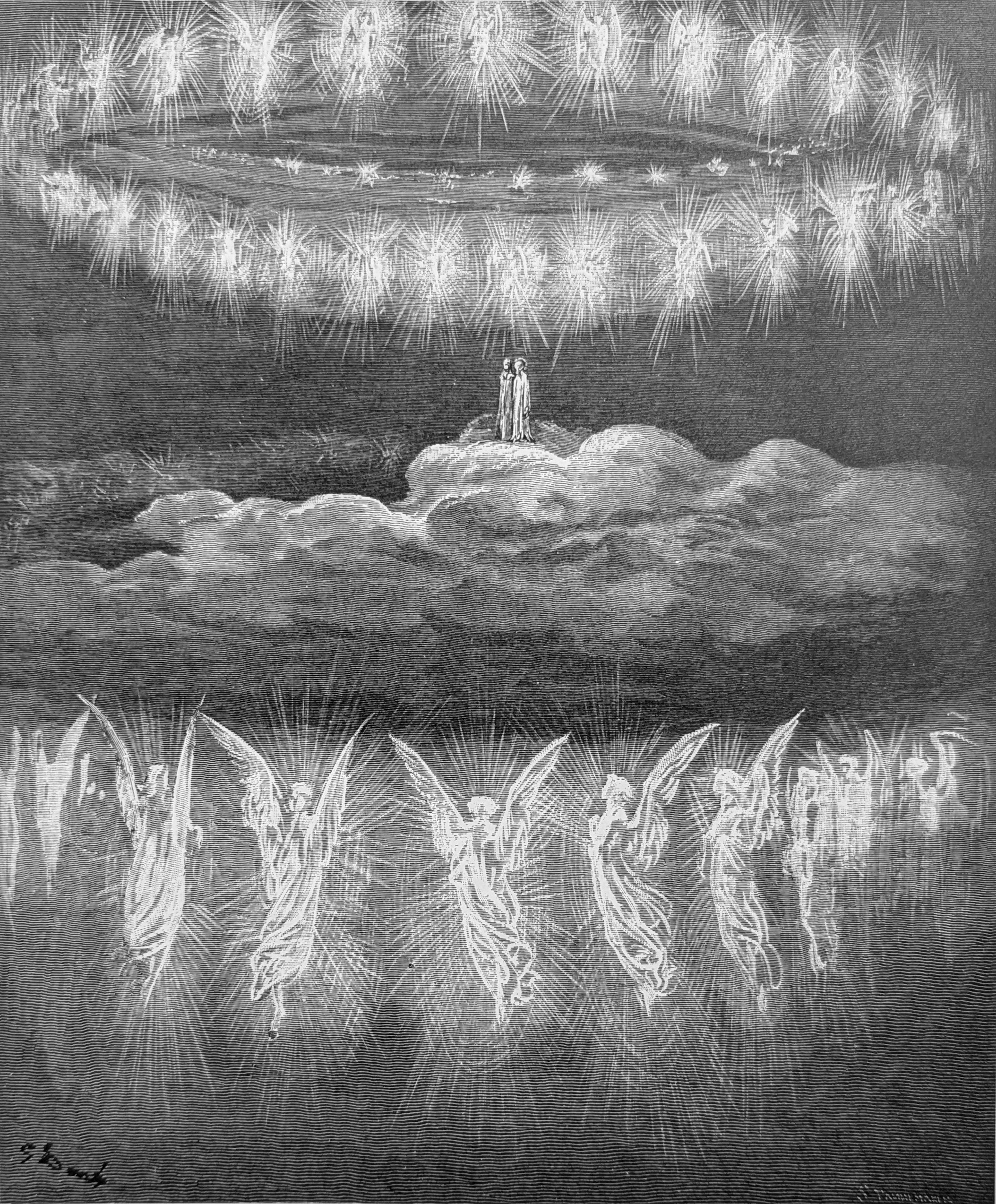
In such wise of those sempiternal roses / The garlands twain encompassed us about, / And thus the outer to the inner answered. Par. XII, lines 19-21
Top of page