Dante's Divine Comedy: Paradiso
Canto XXVI
Having reassured Dante the Pilgrim that Beatrice's loving gaze will heal his blindness, Saint John begins his examination on the object and nature of Love, the third theological virtue. Dante the Poet describes its intensity, which begins and ends in God, and traces the sources from which he obtained the knowledge that God is the ultimate good. When Dante has given this answer Beatrice and the others sing "Holy, holy, holy!" and his vision is restored. He sees that the soul of Adam has joined those of the three Apostles. In reply to Dante, Adam proceeds to reveal the nature of the Fall, the date of his creation, the language he spoke whilst on Earth and the length of his stay in Eden.[1]
While I was doubting for my vision quenched,
Out of the flame refulgent that had quenched it
Issued a breathing, that attentive made me,
Saying: "While thou recoverest the sense
Of seeing which in me thou hast consumed,
'Tis well that speaking thou shouldst compensate it.
Begin then, and declare to what thy soul
Is aimed, and count it for a certainty,
Sight is in thee bewildered and not dead;
Because the Lady, who through this divine
Region conducteth thee, has in her look
The power the hand of Ananias had."[2]
I said: "As pleaseth her, or soon or late
Let the cure come to eyes that portals were
When she with fire I ever burn with entered.
The Good, that gives contentment to this Court,
The Alpha and Omega is of all
The writing that love reads me low or loud."[3]
The selfsame voice, that taken had from me
The terror of the sudden dazzlement,
To speak still farther put it in my thought;
And said: "In verity with finer sieve
Behooveth thee to sift; thee it behooveth
To say who aimed thy bow at such a target."
And I: "By philosophic arguments,
And by authority that hence descends,
Such love must needs imprint itself in me;
For Good, so far as good, when comprehended
Doth straight enkindle love, and so much greater
As more of goodness in itself it holds;
Then to that Essence (whose is such advantage
That every good which out of it is found
Is nothing but a ray of its own light)
More than elsewhither must the mind be moved
Of every one, in loving, who discerns
The truth in which this evidence is founded.
Such truth he to my intellect reveals
Who demonstrates to me the primal love
Of all the sempiternal substances.
The voice reveals it of the truthful Author,
Who says to Moses, speaking of Himself,
'I will make all my goodness pass before thee.'
Thou too revealest it to me, beginning
The loud Evangel, that proclaims the secret
Of heaven to Earth above all other edict."
And I heard say: "By human intellect
And by authority concordant with it,
Of all thy loves reserve for God the highest.
But say again if other cords thou feelest,
Draw thee towards Him, that thou mayst proclaim
With how many teeth this love is biting thee."
The holy purpose of the Eagle of Christ
Not latent was, nay, rather I perceived
Whither he fain would my profession lead.[4]
Therefore I recommenced: "All of those bites
Which have the power to turn the heart to God
Unto my charity have been concurrent.
The being of the world, and my own being,
The death which He endured that I may live,
And that which all the faithful hope, as I do,
With the forementioned vivid consciousness
Have drawn me from the sea of love perverse,
And of the right have placed me on the shore.
The leaves, wherewith embowered is all the garden
Of the Eternal Gardener, do I love
As much as he has granted them of good."
As soon as I had ceased, a song most sweet
Throughout the heaven resounded, and my Lady
Said with the others, "Holy, holy, holy!"[5]
And as at some keen light one wakes from sleep
By reason of the visual spirit that runs
Unto the splendor passed from coat to coat,
And he who wakes abhorreth what he sees,
So all unconscious is his sudden waking,
Until the judgment cometh to his aid,
So from before mine eyes did Beatrice
Chase every mote with radiance of her own,
That cast its light a thousand miles and more.
Whence better after than before I saw,
And in a kind of wonderment I asked
About a fourth light that I saw with us.
And said my Lady: "There within those rays
Gazes upon its Maker the first soul
That ever the first virtue did create."
Even as the bough that downward bends its top
At transit of the wind, and then is lifted
By its own virtue, which inclines it upward,
Likewise did I, the while that she was speaking,
Being amazed, and then I was made bold
By a desire to speak wherewith I burned.
And I began: "O apple, that mature
Alone hast been produced, O ancient father,
To whom each wife is daughter and daughter-in-law,
Devoutly as I can I supplicate thee
That thou wouldst speak to me; thou seest my wish;
And I, to hear thee quickly, speak it not."
Sometimes an animal, when covered, struggles
So that his impulse needs must be apparent,
By reason of the wrappage following it;
And in like manner the primeval soul
Made clear to me athwart its covering
How jubilant it was to give me pleasure.
Then breathed: "Without thy uttering it to me,
Thine inclination better I discern
Than thou whatever thing is surest to thee;
For I behold it in the truthful mirror,
That of Himself all things parhelion makes,
And none makes Him parhelion of itself.
Thou fain wouldst hear how long ago God placed me
Within the lofty garden, where this Lady
Unto so long a stairway thee disposed.
And how long to mine eyes it was a pleasure,
And of the great disdain the proper cause,
And the language that I used and that I made.
Now, son of mine, the tasting of the tree
Not in itself was cause of so great exile,
But solely the o'erstepping of the bounds.
There, whence thy Lady moved Virgilius,
Four thousand and three hundred and two circuits
Made by the sun, this Council I desired;
And him I saw return to all the lights
Of his highway nine hundred times and thirty,
Whilst I upon the earth was tarrying.
The language that I spake was quite extinct
Before that in the work interminable
The people under Nimrod were employed;[6]
For nevermore result of reasoning
(Because of human pleasure that doth change,
Obedient to the heavens) was durable.
A natural action is it that man speaks;
But whether thus or thus, doth nature leave
To your own art, as seemeth best to you.
Ere I descended to the infernal anguish,
'El' was on Earth the name of the Chief Good,
From whom comes all the joy that wraps me round
'Eli' he then was called, and that is proper,
Because the use of men is like a leaf
On bough, which goeth and another cometh.[7]
Upon the mount that highest o'er the wave
Rises was I, in life or pure or sinful,
From the first hour to that which is the second,
As the sun changes quadrant, to the sixth."
Footnotes
1. The three apostles are Peter, James, and John. They examine Dante on the theological virtues of faith, hope, and love, respectively.
| Apostle | Theological Virtue | Canto |
|---|---|---|
| Peter | Faith | 24 |
| James | Hope | 25 |
| John | Love | 26 |
The three apostles—Peter, James, and John—appear to examine Dante on the three theological virtues. Each apostle represents a specific virtue: Peter tests Dante on faith, James on hope, and John on love. This examination occurs in the sphere of the Fixed Stars, where Dante is surrounded by these blessed spirits.
2. Ananias of Damascus was a disciple of Jesus in Damascus, mentioned in the Acts of the Apostles in the Bible, which describes how he was sent by Jesus to restore the sight of Saul of Tarsus (who later was called Paul the Apostle) and provide him with additional instruction in the way of the Lord.
3. Struck blind by the radiance of Saint John, Dante hears the saint beginning to question him about the virtue of love. "Say," John commands, "what point the soul of you / is aiming at." God, Dante replies, is the "Alpha and Omega" of all his desires, the supreme "Good" he seeks to attain. John presses him to be more specific: How did Dante arrive at this love of God? Human intellect, Dante answers, is naturally inclined to seek out good things, and its "aim" is sharpened by the guidance of the scriptures.
4. The Eagle of Christ symbolizes divine justice and authority, formed by blessed souls who represent just rulers. This eagle serves as a reminder to earthly leaders to cherish justice and reflects the theme of predestination and the inscrutability of God's will.
5. Refining his questions further, John likens love to a system of gears and pulleys that gradually draw the soul upward. He asks Dante about the other "gears" and "ropes" that have drawn his soul toward God. Dante cites his own life experiences, Christ's death and resurrection, and the Christian faith he shares with others as inducements to love God. In approval of his answer, the blessed souls burst into song—"Holy, Holy, Holy," they proclaim. Dante is shocked to find his eyesight suddenly restored by Beatrice, better than it was before, as he rises higher each canto.
He now sees a new, fourth figure among the souls of the three saints. This, Beatrice says, is Adam, the "first of souls." Addressing his ancient forefather, Dante asks Adam to speak with him. Adam begins answering Dante's questions before he has even heard them. He tells of his time in the Garden of Eden, of his earthly life after that, and then of the four millennia he spent in Limbo awaiting the resurrection of Christ. He explains the language spoken in Edenic times was extinct in the time of Nimrod, a mighty hunter mentioned in the book of Genesis.
"Holy, Holy, Holy" refers to the Trisagion, a traditional angelic hymn of praise to God. When Dante reaches the Heaven of the Fixed Stars, he encounters the soul of Saint John the Apostle. During this vision, all the blessed souls in that sphere burst forth in a chant of divine praise—“Santo, santo, santo”—which is Italian for “Holy, holy, holy.” This phrase comes from two biblical sources: Isaiah 6:3, where the seraphim cry “Holy, holy, holy, Lord God of hosts” and Revelation 4:8, where the four living creatures around God’s throne continuously sing, “Holy, holy, holy, Lord God Almighty, who was, and is, and is to come.”
In Dante’s poem, this song symbolizes the perfect and eternal worship of God by the blessed spirits - an unending hymn of praise that echoes the harmony of Heaven. It emphasizes the absolute holiness and transcendence of God, fitting for this stage of Dante ’s ascent, when he is nearing the ultimate vision of the Divine.
Trisagion (Greek: Τρισάγιον; 'Thrice Holy'), sometimes called by its incipit Agios O Theos, is a standard hymn of ancient origin of the Divine Liturgy in most of the Eastern Orthodox, Western Orthodox, Oriental Orthodox, and Eastern Catholic churches.
In churches which use the Byzantine Rite, the Trisagion is chanted immediately before the Prokeimenon and the Epistle reading. It is also included in a set of prayers named for it, called the Trisagion Prayers, which forms part of numerous services (the Hours, Vespers, Matins, and as part of the opening prayers for most services). It is most prominent in the Latin Church for its use on Good Friday. It is also used in the Liturgy of the Hours and in some Catholic devotions.
Greek:
Ἅγιος ὁ Θεός, Ἅγιος ἰσχυρός, Ἅγιος ἀθάνατος, ἐλέησον ἡμᾶς.
Hágios ho Theós, Hágios iskhūrós, Hágios āthánatos, eléēson hēmâs.
Latin:
Sanctus Deus, Sanctus Fortis, Sanctus Immortalis, miserere nobis.
English – literal translation:
Holy God, Holy Strong, Holy Immortal, have mercy on us
Trisagion Prayers:
Holy God, Holy and Mighty, Holy and Immortal, have mercy on us. (three times)
Glory... Both now...
All-holy Trinity, have mercy on us. Lord, cleanse us from our sins. Master, pardon our iniquities. Holy God, visit and heal us for thy Name's sake.
Lord, have mercy. (three times)
Glory... Both now...
Our Father…
Trisagion Hymn in English and Greek: https://www.youtube.com/watch?v=oJ6of7ViJ5w
6. Nimrod is a biblical figure mentioned in the Book of Genesis and the Books of Chronicles. The son of Cush and thus the great-grandson of Noah, Nimrod was described as a king in the land of Shinar (Lower Mesopotamia). The Bible states that he was "a mighty hunter before the Lord and ... began to be mighty in the earth". Nimrod became a symbol of defiance against God.
Biblical and non-biblical traditions identify Nimrod as the ruler associated with the Tower of Babel; Jewish, Christian, and Islamic accounts variously portray him as a tyrant who led its builders, turned people from God, and opposed Abraham, even attempting unsuccessfully to kill him by fire. Over time, legends identified him with other figures like Amraphel, Ninus, or Zoroaster, and credited him with innovations such as wearing the first crown and introducing idolatry.
7. “Eli” is actually Elijah—the Hebrew prophet. Dante sees two radiant souls nearby: Adam and Elijah.
Elijah appears because he, like Enoch, was said in scripture to have been taken up to Heaven without dying (see 2 Kings 2:11). In the Christian tradition Dante draws from, Elijah is one of the few mortals assumed bodily into Heaven, which makes his presence appropriate in the realm of the blessed who are closest to God.
Illustrations of Paradiso
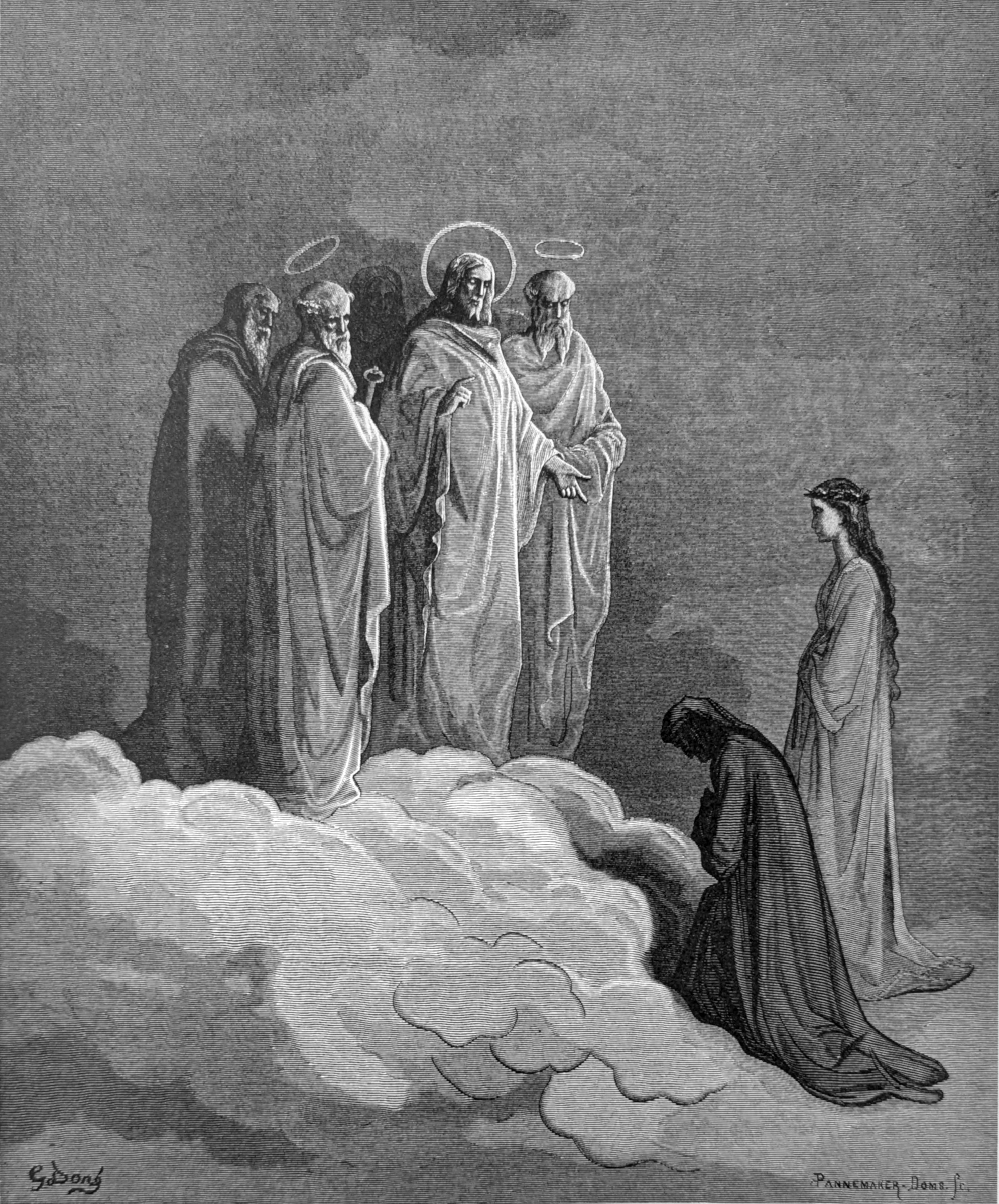
"Begin then, and declare to what thy soul / Is aimed, and count it for a certainty, / Sight is in thee bewildered and not dead;" Par. XXVI, lines 7-9
Top of page