Dante's Divine Comedy: Paradiso
Canto XVI
Proud of his descent and with his dignity gratified, Dante wants to hear more about twelfth-century Florence in her heyday as in his day the once-prominent families who boasted Roman lineage were dying out, many of the grand houses were being demolished and the city's once-solid moral fiber polluted as greedy newcomers from neighboring boroughs flocked to her. Cacciaguida laments the expansion of his city's boundaries and the feud between the Amidei and Buondelmonte which ignited the conflict between Guelfs and Ghibellines. He also stresses that succeeding generations have an obligation to reinforce the noble actions of their ancestors.[1]
O thou our poor nobility of blood,
If thou dost make the people glory in thee
Down here where our affection languishes,
A marvelous thing it ne'er will be to me;
For there where appetite is not perverted,
I say in Heaven, of thee I made a boast!
Truly thou art a cloak that quickly shortens,
So that unless we piece thee day by day
Time goeth round about thee with his shears!
With 'You,' which Rome was first to tolerate,
(Wherein her family less perseveres,)
Yet once again my words beginning made;
Whence Beatrice, who stood somewhat apart,
Smiling, appeared like unto her who coughed
At the first failing writ of Guenever.[2]
And I began: "You are my ancestor,
You give to me all hardihood to speak,
You lift me so that I am more than I.
So many rivulets with gladness fill
My mind, that of itself it makes a joy
Because it can endure this and not burst.
Then tell me, my beloved root ancestral,
Who were your ancestors, and what the years
That in your boyhood chronicled themselves?
Tell me about the sheepfold of Saint John,
How large it was, and who the people were
Within it worthy of the highest seats."
As at the blowing of the winds a coal
Quickens to flame, so I beheld that light
Become resplendent at my blandishments.
And as unto mine eyes it grew more fair,
With voice more sweet and tender, but not in
This modern dialect, it said to me:
"From uttering of the 'Ave,' till the birth
In which my mother, who is now a saint,
Of me was lightened who had been her burden,
Unto its Lion had this fire returned
Five hundred fifty times and thirty more,
To reinflame itself beneath his paw.[3]
My ancestors and I our birthplace had
Where first is found the last ward of the city
By him who runneth in your annual game.
Suffice it of my elders to hear this;
But who they were, and whence they thither came,
Silence is more considerate than speech.
All those who at that time were there between
Mars and the Baptist, fit for bearing arms,
Were a fifth part of those who now are living;[4]
But the community, that now is mixed
With Campi and Certaldo and Figghine,
Pure in the lowest artisan was seen.[5]
O how much better 'twere to have as neighbors
The folk of whom I speak, and at Galluzzo
And at Trespiano have your boundary,[6]
Than have them in the town, and bear the stench
Of Aguglione's churl, and him of Signa
Who has sharp eyes for trickery already.[7]
Had not the folk, which most of all the world
Degenerates, been a step-dame unto Caesar,
But as a mother to her son benignant,
Some who turn Florentines, and trade and discount,
Would have gone back again to Simifonte
There where their grandsires went about as beggars.[8]
At Montemurlo still would be the Counts,
The Cerchi in the parish of Acone,
Perhaps in Valdigrieve the Buondelmonti.[9]
Ever the intermingling of the people
Has been the source of malady in cities,
As in the body food it surfeits on;
And a blind bull more headlong plunges down
Than a blind lamb; and very often cuts
Better and more a single sword than five.
If Luni thou regard, and Urbisaglia,
How they have passed away, and how are passing
Chiusi and Sinigaglia after them,[10]
To hear how races waste themselves away,
Will seem to thee no novel thing nor hard,
Seeing that even cities have an end.
All things of yours have their mortality,
Even as yourselves; but it is hidden in some
That a long while endure, and lives are short;
And as the turning of the lunar heaven
Covers and bares the shores without a pause,
In the like manner fortune does with Florence,
Therefore should not appear a marvelous thing
What I shall say of the great Florentines
Of whom the fame is hidden in the Past.
I saw the Ughi, saw the Catellini,
Filippi, Greci, Ormanni, and Alberichi,
Even in their fall illustrious citizens;[11]
And saw, as mighty as they ancient were,
With him of La Sannella him of Arca,
And Soldanier, Ardinghi, and Bostichi.[12]
Near to the gate that is at present laden
With a new felony of so much weight
That soon it shall be jetsam from the bark,
The Ravignani were, from whom descended
The County Guido, and whoe'er the name
Of the great Bellincione since hath taken.[13]
He of La Pressa knew the art of ruling
Already, and already Galigajo
Had hilt and pommel gilded in his house.[14]
Mighty already was the Column Vair,
Sacchetti, Giuochi, Fifant, and Barucci,
And Galli, and they who for the bushel blush.[15]
The stock from which were the Calfucci born
Was great already, and already chosen
To curule chairs the Sizii and Arrigucci.[16]
O how beheld I those who are undone
By their own pride! and how the Balls of Gold
Florence enflowered in all their mighty deeds!
So likewise did the ancestors of those
Who evermore, when vacant is your church,
Fatten by staying in consistory.
The insolent race, that like a dragon follows
Whoever flees, and unto him that shows
His teeth or purse is gentle as a lamb,
Already rising was, but from low people;
So that it pleased not Ubertin Donato
That his wife's father should make him their kin.[17]
Already had Caponsacco to the Market
From Fesole descended, and already
Giuda and Infangato were good burghers.[18]
I'll tell a thing incredible, but true;
One entered the small circuit by a gate
Which from the Della Pera took its name![19]
Each one that bears the beautiful escutcheon
Of the great baron whose renown and name
The festival of Thomas keepeth fresh,
Knighthood and privilege from him received;
Though with the populace unites himself
To-day the man who binds it with a border.
Already were Gualterotti and Importuni;
And still more quiet would the Borgo be
If with new neighbors it remained unfed.[20]
The house from which is born your lamentation,
Through just disdain that death among you brought
And put an end unto your joyous life,
Was honored in itself and its companions.
O Buondelmonte, how in evil hour
Thou fled'st the bridal at another's promptings!
Many would be rejoicing who are sad,
If God had thee surrendered to the Ema
The first time that thou camest to the city.[21]
But it behooved the mutilated stone
Which guards the bridge, that Florence should provide
A victim in her latest hour of peace.
With all these families, and others with them,
Florence beheld I in so great repose,
That no occasion had she whence to weep;
With all these families beheld so just
And glorious her people, that the lily
Never upon the spear was placed reversed,
Nor by division was vermilion made."
Footnotes
1. The Amidei are one of the oldest and noblest families, among the Greats of Florence , who tradition indicated were of Roman origin and who had lived in the city since its foundation.
Having taken part in a brawl, Buondelmonte dei Buondelmonti decided, after a meeting of the families involved, that to repair the damage while maintaining his honor, he would marry the daughter of Lambertuccio Amidei . However, Buondelmonte, tempted by Gualdrada dei Donati to marry a member of their own family, and assured that they would pay a "fine" for annulling the marriage, decided to call off the wedding with the Amidei and marry a Donati instead. At this point, the Amidei became furious and plotted revenge, and the Amidei advisor, Mosca dei Lamberti, uttered the famous phrase "Cosa fatta capo ha," ("what is done is done"), arguing that Buondelmonte should be killed. At Easter 1215, he was indeed killed in front of a statue of Mars, and the city was thus divided between opponents and supporters of this event.
2. Guinevere, also written Guenevere or Guenever, was an early-medieval queen of Great Britain and the wife of King Arthur. First mentioned in literature in the early 12th century, nearly 700 years after the purported times of Arthur, Guinevere has since been portrayed as everything from a fatally flawed, villainous, and opportunistic traitor to a noble and virtuous lady. The variably told motif of abduction of Guinevere, or of her being rescued from some other peril, features recurrently and prominently in many versions of the legend.
3. The lion often symbolizes pride. This is consistent with the broader themes of sin and virtue that Dante explores throughout his journey. The lion represents a powerful force that can lead individuals away from the path of righteousness.
The lion's symbolism is tied to the idea of divine justice and the consequences of pride. The lion's strength and majesty can be seen as a reflection of God's power, but it also serves as a warning against the dangers of excessive pride. Dante uses the lion to illustrate the balance between divine authority and human humility.
The presence of the lion in this canto emphasizes the importance of recognizing one's limitations and the need for humility in the face of divine greatness. It serves as a reminder that true virtue lies in the acknowledgment of one's place within the divine order, rather than in the pursuit of personal glory or power.
4. Perhaps this is a metaphor for the time of Mars, the Roman God of war, and the time of St. Jon the Baptist, who represents the descendants of the Roman Christians. Also, Mars is the current sphere occupied by Dante in heaven.
5. Campi, Certaldo, and Figghine are references to towns or communities near Florence, Italy. They represent the mixed population of Florence during Dante's time, contrasting with the more noble and pure lineage of earlier Florentine families.
Cacciaguida's outburst against "miscegenation"—or, as translator Allen Mandelbaum less contentiously renders it, "mingling of populations"—is at the very least an expression of elitism. Translator Robin Kirkpatrick goes a bit further, characterizing Cacciaguida's remarks as "betraying ... a dangerous tendency to racism." Either way the poet's ancestor seems to insist that Florence's problems stem in part from unions between "insiders" and "outsiders." For him the intermarrying of noble families—some of the m with little history in Florence—is like the patching together of various types of cloth. The differences remain, and the union is superficial.
This raises the question, is Dante on board with his ancestor's xenophobic attitude? Not entirely, it seems. Although Dante respects Cacciaguida tremendously and accepts much of what he has to say, the poet is self-conscious about his own prideful tendencies. From Heaven's point of view, Dante recognizes, boasting of one's own noble pedigree—of its purity, or of particular famous ancestors—is a vain and foolish exercise. Nonetheless, Dante clearly agrees Florence is in turmoil, and he does not entirely discredit Cacciaguida's attempt to blame ethnic "others" for this outcome.
6. Galluzzo is an Italian city south of Florence. The late-13th-century suburb of Galluzzo Vecchio ("Old Galluzzo"), which originally must have consisted of a handful of houses and villas scattered between the charterhouse bridge and the church of Saint Lucia of Massapagani, expanded as a group of residential buildings starting from the corner of via Massapagani and via Barni, around a 14th-century church.
The Cimitero di Trespiano ("Trespiano Cemetery") is a cemetery along the Via Bolognese near Florence, Italy, named after the hamlet of Trespiano in the hills north of Fiesole.
7. Aguglione is a negative example of a person from Florence, representing the moral decline of the city's nobility. He is depicted as a trickster, contrasting with the noble lineage that Dante's ancestor, Cacciaguida, reminisces about. Aguglione's character serves to highlight the degradation of noble bloodlines in Florence. Cacciaguida, Dante's ancestor, laments that the city has lost its original nobility, which was once evident even among common artisans. The mention of Aguglione emphasizes the shift fro m a more honorable society to one filled with deceitful individuals.
Signa is depicted as a negative figure, representing the corruption and trickery prevalent in society. Dante contrasts the people of Signa with those he would prefer as neighbors, highlighting the moral decay of his contemporaries. The reference to Sign a serves to illustrate Dante's critique of the social and political issues in Florence, emphasizing the need for justice and virtue in society.
8. Simifonte is referenced as a place where the ancestors of certain Florentine families, who have fallen from nobility, once lived. It symbolizes a time when these families were not wealthy and highlights the decline of moral and social values in Dante's contemporary Florence.
9. Montemurlo is a municipality in the Province of Prato in the Italian region Tuscany, located about 25 kilometers northwest of Florence and about 8 kilometers northwest of Prato.
The Florentine banking family of the Cerchi, minor nobles of the Valdarno, with a seat especially at Acone near Pontassieve, settled in Florence in the early thirteenth century and increased their fortunes. The family became the heads of a consortium of the prominent Guelfs that securely controlled Florence after the battle of Benevento in 1266. In Florence, the Cerchi purchased some of the ancient structures in the closely packed inner city formerly belonging to the counts Guidi, cheek-by-jowl with the proud Florentine family of the Donati, with whom their growing mutual antagonism was expressed in violent episodes that polarized Florence within a couple of decades in a virtual civil war that aligned behind two captains, Corso Donati of the Neri Guelf faction—the "Black" Guelfs of the old noble oligarchy—and Vieri de' Cerchi of the Bianchi, the moderate party that represented itself as champions of working people (the magri). The resulting violence lasted, with irruptions of tranquility, into the fourteenth century.
Acone is a parish which is associated with the Cerchi family, one of the notable families in Florence. It reflects the historical context of Florence and the significance of noble bloodlines in Dante's narrative.
Valdigrieve refers to a valley or area near Florence. It is associated with the historical families and factions that influenced Florentine society. The mention of Valdigrieve highlights the intermingling of different social groups in Florence, which Dante critiques. It serves as a backdrop for discussing the decay of noble lineage and the impact of time on family honor. Dante reflects on the nature of nobility, contrasting the ephemeral glory of bloodlines with the lasting value of virtuous deeds. Valdigrieve symbolizes the complexities of familial pride and the historical context of nobility in Florence. The reference to Valdigrieve also underscores the theme of decay in Florentine society, as Dante laments the loss of the noble values that once characterized the city. Valdigrieve thus serves as a significant point of reference in Dante's exploration of nobility, history, and the moral state of Florence.
Buondelmonti, see above.
10. Luni is a municipality in the province of La Spezia, in the easternmost end of the Liguria region of northern Italy. It was founded by the Romans as Luna. It gives its name to Lunigiana, a region spanning eastern Liguria and northern Tuscany (province o f Massa-Carrara).
Urbisaglia is a municipality in the province of Macerata, Marche, Italy. Its name comes from the ancient Roman town of Urbs Salvia, which is now in an archaeological park. The ancient town was founded during the 2nd century BC as a Roman colonia. It gave birth to some leading figures of the Roman Empire, such as the consul Gaius Fufius Geminus, and Lucius Flavius Silva Nonius Bassus the conqueror of Masada. It was utterly destroyed by Alaric in 408–10 AD.
During the following centuries, the inhabitants of Urbs Salvia gradually moved to the top of the hill, giving rise to the Castro de Orbesallia. In the 12th century, a very important religious, economic and cultural center was founded nearby, the Abbey of Fiastra, which had to influence the Fiastra Valley and the surrounding area. Between the 12th and 14th centuries, the town was ruled by the Abbracciamonte family which slowly sold the town to the Comune of Tolentino, which became its only owner.
Chiusi is a town in the province of Siena, Tuscany, Italy. Clusium was one of the more powerful cities in the Etruscan League of twelve peoples. Chiusi came under the influence of Rome in the 3rd century BC and was involved in the Social War. According to a Roman historical tradition Arruns of Clusium invited Gaul mercenaries from the Po Valley into Clusium to seek revenge for a domestic conflict concerning his wife. However the Gauls sacked the city instead and settled in the region.
In 540 AD it was occupied by the Ostrogoths and was later seat of a Lombard duchy. From the 11th century it was under the rule of the local bishop, and was later contended for by Orvieto and, from 1231, Siena, belonging to the latter until 1556, when it was annexed to the Grand duchy of Tuscany. The region was devastated by malaria in the Middle Ages, and did not recover until the Valdichiana was drained in the 18th century.
The Senigaglia family (sometimes spelled Sinigaglia) is an Italian Jewish family, whose origins can be traced back nearly 800 years, the period between the High Middle Age and the Renaissance.
11. Ughi is one of the notable Florentine families mentioned by Cacciaguida. He is referenced alongside other prominent families to illustrate the decline of noble lineage in Florence over time.
Catellini refers to a notable Florentine family mentioned by Dante, highlighting their historical significance even as their fortunes were in decline.
Filippi, Greci, Ormanni, and Alberichi are notable Florentine families mentioned by Cacciaguida, Dante's ancestor. They represent the illustrious citizens of Florence, whose fortunes were already in decline during Cacciaguida's time, highlighting the moral and social decay of the city.
12. La Sannella is referenced among other prominent Florentine families, indicating their influence and status during Dante's time. Cacciaguida uses the mention of La Sannella to illustrate the decline of noble families in Florence. He contrasts the past, when families like La Sannella were esteemed, with Dante's contemporary Florence, which is marked by factionalism and moral decay.
Arca refers to a notable Florentine family mentioned by Cacciaguida, Dante's ancestor.
Soldanier, Ardinghi, and Bostichi are notable Florentine families mentioned by Cacciaguida, reflecting the historical context of Florence during Dante's time. They represent the once-prominent families whose fortunes have declined, illustrating the moral and social decay of the city.
13. Ravignani are mentioned as a notable Florentine family, from whom descended Count Guido. Cacciaguida, Dante's ancestor, reflects on their lineage and the decline of noble families in Florence over time.
County Guido is a historical figure. He is associated with the Ravignani family and is noted for his noble lineage, which Dante reflects upon in the context of the decline of Florentine nobility.
Bellincione refers to Alighiero di Bellincione (1210-1283 AD), Dante's father. In this canto, Dante reflects on his family's noble lineage and the decline of Florentine nobility over time. Alighiero was the son of Bellincione di Alighiero. He was a member of the Guelph party and was probably a moneylender. Alighiero's first wife was Bella and the couple had one child, Dante, in 1265. After Bella's death, Alighiero married his second wife, Lapa Cialuffi, in 1270 or 1271 and they had two children, Francesco and Gaetana (Tana), who were Dante's half-brother and half-sister, respectively.
14. La Pressa refers to a notable family in Florence, specifically associated with a character who was significant in Dante's time.
Galigajo di Cacciaguida is a Florentine who is criticized for his pride and arrogance. He represents the negative traits of nobility and is contrasted with the virtues of humility and grace celebrated in the poem. Galigajo embodies the flaws of the aristocracy, such as vanity and self-importance. His character serves as a critique of the social and political issues in Florence during Dante's time, emphasizing the need for a return to virtuous leadership and integrity.
15. Column Vair refers to a prominent Florentine family who symbolize the nobility and social status of certain families in Florence during Dante's time, highlighting the themes of lineage and honor in the poem.
Sacchetti, a notable family in Florence, recognized for their influence and status.
Giuochi, another prominent family, part of the Florentine elite during Dante's time.
Fifant, less is known about this family, but they were included among the notable families of Florence.
Barucci, a family that held significance in the social hierarchy of Florence.
Galli, this family was also part of the Florentine nobility, contributing to the city's history.
Dante's mention of these families serves to illustrate the contrast between the noble past of Florence and its present state of decline. Cacciaguida, Dante's ancestor, reflects on the virtues of these families during his time, highlighting the moral and social decay that has occurred since then.
16. The Calfucci family is described as having a significant status in Florence during Cacciaguida's time. They are recognized for their historical importance and contributions to the city. Cacciaguida notes that the descendants of the Calfucci family, like many others, have faced ruin due to their pride.
The Sizii were recognized as a prominent family in Florence. Role: They held significant political power and were involved in the governance of the city.
The Arrigucci were also a powerful family in Florence. They were known for holding high offices and contributing to the political landscape of the city.
17. Ubertin Donato is noted for his reluctance to be associated with certain families of lower status, indicating a concern for maintaining his family's nobility. His character serves as a vehicle for Dante to critique the moral and social decline of Florence. Ubertin's discomfort with his wife's father's connections highlights the shifting values and the rise of families that were once considered lowly.
18. Caponsacco is depicted as a citizen of Florence who descended from Fiesole, a nearby town. His mention serves to illustrate the social dynamics and lineage of Florentine families during Dante's time. Cacciaguida recalls the past of Florence, highlighting the nobility and the changes in societal status over time. Caponsacco is noted for having entered the market, symbolizing the rise of certain families from humble beginnings to positions of respectability within the city.
Giuda and Infangato are mentioned in Dante's "Paradiso" Canto 16 as examples of good citizens from the lower social classes in Florence. Giuda is often associated with the name "Judah," he symbolizes a connection to the Jewish heritage and the historical roots of Florence. Infangato translates to "the soiled" or "the dirty," which may imply a fall from grace or a tarnished reputation. This reflects the complexities of nobility and honor in Dante's time.
19. Della Pera refers to a gate in Florence that was named after the Della Pera family, indicating a specific location within the city. The gate is associated with the Della Pera family, which had a notable escutcheon or coat of arms. This family was part o f the Florentine nobility, and their name is linked to the city's past.
20. The Gualterotti were a prominent family in Florence, known for their influence and status. Their mention highlights the shifting dynamics of nobility and the social structure in Florence, particularly in relation to the city's history and factionalism.
The Importuni were another family in Florence, often associated with the political and social conflicts of the time. They symbolize the complexities of Florentine society, including the rivalries and tensions that characterized the city's noble families.
Borgo refers to a neighborhood or district in Florence, specifically the Borgo San Lorenzo. The reference to Borgo serves to illustrate themes of decay and the loss of nobility in Florence.
21. "surrendered to the Ema" refers to a moment when Buondelmonte would have been better off if he had accepted a marriage proposal at the Ema River, which would have spared Florence from future conflicts. This line reflects on the consequences of choices and t he impact of personal decisions on the broader community. This line suggests a missed opportunity for peace in Florence, as it alludes to a marriage that could have united factions within the city.
Illustrations of Paradiso
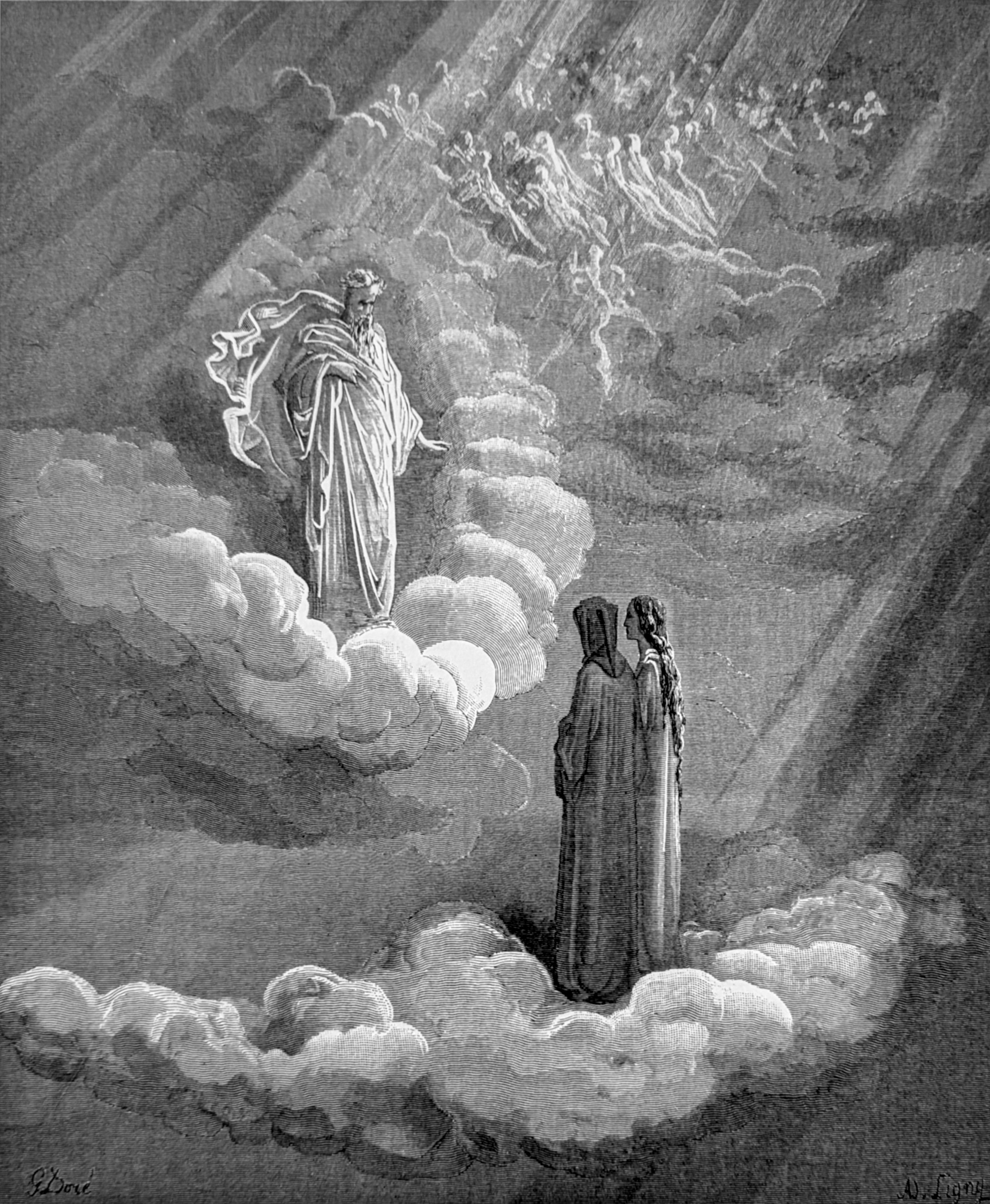
"You are my ancestor, / You give to me all hardihood to speak, / You lift me so that I am more than I." Par. XVI, lines 16-18
Top of page