Dante's Divine Comedy: Paradiso
Canto XXVIII
Dante sees the reflection of a bright object in Beatrice's eyes and, turning around, beholds God as a small but extremely brilliant ball of light that is surrounded by nine glowing, concentric rings. These are the angelic ranks that co-ordinate the movement of the Heavens. Dante is puzzled because the highest-ranking celestial beings are represented by the smallest circles, which does not conform to the universe as he knows it. Beatrice explains that there virtue is not related to size as it is on Earth. She goes on to name the orders of the angels: Seraphim, Cherubim, Thrones, Dominions, Virtues, Powers, Principalities, Archangels and Angels.[1]
After the truth against the present life
Of miserable mortals was unfolded
By her who doth imparadise my mind,
As in a looking-glass a taper's flame
He sees who from behind is lighted by it,
Before he has it in his sight or thought,
And turns him round to see if so the glass
Tell him the truth, and sees that it accords
Therewith as doth a music with its meter,
In similar wise my memory recollecteth
That I did, looking into those fair eyes,
Of which Love made the springes to ensnare me.
And as I turned me round, and mine were touched
By that which is apparent in that volume,
Whenever on its gyre we gaze intent,
A point beheld I, that was raying out
Light so acute, the sight which it enkindles
Must close perforce before such great acuteness.
And whatsoever star seems smallest here.
Would seem to be a moon, if placed beside it.
As one star with another star is placed.
Perhaps at such a distance as appears
A halo cincturing the light that paints it,
When densest is the vapor that sustains it,
Thus distant round the point a circle of fire
So swiftly whirled, that it would have surpassed
Whatever motion soonest girds the world;
And this was by another circumcinct,
That by a third, the third then by a fourth,
By a fifth the fourth, and then by a sixth the fifth;
The seventh followed thereupon in width
So ample now, that Juno's messenger
Entire would be too narrow to contain it.
Even so the eighth and ninth; and every one
More slowly moved, according as it was
In number distant farther from the first.
And that one had its flame most crystalline
From which less distant was the stainless spark,
I think because more with its truth imbued.
My Lady, who in my anxiety
Beheld me much perplexed, said: "From that point
Dependent is the heaven and nature all.
Behold that circle most conjoined to it,
And know thou, that its motion is so swift
Through burning love whereby it is spurred on."
And I to her: "If the world were arranged
In the order which I see in yonder wheels,
What's set before me would have satisfied me;
But in the world of sense we can perceive
That evermore the circles are diviner
As they are from the center more remote
Wherefore if my desire is to be ended
In this miraculous and angelic temple,
That has for confines only love and light,
To hear behooves me still how the example
And the exemplar go not in one fashion,
Since for myself in vain I contemplate it."
"If thine own fingers unto such a knot
Be insufficient, it is no great wonder,
So hard hath it become for want of trying."
My Lady thus; then said she: "Do thou take
What I shall tell thee, if thou wouldst be sated,
And exercise on that thy subtlety.
The circles corporal are wide and narrow
According to the more or less of virtue
Which is distributed through all their parts.
The greater goodness works the greater weal,
The greater weal the greater body holds,
If perfect equally are all its parts.
Therefore this one which sweeps along with it
The universe sublime, doth correspond
Unto the circle which most loves and knows.
On which account, if thou unto the virtue
Apply thy measure, not to the appearance
Of substances that unto thee seem round,
Thou wilt behold a marvelous agreement,
Of more to greater, and of less to smaller,
In every heaven, with its Intelligence."
Even as remaineth splendid and serene
The hemisphere of air, when Boreas
Is blowing from that cheek where he is mildest,[2]
Because is purified and resolved the rack
That erst disturbed it, till the welkin laughs
With all the beauties of its pageantry;
Thus did I likewise, after that my Lady
Had me provided with her clear response,
And like a star in heaven the truth was seen.
And soon as to a stop her words had come,
Not otherwise does iron scintillate
When molten, than those circles scintillated.
Their coruscation all the sparks repeated,
And they so many were, their number makes
More millions than the doubling of the chess.
I heard them sing hosanna choir by choir
To the fixed point which holds them at the 'Ubi,'
And ever will, where they have ever been.[3]
And she, who saw the dubious meditations
Within my mind, "The primal circles," said,
"Have shown thee Seraphim and Cherubim.
Thus rapidly they follow their own bonds,
To be as like the point as most they can,
And can as far as they are high in vision.
Those other Loves, that round about them go,
Thrones of the countenance divine are called,
Because they terminate the primal Triad.
And thou shouldst know that they all have delight
As much as their own vision penetrates
The Truth, in which all intellect finds rest.
From this it may be seen how blessedness
Is founded in the faculty which sees,
And not in that which loves, and follows next;
And of this seeing merit is the measure,
Which is brought forth by grace, and by good will;
Thus on from grade to grade doth it proceed.
The second Triad, which is germinating
In such wise in this sempiternal spring,
That no nocturnal Aries despoils,[4]
Perpetually hosanna warbles forth
With threefold melody, that sounds in three
Orders of joy, with which it is intrined.
The three Divine are in this hierarchy,
First the Dominions, and the Virtues next;
And the third order is that of the Powers.
Then in the dances twain penultimate
The Principalities and Archangels wheel;
The last is wholly of angelic sports.
These orders upward all of them are gazing,
And downward so prevail, that unto God
They all attracted are and all attract.
And Dionysius with so great desire
To contemplate these Orders set himself,
He named them and distinguished them as I do.[5]
But Gregory afterwards dissented from him;
Wherefore, as soon as he unclosed his eyes
Within this heaven, he at himself did smile.[6]
And if so much of secret truth a mortal
Proffered on Earth, I would not have thee marvel,
For he who saw it here revealed it to him,
With much more of the truth about these circles."
Footnotes
1. Dante gazes upon the Primum Mobile. A point of light, impossibly fine and bright, sits at its center, surrounded by nine concentric, halolike rings. These, Beatrice explains, are the nine choirs of angels, with the innermost ring representing the highest rank (the seraphim). Dante is confused: Shouldn't the outermost and largest circle be the highest ranking? In the celestial heavens, which Dante has only recently left behind, the outermost orbits are "more divine" than the inner ones.
Beatrice offers to "untie" the "knot" of Dante's perplexity. In the physical universe, she concedes, greatness is associated with physical extent, so bigger often means better. Here, however, the ranks of angels are ordered in the opposite way. Those closes t to God (the center point) are those who "know" God the most intensely and therefore show the greatest love for Him. Satisfied-indeed, elated-with this answer, Dante looks back at the rings and sees how numerous they are. The individual angels, which appear as "glints" and "sparks," "outnumbered far / progressive doubling of the chessboard squares."
Beatrice proceeds to name the ranks of angels in descending order: seraphim, cherubim, and thrones in the first and innermost triad, followed by dominations, virtues, and powers. In the third and outermost grouping are the principalities, archangels, and a ninth rank known simply as the angels. In between, Beatrice elaborates on the significance of the different choirs: all ranks of angels "have their delight / according to how deep their sight goes down / into the truth that calms all intellect." In other words, seeing God more clearly is a prerequisite to loving Him more deeply and thus enjoying His presence more fully.
Order of Angels
| No | Angel | Description |
|---|---|---|
| 1 | Seraphim | These are the highest order of angels. These particular angels serve as guardians or attendants before God’s throne. The only Bible verse where they are referenced is in Isaiah 6:1-7. They praise God, calling, “Holy Holy Holy is the Lord of Hosts.” What’s interesting to note about Seraphim is that they have six wings. Two of their wings cover their faces, two cover their feet, and the other two are for flying. |
| 2 | Cherubim | Following Seraphim in the angelic hierarchy comes Cherubim. They are the second highest in the nine orders of angels. These angels are manlike in appearance, double-winged and guardians of God’s glory. In the New Testament, they are often considered to be celestial attendants in the Apocalypse, referenced in Revelation 4-6. |
| 3 | Thrones | The Thrones are a class of angels mentioned by the Apostle Paul in Colossians 1:16. This verse says, "For in Him all things were created: things in heaven and on earth, visible and invisible, whether thrones or powers or rulers or authorities; all things have been created through Him and for Him." The Thrones are the angels of humility, peace and submission. If the lower choir of angels needed to access God, they would have to do that through the Thrones. |
| 4 | Dominions | This group of angels is said to keep the world in proper order. They are known for delivering God’s justice in unjust situations, showing mercy toward human beings and helping angels in lower ranks stay organized and perform their work efficiently. They are also recognized for expressing unconditional love. At the same time, they express God's justice. The Dominions are believed to embody qualities of wisdom, authority, and governance, exerting influence over the natural world and spiritual realms. |
| 5 | Virtues | Virtues are known for their control of the elements. Some even refer to them as “the shining ones.” In addition to being the Spirits of Motion, they also assist in governing nature. They also assist with miracles. They are also known for their work encouraging humans to strengthen their faith in God. |
| 6 | Powers | The Powers are considered warrior angels as they defend against evil, defending not only the cosmos but also humanity. They are also called the Powers because they have power over the devil in order to restrain the power of the demons. They also help people who are wrestling with passions and vices to cast out any evil promoted by the enemy. |
| 7 | Principalities | The Principalities have command over the lower angels. They also direct the fulfillment of divine orders. They are also known as Princedoms or Rules as they directly watch over large groups and institutions, including nations and the Church. They also ensure the fulfillment of the divine Will. While these angels are still wise and powerful, they are furthest from God in the angelic hierarchy, so they are better able to communicate with man in ways we can understand. |
| 8 | Archangels | Archangels are called the "great heralds of the Good News" because God sends them to deliver important messages to mankind. They are the ones that communicate and interact with us. Michael is believed to be the angel who delivered God’s divine inspiration to John in the Book of Revelation and is known as the protector of the Church, guarding her from evil. Michael is most widely known for his role in expelling Lucifer from heaven. Gabriel is first mentioned in the Book of Daniel and helps Daniel in his mission on earth. Later on, Gabriel appears to Zachariah and the Blessed Virgin Mary, delivering the greatest message ever that God meant to Incarnate and set his tent with us. Raphael is mentioned in the Book of Tobit to heal Tobit and deliver Sarah from a demon. Raphael accomplished both acts, disguised as a human, guiding Tobias along the way and instructing him on what to do. |
| 9 | Angels | The angels are closest to the material world and human beings. They deliver prayers to God and other messages to people on earth. One of the greatest characteristics of angels is that they are the most caring and social to assist those who ask for help. According to Scripture, angels have various responsibilities and roles in God’s Kingdom. We are ultimately encouraged by the knowledge that God’s angels are at work. There are also circumstances where angels may even visit us. God, who is responsible for cr eating the angels, has also promised us His presence in the face of life’s storms. Guardian angels hold a special place in Christian belief, tasked with watching over and protecting individuals throughout their lives. These celestial beings are believed to offer guidance, comfort, and divine intervention in times of need, serving a s constant companions and advocates for those under their watchful care. |
2. Boreas is the Greek god of the cold north wind, storms, and winter. Although he was normally taken as the north wind, the Roman writers Aulus Gellius and Pliny the Elder both took Boreas as a northeast wind, equivalent to the Roman god Aquilo or Septentrio. Boreas is depicted as being very strong, with a violent temper to match. He was frequently shown as a winged old man or sometimes as a young man with shaggy hair and beard, holding a conch shell and wearing a billowing cloak. Boreas's most known myth is hi s abduction of the Athenian princess Oreithyia.
3. "Ubi" refers to a concept of "where" or "where is" in Latin. It is part of a larger discussion about the nature of existence and the divine order of the universe. The term "Ubi" is used in a philosophical context, as Dante grapples with understanding the nature of God and the universe. It reflects his quest for "Ubi" highlights the contrast between human understanding and divine reality, a central theme in the Divine Comedy.
4. Aries is the constellation Ram. This indicates a movement in time from Capricorn to Aries, or January to March.
5. Dionysius refers to the Christian theologian and philosopher Pseudo-Dionysius the Areopagite, who is known for his writings on the celestial hierarchy of angels. He is mentioned as someone who sought to understand and categorize the orders of angels, which Dante reflects upon in his work.
Pseudo-Dionysius the Areopagite was a Greek author, Christian theologian and Neoplatonic philosopher of the late 5th to early 6th century, who wrote a set of works known as the Corpus Areopagiticum or Corpus Dionysiacum. Through his writing in Mystical Theology, he has been identified as the "progenitor of apophatic or negative theology."
6. Gregory refers to Pope Gregory the Great, who is mentioned in Dante's "Paradise" as having a different understanding of the orders of angels compared to Dionysius the Areopagite. Gregory is depicted as having a misunderstanding about the orders of angels. Upon reaching the Empyrean, Gregory realizes his error in categorizing the angelic ranks and laughs at himself for the mistake. This moment highlights the theme of divine knowledge versus human understanding, as Gregory's initial classification differs from the correct one presented by Dionysius the Areopagite, who is acknowledged for accurately naming the angelic orders.
Pope Gregory I (540–604 AD), commonly known as Saint Gregory the Great was the 64th Bishop of Rome from 3 September 590 until his death on 12 March 604. He is known for instituting the first recorded large-scale mission from Rome, the Gregorian mission, to convert the then largely pagan Anglo-Saxons to Christianity. Gregory is also well known for his writings, which were more prolific than those of any of his predecessors as pope. The epithet Saint Gregory the Dialogist has been attached to him in Eastern Christianity because of his Dialogues. English translations of Eastern texts sometimes list him as Gregory "Dialogos" from the Greek διάλογος, or the Anglo-Latinate equivalent "Dialogus".
Illustrations of Paradiso
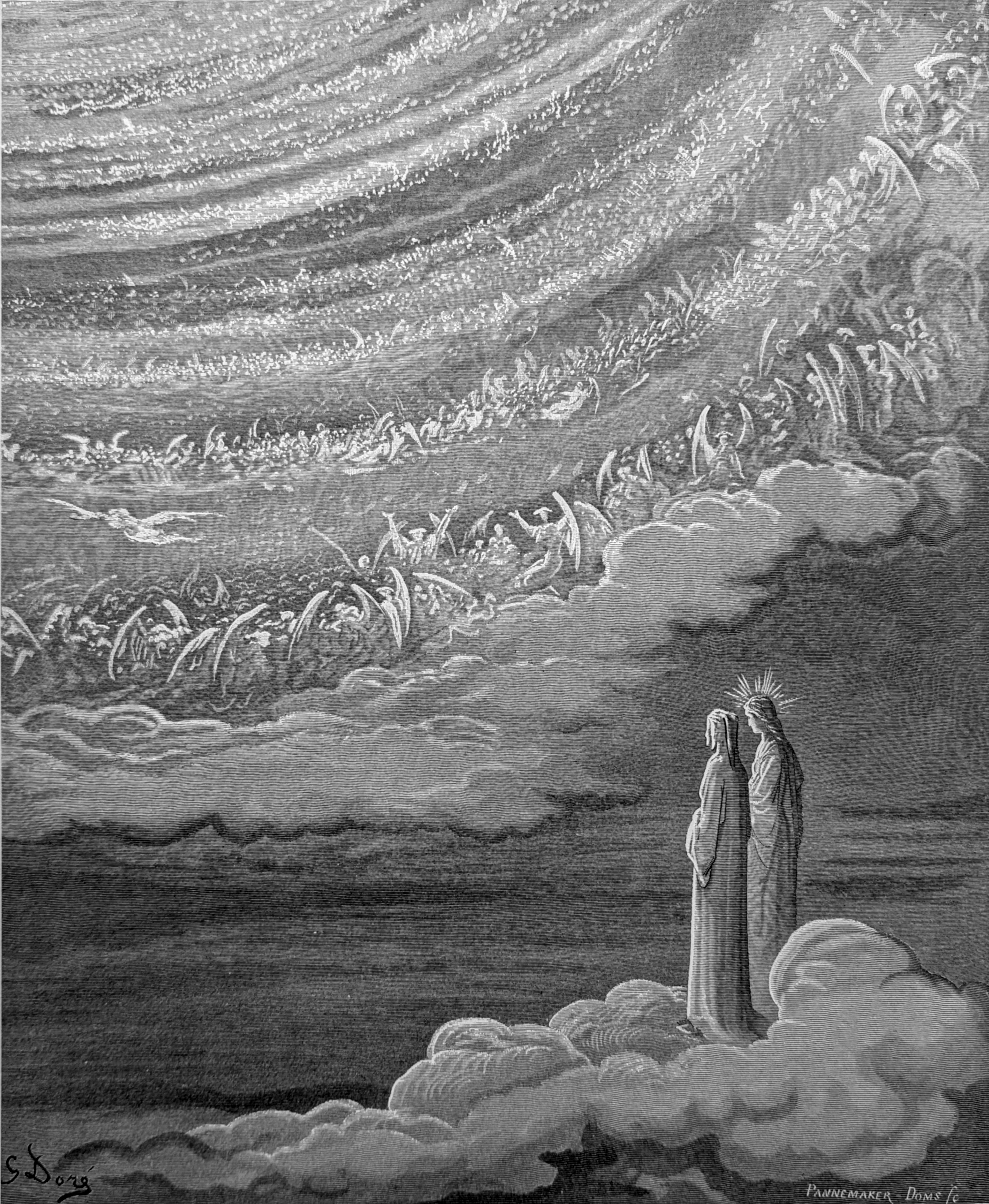
Not otherwise does iron scintillate / When molten, than those circles scintillated. Par. XXVIII, lines 89-90
Top of page