Lumen Christi Catholic Church
Our Spiritual Home
One Family Sharing the Love and Light of Christlumenchristiparish.org
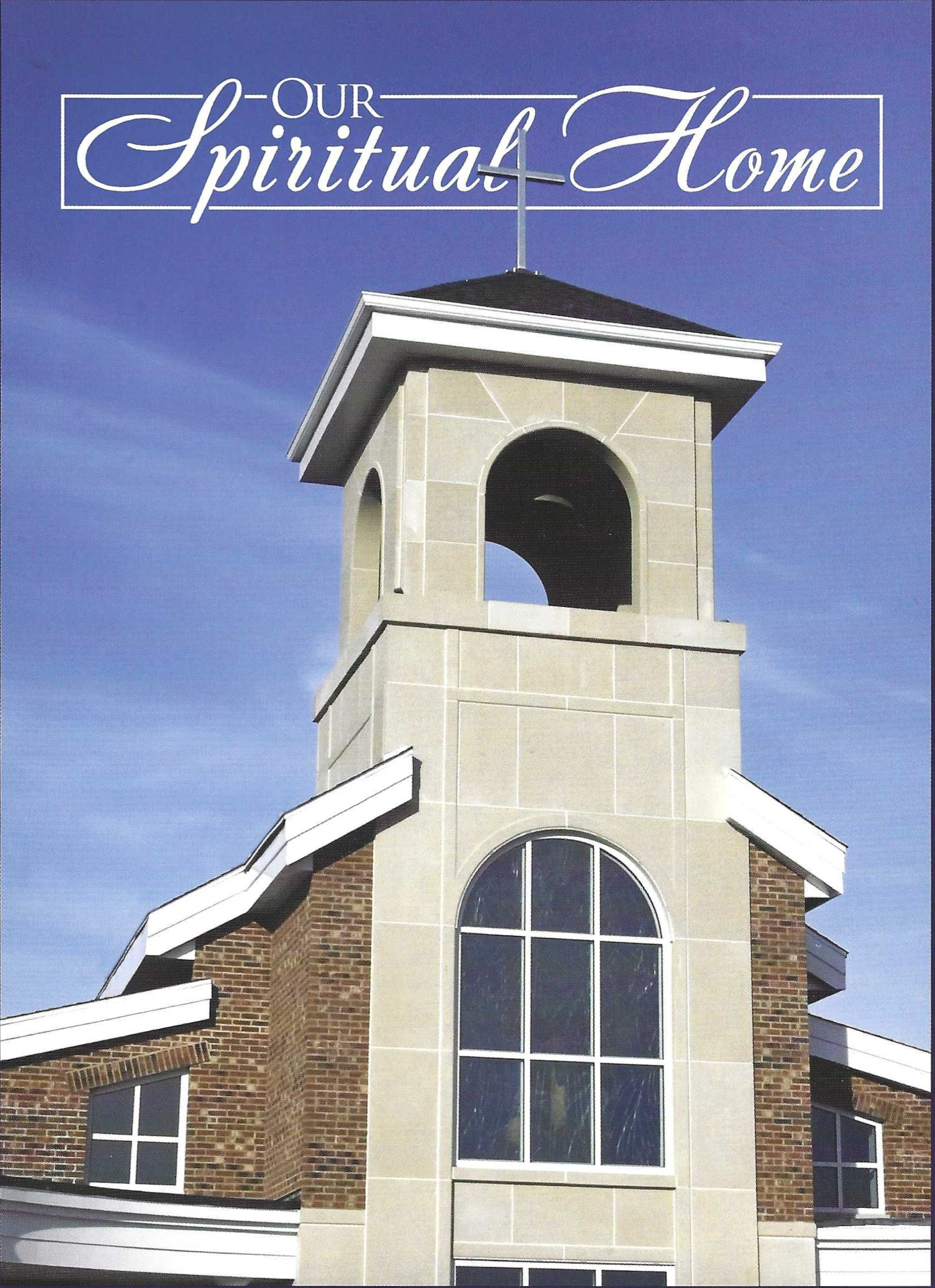
Welcome to Lumen Christi
Our new spiritual home is the final step in the merger of St. James and St. Cecilia Parishes into a unified Catholic community. The dedication of our worship space on December 22, 2019, completed our building master plan which was a five-year process in which our school, church, and grounds were expanded, redesigned, and beautified to support the ongoing spiritual needs of our parish family for generations to come.
Our new spiritual home is the result of thousands of hours invested by more than 100 parishioners and staff, including the members of the Ad Hoc Building Committee, the Arts and Furnishings Committee, and our Pastoral and Finance Councils. Throughout the planning process and listening sessions, parishioner input was important in shaping the architectural design.
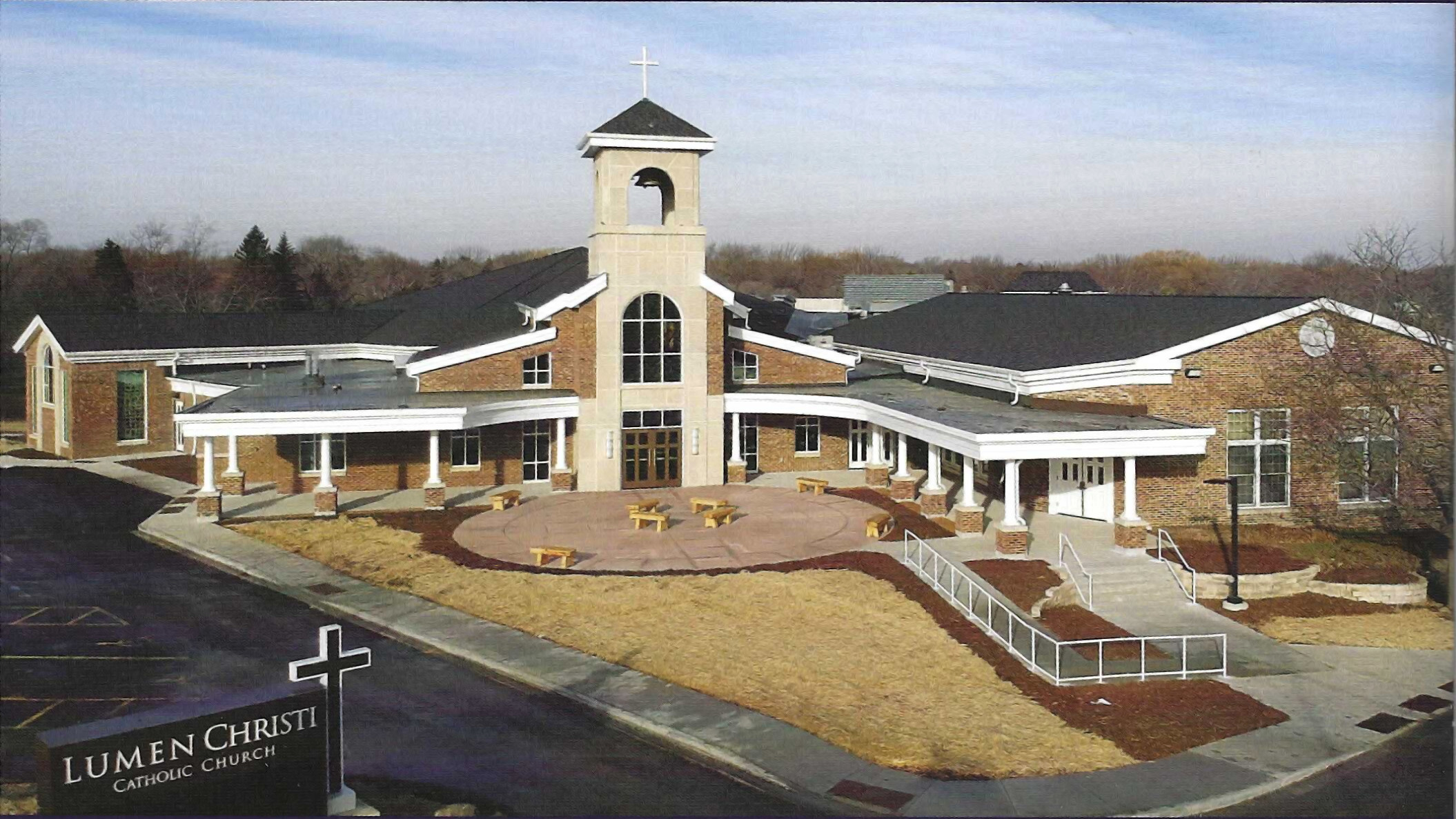
Of course, none of this would have been possible without the generous financial support and prayers of our parishioners, for which we are eternally grateful. Our beautiful church exterior is a beacon of the Light of Christ shining outward to the community beyond our walls. The design of the bell tower sends a strong message to passers-by that the faith community of Lumen Christi Catholic Parish is thriving and invites everyone to come in and experience God's love.
Father, may they all be one.
—John 17:21
As you enter the building, the naturally lit gathering space provides a special place to connect with one another, to welcome newcomers, and to draw us together as a family of faith. Our church and chapel provide a renewed, sacred environment to deepen our prayer and worship experience. The pages will of this booklet help to explain the historical and theological significance of the art and furnishings of Lumen Christi. We hope you keep this booklet and use it as a way to more deeply understand the key elements of our new church in order to enhance your worship. May God enlighten you with faith, inspire you with hope, and embrace you with love. Daniel & Sanders 4 Fr. Dan Sanders, Pastor
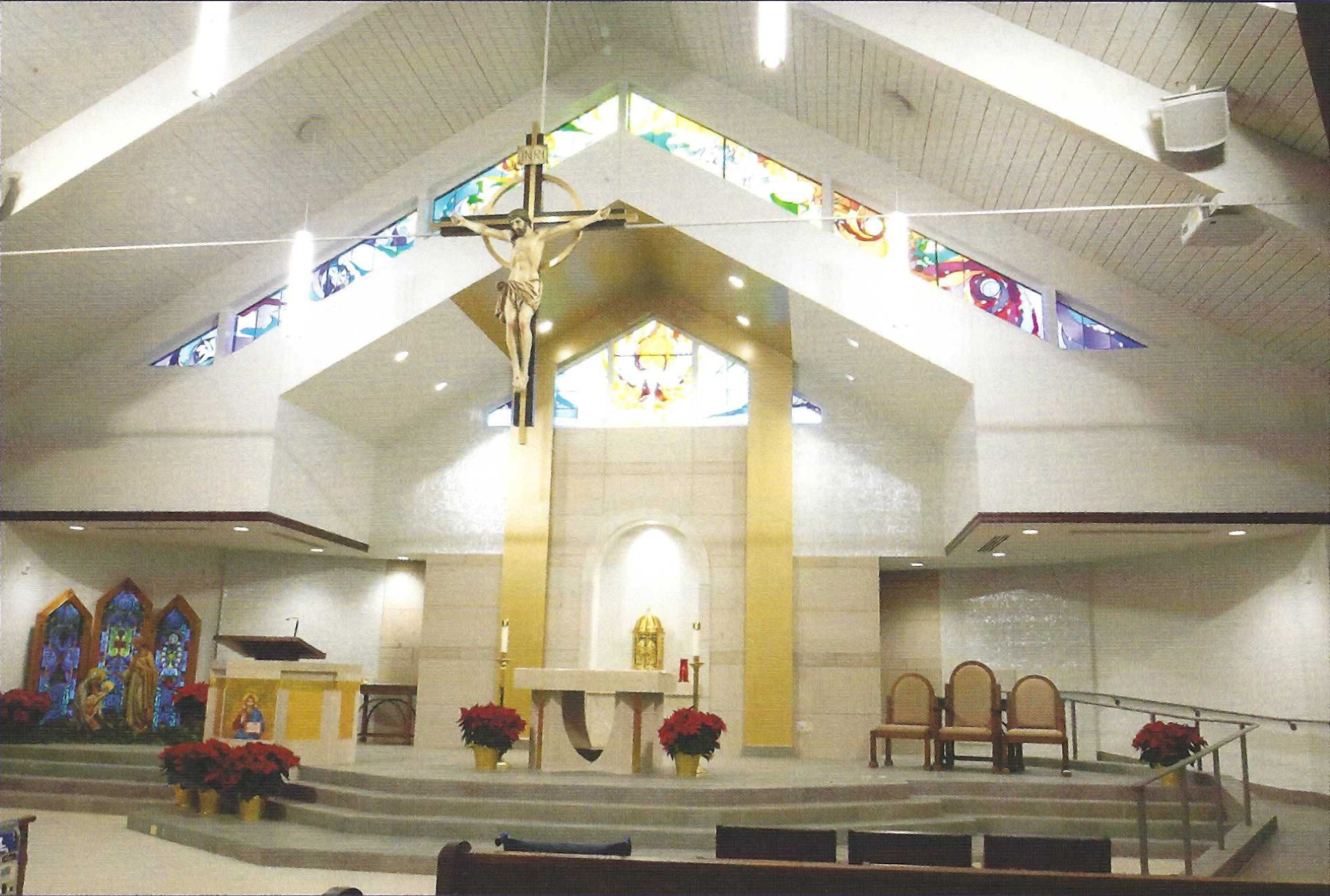
O God, sanctifier and ruler of your Church, it is right for us to celebrate your name in joyful proclamation; for today your faithful people desire to dedicate to you, solemnly and for all time, this house of prayer, where they worship you devoutly, are instructed by the Word, and are nourished by the Sacraments.
This house brings to light the mystery of the Church, which Christ made holy by the shedding of his blood, so that he might present her to himself as a glorious Bride, a Virgin resplendent with the integrity of faith, a Mother made fruitful by the power of the Spirit.
Holy is the Church, the chosen vine of the Lord, whose branches fill the whole world, and whose tendrils, borne on the wood of the Cross, reach upward to the Kingdom of Heaven.
Blessed is the Church, God's dwelling-place with the human race, a holy temple built of living stones, standing upon the foundation of the Apostles with Christ Jesus its chief cornerstone.
From the Order of the Dedication of the Church
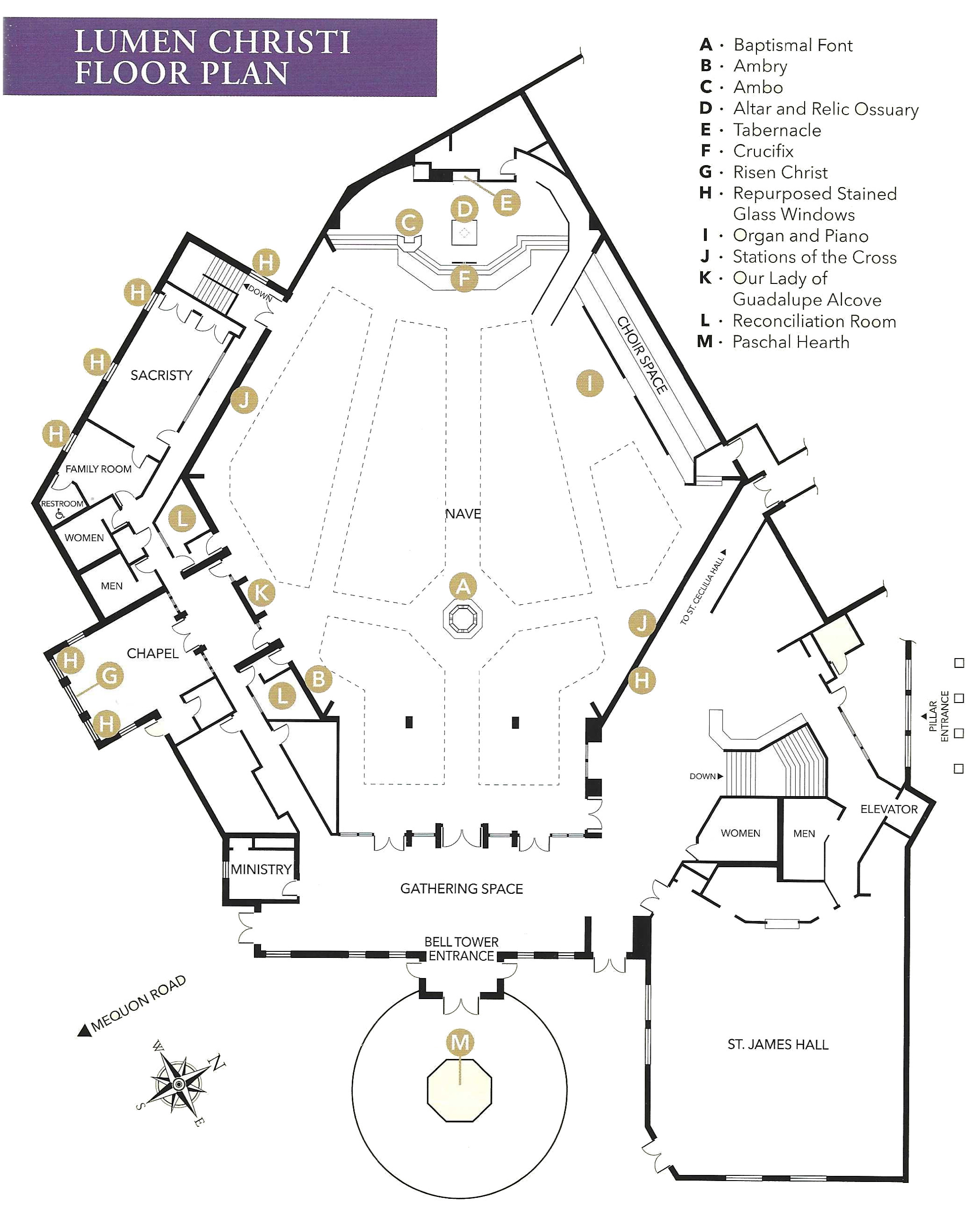
Lumen Christi Floor Plan
The Bell Tower and Christus Window
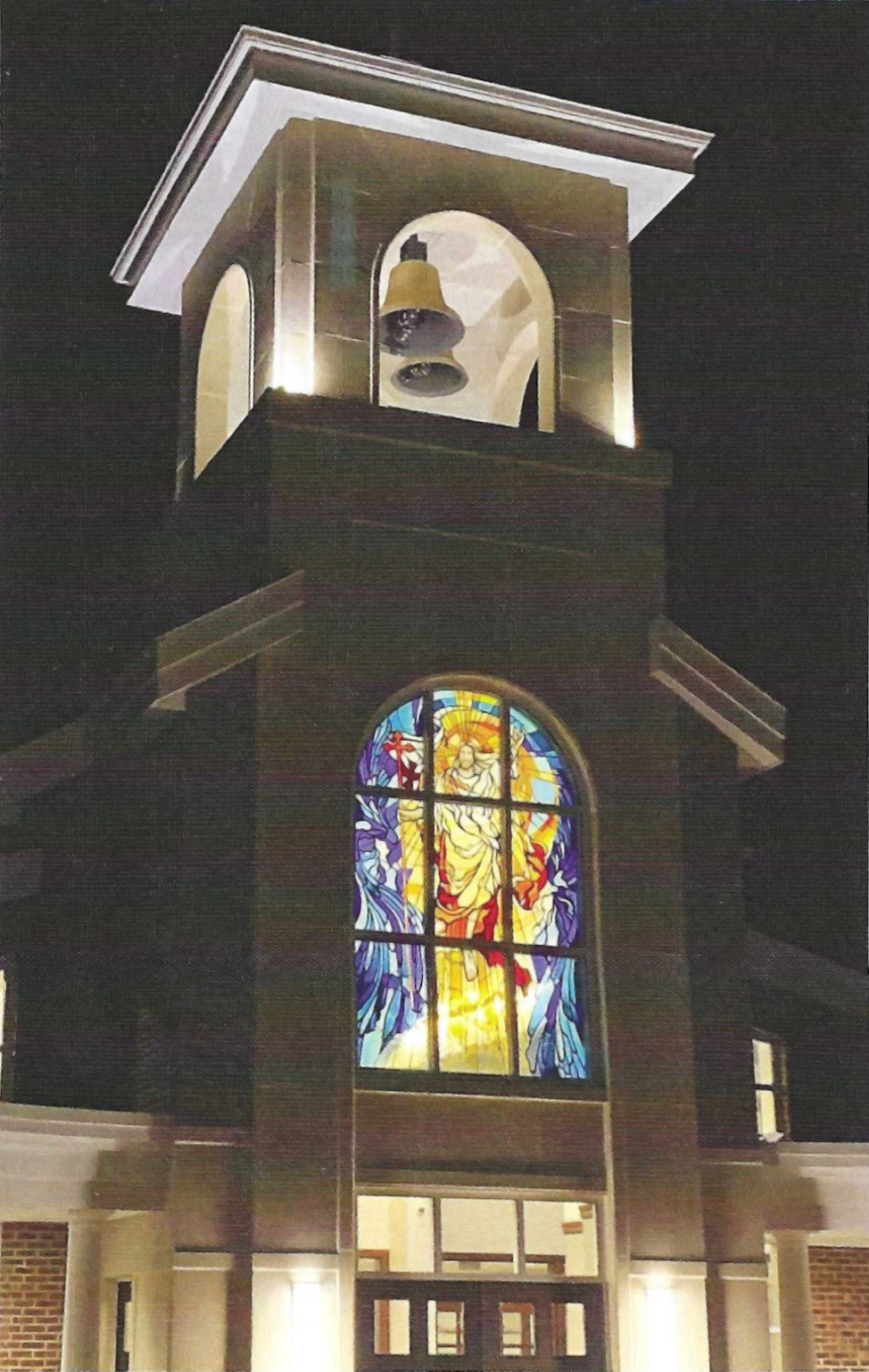
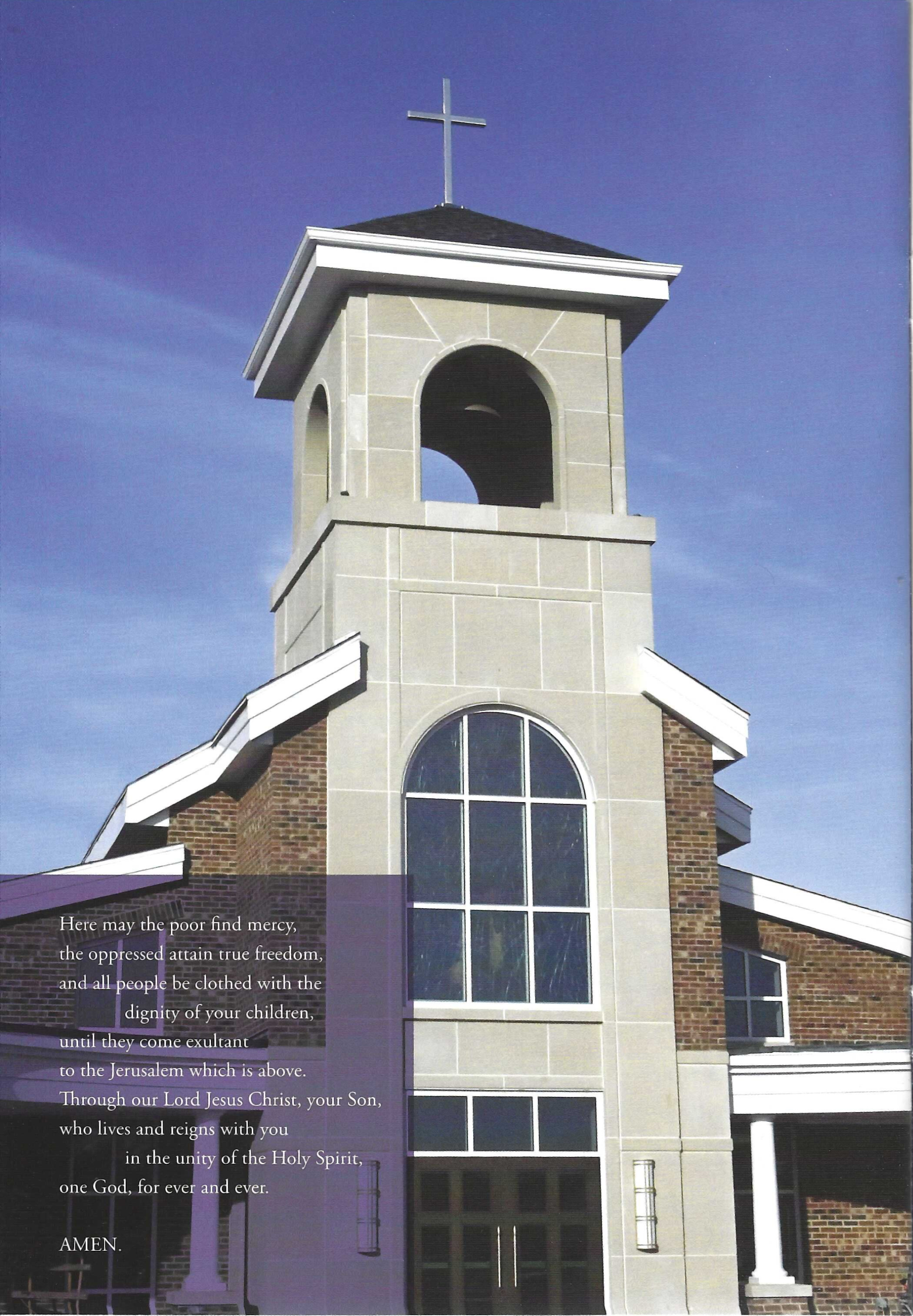
The bell tower and Christus Window stand as a bold statement of the presence and mission of the Catholic Church to the Mequon/Thiensville community. This impressive edifice symbolizes the on-going ministry of Lumen Christi which is to live the Gospel of Christ and respond to the call of love in our world.
There are many reasons, both historical and architectural, that a church has a bell tower, but all reasons point to the mission to proclaim the Gospel and bring Christ in the sacraments to the entire community. A church tower directs attention heavenward and reminds all of the ultimate goal to live in the house of the Lord for all eternity. Jesus said: And when I am lifted up from the earth, I will draw everyone to myself (John 12:32).
The parish campus is crowned with the cross of Christ high atop the tower. The cross, once a symbol of death, is now a symbol of eternal life. Within the tower, bells proclaim the beginning of prayer, the passing of a beloved community member, or the commitment of a couple in the sacrament of marriage.
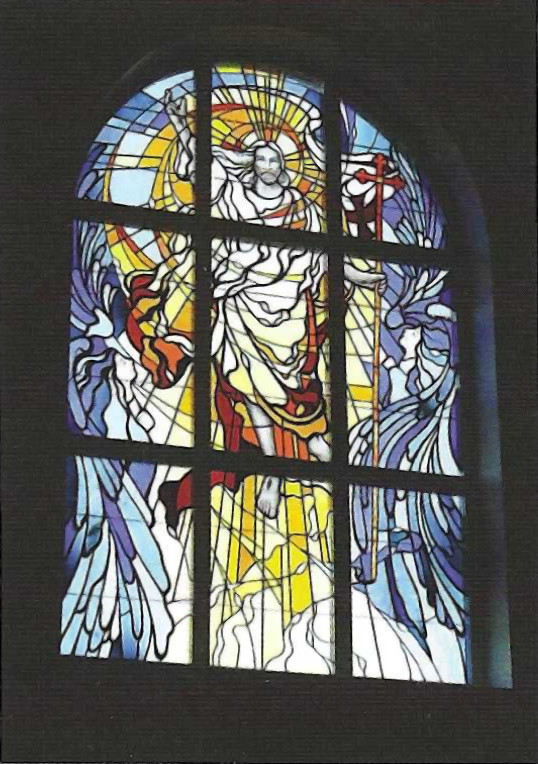
The tower window, known as the Christus Window, depicts an image of Jesus, the Anointed One of God. This glorious image is visible to all travelers on Mequon Road and to all who enter the building. Below the window, the great ceremonial doors are rooted to the foundation of the tower. The doors also powerfully symbolize the Gates of Heaven.
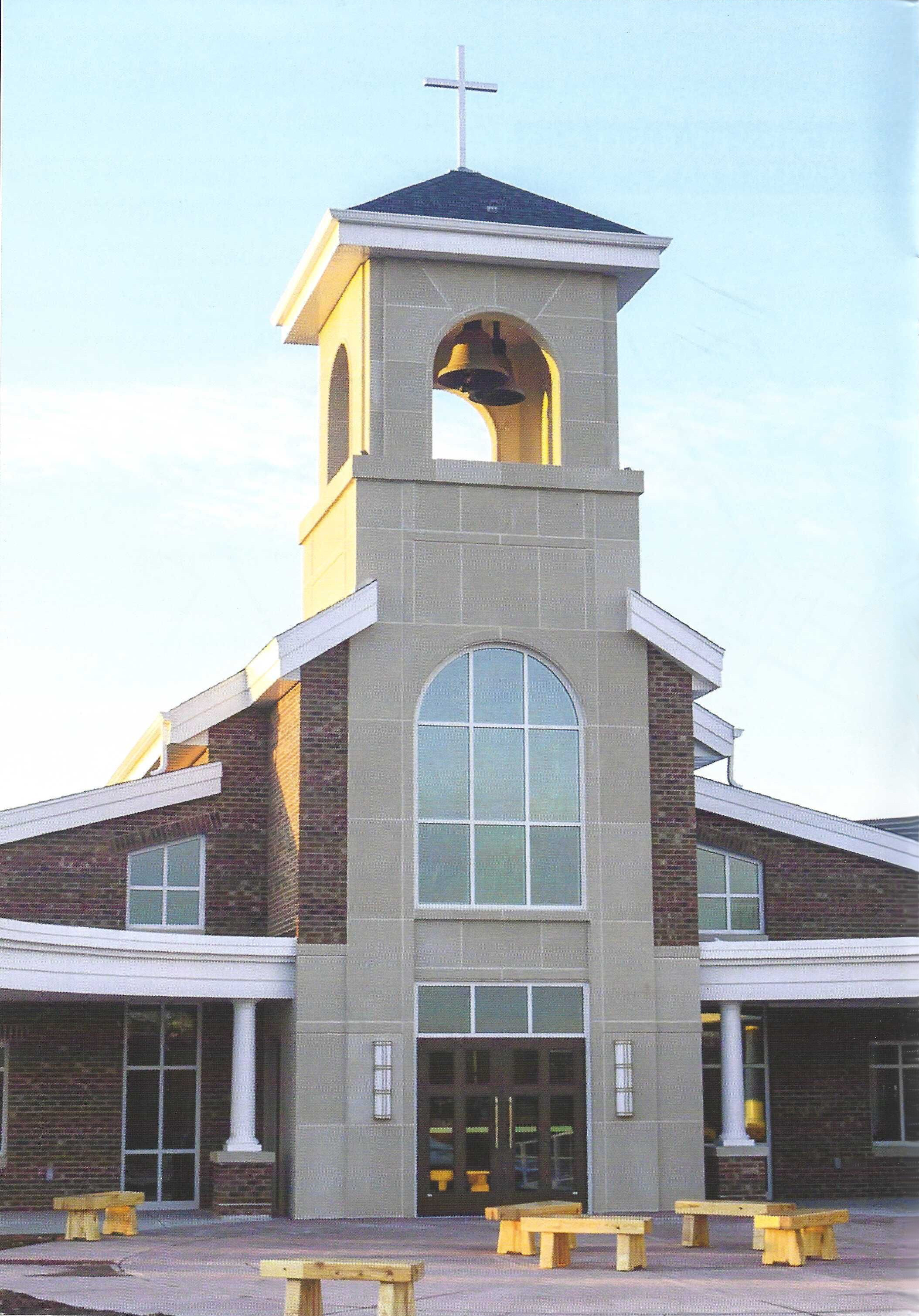
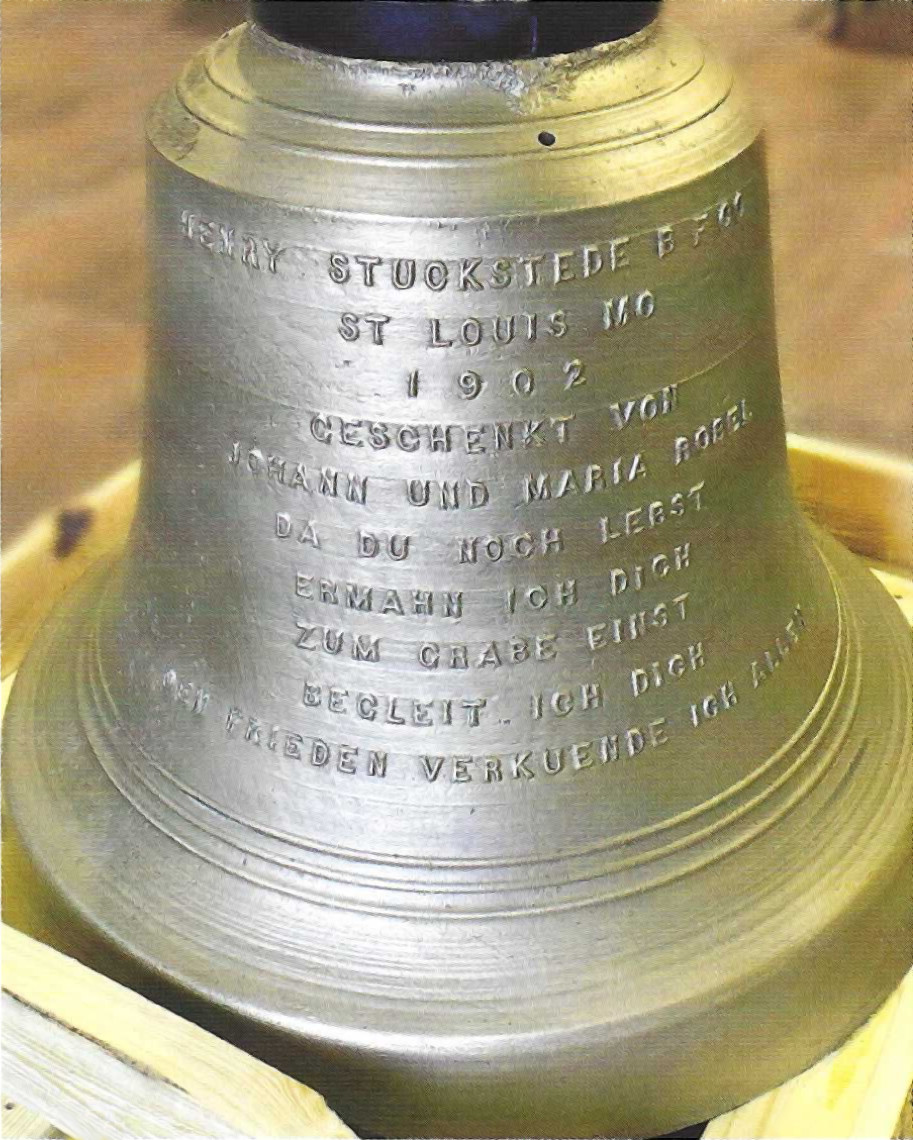
- The former St. James Church, now the site of Lumen Christi, had two bells cast in 1902 by The Henry Stuckstede Bell Foundry Company in Saint Louis, Missouri.
- These two bells were sandblasted and polished; new strikers were inserted.
- A third bell, a Vanduzen bell cast in 1888, was added to achieve a full chord of sound.
The Stained Glass
Tower Windows
As a lantern's glow comforts and lights the way, so too, the illuminated tower and lit stained glass guide those on a faith journey. Shining at the entrance to Lumen Christi, the image of the Christus, the Risen Christ, is positioned over the center doors of the gathering space. The glorified figure of Christ rising up to his heavenly Father on the swirling breath of the Holy Spirit powerfully depicts the glory of the Trinity. Heavenly beings look upon the exalted Christ, echoing the angel choir that surrounds the tabernacle behind the altar. The lower section of the Christus Window contains the colors of his earthly presence; however, as the eye travels upward, these colors become so awash in light that his figure turns crystal clear at the very center, the heart of God's Anointed One. Here the Savior is depicted as the connection between heaven and earth, human and divine, embodying the Paschal mystery, thereby creating a perfect backdrop to the Paschal hearth in the plaza below the image.
"... the light shines in the darkness, and the darkness has not overcome it."
—John 1:5
Sanctuary Windows
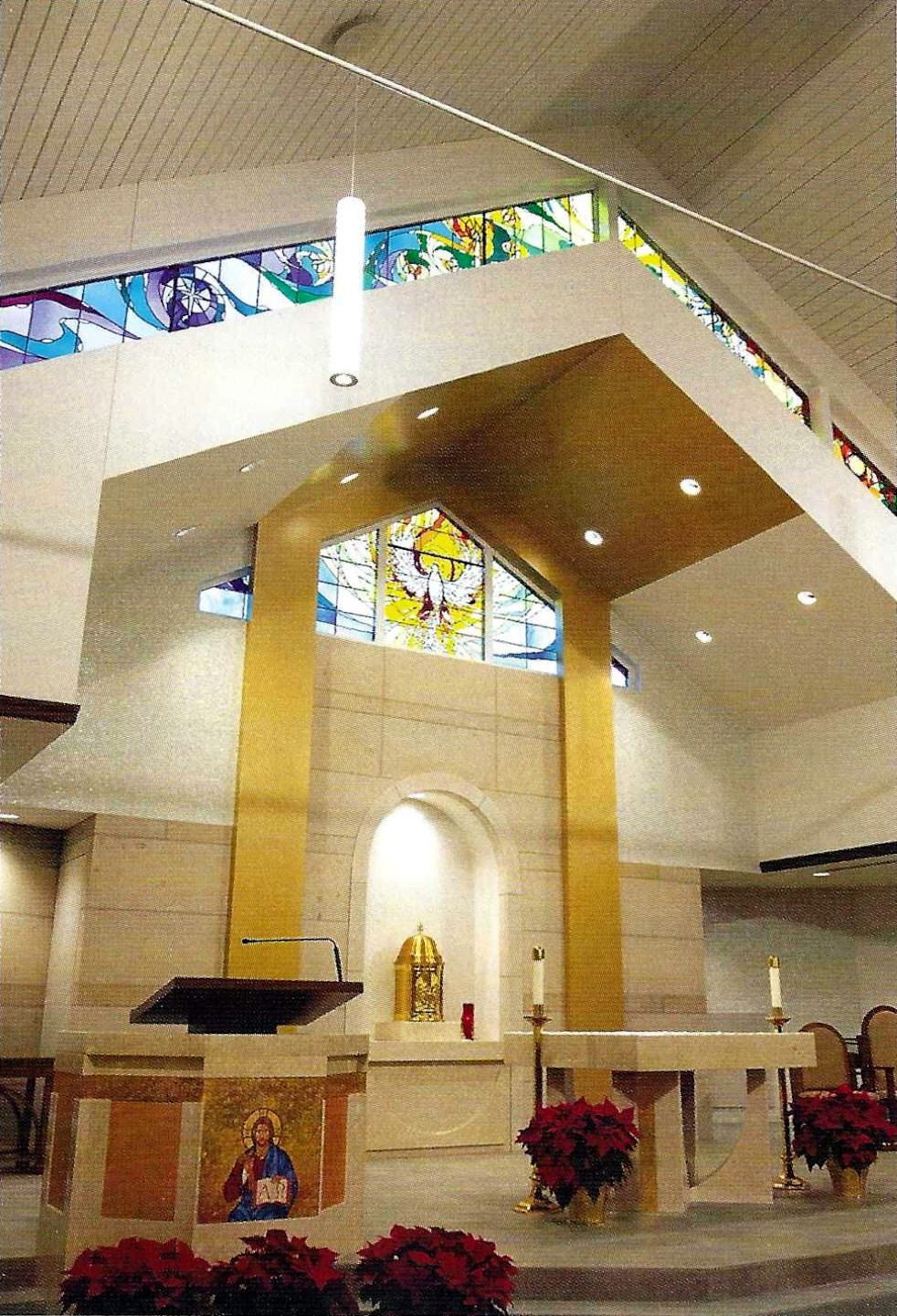
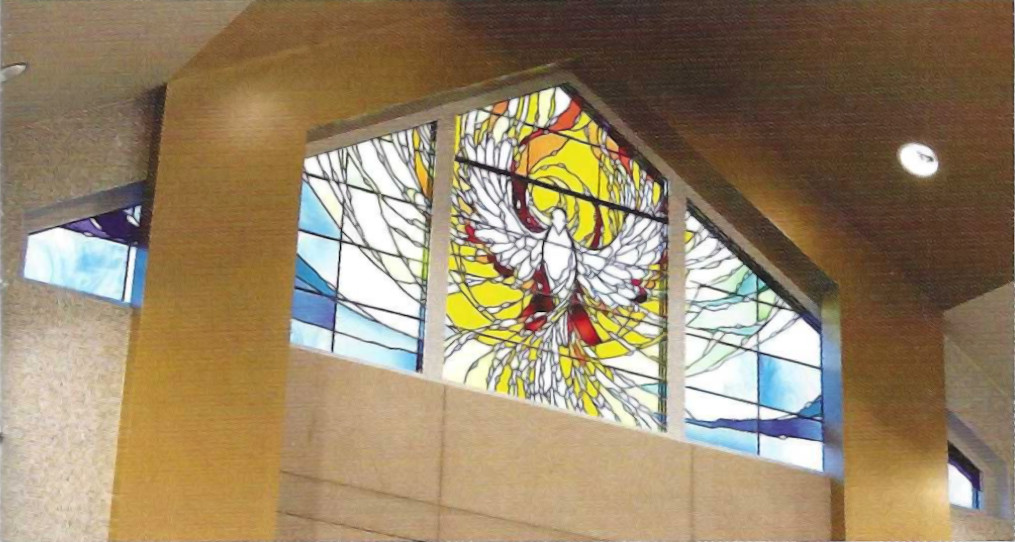
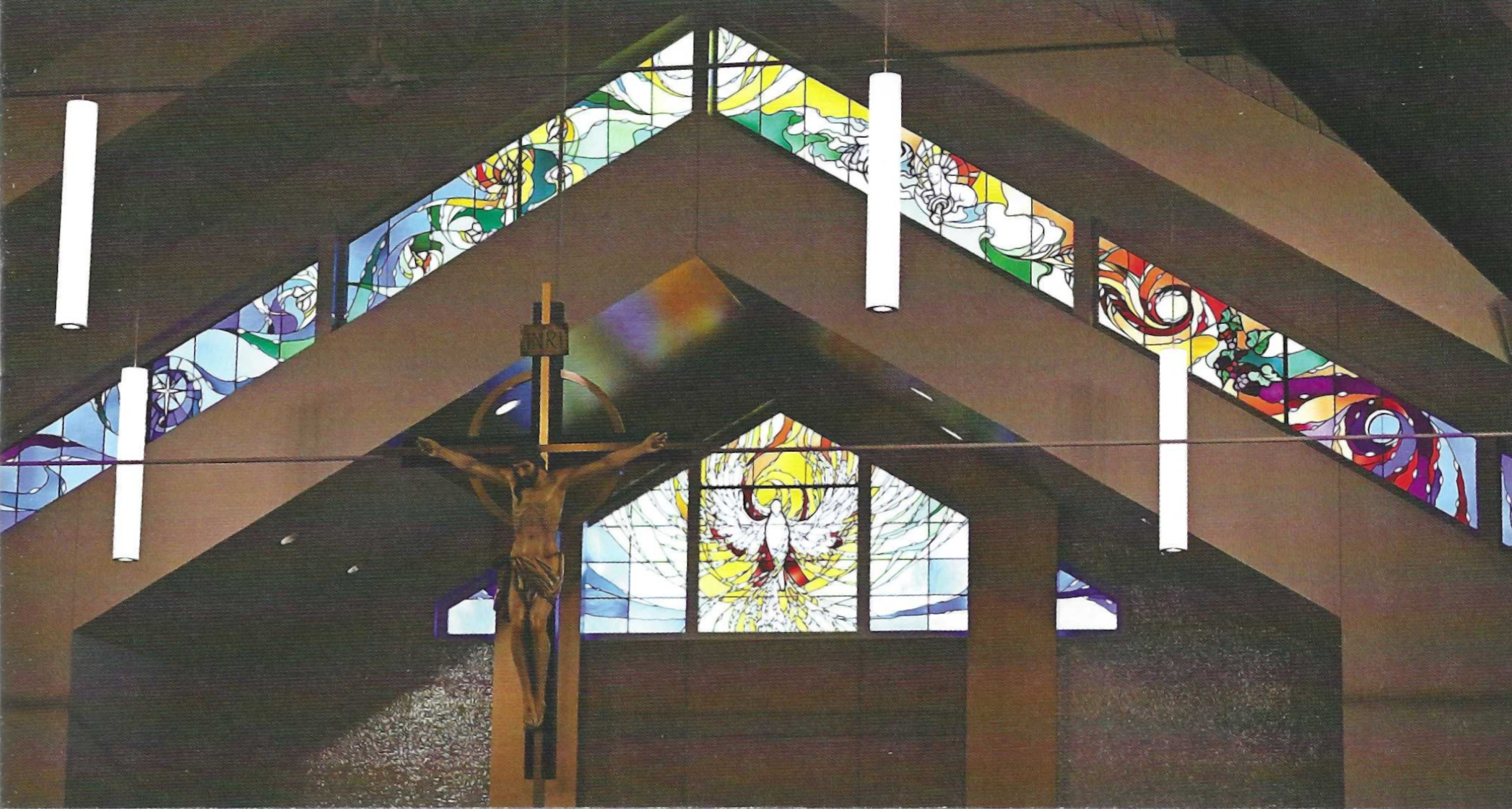
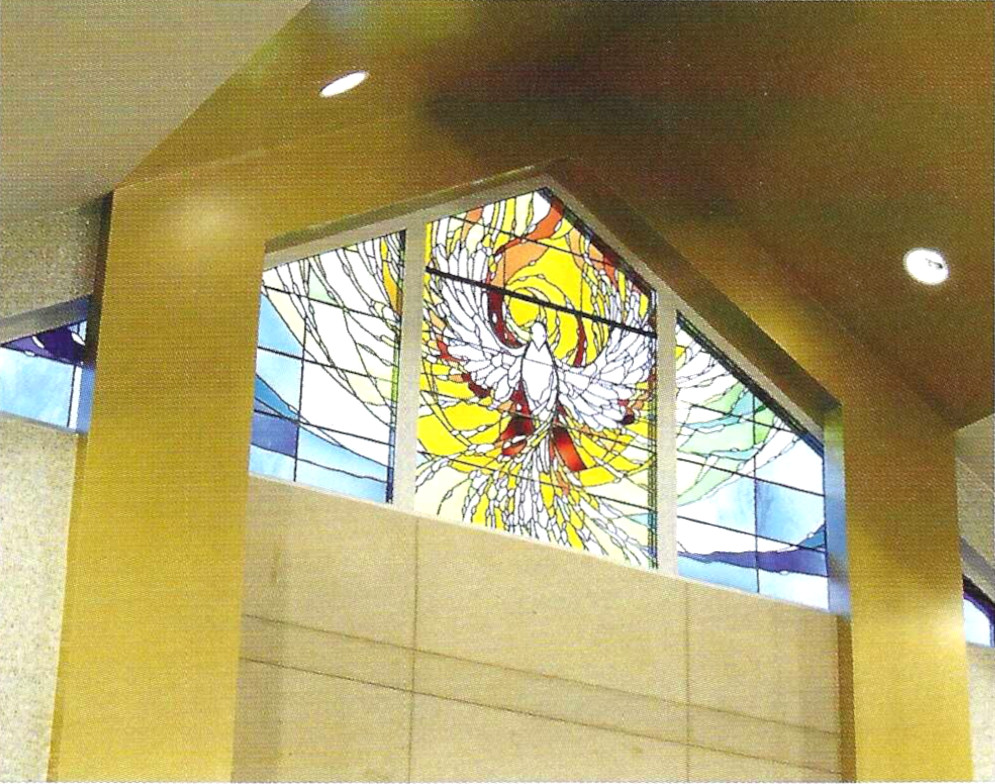
The Spiritus Window, directly above the tabernacle, celebrates the glory of the Holy Spirit, represented as a dove, illuminating the altar and shining forth the light of Christ. In Sacred Scripture, the image of light overcoming darkness is a powerful image of the presence of God. The spiral of warm light emerges as the breath or wind of the Holy Spirit; with no beginning and no end, it gives light and life to all creation. The chevron-shaped windows above the tabernacle celebrate light in each of the four seasons of the year.
Beginning in the lower left is the darkness of winter shattered by the symbolic white lily of Our Lady at the Annunciation (Luke 1:26-28). From there, the colors flow from midnight blue through the steely gray-blues of winter until, once again, they are pierced by the Star at the winter solstice. Here the light increases as the colors begin to soften and warm. As they flow from the star upwards, soft golden light emerges; early spring greens appear amidst a sunrise glow. The Paschal candle, formed with beeswax, burns and glows as the Light of Christ with bees swirling in the breath of the Holy Spirit (The Exultet). Here the golds deepen and the greens strengthen at the top center of the window. The summer solstice, the brightest point, flows into deeper, richer of summer. A shell, with water flowing, and a scroll emerge representing St. John the Baptist. These images recall his words upon seeing the Christ: Behold the Lamb of God, who takes away the sin of the world (John 1:29). John testifies as a witness to the Light through the power of the Holy Spirit, the swirling breath that continues to flow and unify the windows. As summer turns to fall, the golds deepen and the multi-hued colors of autumn reach their peak in the wheat, the symbol of the Bread of Life, as Brother Sun glows (Canticle of St. Francis). The intense colors begin to fade and the background deepens as Sister Moon crests in the darkness (Canticle of St. Francis). The bottom of the right side reflects the color balance of the left. Once again winter solstice encroaches, bringing the chevron window full circle as the Light of Christ throughout the seasons of the Church year.
The Significance of Light
All those who approach Lumen Christi church from the east, pass the paschal hearth. the fire of the world, dispelling the darkness. "I am the light of the world. Whoever follows me does not walk in darkness but shall have the light of life "(john 8:12). Every Easter Vigil begins with the assembly gathering around the paschal hearth {located outside in front of the entrance} for the service of light. the words: "Lumen Christi! Deo Gratias!" Are proclaimed three times. This means "light of CHRIST! Thanks be to god!" Throughout sacred scripture and roman liturgy, the image of light dispels the darkness.
We rejoice as "children of the light" because Christ has shattered the darkness of sin and death, and we now walk in his light (I Thessalonians 5:5).
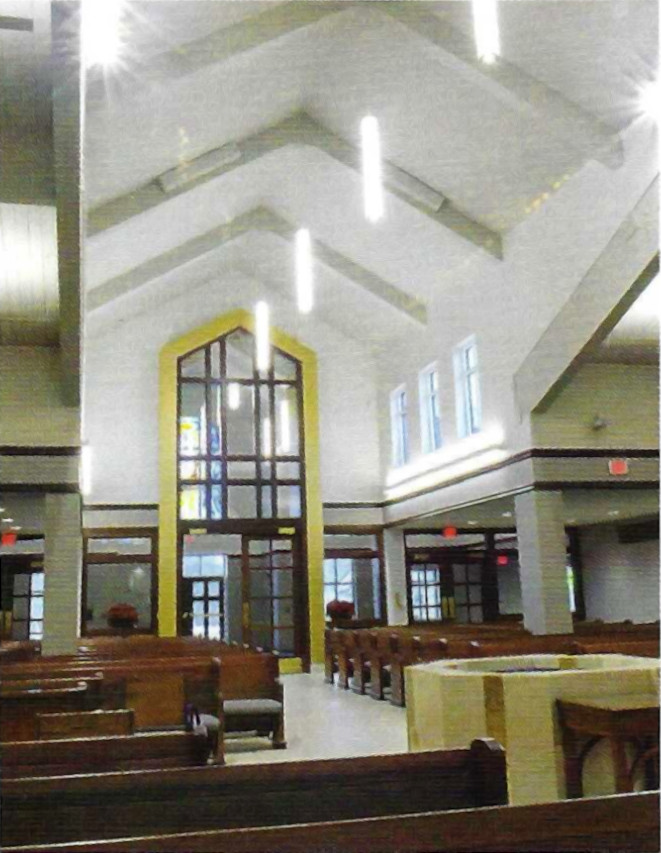
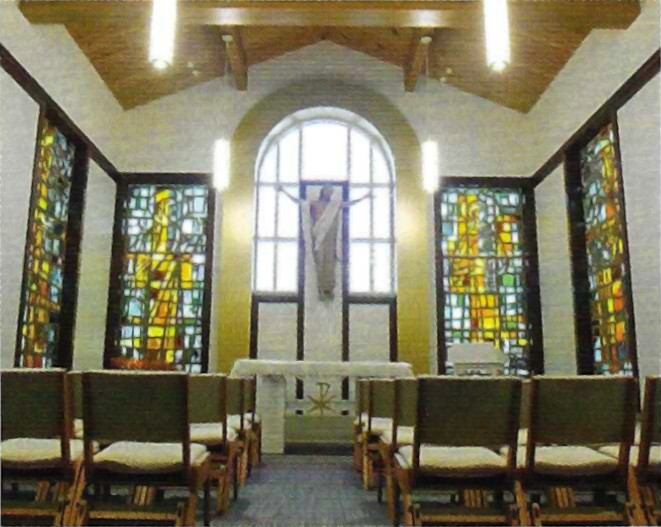
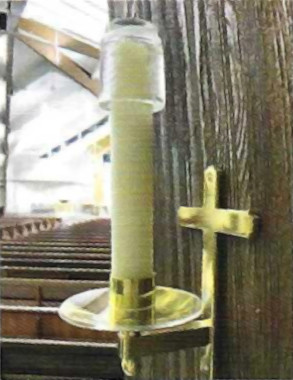
In sacred space, light provides ambiance of a heavenly nature, one that transcends human senses. Accordingly, an essential element in the design of Lumen Christi Church is the use of light, both natural and artificial. The sun floods the sanctuary with direct light and the light reflected and diffused from the Spiritus Window above the altar. The natural light of the four Dedication Candles and the Easter Candle seasonally help dispel darkness. Additionally, the stained glass windows on the chapel walls absorb daylight and fill the chapel with colorful streams. Indirect lights designed uniquely for Lumen Christi bathe the vaulted ceiling of the church with pleasing light that enhances visibility for the entire assembly. Also, the beautiful Stations of the Cross are distinctly lit and easily identified.
Lumen Christi, illuminated by light in new and meaningful ways, inspires all to glance heavenward and to be the Light of Christ in the world today.
The Baptismal Font
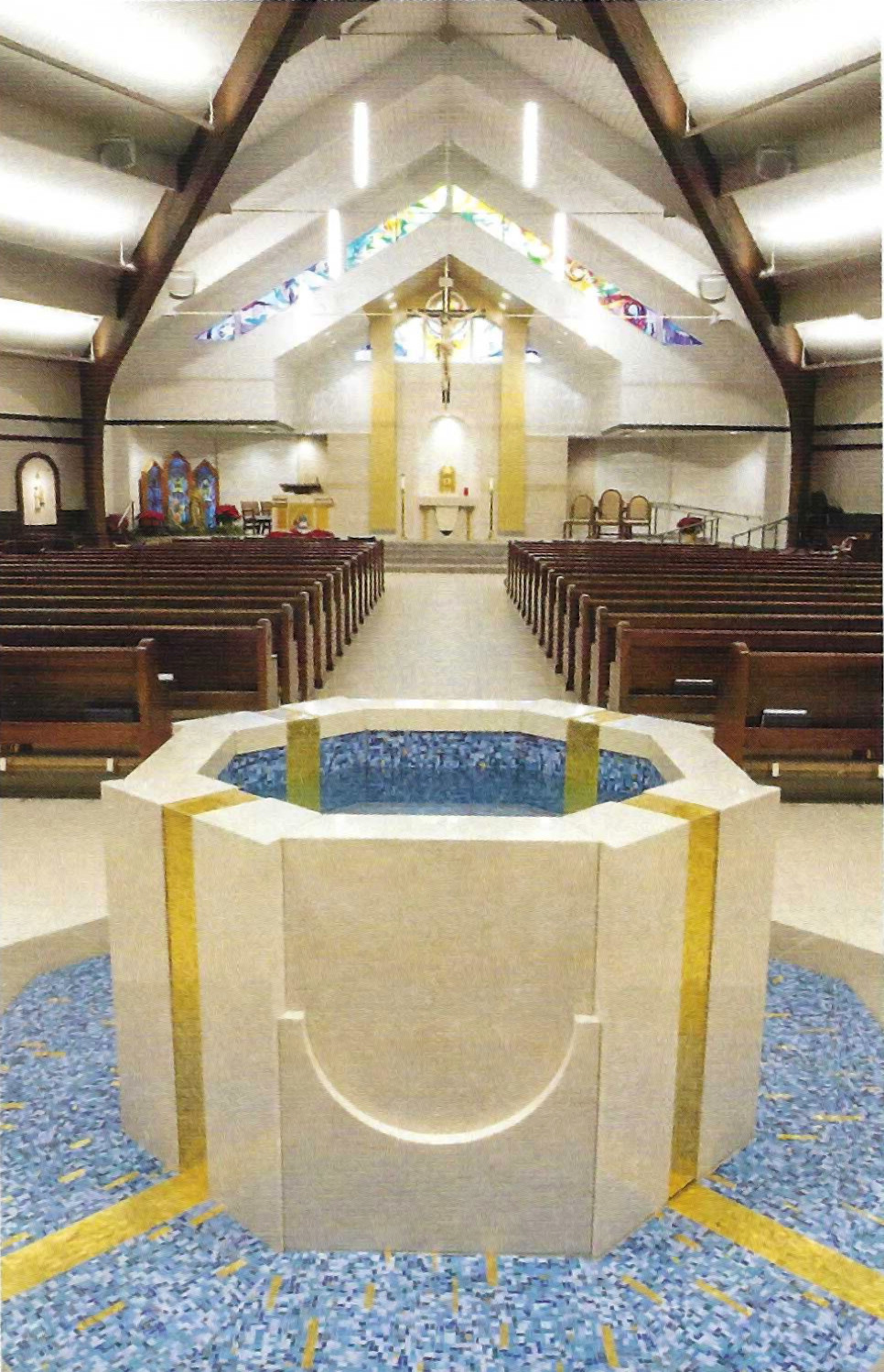
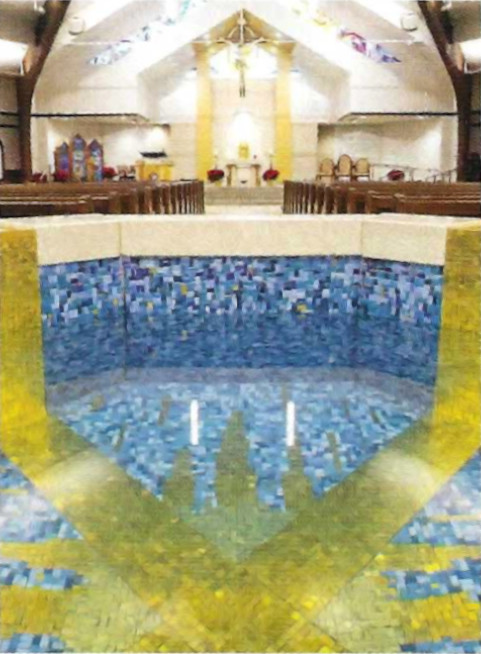
Baptism, the first Sacrament of Initiation, welcomes each member into the family of the Church. The font, full of holy water, provides a visual reminder of membership in the Catholic faith through baptism. As this sign of faith, the baptismal font becomes a prominent symbol to welcome all to the worship space. At Lumen Christi, the font stands equidistant between the altar and the outdoor Paschal hearth. This meaningful placement connects the Sacraments of Initiation, specifically Baptism and Eucharist, with the Easter fire, the symbol of Christ's light overcoming the darkness. Ribbons of gold adorn the font, the altar, and the ambo, and create a golden frame for the sanctuary, all of which call to mind the shining light of Christ ablaze in the outdoor Paschal hearth. The thoughtful connection of these symbols enriches the faith experience of worshipers by providing a sacramental sign for all.
Placing the font inside the nave entrance provides greater visibility during a baptism. The families participating in the baptism will not only feel but see the support of the congregation gathered around them. Increased aisle space around the font allows more room for processions including weddings and funerals.
All who enter this sacred space experience the beauty and symbolism of the font.
The Nave
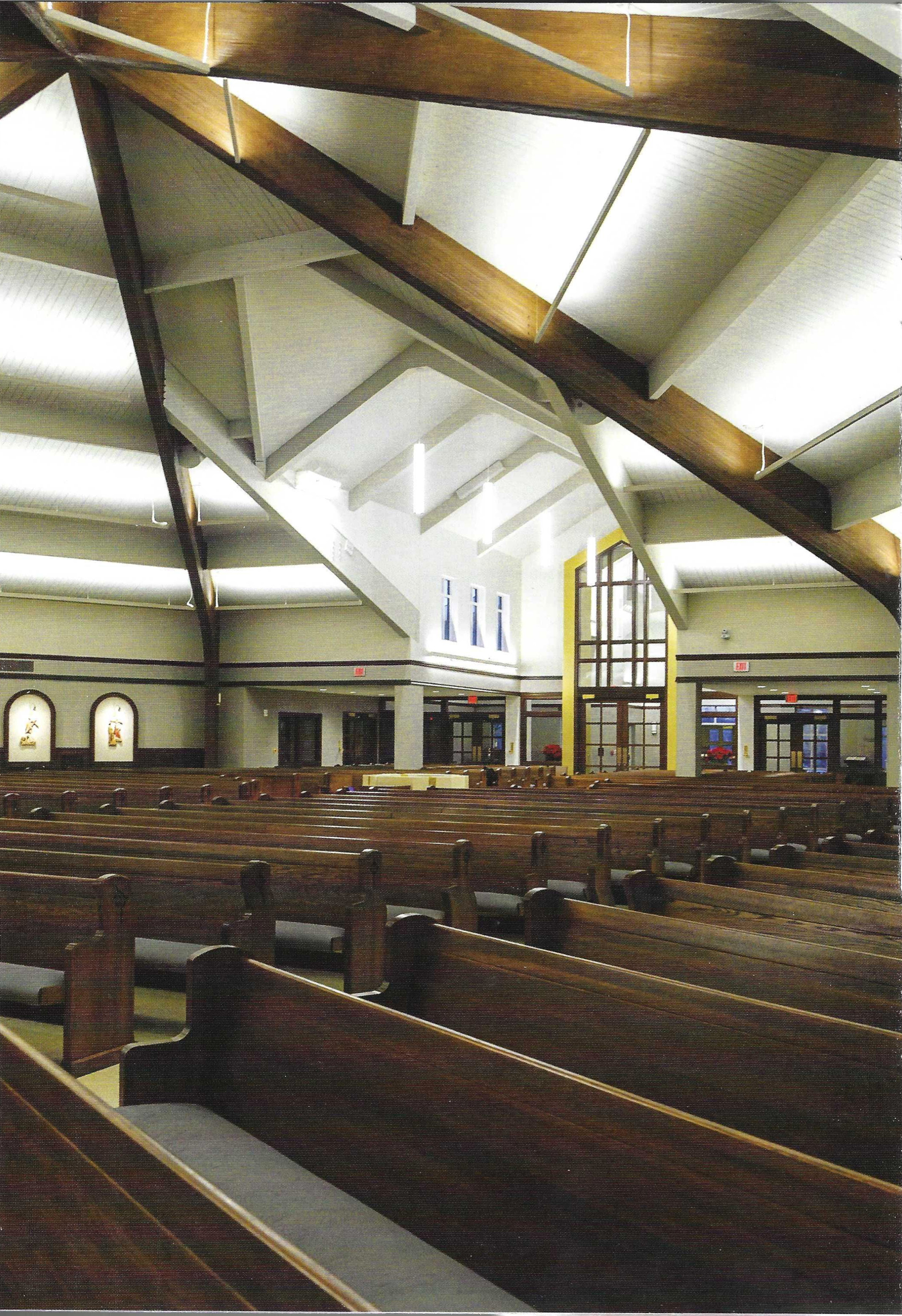
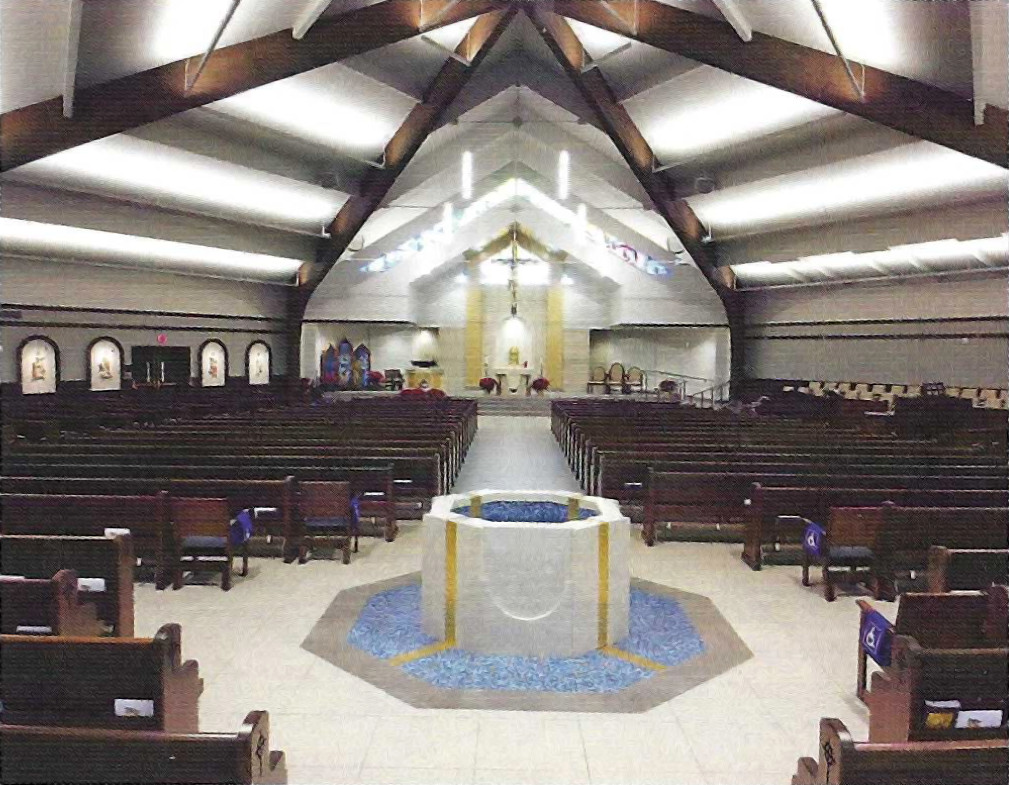
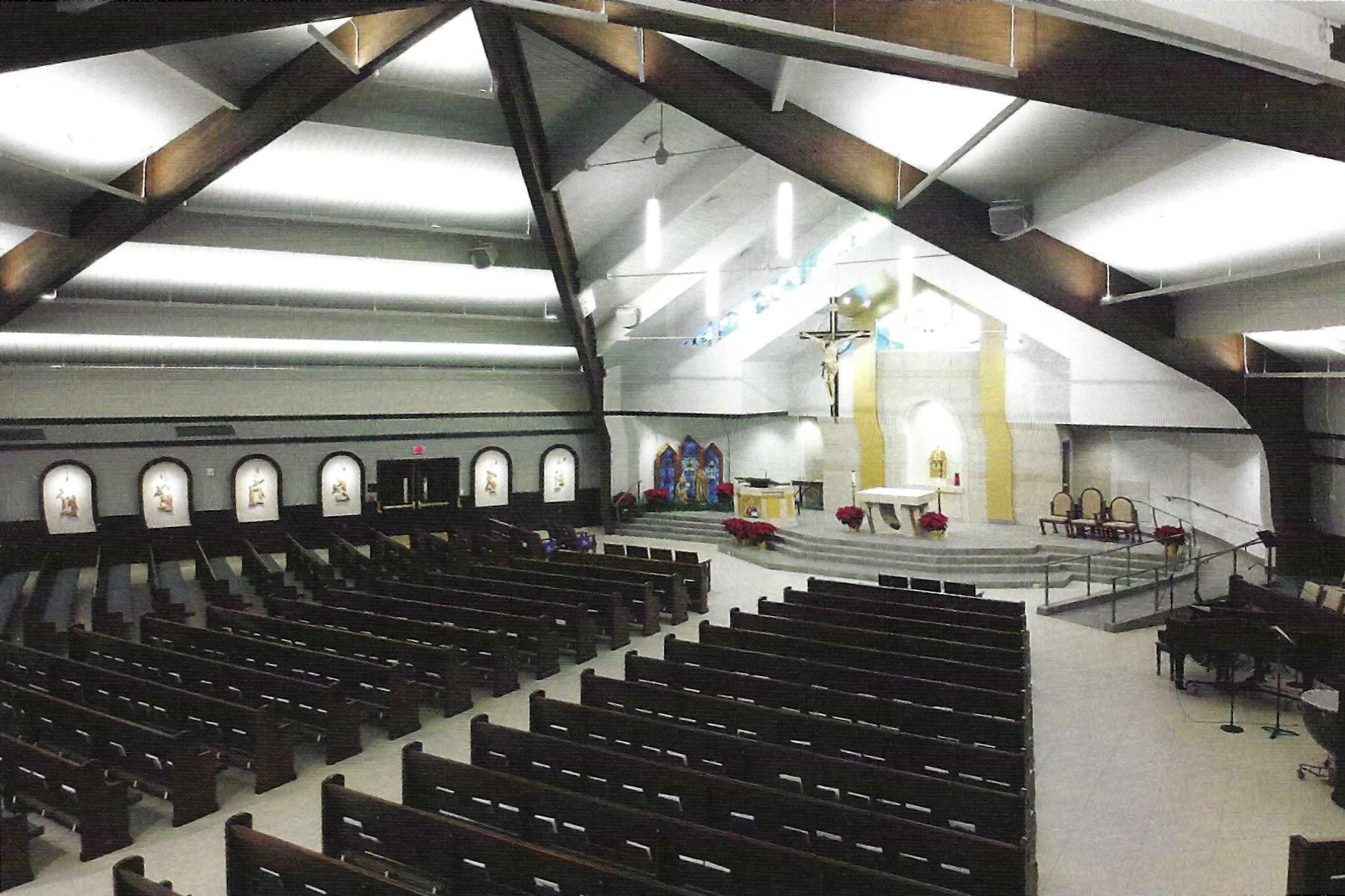
Once through the main doors, the assembly gathers in the nave, the main interior of the church. Named for its allusion to a ship, the most notable being the Ark of Noah, the specifics of a nave are found in an ancient fourth century treatise called the Apostolic Constitution. The treatise states, "Let the building be long, with its head to the east ... and so it will be like a ship."
The orientation of the nave allowed for the altar to be rotated to the west and raised for better visibility. Wide aisles, a larger choir space, and increased seating capacity enhance the worship experience.
"Whatever house you enter, first say, 'Peace be to this house.' "
—Luke 10:5
The Ambo
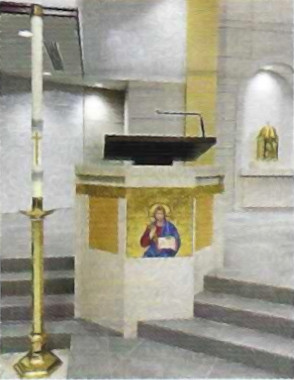
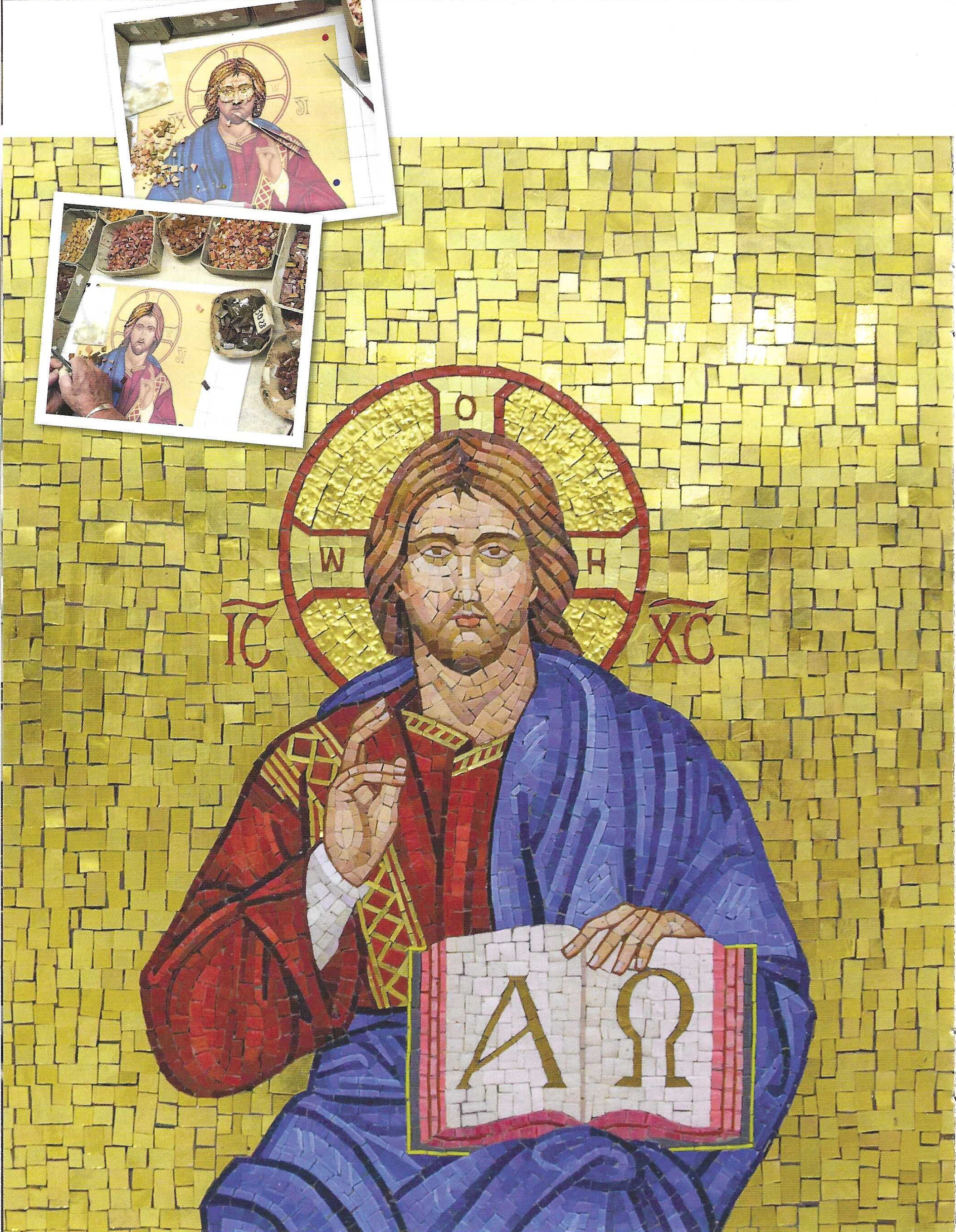
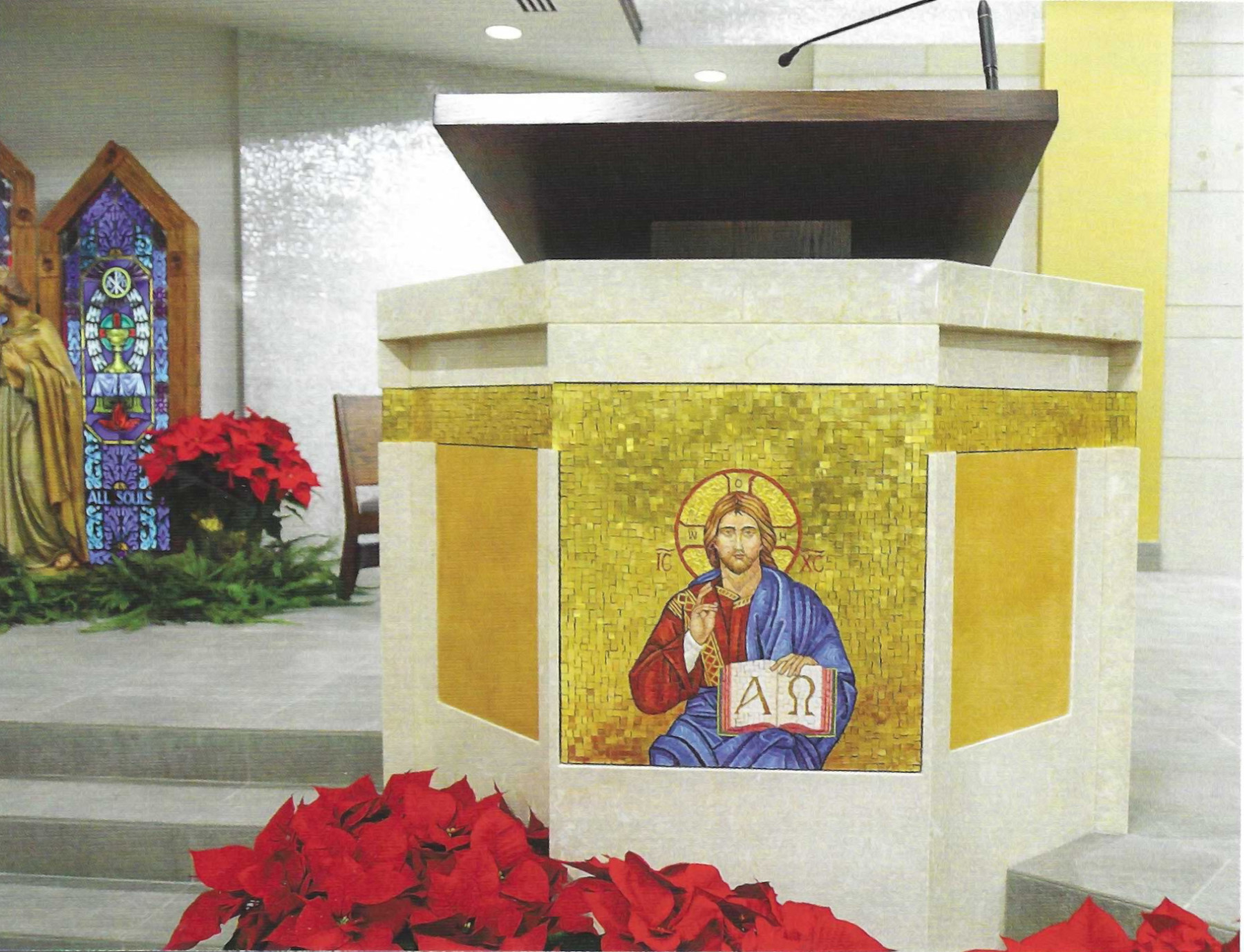
The dignity of the Word of God requires that in the church there be a suitable place from which it may be proclaimed and toward which the attention of the faithful naturally turns during the Liturgy of the Word.
It is appropriate that generally this place be a stationary ambo and not simply a movable lectern. The ambo must be located in keeping with the design of each church in such a way that the ordained ministers and readers be clearly seen and heard by the faithful (GIRM, 309).
The design elements used in the ambo at Lumen Christi create an artistic and aesthetically pleasing coherence between the sanctuary and the nave. Botticino marble found in both the altar and baptismal font is used in the design of the ambo. Five panels of Botticino marble support the reading desk.
The Altar
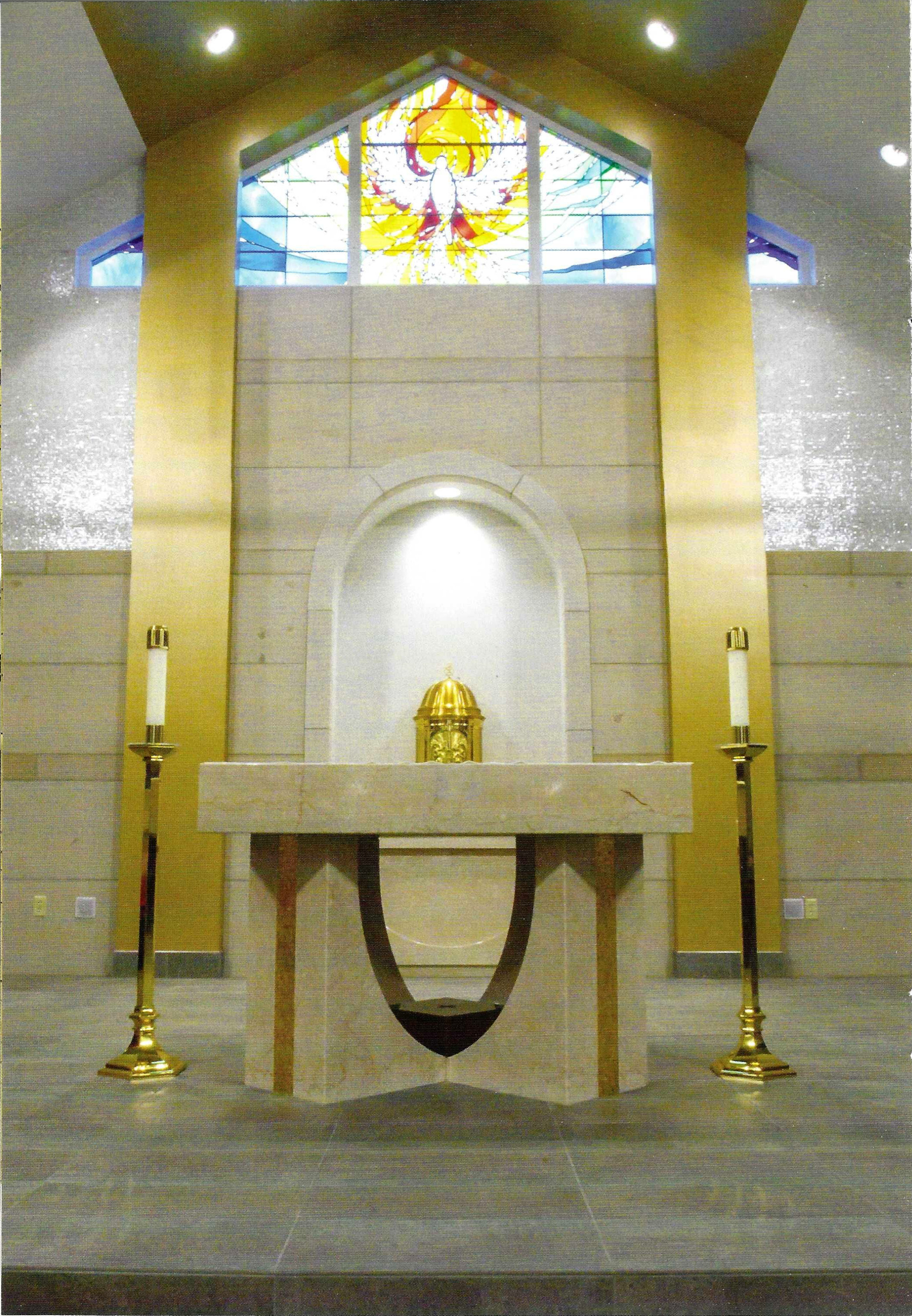
In keeping within the guidelines of the General Instruction of the Roman Missal (GIRM), the table location in the worship space and be fixed in place. The principal element of the Mass is the Eucharistic sacrifice of Christ offered on the altar. There the Last Supper of Jesus with his apostles is also remembered and shared. In the earliest days of Christianity, the sacrifice of the Mass was celebrated in private homes or near the tombs of martyred saints. After the persecution of Christians throughout the Roman Empire ended, more elaborate altars were designed and used. At that time, in order to remember those loved ones who had died, the custom of depositing the relics of saints inside the altar began.
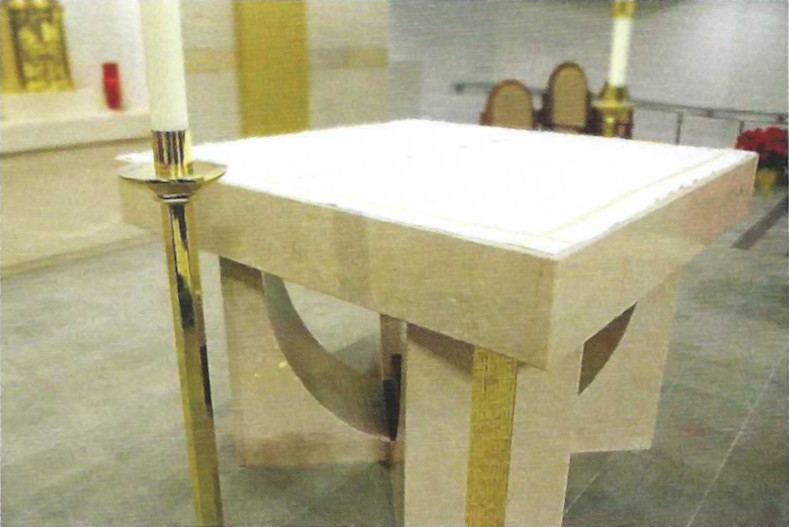
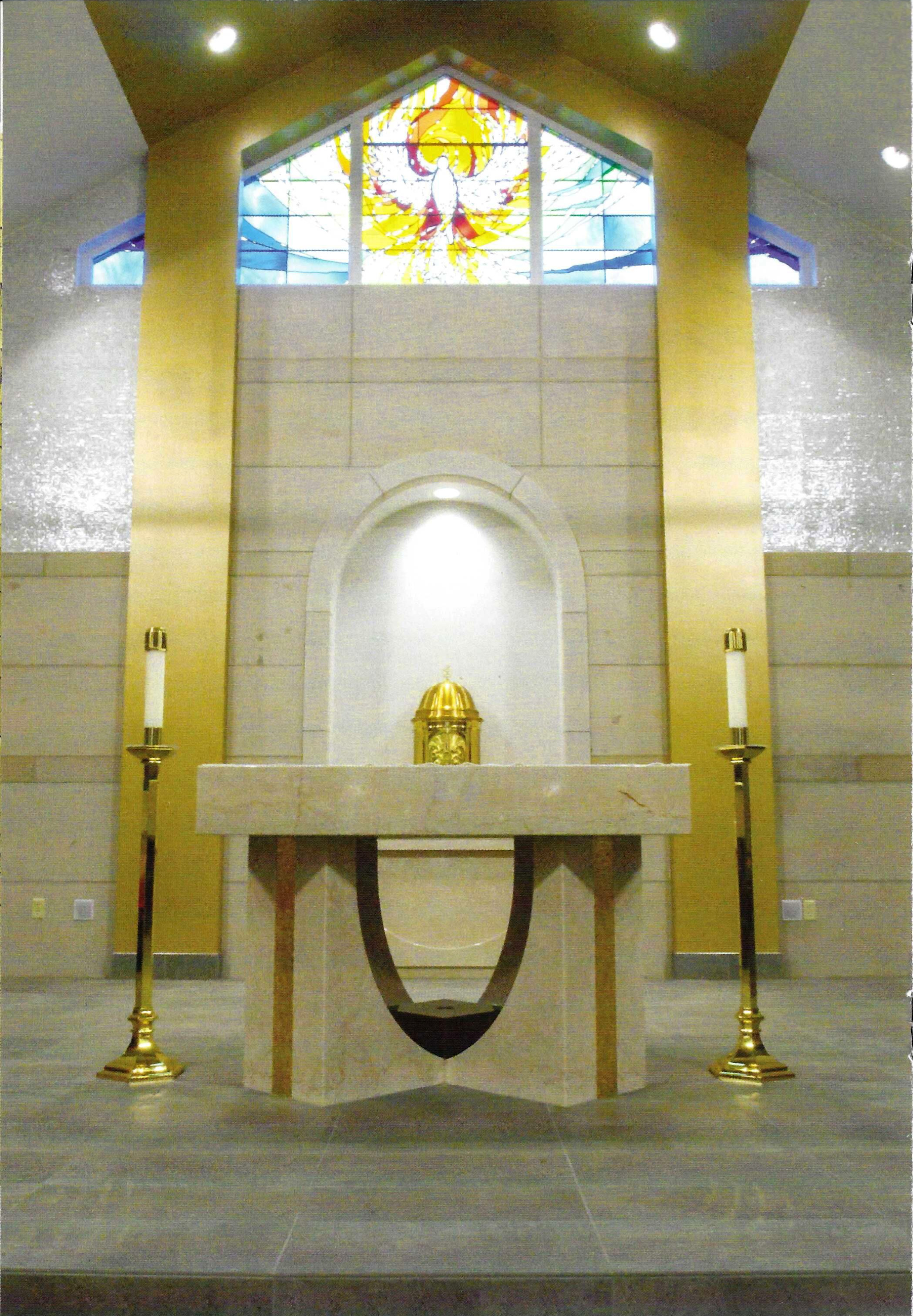
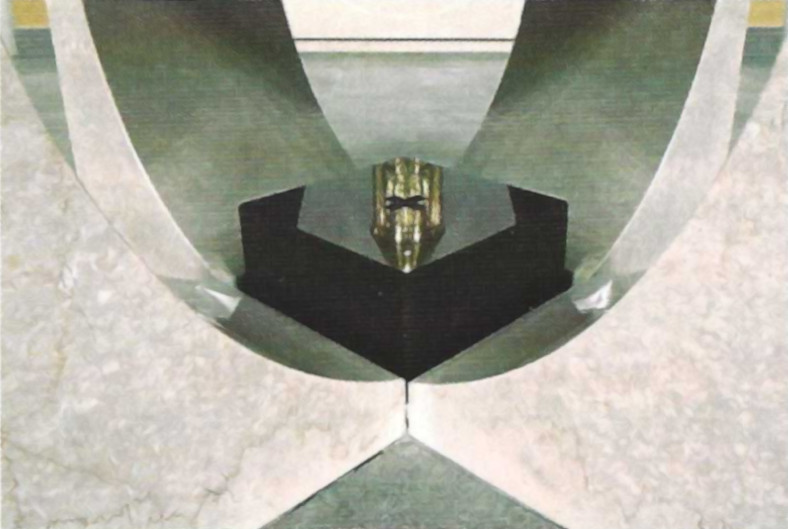
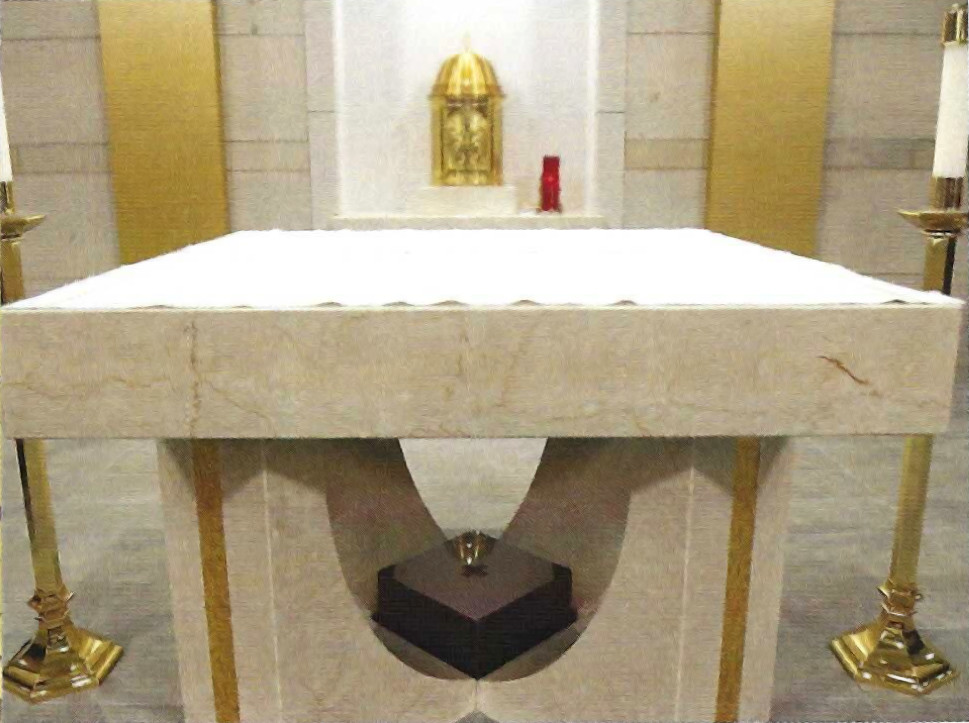
The altar of Lumen Christi, dedicated in December of 2019, is the focal point of the sanctuary. Set at the top level of the tiled sanctuary floor, the square shape of the mensa, or tabletop, follows the ancient design of church altars. A curved interlocking set of four marble arms supports the mensa. The shape of these four supports suggests the orans posture of prayer assumed by the celebrant—arms held wide, palms up. Golden mosaic tiles as in the design of the baptismal font extend down from the tabletop to the floor. Beneath the altar rests a red granite ossuary, a depository for the relic remains of six venerable saints: St. Philomena, St. John Vianney, St. Blaise, St. Jude, St. Francis of Assisi, and St. Teresa of Avila. The relics of St. Blaise and St. Jude were formerly enclosed in the St. James altar.
Lumen Christi Relics
St. Philomena, Martyr
Feast Day: August 11
Canonized: 1837
Patron Saint of infants, babies, and youth
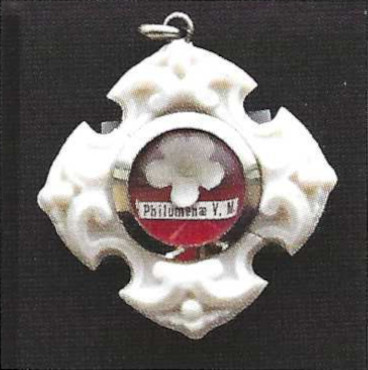
In 1802, in the catacomb of St. Priscilla, archaeologists uncovered the burial niche of a young woman who was martyred sometime in the third century. Because of the partial inscription found near the body, the remains were thought to be those of a young virgin named Philomena. Afterward, these relics were enshrined under the altar of the parish church in Mugnano del Cardinale, in Italy, and soon many miracles and healings were reported in their presence. One of the most famous includes The Miracle of Mugnano, when Venerable Pauline Jaricot was completely cured of a severe illness after receiving Holy Communion on Philomena's feast day. Although her feast day is no longer included in the liturgical calendar, Philomena remains a saint, and devoted believers continue to travel from all over the world to shrines built in her honor. St. John Vianney was particularly instrumental in spreading devotion to Philomena throughout France.
St. John Vianney
Feast Day: August 4
Canonized: May 31,1925
Patron Saint of parish priests
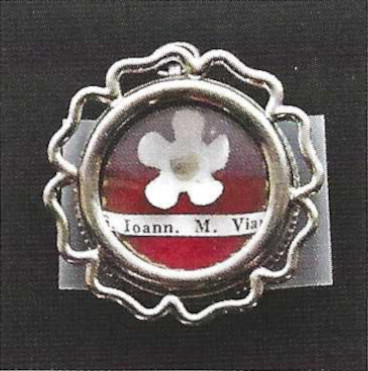
Born in 1786, Jean-Baptiste-Marie Vianney, or John Vianney as he is known today, was raised in a devoutly Catholic peasant home in Lyons. While he felt a deep calling to the priesthood, he did not possess any natural ability for academics. After much work and many disappointments, it was determined that Vianney's piety made up for his lack of scholarship, and he was given permission to be ordained in 1815. He was named parish priest of Ars-en-Dombes, a village of 250, as remote and insignificant a place as his bishop could find. His sermons were simple, and his theology rudimentary. But there was one area in which he excelled: as a confessor. In his cramped confessional, he would sit ten, twelve, as many as eighteen hours a day. Special trains were provided to accommodate the number of pilgrims. John Vianney became one of the most beloved figures in France. He was canonized in 1925 by Pope Pius XI and named the patron saint of all parish priests.
{LumiFig30.jpg}
St. Blaise, Martyr
Feast Day: February 3
Canonized: Pre-Congregation
Patron Saint of diseases of the throat
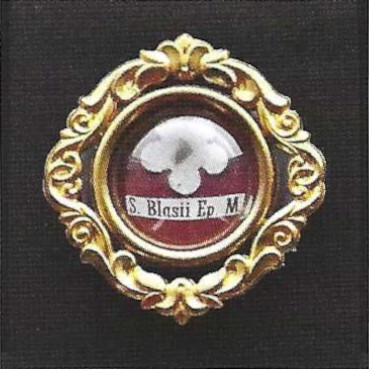
St. Blaise was both a physician and a bishop of Sebastia, a region in the Middle East. The first known record of the saint's life comes from the medical writings found in the king's court early in the sixth century, where Blaise is recorded as helping patients who suffered from objects stuck in their throat. People came from far and wide to have Blaise heal them in body and spirit. At that time, the Romans were persecuting Christians, and the emperor believed that arresting and punishing influential leaders like Blaise would prevent others from becoming followers of Christ. Soon, Blaise was arrested and led off to prison. Tradition tells us that as he was being led away, a mother set her young choking on a fish bone in front of Blaise, and the child was instantly cured. During his time in prison, Blaise was sentenced to death for refusing to renounce his faith. He was martyred in the year 316. On St. Blaise's feast day, many parishes bless the throats of parishioners by holding two crossed, unlit candles on the throat as the priest or deacon recites a prayer for healing.
St. Jude, Apostle
Feast Day: October 28
Canonized: Pre-Congregation
Patron Saint of hopeless causes
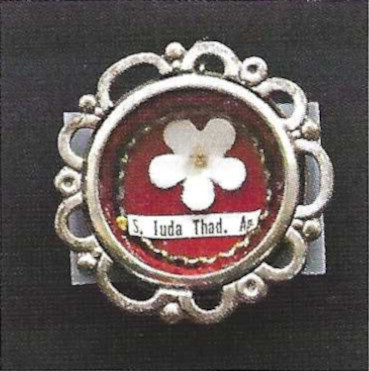
Saint Jude was one of the original twelve apostles of Jesus. It is believed that Jude and the apostle Simon the Zealot brought Christianity to Armenia where Jude was later martyred. Jude is quoted only once in the Gospels. In John, he asks Jesus at the Last Supper why he does not manifest himself to the whole world. His Letter of Jude is the shortest book of the New Testament. In his letter, Jude emphasizes that the faithful should always persevere in harsh and difficult circumstances, just as their forefathers had done. The letter warns against the danger of false teachers who divide the Church and lead many astray. Over the centuries, St. Jude has come to be venerated as the patron of hopeless causes.
St. Francis of Assisi
Feast Day: October 4
Canonized: July 16, 1228
Patron Saint of all who cherish God's creation
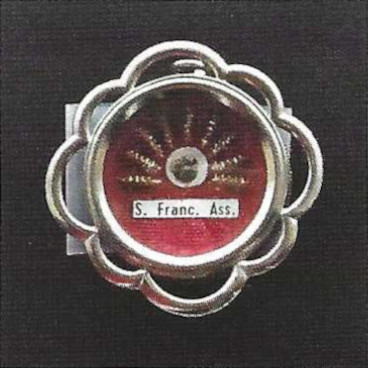
Francis of Assisi was the son of a wealthy cloth merchant. His early life was spent in the frivolous enjoyments of the rich. After several harsh experiences, his heart was turned away from worldly desires. During this transition, Francis's life was irrevocably changed when, tradition tells us, he met a leper and kissed him, and as Francis rode off, he looked back to find the leper had vanished. From that time forward, Francis started helping the poor by sharing goods from his father's warehouse. When his father reprimanded him publicly, Francis removed all his fine clothes and declared henceforth he had no other father but God in heaven.
Francis heard God telling him to "repair" a nearby church while he prayed before a crucifix. Francis soon realized that the Lord was asking him to rebuild the community of the Church, not the actual church building. Over time many young men of Assisi were attracted by his way of life. Francis founded a new order of religious men, the Friars Minor. They embraced poverty and served the poor, the marginalized, and the sick.
Led to Bethlehem due to his love for the Christ Child, Francis was struck by the stark conditions of the very first Christmas. Upon his return to Italy, on Christmas Eve in 1223, he recreated the nativity scene by placing a feeding trough in a cave surrounded by animals. It was Francis's hope that those gazing upon a créche would recall the meaning and simplicity of that first Christmas.
Francis represented the emergence of a new model of a human community through his relationship with the poor, with women, with outcasts, and with all of creation. Francis lived with great suffering at the end of his life, including the stigmata, the wounds of the cross, marking his hands and feet.
St. Teresa of Avila
Feast Day: October 15
Canonized: 1622
Doctor of the Church
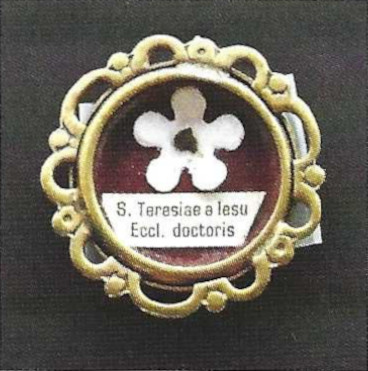
Teresa became a nun at age twenty, living in a Carmelite convent in Avila, Spain. The convent, however, was more of a boardinghouse for daughters of the wealthy, and it was difficult for Teresa to live a devout spiritual life. Almost twenty years later, Teresa experienced a powerful conversion and intense communication with God. She was called to reform the Carmelite community. The Discalced Carmelite order embraced a simple life of strict poverty with deep devotion to prayer. The word discalced means shoeless, and it was that simplicity to which Teresa and her order aspired. Teresa founded many convents throughout Spain and wrote some of the most significant books on spirituality in the history of the Church.
During her lifetime, Teresa was subjected to investigation by the Inquisition because she was a leader, a reformer, and a mystic. Nevertheless, she courageously persevered in her work and her writings, and in 1970 Pope Paul VI declared her the first woman Doctor of the Church.
The Tabernacle
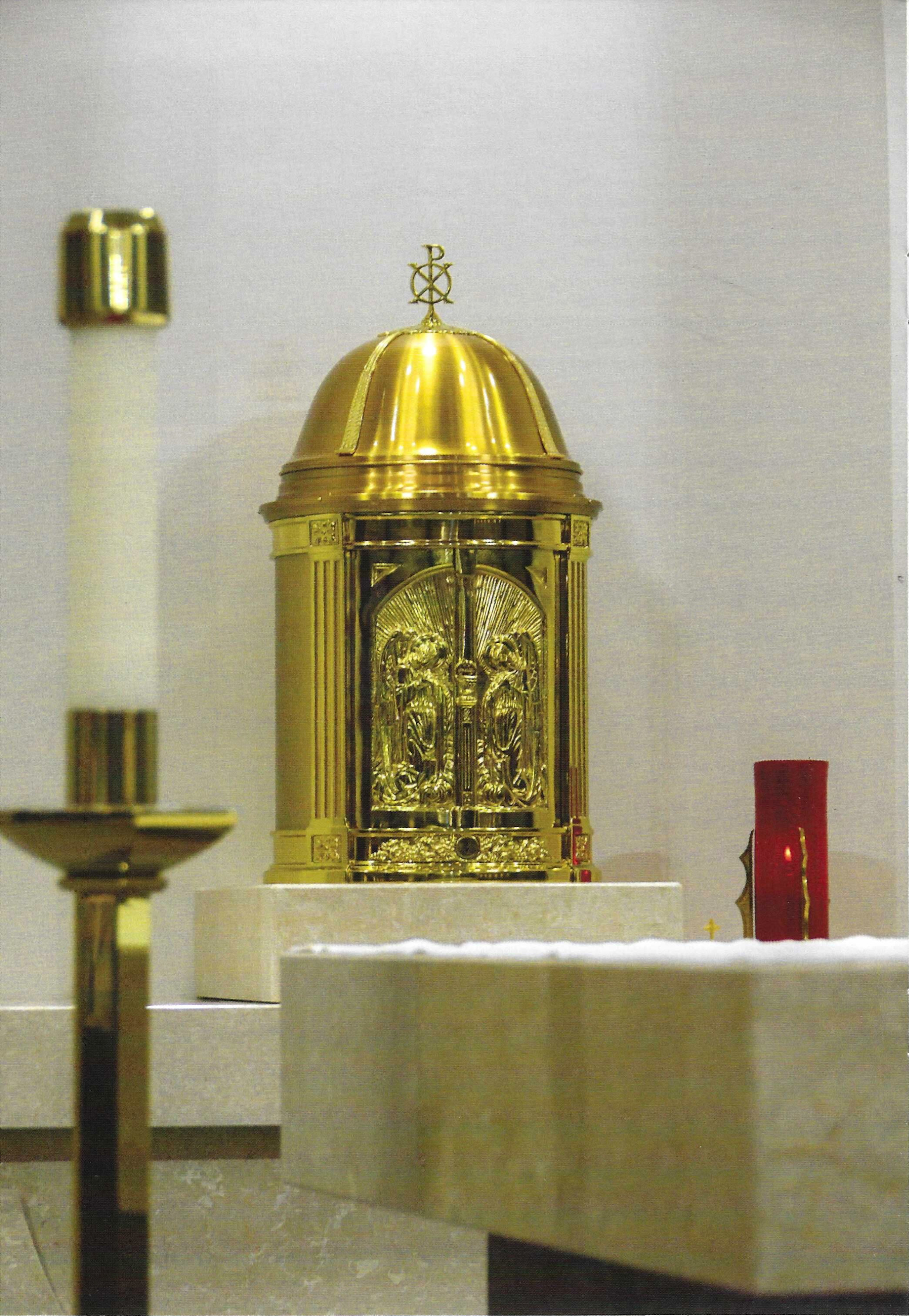
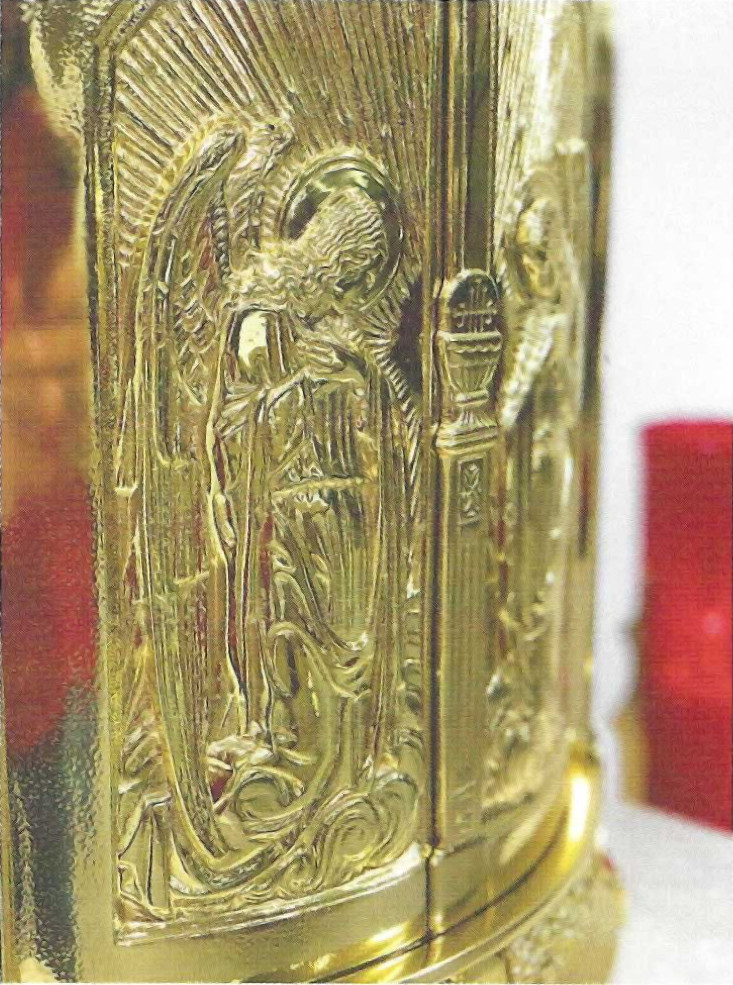
The word tabernacle comes from the Latin word tabernaculum, meaning tent. In the Old Testament, this referred to the portable Ark of the Covenant which carried the stone tablets of the ten commandments. It was believed that the Ark contained the presence of the Lord, the Lord God. Today the tabernacle is the place for the reservation of the Most Holy Eucharist.
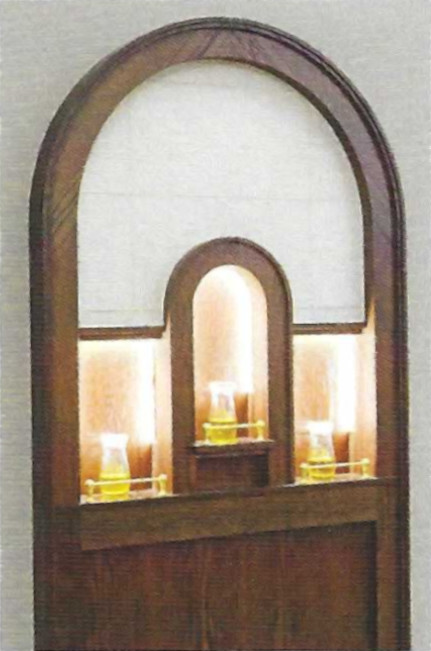
In accordance with traditional custom, near the tabernacle a special lamp, fueled with oil or wax, should shine permanently to indicate the presence of Christ and honor it (GIRM 316).
The Lumen Christi tabernacle was formerly located in the St. Cecilia sanctuary. The tabernacle now stands upon a marble base in an arched niche directly behind the main altar, aligning with the Roman Missal requisite that it be in a prominent and conspicuous place. The wall of the niche, designed as a mosaic, appear as a halo of light surrounding the dwelling place of God. The halo of light is a ring of adoring angels, nine in total, representing the nine choirs of spiritual beings surrounding the throne of God: Seraphim, Cherubim, Thrones, Dominions, Virtues, Powers, Archangels, Principalities, and Angels.
The planned mosaic image behind the tabernacle will take its inspiration from the name of our parish Lumen Christi—Light of Christ, and this passage from the Book of Revelation 21:23-24:
The city had no need of sun or moon to shine on it, for the glory of God gave it light, and its lamp was the Lamb. The nations will walk by its light, and into the city the kings of the earth will bring their treasure.
Box: the Place for the Reservation of the Most Holy Eucharist
In accordance with the structure of each church and legitimate local customs, the Most Blessed Sacrament should be reserved in a tabernacle in a part of the church that is truly noble, prominent, conspicuous, worthily decorated, and suitable for prayer (GIRM 314).
The Crucifix
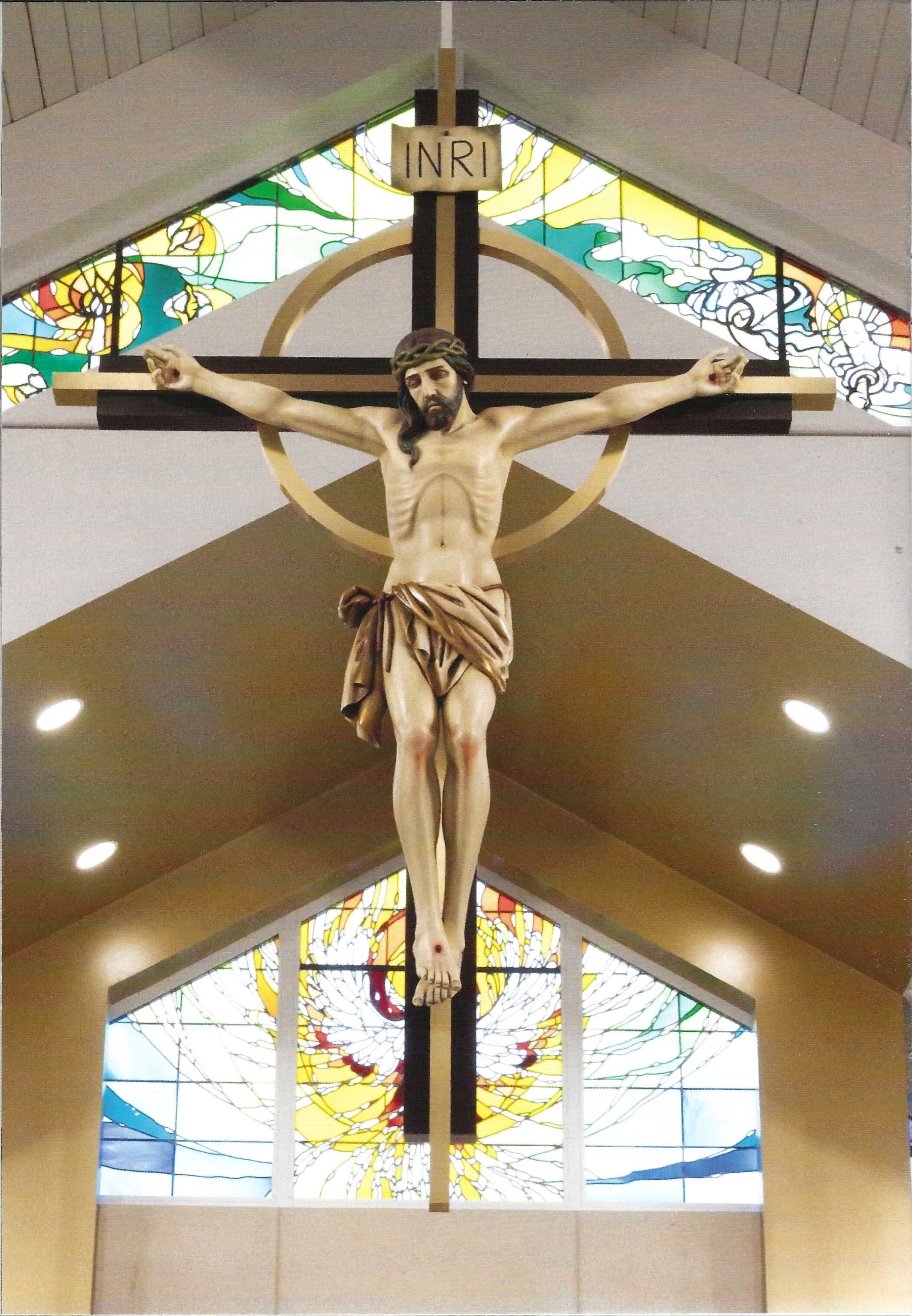
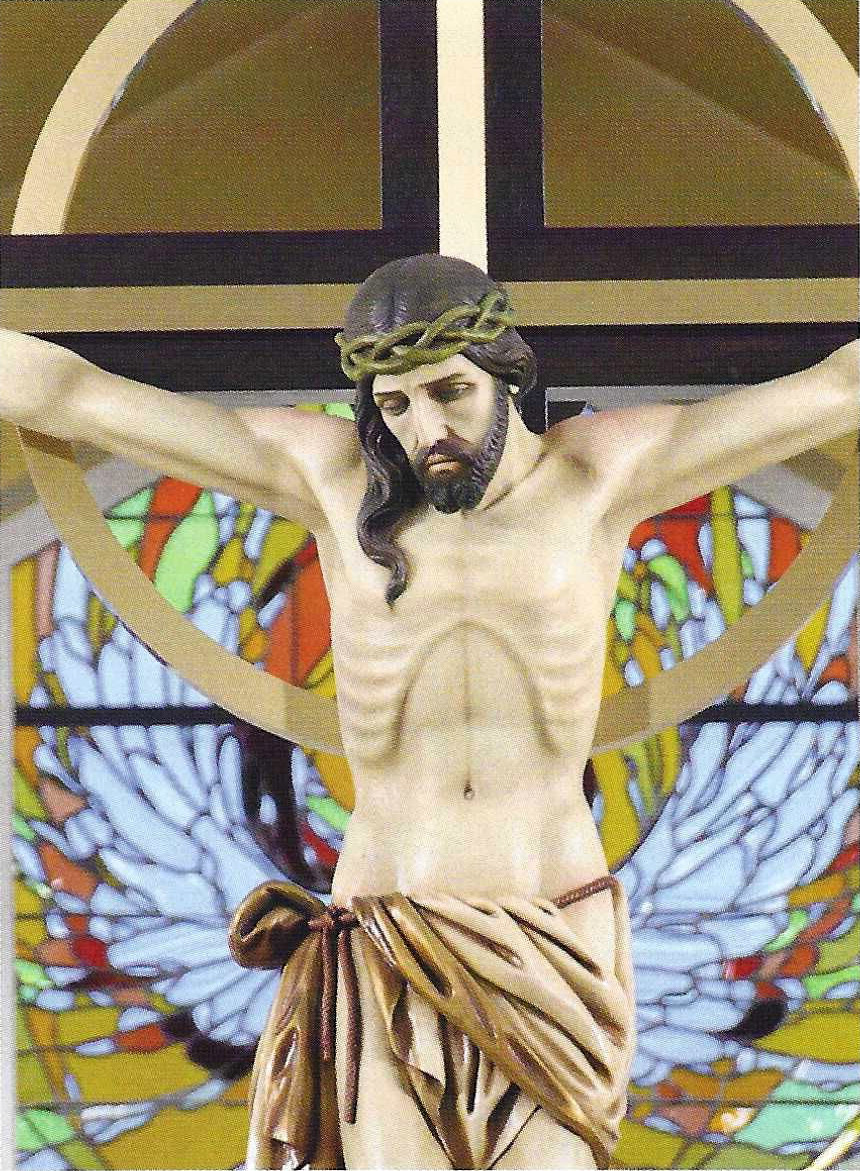
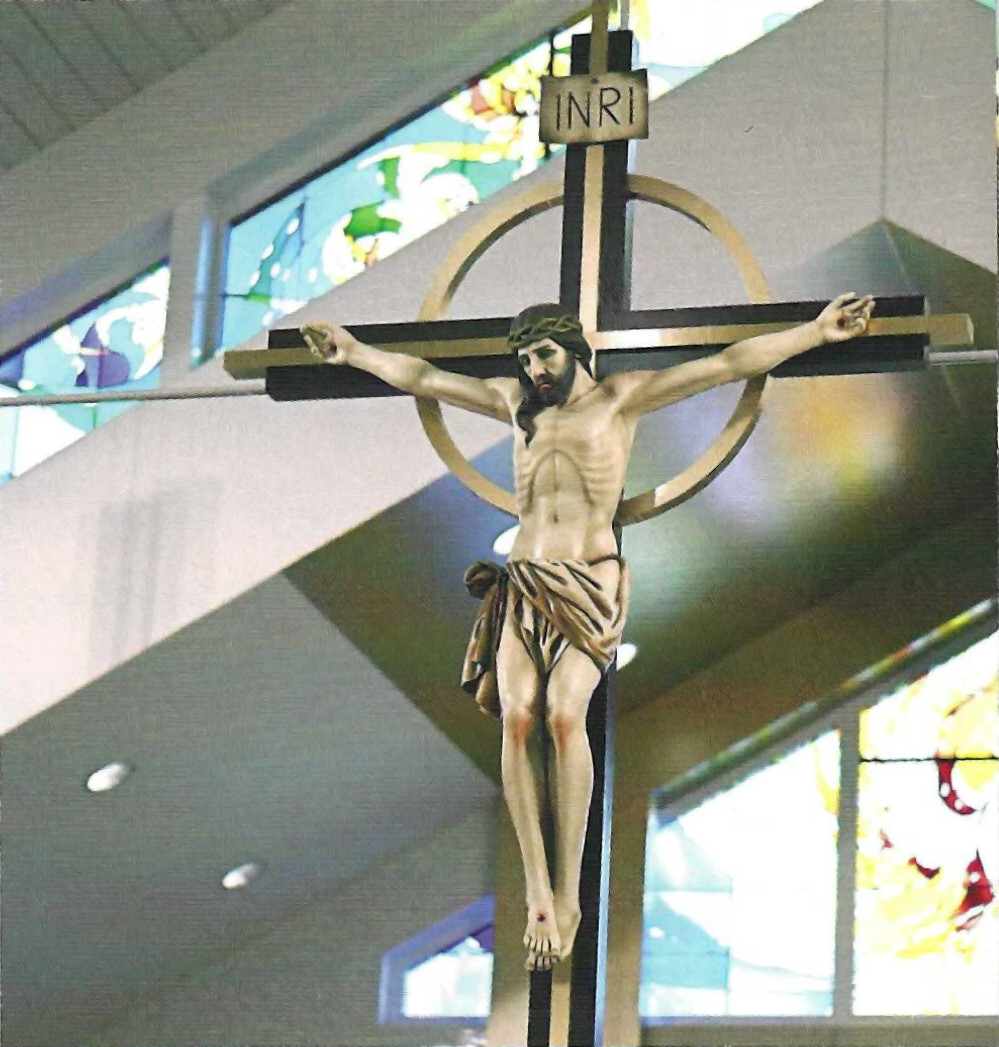
In the year 2000, the revision of the General Instruction of the Roman Missal (GIRM) restated the importance of the image of the crucifix:
"There is also to be a cross, with the figure of Christ crucified upon it ... which is clearly visible to the people gathered together. It is fitting that a cross of this kind, recalling for the faithful the saving passion of the Lord, remain near the altar even outside of liturgical celebrations" (GIRM 117).
Later that same year, in the publication Built of Living Stones, the U.S. Bishops added,
"The cross with the image of Christ crucified is a reminder of Christ's Paschal mystery. It draws us into the mystery of suffering and makes tangible our belief that our suffering when united with the passion and death of Christ leads to redemption. There should be a crucifix ... clearly visible to the people gathered there. The crucifix may be suspended over the altar or affixed to the sanctuary wall" (91).
The image of Christ Crucified, the Anointed One who was sacrificed, is clearly visible to all who worship at Lumen Christi Parish. The nine-foot tall crucifix, locally designed and crafted, is suspended over the altar steps. Since the tenth century, the crucifix has held a place of priority in Catholic churches. The sacrifice of Christ is celebrated on the altar every time we gather for the Eucharist.
The Chapel
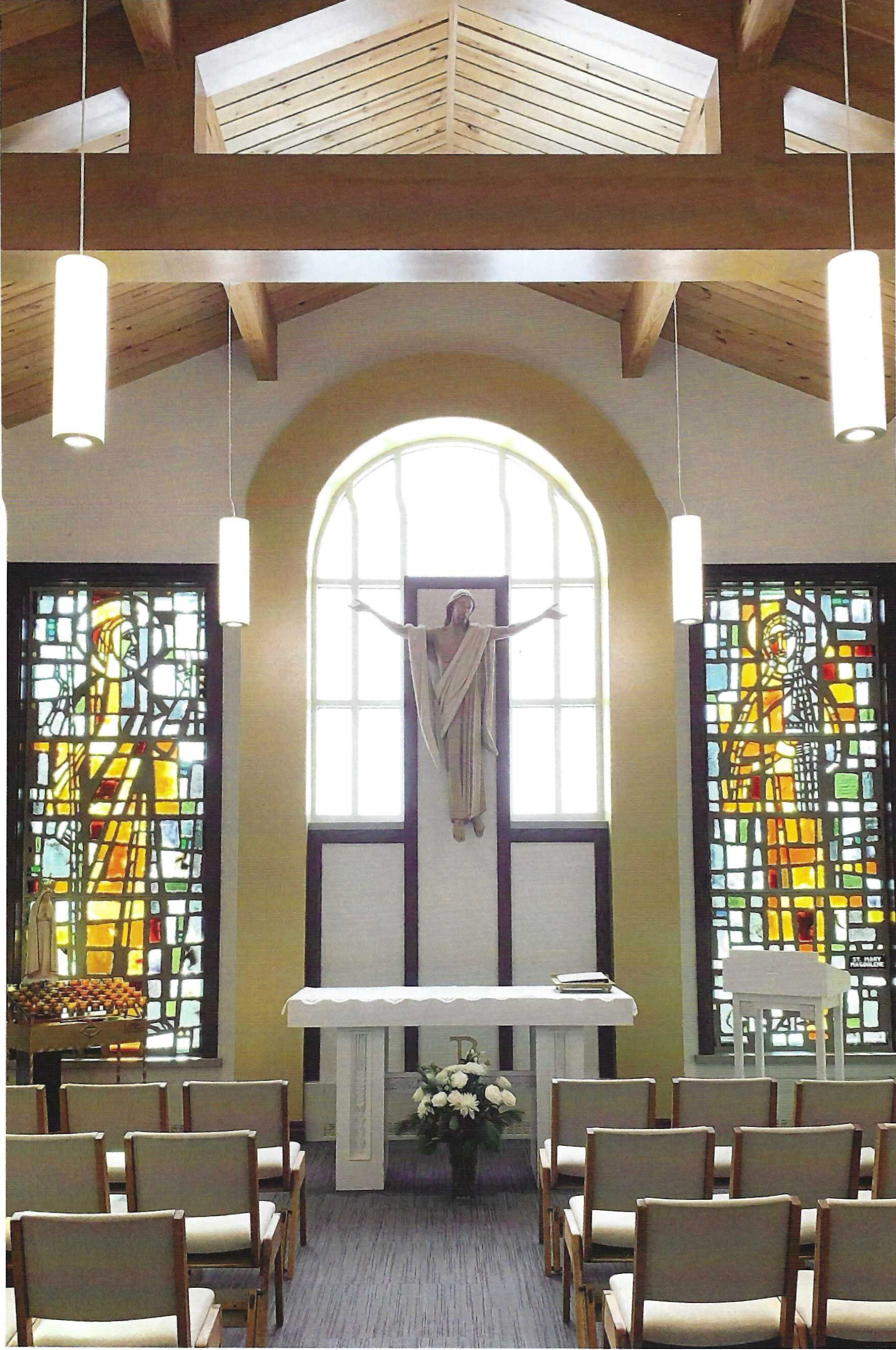
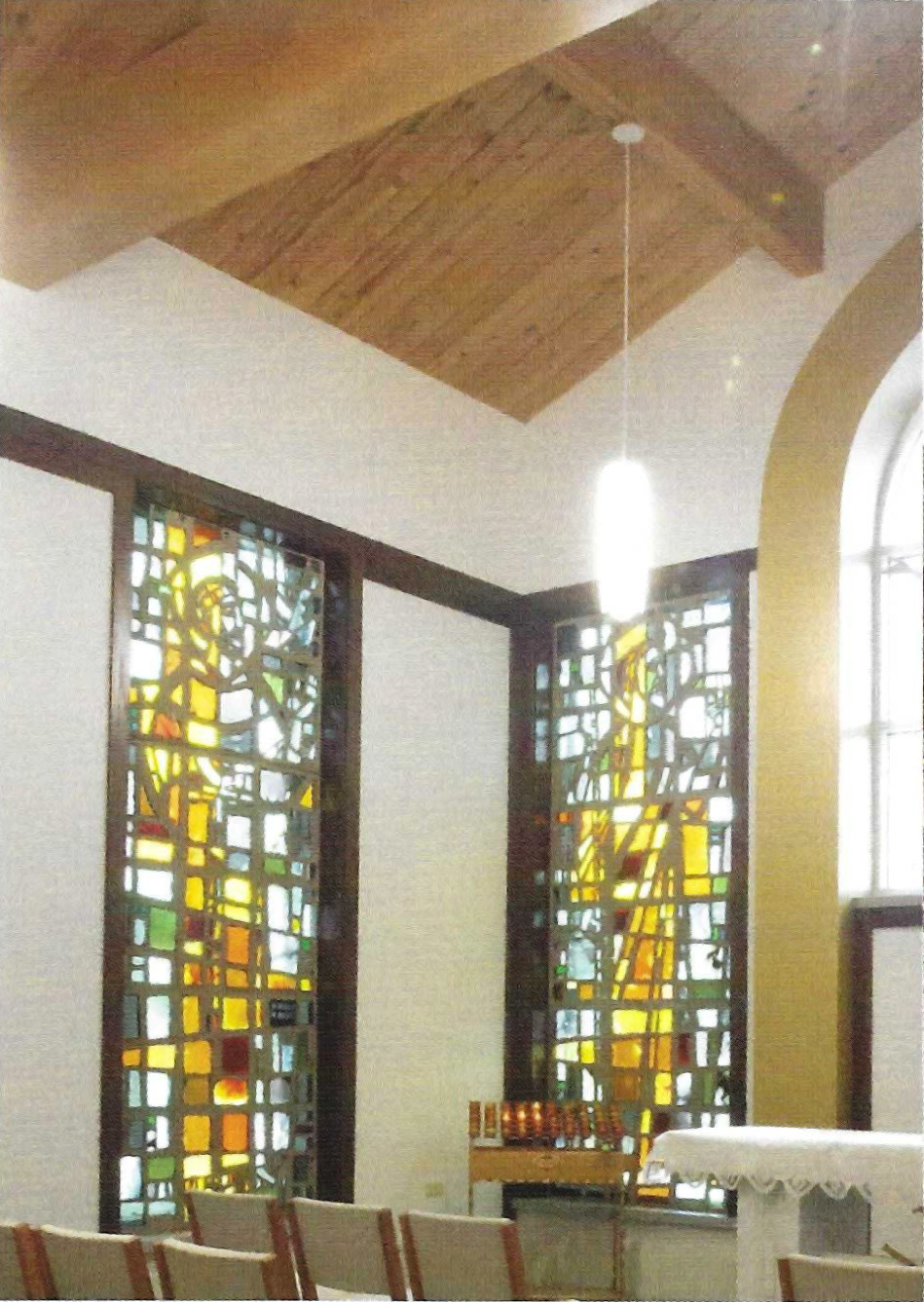
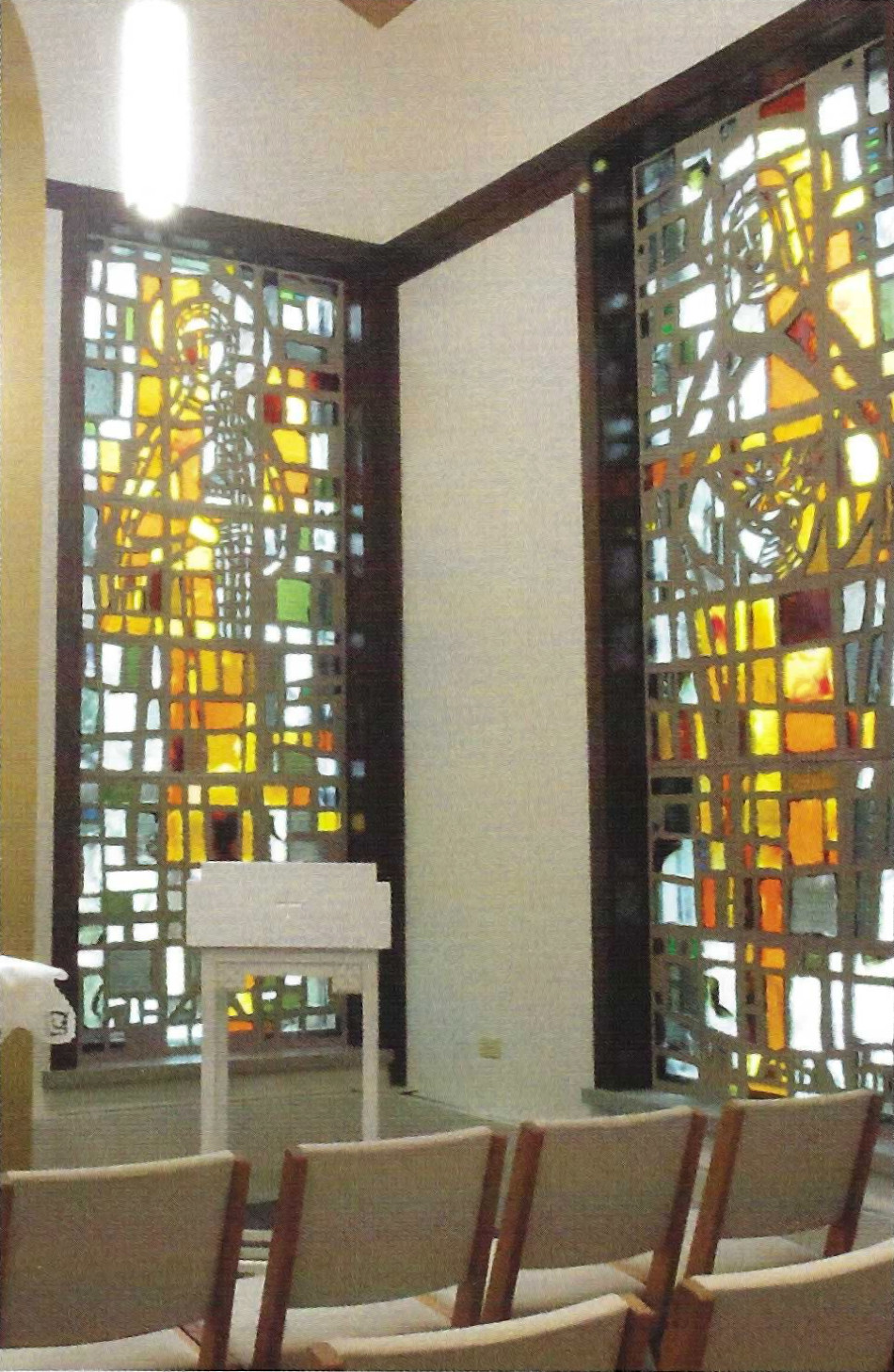
The Lumen Christi chapel extends to the south toward Mequon Road. Its walls contain four of the eight original stained glass windows from St. James Church. The other four windows can be found along the wall entering St. Cecilia Hall. The chapel is set aside for quiet, private, more intimate prayer as well as small liturgical celebrations. Since private prayer often flows from a spontaneous response to God's voice amidst the noise of the world, much consideration was given to making this space available at all times. Therefore, a secured private entrance allows for twenty-four hour access for personal prayer. This space holds the potential for twenty-four hour Eucharistic Adoration, allowing parishioners to visit with Our Lord as he is present in the Most Holy Eucharist.
Adoration is the first attitude of man acknowledging that he is a creature before his Creator. It exalts the greatness of the Lord who made us and the almighty power of the Savior who sets us free from evil. Adoration is homage of the spirit to the "King of Glory," respectful silence in the presence of the "ever greater" God. Adoration of the thrice-holy and sovereign God of love blends with humility and gives assurance to our supplications.
—The Catechism of the Catholic Church (no.2628)
Music Liturgy
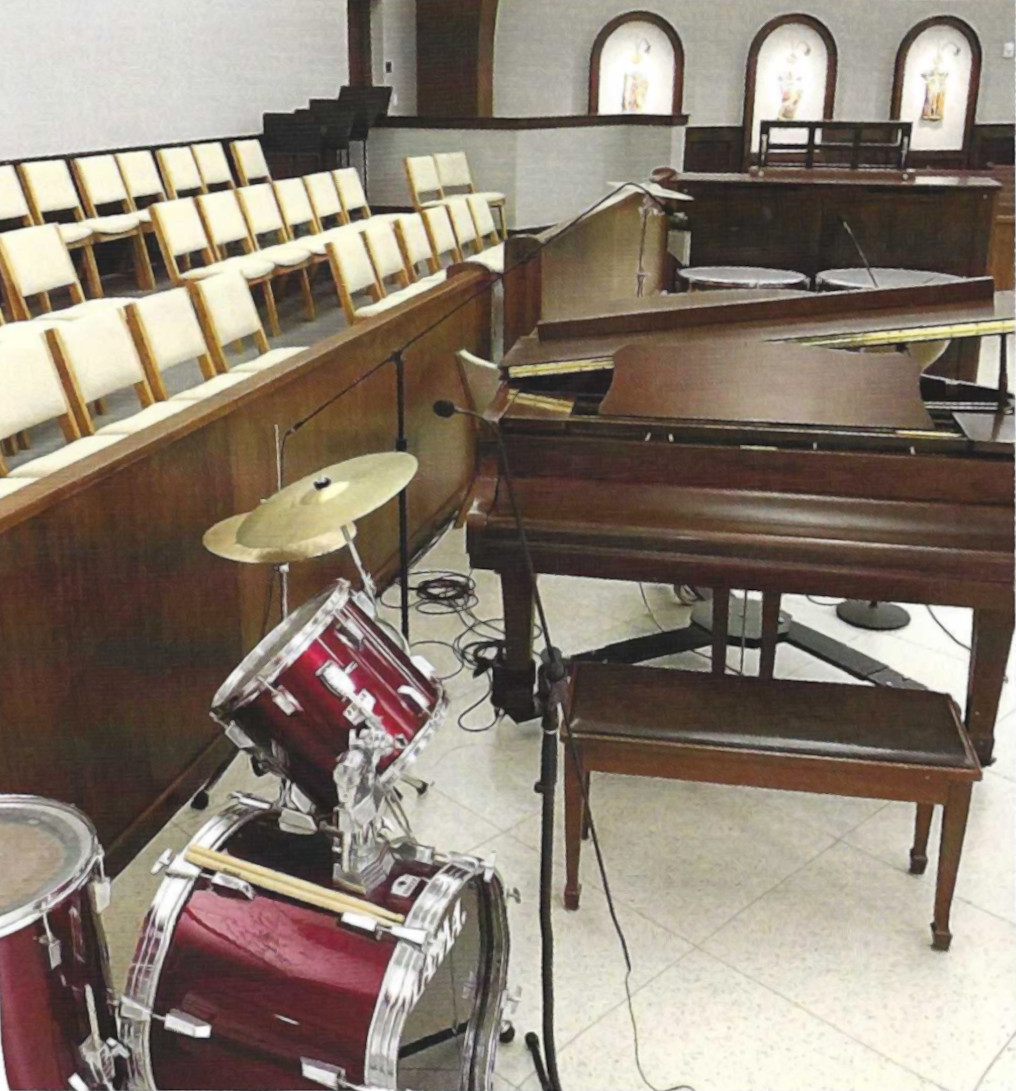
Music, especially the chanting of psalms and canticles, has always been an integral part of worship. The Gospels of Matthew and Mark describe how Jesus and his apostles sang hymns before going out to the Mount of Olives. Music and singing allow for active participation that lifts and inspires the people assembled for Mass. According to the 2007 USCCB guidelines Sing to the Lord: Music in Divine Worship, the full depth of musical possibilities, crossing all cultures, can and should be celebrated by the inclusion of a multitude of genres in the worship experience. Great care should be taken to remain true to liturgical text when setting those words to music, but there is no limit to the variety of music that can and should be used. The music ministers, choirs, cantors, and musicians all help to create a worship experience that lifts liturgy in holy song and opens the mind to the presence of Christ.
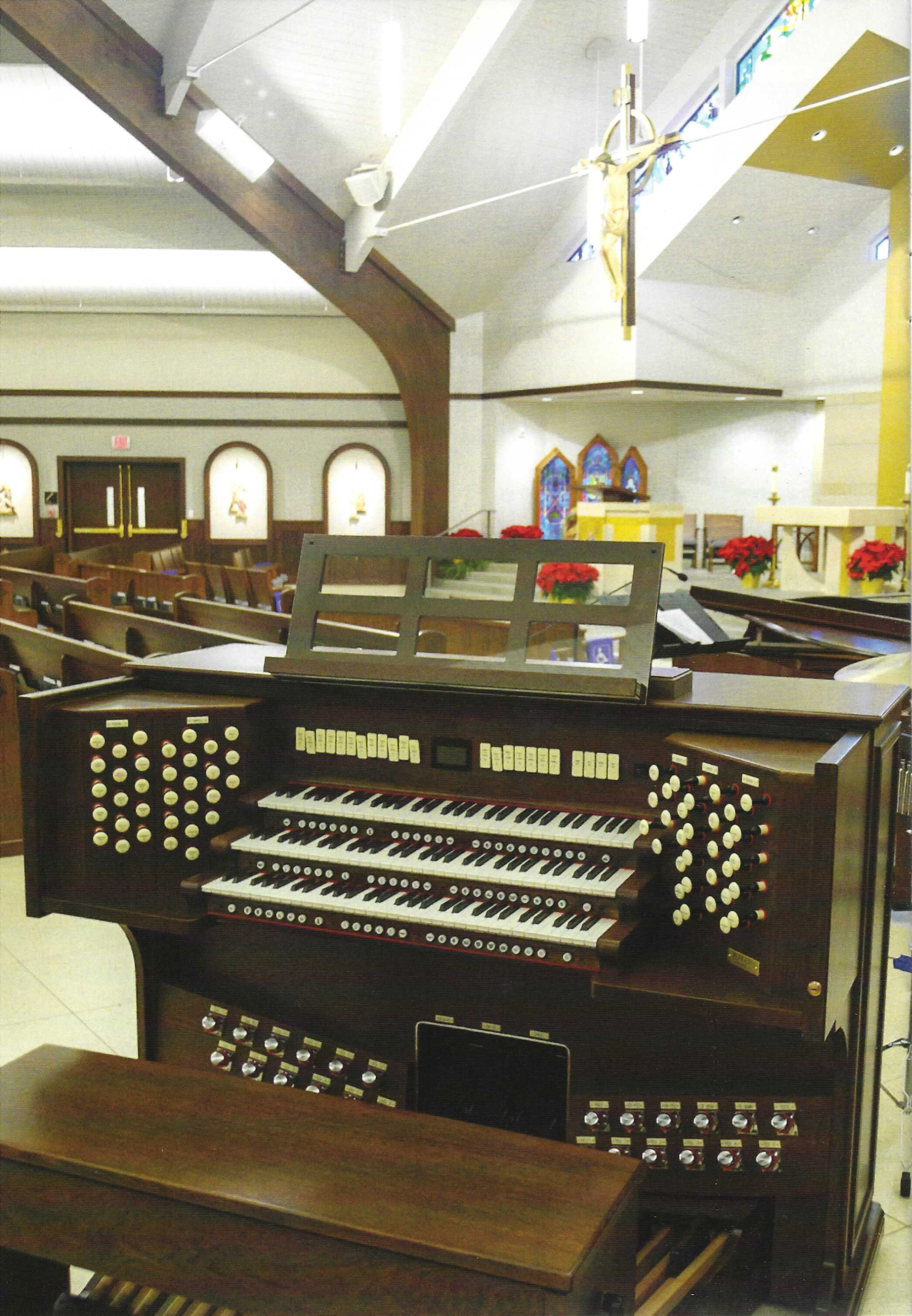
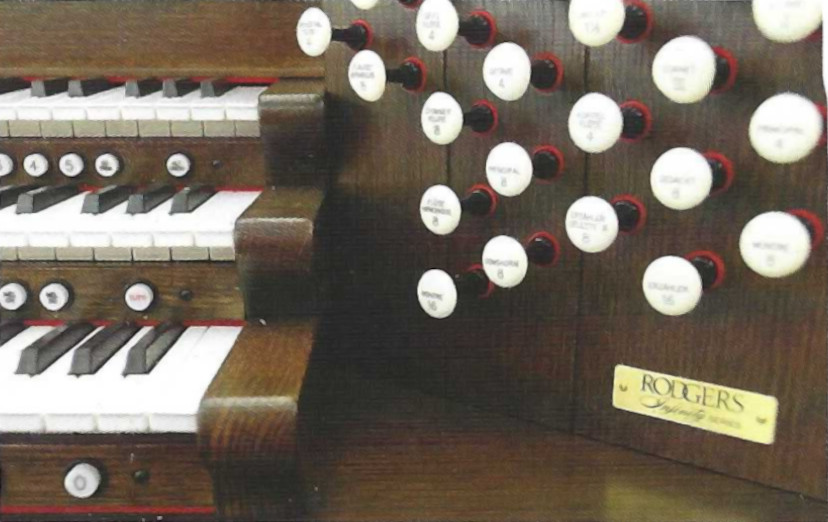
In addition to an expanded choir area, a piano, and other musical instruments, a new Rodgers Infinity 361 three manual digital organ resounds in Lumen Christi. The organ is capable of introducing fifty-nine orchestral voices. Sounds of trumpets, oboes, flutes, and even timpani can be added to the principal sounds of the organ. With the great advances in technology in recent years, the authenticity and the volume of sound provide a glorious addition to liturgical events. The digitally created sound rivals the sound of a traditional pipe organ. Speakers masterfully placed throughout the nave add to the acoustical brilliance of this instrument, creating a beautiful audio accompaniment that will enhance the sounds of all genres of music for years to come.
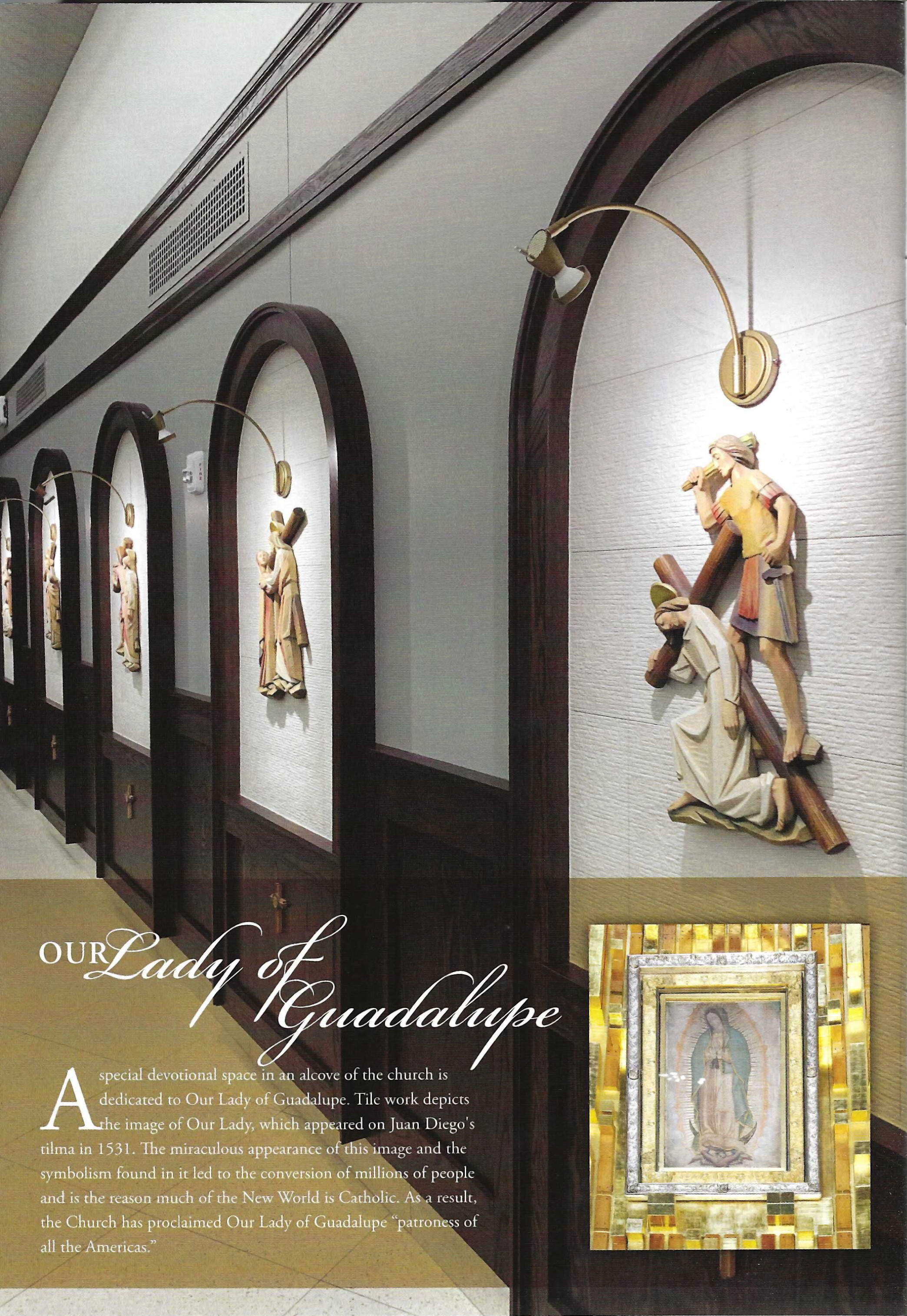
Our Lady Guadalupe
A special devotional space in an alcove of the church is dedicated to Our Lady of Guadalupe. Tile work depicts the image of Our Lady, which appeared on Juan Diego's tilma in 1531. The miraculous appearance of this image and the symbolism found in it led to the conversion of millions of people and is the reason much of the New World is Catholic. As a result, the Church has proclaimed Our Lady of Guadalupe "patroness of all the Americas."
{LumiFig46.jpg}
The Stations of the Cross
The earliest Christian pilgrims to Jerusalem walked in the footsteps of Jesus, following the path on which he had carried his cross. These streets through Jerusalem became known as the Via Dolorosa.
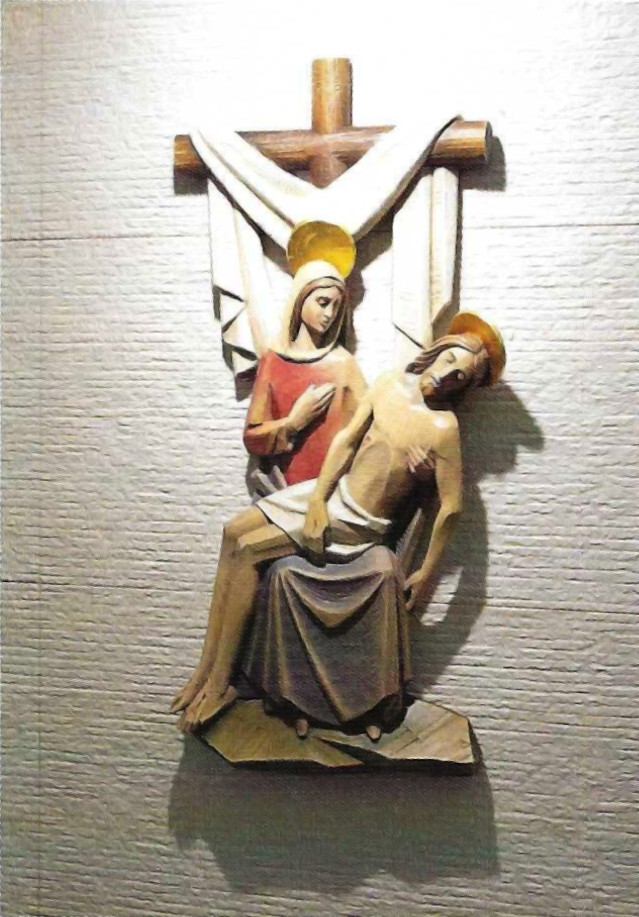
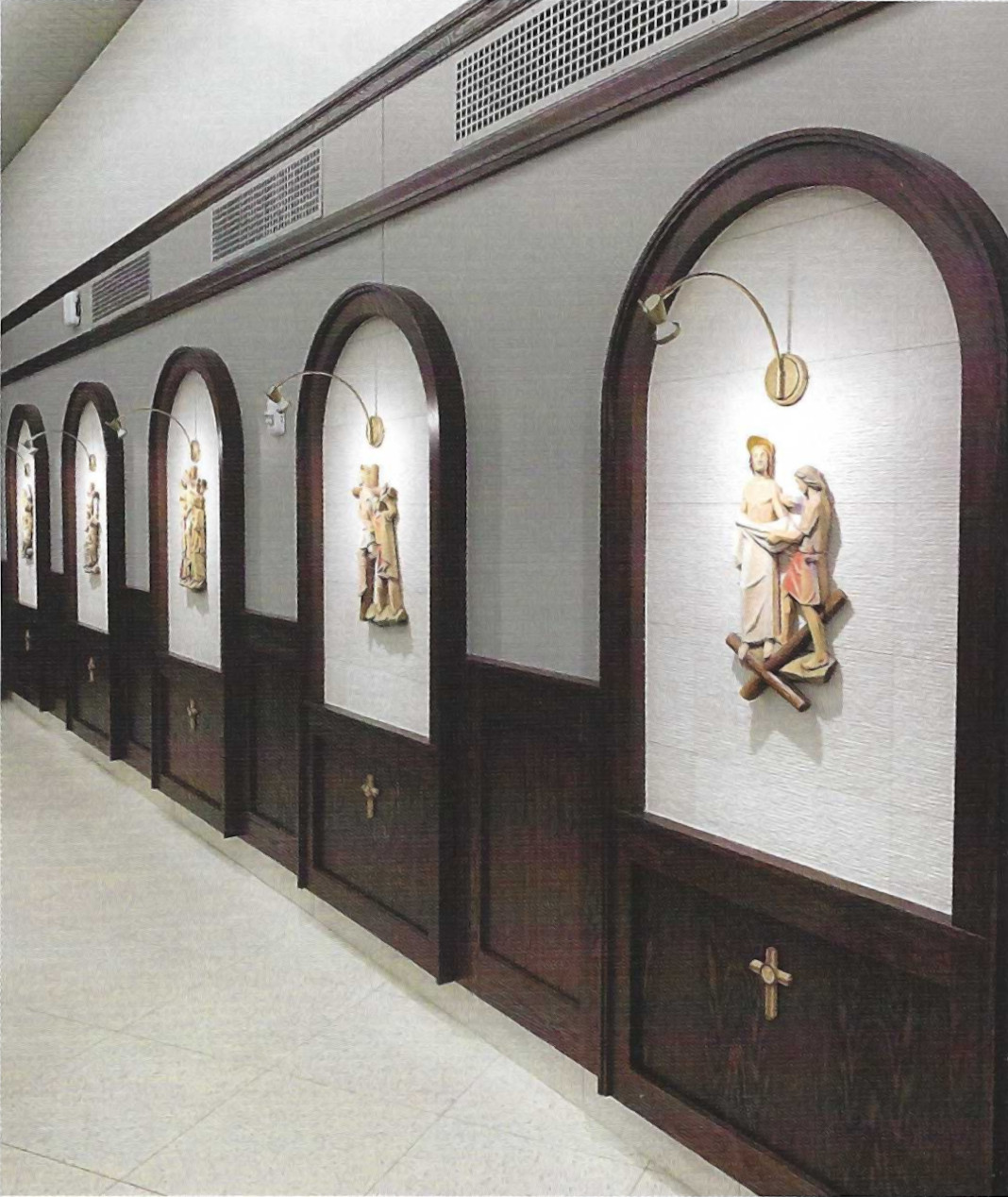
Since most people were unable to travel to Jerusalem, a way was designed to follow in the footsteps of Jesus in one's parish church. St. Leonard, in the 17th century, developed a series of artistic representations of various moments along the Via Dolorosa. He began erecting the "stations" throughout Italy to encourage this devotion. Over 500 sets of stations are credited to St. Leonard, including those located in the Colosseum. Also known as the Way of Sorrow, the Stations of the Cross are an important part of the Lenten tradition in many Christian faiths. Every Good Friday the pope celebrates the Stations of the Cross in the Colosseum in Rome. The fourteen stations are often set around the perimeter of the worship space as an accessible pathway for today's pilgrim.
The beautifully hand-carved and distinctive Lumen Christi Stations of the Cross, previously located in St. James Church, are impressively displayed to encourage personal devotion to this powerful form of prayer all year long.
We adore you O Christ and we praise you, because by your holy Cross you have redeemed the world.
Here may the poor find mercy, the oppressed attain true freedom, and all people be clothed with the dignity of your children, until they come exultant to the Jerusalem which is above. Through our Lord Jesus Christ, your Son, who lives and reigns with you in the unity of the Holy Spirit, one God, for ever and ever.
AMEN.
Acknowledgments
Parish Project Chairperson: Michael Walton
Special Thanks to: Reverend Daniel Sanders, Pastor; Reverend Matthew Jacob, Associate Pastor; Ad Hoc Building Committee; Arts and Furnishings Committee; Peggy Hughes and Margaret Caldwell, Directors of Music and Liturgy; Jane Bartlett, Director of Finance
Consultants and Artists: Joseph P. Wittmann, MTS; Inspired Artisans; Lynchburg Stained Glass; Metro Sound and Video; T.H. Stemper Co.
Architect: Plunkett Raysich Architects
Construction: Berghammer Construction Corporation
Publication Writing and Editing: Anne Best, Marilyn Malcolm, John Rice, Dianne Tarcin
Design and Photography: Bigonia Creative
Publication Printing: The Fox Company
Lumen Christi Catholic Church
One Family Sharing the Love and Light of Christ
top of page